Trope Tuesday: The Call to Adventure

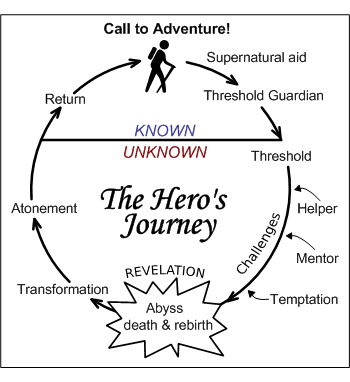
One of the first (and most important) stages of the hero’s journey is the call to adventure.  It happens when the hero first confronts something outside the experience of his ordinary world that beacons him to leave it.  It overlaps closely with the inciting incident, and marks the point at which the hero’s journey begins.

However, it is not typically where the story begins.  In order for the hero to leave the ordinary world, he must first start out there, so we know what’s at stake and what he’s leaving behind.  This is why Luke Skywalker starts out on his uncle’s homestead, and why Neo starts out as a bored and lonely employee of Metacortex.  Events outside the hero’s experience may have already put him on a trajectory to leave on the adventure, but he won’t know it until the call comes.

The hero may start out in a quiet, peaceful village, far removed from any sort of conflict–or he may start out in the middle of a crapsack world, as is the case with dystopian fiction.  The important thing is that it’s the world he’s always known–that he hasn’t ever really made an effort to leave or change it.

How he feels about his world largely determines how he chooses to respond to the call.  In older literature, the hero typically refuses it.  The advantage of this is that it gives the reader a sense of scope–that this adventure is not a small or a trivial thing.  It also sets up an immediate minor conflict that gives some motion to the opening chapters.

In modern stories, though, it’s more common for the hero (or his friends) to jump at the call.  There are also many advantages to this.  In Lord of the Rings, it gives Frodo an immediate band of sidekicks.  In Harry Potter, it plays up the sense of wonder at the magical world.  In the Chronicles of Prydain, it highlights the impulsiveness and naivete of Terran, as he realizes later on in the story just how stupid of him it was.

The call itself can take many forms.  It can come as a fateful visitation from a supernatural messenger, a mysterious request from a dying stranger, or a sacred trust from a dying friend.  It can also be more internal, such as an important moment of decision, or a desire to find some greater purpose in life.  Whatever the case, the one thing the hero cannot do is ignore it–at least, not forever.  One way or another, the hero sets out, and the adventure begins.
Trope Tuesday: The Hero’s Journey

For the next few Trope Tuesday posts, I’m going to pick apart one of my favorite story patterns, the monomyth or “hero’s journey.” Other tropes come and go, but the hero’s journey is truly timeless.  If you can get it to work for you, it can do wonders for your ability to understand and tell stories.

In many ways, this is the trope to end all tropes. it is the source of almost all the major story archetypes, and can be found in the myths and folklore of almost every human culture–hence the term “monomyth.” It was first formulated by Joseph Campbell, who outlined it in his book The Hero with a Thousand Faces.  He summarized it like this:

A hero ventures forth from the world of common day into a region of supernatural wonder: fabulous forces are there encountered and a decisive victory is won: the hero comes back from this mysterious adventure with the power to bestow boons on his fellow man.

Campbell was an academic who studied mythology and folklore, and his book, though insightful, is pretty friggin dense (not to mention scientifically obsolete–he references a lot of Freud’s theories that have largely been discredited).  Later, writers like  Chris Vogler, Phil Cousineau, and David Adams Leeming analyzed and simplified the monomyth for popular audiences.

Enough background–what is it?  Basically, it’s a story pattern that resonates powerfully with readers across all genres.  In its simplest formulation, it follows three steps:

  1. Departure: The Hero leaves the familiar world.
  2. Initiation: The Hero learns to navigate the unfamiliar world.
  3. Return: The Hero masters  the unfamiliar world and returns to the familiar.

Campbell himself identified 17 stages, some of which are interchangeable:

  1. Call to Adventure: The Hero learns that he must leave the familiar world.
  2. Refusal of the Call: The Hero balks, for any number of reasons.
  3. Supernatural Aid: The Hero receives something to help him on his quest.
  4. Crossing the Threshold: The Hero ventures into the world of adventure.
  5. Belly of the Whale: The Hero passes the point of no return.
  6. The Road of Trials: The Hero’s resolve is tested, and he begins to grow.
  7. The Meeting with the Goddess: The Hero experiences the power of love.
  8. Woman as Temptress: The Hero faces and overcomes temptation.
  9. Atonement with the Father: The Hero passes the final test.
  10. Apotheosis: The Hero dies and is reborn.
  11. The Ultimate Boon: The Hero receives a gift to take home.
  12. Refusal of the Return: The Hero doesn’t want the adventure to end.
  13. The Magic Flight: The Hero uses his newly mastered skills to escape.
  14. Rescue from Without: The Hero is saved by his newfound friends.
  15. The Crossing of the Return Threshold: The Hero leaves his new world.
  16. Master of Two Worlds: The Hero reconciles the old ways with the new.
  17. Freedom to Live: The Hero uses what he has learned to live the rest of his life.

Do any of those sound familiar?  Yeah, I thought so.  It might be hard to think of a story that fits all 17 points at once, but it’s not uncommon to find one that hits seven or eight (or possibly more).

A simpler formulation by Leeming goes like this:

  1. Miraculous conception and birth
  2. Initiation of the hero-child
  3. Withdrawal from family or community for meditation and preparation
  4. Trial and Quest
  5. Death
  6. Descent into the underworld
  7. Resurrection and rebirth
  8. Ascension, apotheosis, and atonement

My personal favorite, though, is Vogler’s:

So how useful is this trope really?  Well, consider this: Orson Scott Card’s Ender’s Game was the first novel to win both the Hugo Award and the Nebula Award in the same year…and it hits up all eight points listed above.  The following year, Card published Speaker for the Dead, which also hit all eight points, and also won both the Hugo and the Nebula award.

The thing that made Star Wars more than just another campy sci-fi b-movie with (let’s face it) terrible acting and hokey dialogue is the fact that George Lucas drew so heavily from Joseph Campbell and the hero’s journey.  Think about it: Luke Skywalker passes through almost every one of the 17 points, right up to the awesome throne room finale at the end.

Well, this guy certainly helped.

Of course, it’s possible to go too far.  Lucas also tried to use the hero’s journey in the prequel trilogies, and failed miserably.  Why?  Many reasons, but mostly because he used it as a rigid checklist rather than a dynamic set of flexible guidelines.  The hero doesn’t have to have a literal miraculous conception; he just needs to be chosen in some way.  The goddess doesn’t have to be literal, and neither does the father–those stages can be represented quite loosely, or merged with others.

In my own writing, I’ve found that the best way to use the hero’s journey is to use it to understand what I’ve already written, and to trust my subconscious to fill in the next step.  In every book I read, or every movie I watch, I constantly pick it apart, looking for each of the steps.  This trains me to recognize the hero’s journey in my own work without having to break out the hammer or force things too much.

So how do you use the hero’s journey in your own work?  Do you find yourself hitting up all the points subconsciously, or do you use some other method?  Or do you hate the hero’s journey and try to avoid it altogether?  If you do hate it, I hope that my next few Trope Tuesday posts will help you to change your mind.

Trope Tuesday: The Call Knows Where You Live

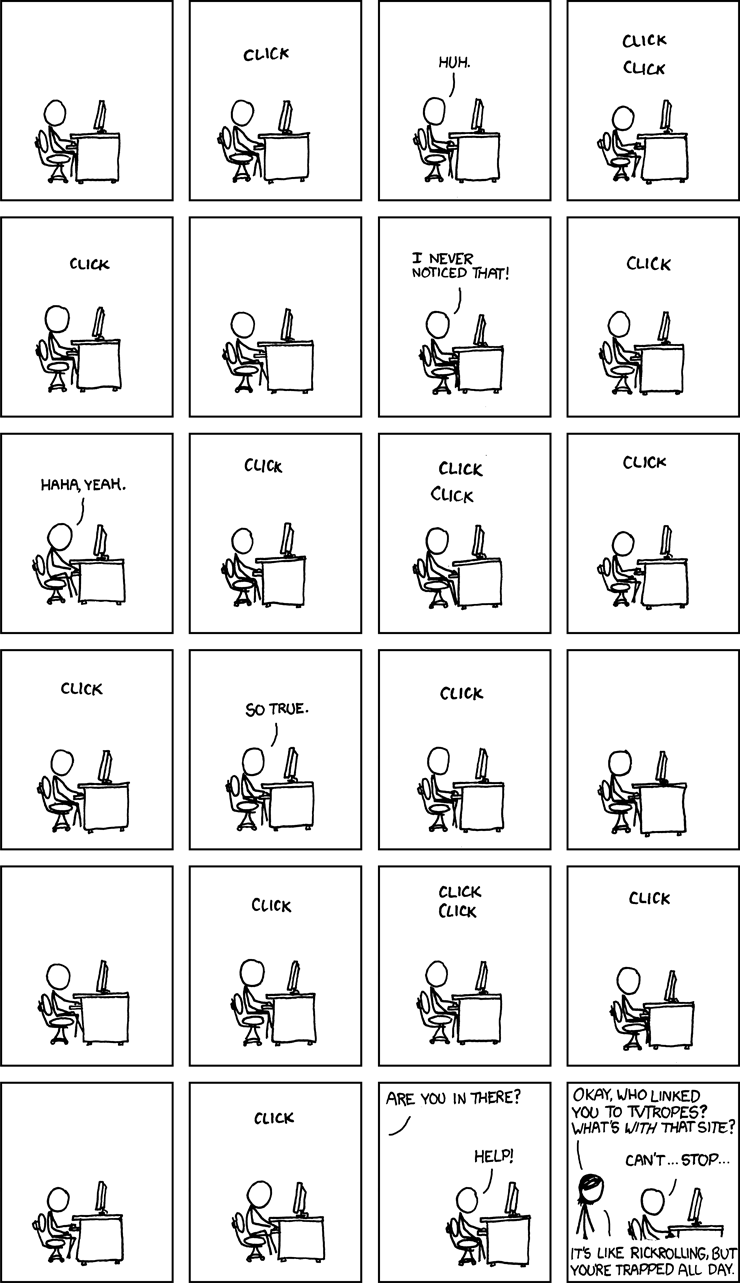
Yeah, it's kind of like that.

I have a confession to make: I’m a tvtropes addict.  Fortunately, it’s only about as bad as vicodin, which means that doses which would knock other people out do nothing to me–but still, I’ve wasted many, many hours on that site.

So anyhow, I thought it would be fun to do a weekly series where I pick out a trope and discuss it.  After a lot of deliberation (and much clicking), I decided to start with:

The Call Knows Where You Live

This trope stems from one of the stages of the archetypal Hero’s Journey.  The hero usually starts out in some sort of familiar setting, so that the reader gets a sense of who he is and where he’s coming from.  To get the story started, someone or something from the realm of the unfamiliar calls him to leave on an adventure.

Most of the time (but not always), the hero turns down the call at first, not wanting to leave his comfort zone.  This is called the Refusal of the Call, and it happens a lot.  In The Matrix, Neo refuses to climb outside the window to escape the agents.  In Ender’s Game, Ender Wiggin doesn’t actually want to go to Battle School, he just wants to be a normal kid and stay with his sister Valentine.  In Star Wars IV, Luke tells Obi-Wan that he can’t go to Alderaan because he’s needed on the farm.

Unfortunately, the Call is not so easily evaded.

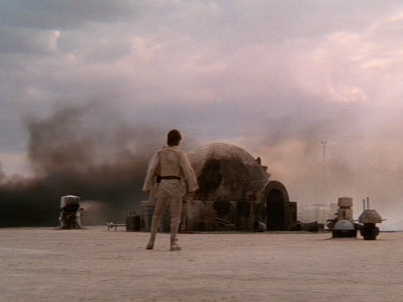
Uncle Owen? Aunt Beru?

Sometimes, the best way to send a character off on an adventure is to have him lose everything right at the very beginning.  With nothing to hold him back, the hero is free to go off and do something truly reckless.

I still remember how I felt when I first saw the burning homestead scene in Star Wars IV.  The sinking feeling when I saw the smoke billowing from Luke’s house, the wide-eyed gasp at the mangled bodies of Luke’s aunt and uncle (I was so young, I had to close my eyes for that part).  All of a sudden, the conflict felt a lot more real–and a lot more inevitable.

Of course, this trope only works for a certain kind of story. If the hero’s family is dead before he even leaves his home, there had better be some serious action later on. Also, the villain had better be the real thing–if nothing else in the story lives up to the depravity at the very beginning, a major promise has been left unfulfilled.

Alternately, I suppose you could have the hero’s family killed off by a natural event, or an unintentional accident–something where he has no one to blame and no face to put to the tragedy.  I can’t think of any examples of this off the top of my head, but it seems a plausible motivation for, say, a scientist who wants to find a cure for some disease, or the source of some magnificent and dangerous anomaly.

Now, if I were an overlord, I would avoid this trope altogether by cozying up to the hero’s parents, perhaps even sending them Christmas cards.  I might consider imprisoning them alive as collateral, but that would give the hero too much of an incentive to storm my castle.  And of course, when slaughtering villages, I would make absolutely certain that everyone in the village is dead.

So what do you guys think of this trope?  Any other cool examples you can think of, or interesting ways to subvert it?  Let me know!

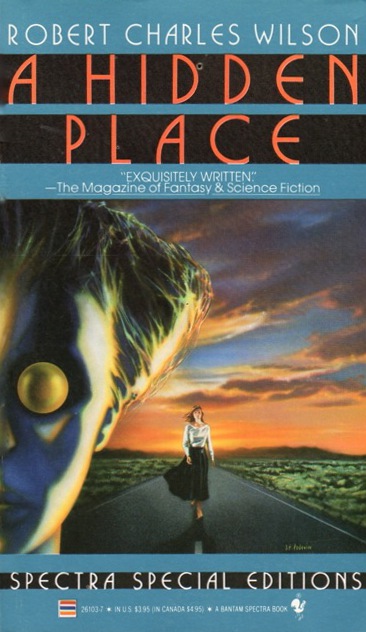
A Hidden Place by Robert Charles Wilson

Travis Fisher is an outsider in most places, but nowhere more than the small midwestern town of Haute Montagne.  But when his mother dies, leaving him parentless and jobless in the midst of the Great Depression, his stern aunt and uncle are the only ones who will take him in.

When Travis falls in love with Nancy Wilcox, the rebellious daughter of the Baptist Ladies Association president, things become worse.  With murderous transients roaming the countryside, Haute Montagne closes ranks, casting them out.

In this moment of distress, a mysterious yet hauntingly beautiful woman reaches out to them with a cry for help.  Stranded in the small midwestern town, she is a being from another world, and she is dying.  Only the two young lovers can help her, but to do so, they must find her dark, masculine half–and in so doing, confront the demons that threaten to tear them apart.

This is one of Robert Charles Wilson’s earlier novels, and I enjoyed it quite a bit.  It’s very short, yet well crafted and beautifully written.  Wilson’s prose is extremely evocative, and his descriptions of Haute Montagne brought back childhood memories from when I lived in the Midwest.  The story was also done well, and had a very satisfying ending.

While this is a good book, though, I wouldn’t say that it’s Wilson’s best.  His characters were interesting, but not nearly as compelling as those in Spin. The baptists were a little too villainous, though Travis’s aunt and uncle were individually more complex.

In spite of all this, however, the story was structured so well that the poignance of it largely overcame these flaws.  As a writer, that’s what I found most interesting about this book–how the masterful way the story was constructed made the whole greater than the sum of the parts.  Call it the monomyth, the hero’s journey, or whatever else, but something about this story made it reverberate in a powerful way.

I suppose that this is what all great stories do: echo some greater, universal story that is in all of us.  It’s the same echo that I felt when I read Spin, or Ender’s Game, or The Neverending Story, albeit a little softer.  It’s something that I hope my own stories evoke, this sense of clarity and wholeness, of returning to some great truth that we lost somewhere between birth and adulthood.

I don’t know if I’m making any sense, but those are my thoughts.  It’s a short read, and I enjoyed it quite a lot.  If you can find it, it’s a good one to pick up.

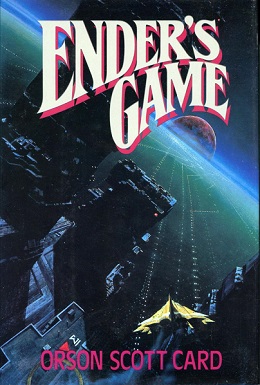
Ender’s Game by Orson Scott Card

“I’ve watched through his eyes, I’ve listened through his ears, and I tell you he’s the one.  Or at least as close as we’re goign to get.

“That’s what you said about the brother.”

“The brother tested out impossible.  For other reasons.  Nothing to do with his ability.”

“Same with the sister.  And there are doubts about him.  He’s too malleable.  Too willing to submerge himself in someone else’s will.”

“Not if the other person is his enemy.”

“So what do we do?  Surround him with enemies all the time?”

“If we have to.”

“I thought you said you liked this kid.”

“If the buggers get him, they’ll make me look like his favorite uncle.”

“All right.  We’re saving the world, after all.  Take him.”

Thus begins one of the greatest SF classics of all time, Ender’s Game. With such a spectacular beginning, it only keeps getting better.

I decided to reread Ender’s Game because a friend of mine in Washington was reading it.  I read this book back in high school in only two sittings–the first twenty pages in the library, and the rest back home, where I finished it wide-eyed at three in the morning.  I didn’t regret a single moment of it, then or now.

One of the most fascinating things to me about this book is the way that Orson Scott Card breaks almost all of the rules of writing.  On every page, he “tells” much more than he “shows”–some of the battles he glosses over in only a couple of paragraphs.  He gives only minimal setting details, and very few of these are visceral or concrete–it’s very hard to “get into” the world of Ender’s Game the way you would with a fantasy novel.  Most of the characterization consists of “navel gazing”–Ender thinking to himself about how bad things are, rather than taking action.

Breaking these rules, however, is exactly the thing that makes this a good book.  The story isn’t in the setting, or in the nitty gritty of the battles–it’s in Ender’s mind, how he reacts to the forces around him, and how those forces change him. “Telling” rather than “showing” allows him to keep the pace at a breakneck, thrilling speed while cutting out unnecessary details, and the “navel gazing” allows us to get an intimate picture of Ender’s mind.

It goes to show that good writing isn’t just about knowing the rules, but knowing how to break them.  And when it comes to plot, character, pacing, foreshadowing, thematic elements, and the hero cycle, Orson Scott Card proves his masterful brilliance in this work beyond a doubt.

One of the most fascinating things about this book is that it hits all eight points of the Campbellian monomyth.  This excellent article (originally published in Leading Edge) explains how.  The most incredible thing to me is that the year after Ender’s Game came out, Orson Scott Card did it all again–wrote a blockbuster book hitting all eight points of the monomyth–with Speaker for the Dead, which I think is a superior book.

Ender’s Game is a true classic of the science fiction genre.  Not only is it a highly entertaining story, it is deeply meaningful and insightful as well.  It’s one of those books you can reread multiple times, and it only keeps getting better.  Whether or not you’re a fan of science fiction, this is a book you will deeply benefit from reading.