The New (and Improved) Vasicek Free Library

For several years, I would publish a new, free short story every month, keeping about six of them up at a time and unpublishing an old one every time I published a new one. I was able to do this because I was constantly writing short stories, in order to submit to the traditional short story markets (Asimov’s, Analog, Clarkesworld, etc). Typically, each story would go on submission for a year or two, and if it didn’t get picked up by a professional or semi-pro market, I would just publish it myself.

All of that changed in 2023 when I decided I was done trying to pursue the traditional short story markets. When I landed a story in the conservative (or at least anti-woke) anthology Again, Hazardous Imaginings, and that story (“The Promise of King Washington”) was reviewed favorably on the conservative review site Tangent Online, I saw a marked rise in my rejection rate—and all of them form rejections, too (about 10%-15% of my rejections were personalized before this, which typically indicates that an editor likes your writing but doesn’t want that particular story).

It was at that point that I realized that every professional short story market (and most of the semi-pro ones) is ideologically captured, and that my odds of getting published as a straight white male conservative were essentially zero. So I stopped writing short stories, and in 2025, after cycling through the last story from the submission queue, I unpublished all but one or two of my free short stories and discontinued the series.

The free short stories used to make up the backbone of what I like to call the “Vasicek Free Library.” I patterned it after the Baen Free Library, and it’s basically a list of all of my free books, including permafree first-in-series like Brothers in Exile and, of course, the free short stories. It’s basically a way for readers to sample my writing, and hopefully go on to buy some of my other books.

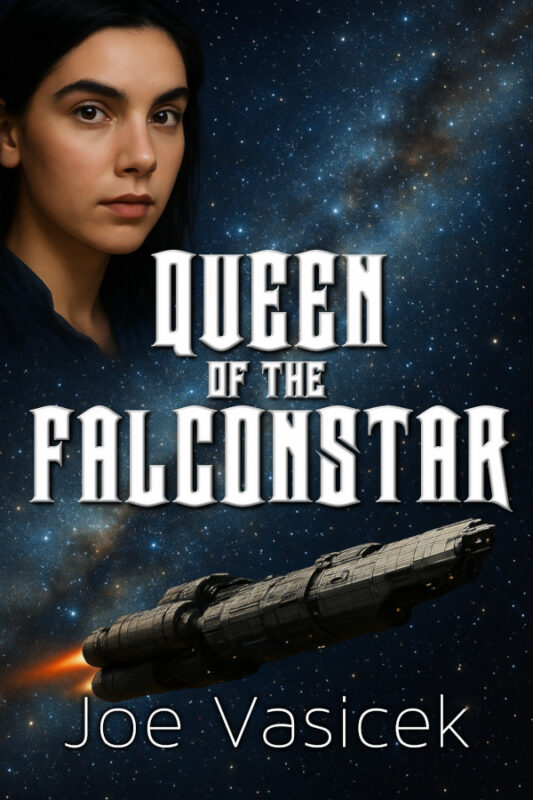
Long story short, I have decided to bring back the Vasicek Free Library, this time not just with short stories, but with a rotating selection of standalone longer works, too. I’ve got about half a dozen standalone novellas and novelettes, plus a couple of novels like Queen of the Falconstar where I’m currently writing the sequels. I’m going to rotate slowly through those, keeping each one free for a few months, and also rotate through my back catalog of 60+ short stories similar to how I was doing it before. And I plan to do this for the foreseeable future.

Here is the current selection:


Check back each month for new stories!

Bowing Out

Back at the end of August, I blogged about how I was going to do a writing challenge in September to produce more short stories to fill out my publishing queue. At the time, I had a couple of stories that looked like they were going to be picked up by one of the major magazines: the editor had expressed interest in buying them, and we were going back and forth with an editorial discussion about the series.

Well, to make a long story short, all of that fell through, and it looks like I’ll be self-publishing those stories after all. I’m not really sure what changed, but to give you an idea of what kind of a short story market this is, it’s been around for decades and regularly gets written up in Locus Magazine’s year-in-review. The editor said that things had gotten crazy on his end, then didn’t respond for about a month, and when I sent a polite followup email asking for an update on the status, he gave me the standard “I’m going to pass on this one, but send me your next story.” Which strikes me as kind of weird, given how our previous correspondence led me to believe that the contract was just a formality and he’d be sending one over soon, but whatever.

So now that these stories are back in the publishing queue, I no longer need to write a bunch more to fill it out. In fact, I’ve actually got enough stories to publish one a month through next April, and after I finish the third Christopher Columbus story, I’ll have enough to get through June (one of my older stories comes out of exclusivity in May 2023). Here is the schedule as of right now:

  • OCT 2022: “Blight of Empire”
  • NOV 2022: “Christopher Columbus, Wildcatter”
  • DEC 2022: “The Freedom of Second Chances”
  • JAN 2023: “The Body Tax” (needs to be revised, but it’s already been workshopped)
  • FEB 2023: “Christopher Columbus, Treasure Hunter”
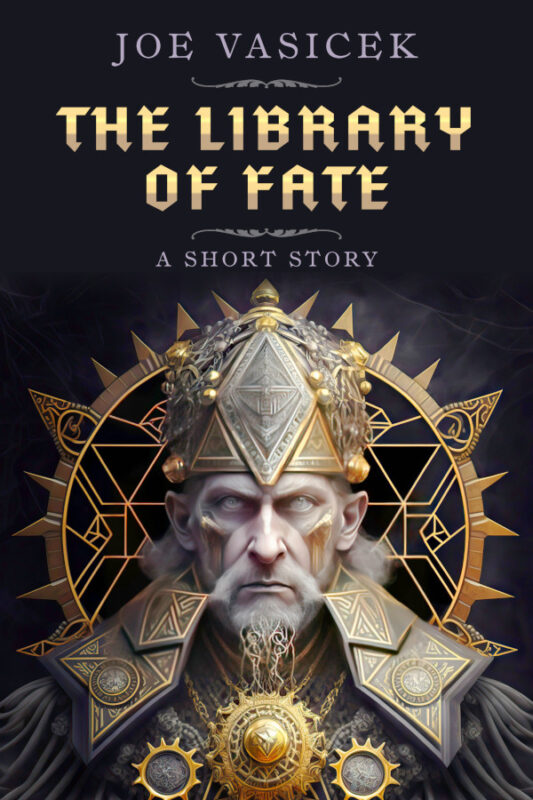
  • MAR 2023: “The Library of Fate”
  • APR 2023: “Hunter, Lover, Cyborg, Slave” (needs to be workshopped and revised)
  • MAY 2023: “Christopher Columbus, Wormhole Mechanic” (partially written, needs to be finished)
  • JUN 2023: “In the Beginning” (still under exclusivity, though I got a special exception to publish it in my third short story collection, The Stars Our Destination.)

Given that I have enough stories to fill out the next nine months, I’m going to bow out of the September Shorts challenge. This is really good for two reasons: first, it allows me to focus more attention on my current novel WIP, the sequel to Star Wanderers; and second, because I’ve fallen really behind on the Zedekiah Wight stories for my J.M. Wight pen name, and this should give me some space to work on the next few of those.

So that’s the plan: refocus on Children of the Starry Sea and work on Zedekiah Wight stuff on the side.

Short Story: The Body Tax

This was a fun one to write, even if it did go a little dark at first. The idea for it came from this article about a couple in San Francisco who received an outrageously huge warning fine ($1,500) for parking their car in their own driveway. In the comments to the article, I wrote:

This is why property taxes are evil. If the government can seize your house for non-payment of taxes, was it ever really yours to begin with?

But here’s the thing: every possible answer to that question is terrifying.

If you answer “no, I guess it wasn’t ever really my house,” you’re acknowledging that Mao was right and all power (and with it, ownership) flows from the barrel of a gun.

If you answer “yes, it’s still my own house,” then you have to answer the question: does the state have the right to issue property taxes?

Answer “yes, the state is within its rights,” then congratulations, you’ve just given the Maoist approach to property ownership a veneer of legitimacy and revealed yourself for a boot-licker and a coward.

Answer “no, the state is not within its rights,” then you’ve just acknowledged that you live under a tyrannical regime. It might be a relatively benign regime, but a petty tyrant is still a tyrant, as we saw during the covid lockdowns.

But you’ve still got one more question: do you pay the property taxes, or don’t you?

Answer no, and the state seizes your property and/or throws you in prison.

Answer yes, and you’ve just put yourself in the same position as the landlord who pays protection money to the mob. The only difference is that this mob wears uniforms and has a geographic monopoly on the use of deadly force.

This is why the Roman farmers welcomed the barbarians. Perhaps we should as well.

Later, as I thought on it, I wondered if perhaps I couldn’t write a short story that gets across everything I hate about the property tax. I came up with an idea where the thing that’s being taxed isn’t your property, but your time and your body—literally.

Once a quarter, you are required to voluntarily submit your body to the state, who uses a chip in your brain to turn you into a mindless zombie and exploit you for manual labor. If you have no record and a clean social credit score, it’s typically only for a couple of days. Otherwise, you’ll be a mindless zombie slave of the state for a couple of weeks, or maybe even a couple of months. If you’re a criminal, you may spend more of your life as a zombie slave than as a free man.

To make it even more outrageous and controversial, the story is about a young woman who wakes up from the body tax and finds that she’s pregnant. She was used as a sex worker, and the birth control failed. But the twist is that she’s pro-life, and wants to keep the child. Yay for controversy!

Like I said, it was a really fun story to write. And even though it goes to some pretty dark places, it actually has a happy ending, oddly enough. But the way I’ve currently written it, I think it’s a bit too sappy, so hopefully my writing group can help to smooth that out and make it end on the right note.

This will probably be my last short story for a while. I’ve decided to turn “Christopher Columbus, Wildcatter” into two stories: “Christopher Columbus, Wildcatter” (which I’ve already written) and “Christopher Columbus, Treasure Hunter.” That will probably turn into a wild and zany series of short stories. Also, based on the feedback from my writing group, I will probably turn “The Freedom of Second Chances” into two short stories (one of which will also be very pro-life, oddly enough).

But I may have to come back and write more short stories soon. “Blight of Empire” and “Christopher Columbus, Wildcatter” are both out on submission to the traditional markets, and both of them have received some surprisingly favorable responses from the editors. No contracts yet, but they are on hold for consideration. If they do get picked up, then I’ll have to write a couple more short stories (probably in the Christopher Columbus series) to fill out my publication schedule. Got to keep a solid buffer of short stories to publish.

In the meantime, I’ve resumed work on Children of the Starry Sea and hope to have it done by Thanksgiving. That should be enough time to finish the rough draft and cycle through all the necessary revisions, barring some unforeseen hangups like another major writing block or a difficult life event. But that’s the plan.

That’s all for now. I’ll leave off this post with an excerpt from “The Body Tax,” where Ellie (the protagonist) confronts the terrorist leader who has kidnapped her:

“If the state can throw you into prison—or worse, turn you into a robota—for failure to pay the body tax, was your body ever really yours to begin with? Be careful, because every possible answer to that question is terrifying.”

I sighed heavily. “All right. Suppose I say that you’re right, and it means that I don’t own my own body?”

Mav leaned forward, grinning manically from ear to ear. “Then you’ve just admitted that Mao Tsedong was right, and all power—as well as ownership—flow from the barrel of a gun. But consider the implications if your answer is no—that in spite of the body tax, you do still own your body. Then you have to ask yourself: does the state have the legitimate authority to levy such a tax, or does it not?”

“I don’t know,” I said, growing tired of these rhetorical games.

“If you answer that the state is acting within its authority to issue such a tax, then congratulations, you have just legitimized the Maoist philosophy of property and ownership. Might makes right, the strong always take what is theirs, and possession is the whole of the law. But if you answer contrarywise, that the state does not have legitimate authority to issue the body tax, then why do you pay it? Is it not simply because you fear what the state will do to you if you do not pay? In that case, your position is no different than the man who pays protection money to the mob—only this mob wears uniforms and calls itself the law. In which case, the state is simply the dominant criminal enterprise—or dare I say it, terrorist organization—in the area in which you live. Terrifying, yes?”

“Yes,” I agreed, more to get him to drop the subject than anything else. “It’s terrifying.”

Refining my short story strategy

I’ve blogged several times about my short story strategy. To restate it briefly, I’ve found that it works best to self-publish all of my short story singles for free, and to take them down when I have enough of them (+40k words, usually about 10 stories) to bundle into a collection. I earn more this way than I do from selling the singles at 99¢, since all of the free stories help me to sell the collections. Also, I get better engagement from my fans and better discoverability with new readers, since when time is the only cost for reading a story, readers tend to prefer something short.

I’ve also found that with just a little bit of a marketing push, consisting mostly of my newsletter, reddit, free promotion sites, and group promotions such as Book Funnel and Story Origin, I can get my stories out to as many readers as most of the professional and semi-prozines. This was surprising to me, but when I compare my download numbers to the magazine circulation numbers published annually in Locus Magazine, there’s actually not much of a disparity. With a more aggressive marketing push, I can probably exceed those numbers.

Partly because of this, and partly because of how batshit crazy insane woke most of the traditional and award-winning SF&F short story markets have become, I no longer prioritize selling my short stories to the traditional markets, and am just fine self-publishing them first, even if that means forfeiting the couple hundred bucks they might have earned by selling them to a traditional market first. Many of my stories have languished on my hard drive for years while I was pursuing that path, and since time is money, I find it more worthwhile to publish them now. However, I do like to take at least a few months to submit them to the markets that aren’t insanely woke, and occasionally make a sale.

But still, I’ve been struggling lately with some of the finer details of this plan. How often should I publish my short story singles? How long should I keep them on submission before self-publishing them? Should I self-publish all of the stories that will eventually go in the next collection, or should I hold a few back so as to give my readers a reason to buy it? How long should each story be available as a free short story single?

From September 2021 through March 2022, I self-published at least two new titles every month. The purpose of the experiment was to see how this would impact overall sales. My sales did go up quite a bit by the end of this period, but that may have also been because of a few lucky BookBub Featured Deals that I got.

(It was a lot harder to get BBFDs back in 2021, largely because traditional publishing dumped all of the books that were in the production process when covid hit, so there was a lot more competition for spots. But now, it appears that there’s a bit of a drought of trad-published books, since all of the stuff coming out now was acquired during the time when they were still adjusting to all of the pandemic lockdown measures, and weren’t nearly as productive.)

However, the experiment was useful in demonstrating just how difficult it is to maintain such a rigorous self-publishing schedule for a lengthy period of time. I think that at least part of the reason I’m going through something of a creative slump right now is because of how much energy and mental space it took to publish 14 new titles in 7 consecutive months. Perhaps when I was still single, I could have kept up that pace indefinitely, but not with a wife and a baby daughter who deserve my attention. I can still occasionally publish more than one title per month, but not for multiple consecutive months without suffering some detrimental consequences.

At the same time, I do think there’s something to be said for consistency. For a long time in my early career, I would publish only intermittently, sometimes with several months going by before I put out another title. If instead, I’d spent the last ten years putting out a new free short story once a month, in the first week of the month, I’d probably not only have more fans right now, but more loyal fans.

So the plan from now on is to publish a new free short story each month, on the first Saturday of the month, and to publish it under my Joe Vasicek name (stories published under any of my pen names don’t count, even if they’re under an open pen name).

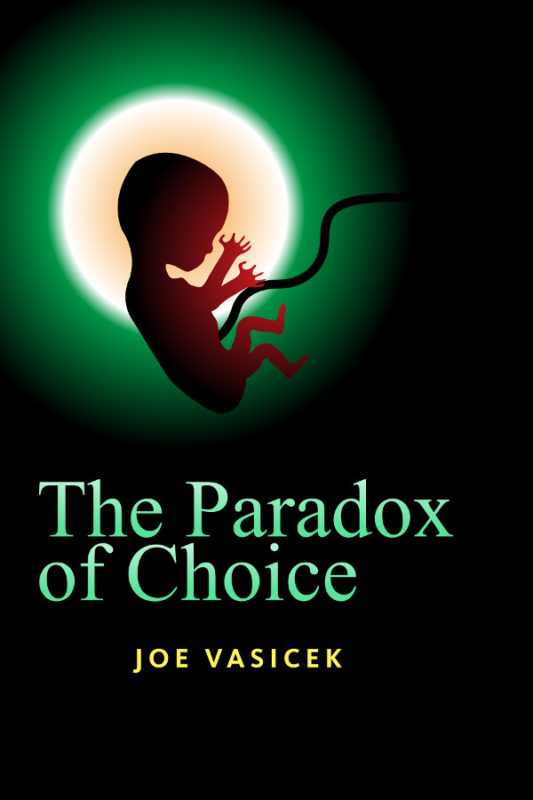
But at the same time, I don’t want to have more than six free short stories out at a time. Six, because 1. that’s how many stories appear at a time on the series carousel on Amazon, at least with a wide screen monitor, and 2. I don’t want to have more than half of the stories I plan to bundle together out at the same time. Since I’m never going to put less than ten stories in a collection, and one of the six free singles is always going to be “Paradox of Choice” (it’s published under a CC BY 4.0 license, so there’s no sense in ever unpublishing it), six is the magic number.

As for whether or not to hold some stories back, so long as no more than half of the stories in the next collection are available as free singles at the same time, I think it’s okay to put them all out there. My loyal fans will have already downloaded all of the stories when they were free, but they’re also my loyal fans, and that seems like a good way to reward their loyalty. Besides, some of them will probably go ahead and buy the collection anyway, both to support me and to get the author’s note.

What about putting stories on submission? How much of a buffer should I keep to ensure that each story gets sent out to all of the markets that I’m willing to sell it to?

I think a buffer of six months is enough. It might require doing some simultaneous submissions, but a lot more markets allow simultaneous submissions nowadays. And with a six month buffer, if I sell a couple of them, I won’t be scrambling to write new stories to fill up the next publishing slot—not unless all six of them sell within a few days of each other.

If a story sells to a traditional market, I’ll probably just put it straight in the next collection when the exclusivity period expires, rather than putting it on the schedule to publish as a free short story single. But it depends on what’s going on at the time, and whether it’s more important to get that collection out or to refill the buffer. I won’t put out the next collection until I have at least six other short stories to fill out the free singles.

So that’s the plan. Maybe it makes sense to you, maybe it’s clear as mud, but the important things are 1. I’m going to put out a new free short story each month on the first Saturday of the month, come hell or high water, and 2. I’m only going to have six free short stories available at a time. And all of the stories in my collections will appear first either as a free short story, or in one of the magazines/anthologies. Sometimes both.

Navigating Woke SF, Part 4: Götterdämmerung

Governor Andrew Cuomo announced his resignation today, after his sexual harrassment scandal that has seen an overwhelming number of women come forward. As tempted as I am to dive into the politics of this story, I bring it up only to provide context for this:

Yeah, I’m cringing too.

For the last several years—arguably, since the Ferguson riots and President Obama’s pivot toward intersectionality, this country has been progressing steadily toward the woke moral panic that we now find ourselves living through. Unlike the Red Scare, to which it is comparable in both scope and severity, the threat posed by “white supremacists” and other villains of the intersectional left is as laughable and contrived as the term “Cuomo-sexual,” and will age just as badly.

To anyone who studies history, it is obvious that there’s going to be backlash against all the gaslighting and hypocrisy of the woke moral panic that is currently gripping our nation. All around us are signs that the tide is beginning to turn.

The first indication that caught my attention was the “woka-cola” scandal over critical race theory (CRT) in Coca Cola’s employee training. Instead of giving a token response, Coca Cola reversed the policy and fired the executive responsible for implementing the policy. The only reason a major coproration would do something like that is because the scandal was hitting their bottom line in a way that they could not ignore—and yet, there were no organized boycotts on the part of the conservative right. Just a lot of disenchanted consumers quietly saying to themselves: “I think I’ll get a Pepsi instead.”

There are other indications of a growing cultural backlash all throughout our society, from the Marvel Cinematic Universe to viral videos of parents standing up to CRT in their kids’ schools. All of the organizations pushing the woke moral panic are little more than establishment astro-turf backed by corporate money, while the organizations pushing back are genuine grassroots movements—and they’re winning. All of the ground gained by the left during their “long march through the institutions” is about to be lost in a single generation, perhaps even a single decade. Public trust of established institutions is plummeting, and with every glaring instance of “sophisticated” woke hypocrisy, people are rejecting the establishment narrative, just like in V for Vendetta. Bollocks!

So what does this have to do with science fiction? In the second part of this blog series, I pointed out the following:

Traditional sci-fi publishing has trended to the political left (sometimes to the extreme political left) of mainstream American culture since the New Wave era back in the 60s and 70s. It seems that the campus radicals took over much of the field, not to mention the fact that American traditional publishing has always been centered in New York. But until just the last few years, it was still possible for left and right to coexist in our pluralistic society. People of different political persuasions could agree to disagree amicably, and while there may have still been whisper campaigns and secret author blacklists, you could still expect to see a healthy mix of opinions and perspectives in most places that published short stories.

That is not true today. Certain subjects and opinions have been deemed verboten, while others have been exalted to the status of eternal truth, and any story that questions or challenges the politically correct narrative doesn’t have a chance in most of these markets. In other words, science fiction has gone woke.

If I’m right and a major backlash against the woke intersectional left is brewing, then many of today’s most recognized and award-winning publications and editors are going to fall, or at least become relegated to a position of cultural insignificance. Indeed, we had an indication back in 2017 that this was already starting to happen, when it came out that China Mike Glyer buys traffic from Chinese bots to artificially boost the stats for his Hugo award winning site, File 770.

I suspect that these woke institutions within the SF field will try to maintain the illusion of cultural relevance for as long as they possibly can, much as ex-Governor Cuomo did everything he could to maintain the illusion of his fitness to hold office (even publishing a book about his leadership during the pandemic—talk about gaslighting!) until his inner circle had abandoned him, the Biden administration had called on him to resign, calls had come for his arrest, and the New York state congress had a deadline in place to begin the impeachment proceedings.

When the illusions fade and the gaslighting can no longer be maintained, there is going to be a cultural götterdämmerung—a “turbulent ending of a regime or institution.” Or perhaps the götterdämmerung has already arrived, and it ends when the illusions can no longer be maintained. Either way, it seems that the smart move is to reject these woke SF markets—or, as they so arrogantly put it, to “self-reject”—in favor of going indie, going with the semi-pro markets, and otherwise building an audience that isn’t caught up in all this woke madness.

What I would do if I were starting out now

In a word, short stories.

Write a bunch of short stories. One or two a week if possible. Keep that up for a year or two, tapering off at the end to transition into novels. But keep writing short stories even after novels have become the main focus.

Make a serious effort while writing short stories to master both the craft and the art of storytelling. View it as an apprenticeship period. Experiment. Try out new things. Join a writing group, preferably of experienced professional writers, and have them rip your stories apart. Soak up as much constructive feedback as possible, and apply it to the next story.

At the same time, don’t spend so much time reworking old stories that you aren’t producing new ones. Learn how to keep a rigorous production schedule. If a story is totally broken, toss it out! Get to the point where you can hit 2k words consistently every day, and knock out a story at least every couple of weeks or so.

In a word, learn how to be prolific.

Experiment with standalones, but also build a couple of universes with recurring characters. Write a few series, both sequential and non-sequential. Focus especially on the non-sequential series, though—the ones where any story can be an entry point. Learn how to find the sweet spot between writing a satisfying ending and leaving a hook for the next one. That sweet spot is different for every genre.

Submit every story you write to the traditional short story markets. Start with the highest paying markets and work your way down. Pay close attention to average response times on sites like the Grinder and don’t submit to any market with an average response time of more than 30 days, no matter how high the pay rate. The goal is to get each story through all of the pro- and semi-pro markets in about a year. If a market can’t get back to you in a timely fashion, it’s not worth your time. Ideally, you want to be receiving multiple rejections every day.

Once you’ve got about twenty or so stories that have come off of submission, start self-publishing.

Use the first couple of stories to learn how the process works. Figure out how to format, do cover work, and write up all the metadata on your own, then do all you can to streamline that process until it becomes automatic. You can outsource some of the more difficult stuff, but learn to do as much as you can on your own. Don’t spend more than about $50 per story to publish it, preferably more like $30.

Once you’ve got a process down, set a rigorous release schedule of 2 stories per month. Keep to that schedule religiously. Don’t worry too much how the stories are selling: they probably won’t sell well until you’ve got a couple dozen or so out. Just focus on getting them out.

Keep an email list, with links to subscribe in the front and back of all your books. Build that list as much as you can. Most of your early marketing efforts should go to building that list, and cultivating a relationship with the people on it. Don’t rely on Facebook, because you don’t own that site and can’t control it. Same with any other social media. Do all you can to bring your readers to a place you control.

Start blogging. Build relationships with other bloggers. Strive to post something new every day. Make it the kind of site that your readers will want to come to. Be sure to have pages for all of your books, as well as a series page that lists every story in every series, in chronological and written order (side note: I really need to write up a series page).

Experiment with free pulsing and price pulsing. Experiment with price points. Experiment with bundles. Experiment with everything.

ORGANIZE YOUR DATA. Ohmygosh. You’re going to be drowning in data after just a few months. Keep all of your sales reports, and compile all that into spreadsheets showing how many sales you got of each title each month, how much you earned from each title each month, etc. Data, data, data! Learn how to thrive with data!

Write a formal business plan, and update it constantly as you go. Write down all the strategies that work, as well as the ones that don’t. Write down all the strategies you want to try out. In case it wasn’t obvious, write down your release schedule. Write down your to do list, organized by urgent / not urgent and important / not important quadrants. Write down everything. WRITE IT DOWN.

Eventually, you’ll get to the point where you’re releasing bundles alongside or even in place of your short stories. Don’t unpublish anything. Maybe update the covers, if you decide your early ones are really really bad. But don’t worry about it too much. Just focus on being as prolific as possible.

As long as you keep moving, you’re going to get somewhere. So always keep moving. Even when you have a disappointing sales month, or a spat of bad reviews, or whatever, just keep moving. Even if you’re moving in the wrong direction, that’s better than not moving at all.

At some point, you’re going to start to see some success. You may even have a breakthrough. At that point, you can start moving on to novels. Hopefully you’ve written a couple of them by now. Your first one is probably utter crap, so toss it out and focus on the good ones.

Hopefully, you’ve written it in the same universe as a bunch of your short stories. That will make the marketing easier, but its not strictly necessary so don’t worry about it too much if you haven’t. Also don’t worry too much if the novel isn’t in a series of its own. It’s better if it is, but standalones have their place too.

Try to write in trilogies, or to write standalones that can easily be turned into trilogies. The first book should stand on its own, the second should end on a low note and hook into the third book, and the third book should blow the reader’s mind away. Brandon Sanderson’s Mistborn series is a great example of this.

If your career hasn’t taken off by now, you aren’t experimenting enough. That, or you’re cutting too many corners. One way or another, you’re going to have to put in the work.

That’s pretty much it. Have fun!

What’s up with Asimov’s?

Way back in June, I submitted a short story to Asimov’s. Normally, it takes them four to six weeks to come back with a response. However, it’s been almost five months and I haven’t heard anything.

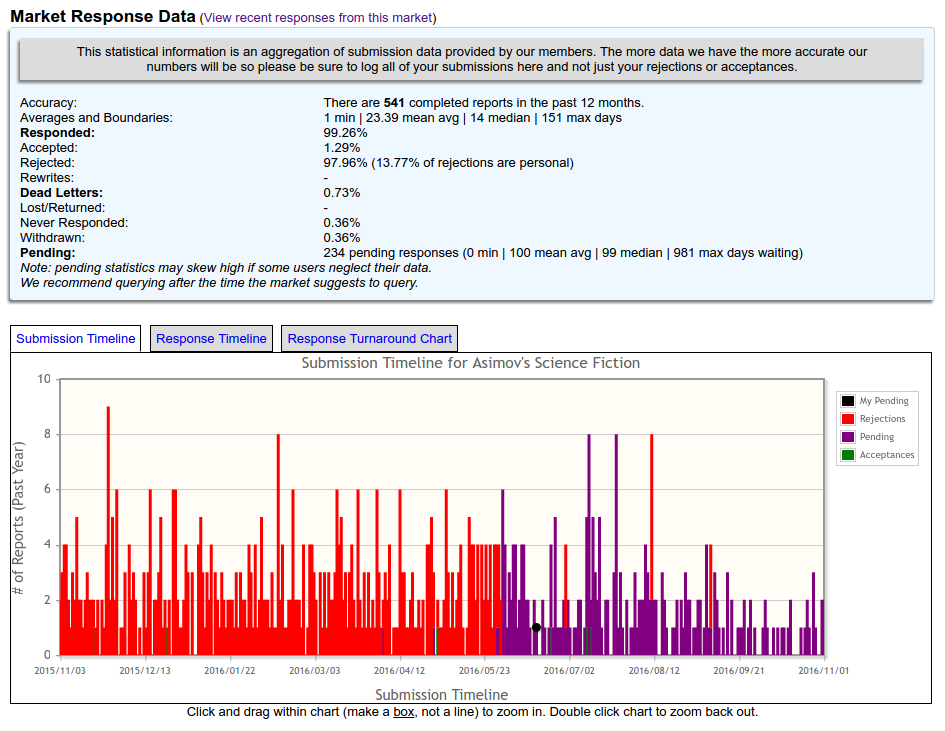
I’m not the only one, either. According to The Submission Grinder, their slushpile is backed up to the end of May. The average wait time for stories currently on submission is 100 days:

asimovsClearly, something weird is going on. In the last 30 days, only seven responses are logged. Seven.

What’s going on?

I queried the editors six weeks ago, and they confirmed that my story was still under consideration. So it’s not like they’ve dropped off the face of the Earth completely. Still, that was six weeks ago, and there hasn’t been much movement since then.

Maybe there was a personal tragedy or family emergency? If so, that’s completely understandable. But I can’t find anything online to indicate that that’s the case, and my friends in the industry haven’t heard anything either.

I really hope this isn’t the new normal for Asimov’s. I stopped submitting to Analog because their average response time is more than 150 days. In an age where self-publishing is the new normal, it really doesn’t make sense to have a story sitting on an editor’s desk for that long.

This particular story takes place in the same universe as Gunslinger to the Stars, which I hope to publish in a few months. I would really like to get this story out sometime next year, either in one of the magazines or by publishing it myself.

If anyone knows anything about this, please let me know.

A short rant about simultaneous submissions

TL;DR: If you run a short story magazine and it takes you longer than six weeks to respond to submissions, you should allow simultaneous submissions as a courtesy to your writers.

A simultaneous submission is when the writer sends the same story to multiple markets at the same time, instead of going down the list one-by-one and waiting for a rejection before submitting it to the next market. Multiple submissions are when the writer sends multiple stories to the same market at the same time. Generally, most sci-fi magazines do not accept simultaneous or multiple submissions.

I can understand why you don’t want to open the door to multiple submissions. A lot of us are fairly prolific, and if you allow us, we can swamp you with manuscripts in very short order. But simultaneous submissions are completely different.

Of course it’s frustrating to find a great story, only to learn that the writer has sold it somewhere else. But you know what’s even more frustrating? To watch your stories languish in slushpiles for months and even years while you know that you have readers who would eagerly snap them up the moment you publish them yourself. When you don’t allow simultaneous submissions, you are effectively demanding exclusivity for the length of the submission period, and exclusivity hurts readers and writers alike.

See, the publishing world has changed. The magazines aren’t the only available option for publishing our stories anymore. It is entirely possible for us to publish those stories ourselves, and to do quite well by them. In fact, if we have a story that’s ready to go, we’re putting off the money that we could be making if we decide to submit to the magazines instead.

The current status-quo regarding simultaneous and multiple submissions was made back when publishers held all the power, and writers could not realistically be their own publishers. It’s a holdout from the era of the gatekeepers, before the golden age of self-publishing. But that era is over, and we’re no longer as dependent on you as we used to be.

Which is not to say that the magazines have no value. On the contrary, you provide a great deal of value, and we want to support you with our content. That’s why we’re still submitting our stories to you instead of publishing themselves. When you publish our stories, it allows us to reach new readers and boosts our reputation in the field. We’re all in this together, and we want to support you just like you want to support us.

But look, can we meet in the middle here? When our stories are locked up in your slushpile for five months at a time, it makes us think twice. If you’re going to take your time, let us send our stories elsewhere while we wait to hear back from you.

I’m not going to lie: when it takes you three or more months to respond to our submissions, demanding exclusivity all the while, the word that comes to mind is “unprofessional.” I don’t care if your magazine has been in print for longer than I’ve been alive, or that you published such-and-such big name author before he was famous. It’s 2015 now, and that’s what it looks like.

I understand that you might not have the resources to respond to every submission in a timely way. That’s totally understandable. But if that is the case, there is no good reason why you can’t allow simultaneous submissions as a professional courtesy.

There are a lot of magazines that I would love to be published in. Many of these are semi-pro and token paying magazines that still want to support, in spite of the fact that they don’t pay very well. But even the pro-paying magazines make me think twice when my stories are locked up with them for months at a time. If your goal is to keep your slushpile manageable by getting me to self-reject, the best I can say is that it’s working.

If you run a short story magazine and you aren’t able to give us a timely response to our submissions, then please, do your writers a favor and allow us the courtesy of simultaneous submissions.

Yay for short stories!

So for the past three weeks while waiting for my first readers to get back to me with their comments on Strangers in Flight, I’ve been working on short stories. It’s a great way to stay busy and productive between projects, and feels really gratifying too because it only takes a week or two to finish things.

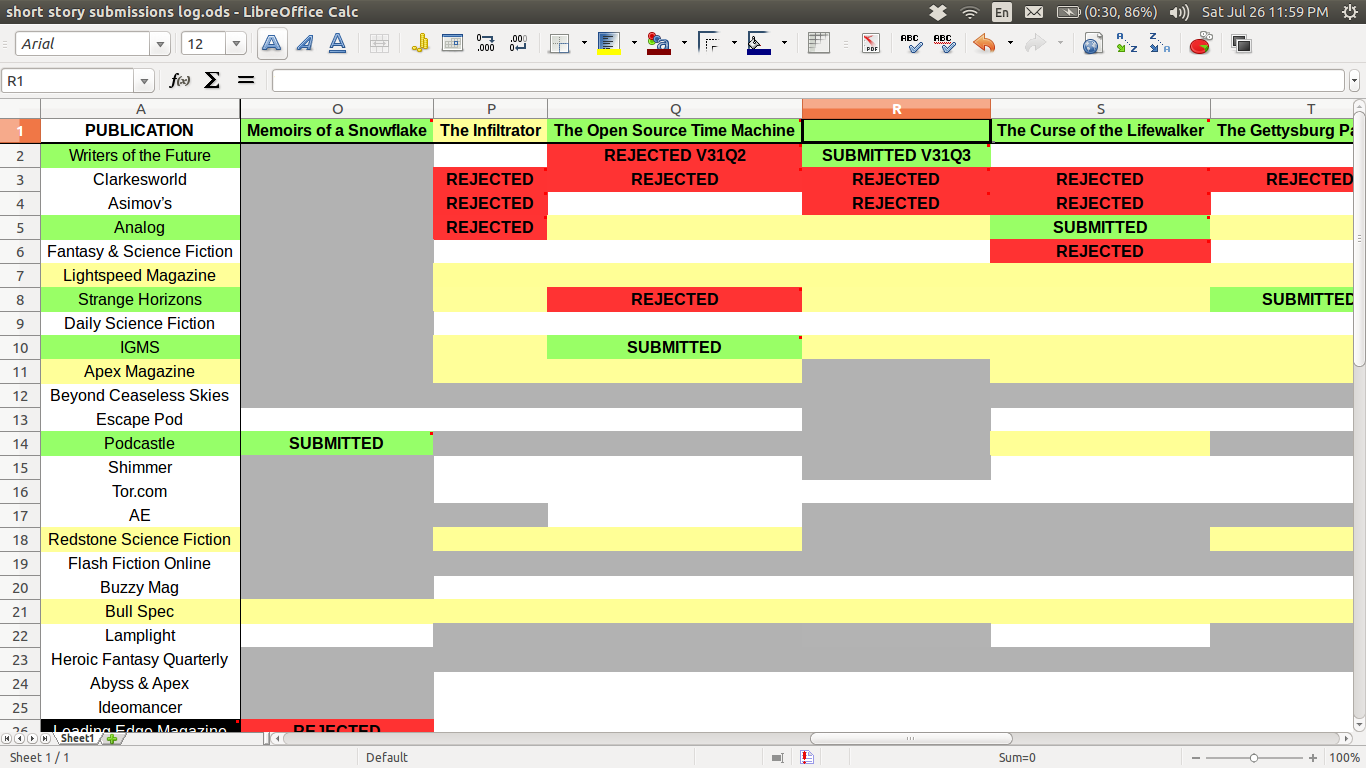
Screenshot from 2014-07-26 23:59:19The really gratifying thing for me, though, is sending off my stories to the magazines and having half a dozen or more on submission at any time. I love self-publishing, but for short stories, it makes a lot more sense to shoot for publication in one of the traditional markets first. They don’t buy exclusive rights, so you’re free to self-publish later, and they put your writing in front of a new audience, giving you some great exposure–all while paying you!

So far, the only market I’ve cracked has been Leading Edge. But the more I write, the sooner that will change! And since I still have the option to self-publish, the rejections don’t feel quite so discouraging. Instead, it’s almost like a friendly competition with myself to see how many rejections I can rack up, and how many stories I can have on submission at one time.

Lately, I’ve been working on a Sword & Sorcery story titled “A Hill On Which To Die.” It started off as a short story, but then it morphed into a novelette–not quite as long as Star Wanderers: Outworlder (Part I), but long enough that most of the markets won’t take it. It’s also long enough that it will probably need a revision once it’s done, and I may run it past a reader or two. It’s definitely turned out to be more work than I’d bargained for.

There’s another story I’m working on about a naturally occurring time portal in rural Pennsylvania, and how the Amish are so isolated from modern society because they’re the ones guarding it. Then I’d like to rewrite “The Infiltrator,” to cut out most of the stuff at the beginning and dive straight into the action. That should take only a day or two. And then, there’s that story about the uplifted Deinonychus that my girlfriend really wanted to read …

Gah! So many ideas to play with! I cannot possibly write fast enough to keep up with them. It’s the most frustrating thing in the world!

I suppose for most of my readers, this talk of short stories is kind of frustrating too, since they probably won’t be available for you to read for a while. But one way or another, they will come out eventually! And it’s definitely better to write something while in that weird space between projects. At least I’m finishing stuff.

So that’s what I’ve been up to lately. I’ll probably finish “A Hill On Which To Die” in a day or two, then work on “That Which Is About is” until it’s finished. It’s an Amish sci-fi romance–I can barely wait to get it all down on the page!c And after that, I’ll probably move on to Strangers in Flight, making the revisions and getting it ready to publish in August.

Thoughts on traditional vs. indie publishing

In case you didn’t know, the publishing industry is in the throes of a major revolution.  With the growing popularity of e-books and the collapse of distribution channels and chain bookstores such as Borders, traditional business models are proving simply untenable.

I’ve been perusing several internet sources to make sense of all the craziness, among them Joe Konrath’s blog (a midlister who is now making six figures via ebooks), Writer Beware (which still emphasizes caution with self-publishing), the Adventures in Sci Fi Publishing podcast (which has recently started interviewing several successful indie authors), Dean Wesley Smith’s blog, and his wife Kristine Rusch’s series on the changing business of publishing (which I highly recommend–seriously, if you read nothing else, read this).

Some of these people predict the imminent collapse of the big publishers, and have selected (ironically enough) 2012 as the predicted date of the collapse.  Others agree that many traditional publishers will collapse, but believe that most will survive and evolve into something different (the “dinosaurs evolved into birds” theory vs. the giant meteor).  All of them agree, however, that whatever new form the publishing industry takes, ebooks will dominate.

For someone in my position–a budding author looking to break in in the next few years–all of this is simultaneously thrilling and unnerving.  Should I venture into indie publishing and risk having my work lost in the flood?  Or should I spend the next five years toiling endlessly to break into traditional publishing, only to see my rights get tied up in a bankruptcy?

Thus far, my strategy has been to a reputable agent, or a new agent at a reputable agency.  I’ve been holding back from submitting directly to publishers, out of fear that getting rejected from publishers would make it difficult for an agent to do her job.

That was the orthodox model under the traditional system, when the big six (HBGUSA, HarperCollins, McMillan, Penguin, Random House, and Simon & Schuster) dominated the industry.  For the time being, they still dominate, but I’m wondering whether it’s such a good idea to go with them.

The big six have been swallowing up independent presses and imprints for years, and as a result, they’re now major corporations.  As such, they aren’t looking for moderate midlisters who sell consistently–those kinds of writers would drive them bankrupt.  No, in order to support their corporate expenses (like multimillion dollar office space and executive bonuses), they need bestsellers like Stephen King or J.K. Rowling.

Trouble is, they often lose when they gamble on new writers, which means that the next bestseller needs to be even more spectacular than the first.  And with the ebook revolution underway, they’re getting desperate.

Agent Kristin Nelson recently lambasted McMillan for claiming rights to all “derivative works” in their new boilerplate (a bad faith move comparable, IMO, with the worst scams on Writer Beware), while Kristine Rusch recently noted how the big publishers are becoming increasing hostile to new writers.  Advances as low as $1,500, or single book only contracts, or nebulous clauses that ensure publishers keep ebook rights for decades, even with the author barely making $20 per year on royalties?

How am I ever going to make it full time in a business like this?

Well, according to Joe Konrath, every day my books aren’t up as indie published ebooks, I’m losing big money.  His views are pretty extreme, but he makes a very compelling argument, especially for someone in my position.  Yes, there will be a flood of crap, but good stuff inevitably rises to the top.  Yes, sales start out slow, but that’s simply part of the new model–and they build over time.  For a minimal investment of time and money, I could launch my books and start earning an income from them now.

But money (such as I may or may not make as an indie) isn’t everything in this business.  At this point in my career, gaining prestige and making a name for myself is just as much if not more important than income.  Granted, I can build some prestige through indie publishing if my books sell enough, but I don’t want to have to depend on that, especially if it takes years for sales to build.

For the science fiction and fantasy genres, the professional standard is set by SFWA, or the Science Fiction & Fantasy Writers of America.  In order to become a member, you have to have your work published in one of their approved markets.

Last night, I did some research on those publishers.  Of those that specialize specifically in science fiction and fantasy, seven of them are affiliated with the big six (Tor, Ace, Baen, Bantam Spectra, Roc, Del Ray, and Orbit).  Thirteen others are independent presses that might conceivably be interested in my work.

Now, just because a science fiction and fantasy imprint is affiliated with the big six doesn’t mean it’s a bad idea to submit to them.  Tor, after all, is the undisputed king of the genre–the company has won the Hugo for “best publisher” every year since 1988.  I also tend to think (though I have no data to support it) that the bad contracts are more common with mainstream fiction.  Science fiction, after all, has always been small potatoes to the rest of the publishing world.

But precisely because science fiction is so small, I’m starting to wonder if it’s a bad idea to submit to agents first.  Agents go where the money is–in LDS publishing, virtually every author is unagented.  While there’s still a national market for science fiction, it’s definitely a small one, and all the agents I’ve found always tend to list it as an afterthought, focusing instead on YA/MG, thrillers, romance, or the ubiquitous “commercial fiction.”

In other words, I think that part of the reason agents have been so reluctant to pick me up, even after showing some interest, is that they just don’t see enough money to justify taking a risk on me.  Granted, it may also be the quality of my work, but the bulk of the rejections I’ve accrued seem to point more to subjective factors, like the agent’s personal tastes (the ubiquitous “I don’t feel I’m the right agent for this work”).
Which is not to say that I don’t think it’s a good idea to get agent–not at all.  Even Amanda Hocking, who has turned down several big publishing deals, has an agent.

No, what I’m saying is that in today’s market, it might be easier for a science fiction writer to attract an agent by getting picked up by a publisher, rather than attract a publisher by getting picked up by an agent.

And, of course, the only big reason to do any of this is to make a name for myself.  At some point, I will go indie, even if only with a few of my works.  The revolution has arrived, and I’d be a fool not to capitalize on it–the only question is when, and how.

(images from Postsecret)