Star Wars is more of a space fantasy than a space western, but the music still fits surprisingly well. I am really looking forward to watching The Good, The Bad, and the Ugly with my kids (and probably Star Wars too).
Tag: Star Wars
Fantasy from A to Z: V is for Villains
Back in the early days of the internet, when it was still a fun and carefree place, there was this thing called the evil overlord list (which is still up, if you want to read it). The list is organized like a top 100 list of resolutions that the smart evil overlord has made, in order to avoid the fate of all the not-so-smart evil overlords who have come before him. It’s got some really hilarious zingers, including the last one:
Finally, to keep my subjects permanently locked in a mindless trance, I will provide each of them with free unlimited Internet access.
Yikes. Explains a lot about the world today, doesn’t it?
But all joking aside, villains are a staple of fantasy literature—including the super campy villains that we love to mock with things like the evil overlord list. And there’s a very good reason for that. Every great hero needs an intractable problem to overcome. And while man vs. nature and man vs. self provide a certain degree of conflict, nothing provides a hero with more opportunities to prove himself than man vs. man.
When I was learning how to write fiction, the popular advice when writing villains was to remember that every character is the hero in their own story. Thus, every villain you write shouldn’t think of himself as the bad guy. Instead, he should think of himself as the good guy, who only does morally questionable things because that’s what needs to be done.
I do still think that there is validity to this advice. I still remember the moment when, as a young boy who was starry-eyed for all things Star Wars, I first saw the opening cinematic for the computer game Tie Fighter. It blew my nine year old mind to think that my beloved Rebel Alliance might actually be a band of terrorists, opposing the forces seeking to restore law and order to the galaxy. Suddenly, the one-dimensional conflict at the heart of my favorite franchise had a whole other dimension to it. I was hooked.
But in the last few years, I think people have become hungry for villains who are truly evil to the core. The transition probably began a while ago, around the time when Breaking Bad was still new. Walter White is an extremely complex and nuanced character, with a rich and well-developed character arc, exactly in line with the old writing advice. And yet, by the end of the show, he is genuinely evil. He gets a bit of a redemption arc in the last episode, but he is not a good guy by any stretch—and he admits it. In fact, the scene where he finally admits as much to his wife is, in many ways, the capstone of his character arc. He has no illusions about the fact that he never was a hero—not even in his own story.
These things tend to be cyclical and generational. From the mid-1960s to about the 2010s, I think most readers preferred villains who were nuanced. Even in Lord of the Rings, which really took off in the 1970s, Sauron is more of a force of nature than an actual human person. Besides, the true villain of Lord of the Rings is the ring itself, and everyone who interacts with it has a slightly different reaction, with some of them passing the test, and others failing (and, in the case of Boromir, redeeming themselves afterward). Besides, Tolkien wrote Lord of the Rings at the tail end of the last cycle, where from the 1910s through the 1950s the villains were unambiguously evil. Robert E. Howard’s Conan stories are a great example—there is no redemption arc for the Stygian priests or the remnant of Xuchotl.
The older I get, the more I have come to appreciate stories with unambiguous heroes and villains. That doesn’t mean that everything has to be black and white—just look at Lord of the Rings for that. But there’s a lot more room for nuance and complexity between two extremes than there is between different shades of grey. Again, Lord of the Rings is a good example of this. You can make a solid case that the true “hero” of that story is Gollum, who succumbed entirely to the ring and had absolutely no desire to save the world at all. And yet, the ring is unambiguously evil, and Gandalf, Aragorn, Elrond, etc. are all unambiguously good.
What would a revised version of the evil overlord list look like? Most of the tropes in the original list are based on recycled old franchises that have mostly faded from cultural relevance now. Would the new list include things like “I won’t waste time fretting about the corruption of my soul” or “I’ll harbor no illusions about being the good guy”? I don’t know, but I suspect that a good number of items will remain relevant for a long time. After all, whether or not the villain sees himself as the hero of the story, a good villain is always very competent at what they do.
Every (main arc) Star Wars movie, but only when they say “star” or “war”
I don’t know why I find this so hilarious, but I do!
Star Wars if it were made in the 50s
#GiveThanks Day Three
(30) My wife posted today that she’s grateful for Tillamook Mudslide ice cream. So am I!
(31) I’m grateful for the original Star Wars series for cultivating within me a deep and lifelong love for science fiction.
(32) I’m grateful for Michael Ende and his magnificent book The Neverending Story, which remains my favorite novel of all time, and showed me as a child just how powerful and moving a book can be.
(33) I’m grateful for Madeline L’Engle and A Wrinkle in Time for helping me to realize that one day, I would be a writer.
(34) I’m grateful for Ursula K. Le Guin and her masterful book The Dispossessed for showing me how the written word can make you feel you understand a fictional character from a completely alien culture better than you understand yourself.
(35) I’m grateful for Orson Scott Card and Ender’s Game for keeping me up until 4am and giving me one of the most incredible reading experiences of my life.
(36) I’m grateful for David Gemmell and his Drenai Series for moving me to tears with the inspiring heroism of his characters.
(37) I’m grateful for my childhood teachers who encouraged me to read and instilled in me a love of reading.
(38) I’m grateful for Terry Pratchett and his wonderfully entertaining Discworld books, which definitely helped me to become a funnier person.
(39) I’m grateful for Paperback Swap, which has been a wonderful tool for swapping books and building my personal library.
(40) I’m grateful for all of the wonderful books I have yet to discover.
(41) I’m grateful for Goodreads for helping me to organize and keep track of the books that I read, and to set reading goals.
(42) I’m grateful for the ability that I have to blog about my writing and my reading, something that didn’t really exist until just a couple of decades ago.
(43) I’m grateful for NaNoWriMo and the encouragement that it gives all of us to write things we didn’t think that we could.
(44) I’m grateful for Brandon Sanderson, his wonderful books, the positive influence that he is on the fantasy genre, and for the class he taught at BYU that both I and my wife were privileged to be able to take (though we didn’t know each other at the time).
2019-10-24 Newsletter Author’s Note
This author’s note originally appeared in the October 24th edition of my author newsletter. To subscribe to my newsletter, click here.

There’s this guy I follow on YouTube named Tom Luongo who has a very interesting take on Star Wars: The Last Jedi. According to him, it’s one of the best Star Wars films ever made. I recently got into an online conversation with him about it, so I thought it would be interesting to bring up some of that in this newsletter.
Tom is a radical anarcho-capitalist libertarian who lives on a farm in Florida that he and his wife built. I listen to his political commentary mainly for the contrast. He’s a natural contrarian who tends to fall into the trap of wishcasting, which has really blackpilled him in the last few years. I disagree with him almost all of the time, but he’s got a fascinating take on things, and I think his central thesis is basically correct.
You really should read or listen to Tom’s take on The Last Jedi. His argument goes something like this: the Skywalker-Solo family was always bound to come to a tragic end because the original series never resolved any of their underlying flaws, so in order for anything good to come of the family’s fall, everything built up by the previous generation first needs to come crashing down. Unfortunately, The Last Jedi falls in the midpoint of that arc, when the characters hit their lowest point, which is why so many fans were disappointed with it—just like so many fans of A New Hope were disappointed by The Empire Strikes Back the first time they watched it.
If nothing else, his argument has convinced me to watch The Rise of Skywalker, which I wasn’t planning to do. In fact, after The Last Jedi, I had pretty much checked out of the Star Wars fandom forever.
I discovered Star Wars when I was seven years old and saw A New Hope for the first time. Completely blew me away. My parents made me wait a year and a half to watch Empire Strikes Back, and for the last couple of months I was counting down the days. When I first saw Empire, I was lukewarm on it, but I really liked the Battle of Hoth and Luke’s duel with Vader (strangely, I don’t remember being surprised to learn that Vader was Luke’s father). In later rewatchings, it grew to be not only my favorite Star Wars movie, but my favorite movie of all time. I also loved Return of the Jedi, and felt that it really sticked the landing for the trilogy.
I read all the Star Wars books from the library that I could get my hands on. Timothy Zahn, Kevin J. Anderson—but it was Roger Allen McBride’s Corellia Trilogy that really opened my eyes to a different kind of science fiction. Instead of all the flashy lasers and adventurous antics, he used the limitations of physics to depict a universe far more vast and far more ancient than my young, boyish mind had ever dared imagine. I began to branch out to other works of science fiction, and over the next few years I discovered Card, Le Guin, Asimov, Clarke, Heinlein, Herbert, Burroughs, and all the other greats.
When Phantom Menace came out, it was a huge disappointment. Midichloriens? Jar Jar Binx… ugh. Darth Maul was pretty okay, but the rest of the movie was garbage. But I held out hope that Clone Wars would be better… and it wasn’t. Too much CGI, too little story. The romance was icky, the plot was too slow, and the fight scene with Yoda was a farcical caricature. I was disgusted, but I still saw Revenge of the Sith in theaters, because surely they had to get Vader right… and once again, they failed. Massive disappointment. It was like Lukas had taken a massive dump on my childhood, and was trying to sell it back to me as merchandise.
I cooled off to Star Wars for the next few years. It was never a religion to me. I dabbled a bit with the video games and expanded universe novels, but at this point in my life, I was more of a casual fan. I turned to other works of science fiction and fantasy, and began to pursue my own writing more seriously.
Ever since 4th grade, I always knew I would be a writer. All through high school I had some novel project or another I was working on, but it wasn’t until college that I finished any of them. In 2008, I took Brandon Sanderson’s writing class at BYU and finished my first novel. Incidentally, my wife was in the same class, though it would be another ten years before we met each other.
When The Force Awakens came out, my expectations were low. I didn’t want to get shafted like I had by the prequels. It was probably because of those low expectations that I enjoyed it. Han Solo’s character was utterly ruined, and the plot was little more than a rip-off of A New Hope, but hey, at least it didn’t totally suck! Then Rogue One came out, and it was excellent. On par with the original trilogy. Star Wars was back.
And then, The Last Jedi… green alien breastmilk… Leia Poppins… Admiral Gender Studies… Space Vegas…
Ironically, I think I would have hated it less if Rogue One hadn’t been so good. By the time TLJ came out, I felt like I was on a rollercoaster that was giving me a really bad case of whiplash, and I just wanted it to end. The low points felt so low because the high points were so high, and with TLJ it felt like it was all crashing down again.
At that point, I noped out. No more Star Wars. I was out. The fact that so much of my childhood—and not only that, but my chosen career—was so tied up in the franchise only made it that much more painful.
And then I heard Tom Luongo’s take on The Last Jedi, which has made me rethink some things. I’m not entirely convinced that it’s a great film, but perhaps it’s not as flawed as I thought it was. It really does come down to The Rise of Skywalker. Will it bring the roller-coaster ride to a satisfying conclusion, or will it fling us off the rails the way the prequels did? (“nooooooooooooo!”) I guess we’ll find out in December.
Thoughts on Minimum Viable Product
So I read an article on Draft2Digital’s blog about Minimum Viable Product and what it means for writers, and it got me to thinking about what that means for books in general, and my own books in particular.
From what I’ve managed to gather (and I could be totally wrong), the controversy in the indie writing community over MVP began when the guy who started 20 Books to 50K first started a topic on KBoards, talking about how he’d used the MVP concept to launch a successful career. This rubbed the KBoards groupthink in the wrong way, and they ran him out with torches and pitchforks, so he started his own group. Indie writers have been arguing about it ever since.
On the one hand, I can’t really criticize the concept, because I kind of followed it myself. When I published my first three books, I sunk a fair amount of money into them, and when I realized it was going to take a long time to earn that back I shifted strategy, publishing the best quality work that I could on a shoestring budget. The result was this:
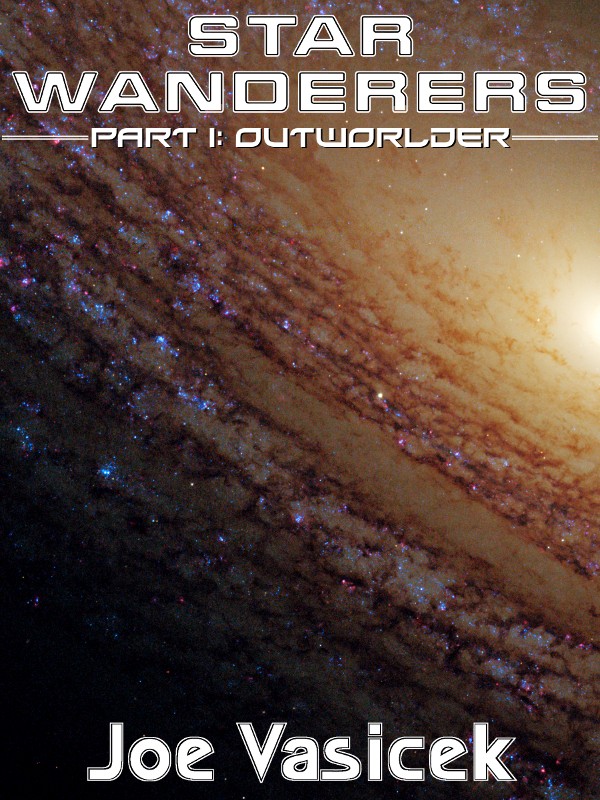
Ah, the good old days when I was young and stupid (now I’m just stupid). Cover art taken from NASA, which is all in the public domain. Title and subtitle font taken from a free font site, author font cribbed from an old 90s-era Sid Meier’s Alpha Centauri CD-ROM. No gradients or visual effects on the text itself—even the drop shadow is just a mirror image of the text in black, offset diagonally by a few pixels. As if that’s not enough, the aspect ratio is 3:4, which makes me want to grate my teeth.
So that was my minimum viable product at the time. The other novellas had very similar covers, with NASA space art, free fonts, and everything else. I also self-edited most of them, though I did have some editing student friends who volunteered to proofread the later ones. Surprisingly, the books sold. By 2013, they’d earned enough that I could afford to hire out a cover designer, who made the covers the books have today. Needless to say, the quality is much better.
I guess you could say the MVP strategy worked for me, though I’m not so sure it would work as well today. The key point, though, is that once I could afford to upgrade to a better quality product, I did so. The production aspect of a book is stuff like the cover art, copy editing, proofreading, etc. Most of that stuff can be upgraded over time, so if you have to do it on a shoestring budget, it’s not such a big deal.
But in my opinion, the writing itself is completely different. Some writers will go back and rewrite their books after they’re published, but I think that’s a horrible idea. What about the readers who enjoyed the first version? It’s okay to fix things like typos, or maybe remove some bad language but changing things so completely that the story itself changes is just wrong. It’s how we end up with memes like this:

A lot of people got pissed at George Lucas for the changes he made to the original Star Wars trilogy, myself included. It’s one thing to update the CGI for the X-wing dogfights, but it’s something else entirely to rewrite the characters. Han shot first, dammit!
So as far as MVP goes, I don’t think it works for writing—at least, not the kind of books that I’m trying to write. Perhaps in some genres, like porn, clickbait, and Buzzfeed articles, it’s better to put as little time and energy into the writing as you can get away with, but for the books I like to read, I want to know that the author did their best work. You can’t produce your best work and simultaneously aim for what’s minimally viable.
Of course, as the Draft2Digital blog post points out, that doesn’t mean that you should write slowly and slog through endless revisions. Sometimes the best books are written quickly, in a single draft. One of the great enduring myths is that there’s a correlation between how good a book is and how long it takes to write it, and another enduring myth is that revisions always make a book better.
I know there are some indies out there who have had great success by reading the one-star reviews and rewriting their books accordingly. To which I say: you shouldn’t use paying customers as beta testers like that.
Some media formats, like blogs, TV, or magazines, are designed to be ephemeral or to be changed or updated over time. Books are not. As Stephen King put it in On Writing, when we write a book, we are acting as time travelers, packaging up our stories and sending them forth, to be recreated in the mind of a reader long after we have written it. Books are unique like that.
So that’s what I think about minimum viable product. It’s a useful way of thinking about all the stuff you can update later, but for the story itself, it’s a horrible idea. Write the best book you can right now, then send it out into the world and write another one. That’s my strategy, at least.
Merry Christmas everyone!
Thoughts on Star Wars: The Last Jedi
 What a disappointment.
I was going to avoid spoilers, but now that I’ve had some time to reflect, man oh man I’m just gonna vent about everything. Because there is so much wrong with this movie, and so many things that could have been awesome but instead turned into missed opportunities. So this post is full of spoilers. Consider yourselves warned.
First, taken entirely on its own, the story is just broken. I’m undecided whether the writers and/or director were too clever or too stupid for their own good. Half the plot of the movie turned out to be a red herring, which made Finn, Rose, and to a certain extent Poe Dameron completely unnecessary characters. It seemed like the writers were trying to play with tropes and plot conventions in an unexpected way, but it ended up completely breaking the story. The Dark Knight did something similar and pulled it off masterfully, but The Last Jedi is no Dark Knight.
The purple-haired feminazi who replaced Princess Leia for half the movie deserves a special measure of my wrath. How a woman with all the charisma of a dead fish became one of the chief leaders of the rebellion lite, aka the resistance, I don’t know. There wasn’t a single scene with her where I wasn’t screwing my face up and cringing. And her command decisions were just completely awful. If you know that you’re going to lose most of your starships anyways, why not ram the super star destroyer at light speed with the first damn one to fall?
I think my biggest problem with the new Star Wars movies is that, with the notable exception of Rogue One, they introduce a bunch of new characters and assume that you’re going to admire them simply because they show up. We’re told that Snoke is the new big bad, but we know nothing about who he is, how he rose to power, what his capabilities are, etc. So when he dies, the only thing going through my head was “well, that was interesting,” whereas when Emperor Palpatine dies, it was this big emotional moment.
We’re never made to admire the new characters, we’re simply told why we should admire them. Goggle eyes orange face is supposed to be this super well-connected smuggler type, but we never learn anything about her other than that Han Solo apparently admires her, and she ends up shooting things a lot. Who is she? Where does she come from? What’s her history? Who is she connected with, and how? Show don’t tell, dammit. Give us something to make us care.
The fridge logic really ruins this movie. Why did Luke tell Rey to go away, when he obviously left a map for them to find him? If ramming starships at light speed is a thing, why hasn’t anyone ever done it before now? If Kylo Ren truly wants to wipe out the past and start over, why is he still fighting the Resistance?
Which brings me to the greatest missed opportunity of the movie. When Rey and Kylo Ren team up, that was truly awesome. Great fight scene, great turning point. For a moment, you think that you’re going to see something new in the Star Wars universe. The whole movie has been building up to it. Luke Skywalker has already established that the Jedi deserve to die out because they’re really a bunch of zealous fanatics, and Kylo Ren has already refused to give himself to the dark side fully. He reaches out his hand to Rey, offering her the chance to join forces and create something new, something that transcends both the light and the dark sides of the force. And then they go right back to fighting each other as if none of this had ever happened, because this is Star Wars, where apparently nothing ever changes.
It’s not so much that Kylo Ren was the most interesting character in the movie, so much as that he was the only interesting character. At this point, he’s the only one I’m still rooting for. Rey is an idiot. Finn and Rose are useless baggage and dead weight, respectively. Princess Leia is apparently still around, but without Carrie Fisher playing the part I really do not care about her. Chewbacca is still alive, I guess. So are R2D2 and C-3PO. But they’re the last original Star Wars characters, and I really don’t think they can carry a story. Poe Dameron is cool, but perpetually hamstrung by the idiots running the Resistance, and that gets old real fast.
As someone who grew up with Star Wars—who ranks Empire Strikes Back as his favorite movie of all time—I hate to say this, but I’m not going to watch the next Star Wars movie to come out. Not unless it gets overwhelmingly positive reviews and all my geek friends can’t stop raving about it. Rogue One was good, but The Last Jedi? It’s crap.
Here’s my ranking of Star Wars movies from best to worst:
- The Empire Strikes Back
- A New Hope
- Rogue One
- Return of the Jedi
- The Force Awakens
- Revenge of the Sith
- The Last Jedi
- Attack of the Clones
- The Phantom Menace
At this point, I don’t think anything below Return of the Jedi is worth rewatching.
Something awesome for the middle of your week
Glory to the Empire!