A fascinating take on Brandon Sanderson’s Winds of Truth

Really interesting take on the publishing industry. This is politically incorrect, but I think it’s related to the way that publishing has become dominated by liberal women. The Nonsense-Free Editor has a lot of great videos about that.

There are lots of great books in the indie publishing scene that are not “Potempkin villages,” as this BookTuber calls them… but how is one to find them? When we finally solve that question, there will be a resurgence of great writing and great art.

Extra Sci-Fi S3E3: The Two Towers

This episode of Extra Sci-Fi got me to thinking about a speech that Orson Scott Card gave when he visited BYU back in 2007. He said a bunch of interesting things that have stuck with me over the years, including (to paraphrase) “conservatism is the new counterculture.” He was probably ten to fifteen years before his time on that one. But the thing that struck me the hardest was this:

Fiction is the culture talking to itself.

This goes along with what I talked about in my commentary on the last Extra Sci-Fi episode: that every generation reinvents the world. How do they reinvent it? Through story. And because there’s a necessary give-and-take as part of the process, the bestselling fiction that a culture produces is a reflection of that culture’s values, the issues of the day, and the zeitgeist as it changes and evolves over time.

We can see this in the themes discussed in this video. While Tolkien denied that Lord of the Rings was allegorical in any way, I agree with the folks at Extra Credits that the world wars and the rise of fascism almost certainly influenced his depiction of good and evil. It’s probably also true that the conflict between industry and nature influenced the book too. This isn’t because Tolkien set out to tell a story about these things; rather, because Tolkien himself was a product of the culture of his day, that culture shines through in his works.

This makes me wonder about the stories that don’t become bestsellers. Are there lots of amazing, well-written stories out there that don’t succeed simply because they’re out of step with the ongoing cultural conversation? Kind of like Orson Scott Card’s argument, back in 2007, that “conservatism is the new counterculture.” He made that argument a decade before we reached peak social justice, and got pushed more or less into cultural irrelevance because of it.

Card might not be the best example, because of his role as a culture warrior as well as his fiction writing career. With his Ornery American column, he was basically a shitposter before shitposting was a thing. But I wonder: what are the stories that aren’t getting traction only because they don’t really speak to the culture?

Or is it even possible to write a story that doesn’t speak to your own culture? Since you are a product of the culture that you live in, does that mean that your stories will be a product of that culture too? That certainly seems to be the case with Tolkien. Hindsight is 2020, though, and it’s really tricky to account for unknown unknowns.

I don’t know. I guess the big takeaway is that if you want to be a sucessful writer, you should do everything you can to immerse yourself in your own culture, not only because that’s the best way to improve your storytelling instincts, but because all of the most successful stories contribute something meaningful to the culture’s ongoing conversation with itself.

#RIPTwitter

Two weeks ago, I decided that I was done with Twitter. This came after a long series of controversies, starting with gay conservative pundit Milo Yiannopoulos’s de-verification and culminating with Twitter’s Trust and Safety Council. For those of you unfamiliar with all of this Twitter-related internet drama, Sargon of Akkad does an excellent job explaining it:

I was originally going to blog about this a couple of weeks ago, but then Larry Correia came out and said that he had made the exact same decision, for much the same reasons I had. That surprised me, though, because Larry was one of the more active Twitter users I followed, with an impressively large following. To give that all up… wow.

Larry wrote:

You’ve probably heard about how Twitter is falling apart. Their stock price has been tanking.

Recently they created a Trust and Safety Council, to protect people from being triggered with hurtful dissenting ideas. Of course the council is made up of people like Anita Sarkesian, so you know how it is going to swing.

They’ve been unverifying conservatives, and outright banning conservative journalists. Then there were rumors of “shadow banning” where people would post, but their followers wouldn’t see it in their timelines. So it’s like you’re talking to a room that you think has 9,000 people in it, but when the lights come on you’ve been wasting time talking to an empty room.

In the last couple of months before I signed off, I saw this happening myself—not so much the shadow-banning, which is invisible by nature, but the fact that certain hashtags (like #GamerGate) fail to auto-complete. I also saw it in a double-standard applied to conservative Twitter users like Adam Baldwin, who had his account locked for tweeting that anti-GG people are unattractive, while around the same time a certain liberal journalist compared Ted Cruz to Hitler and received no disciplinary action whatsoever. Lots of little stuff like this, which over time builds up.

All of this probably sounds like a tempest in a teapot if you aren’t on Twitter. And yeah, it kind of is. In the last two weeks, I’ve learned that life is generally better without Twitter than it is with it. No more getting sucked into vapid tit-for-tat arguments in 140-character chunks. No more passive-aggressive blocking by people who are allergic to rational, intelligent debate. No more having to worry about being an obvious target for perpetually-offended SJW types who, in their constant efforts to outdo each other with their SJW virtue signaling, can spark an internet lynch mob faster than a California wildfire.

The one big thing that I miss about Twitter is the rapid way that news disseminates through the network. I can’t tell you how many major news stories I heard about through Twitter first—often while they were still unfolding. But if the #RIPTwitter controversy demonstrates anything, it’s that Twitter now has both the means and the motive to suppress major news stories that contradict their preferred political narrative. That puts them somewhere around Pravda as a source for news and information.

Am I going to delete my account the same way that I deleted my Facebook account? Probably not. I deleted my Facebook account because of privacy concerns and Facebook’s data mining. With Twitter, it’s more of an issue with the platform itself. I don’t need to delete my account to sign off and stop using it.

No more Facebook, no more Twitter… does this mean I’m no longer on any social media at all? Practically speaking, yes. For someone who makes their living on the internet, that may not be the smartest decision, but I do still have this blog, where I know I will never be un-verified or shadow-banned.

Blogging may seem like an old-fashioned relic of the late oughts or early teens, but I’ve always enjoyed it and have been doing it consistently (more or less) for the past ten years. That’s more than I can say for any social media site. For those of you who are active on social media, I do intend to keep the share links active on my blog posts and pages. However, the best place to find me online still is and always has been this blog.

The death of the Republic

This post is going to be political. Consider yourself warned.

I am not afraid of terrorists. I am not afraid that I, or anyone I love, will be caught up in a Paris-style terrorist attack. For one thing, most of the people love live in Shall Issue states with very few gun restrictions. Time and again, the second amendment has proven to be an effective line of defense against terrorists, mass shooters, and other deranged individuals who consider themselves above the law. Gun laws do not stop these people (surprise!), but a responsible armed populace does.

I am not afraid of a massive economic collapse, though I suspect that another one is imminent. I just looked at my mutual funds and realized that they have flatlined for about the last year—which is exactly what happened just before the collapse of 2008. The Chinese stock market collapse earlier this year is having repercussions across the world, but an economic collapse is something you can personally prepare for, and I believe very firmly in the principle “if ye are prepared, ye shall not fear.”

I am not afraid of a massive societal collapse, of zombies roaming the landscape—either the literal undead zombie or the metaphorical people-as-animals type. I consider a collapse of this kind to be highly unlikely, because if there’s one thing the Great Recession taught me, it’s that there’s a very big difference between the collapse itself and people’s experience of it. In some parts of society, the last collapse was barely felt at all. In other areas of society (such as Detroit), the collapse has never ended. Rarely do all sectors of society collapse at the same time—and even if they do, it’s still something that you can prepare for.

I am not afraid of any of these things. However, I am terrified that the United States, like Rome of old, is about to witness the death of the Republic.

In his groundbreaking book The Next Hundred Years, George Friedman discussed this dilemma at length. He foresaw the 21st century as a fundamentally American century, with the Pax Americana defining the geopolitical landscape. Many of his predictions have been and are currently being vindicated, including the return of an aggressively expansionist Russia, the gradual collapse of Europe, the economic development of Mexico, and the Chinese economic slow-down.

Yet the tension between Republic and Empire was something that he could not resolve, except to say that it is imperative that we find a balance between the two. A Republic places moral constraints on the power of the state, tempering the forces of Empire. When the Republic is destroyed, the Empire ceases to be benevolent and becomes totalitarian.

So why do I bring this up now? Because the recent events in this country have left me profoundly disturbed.

useful idiotsIn October, House majority leader John Boehner (R) stepped down from office. Before he went, however, he and his cronies in the Senate and the House of Representatives rammed through a bill that effectively abolished the US debt limit until March 2017. Immediately after the bill was signed, the US debt jumped by more than $300 billion in a single day, and it has been rising precipitously ever since.

(As a side note, the debt-to-GDP ratio in the United States is now as bad as the PIGS countries in Europe—you know, the ones whose sovereign debt crisis precipitated the economic collapse in Europe, which has been FAR worse than our own collapse. That alone is enough to be frightening, but again, an economic collapse is something that I can prepare for. I’ve lived through one already, after all.)

In early November less than a week later, student protests broke out at the University of Missouri and other prestigious universities across the country, including Yale and Smith College. By now, I’m sure that you’re familiar with these events. The supposedly oppressed students at the heart of this movement are children of millionaires. The alleged acts of racism that worked the students into a frenzy were either completely falsenever verified, or not credible. The students who opposed the protest movement were aggressively bullied both before and after the protests broke out, and the students who joined the movement are now being segregated by race. The demands of the movement amount to nothing less than tyranny, trampling first amendment rights while pushing their Orwellian vision straight to the gates of the White House.

And what was Our Glorious Leader’s response? He praised them, natch.

In fact, he’s doing more than that: he’s BANKROLLING them. That’s right: the same administration that gave the NSA a mandate to spy on the entire US citizenry and established a legal basis for drone strike assassinations of US citizens is now bankrolling a movement of domestic civil unrest.

With no debt limit.

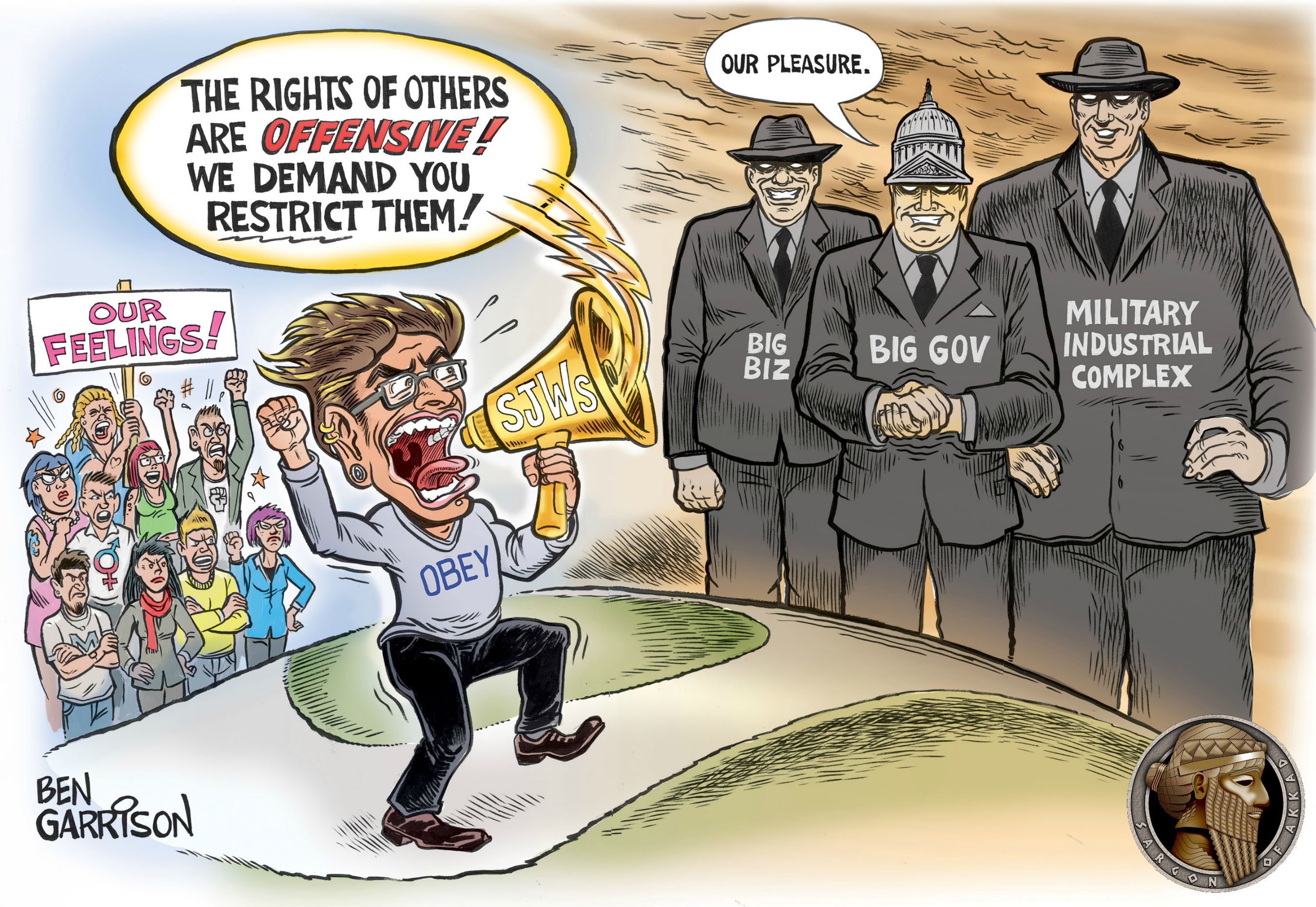
There’s a term for these students, and that term is USEFUL IDIOTS. According to Wikipedia, useful idiots are “propagandists for a cause whose goals they are not fully aware of, and who are used cynically by the leaders of the cause.” In other words, they are pawns for evil and conspiring men who use them to sieze power and control.

This is not a new thing. In the Cold War, the KGB devoted the vast majority of its resources not to espionage, but to subversion. In this manner, they infiltrated, destabilized, and ultimately siezed control of several third-world countries. The primary target of their subversion efforts was always the United States and her allies. Defectors such as Yuri Bezmenov repeatedly warned us of this threat.

We can see the subversion process in action through the development of Left-wing movements like modern feminism. If you can spare an hour and a half, I highly recommend that you watch this video where Youtuber Sargon of Akkad interviews Erin Pizzey, the founder of the women’s shelter movement. What began as a movement to genuinely help victims of domestic abuse was blatantly co-opted by Marxist elements and folded into the modern feminist movement as a front for raising money. Even though men are also victims of domestic abuse, there are almost no shelters for men because this would threaten the taxpayer gravy train that has been siphoned off by the feminists for years. And the scariest part? That the radical feminists ultimately won. Our modern society has been reshaped by them in so many negative ways that it’s hard for us in this generation to see the forest for the trees.

But as scary as third-wave Marxist Feminism can be, it’s not them that I’m afraid of. They are, after all, little more than useful idiots. What frightens me are the evil and conspiring men (and women) behind them.

Are the old Soviet subversion programs still active and in operation? Probably not. The modern FSB is a shadow of its former KGB self, as the numerous Russian intelligence failures in Ukraine have shown. For all its aggressive bluster, Putin’s Russia is weak.

Still, it’s worth pointing out that the Soviet Union was never completely dismantled. When we conquered Nazi Germany, we held the Nuremberg Trials to root out Nazism and exterminate it. We did no such thing in Russia. Many of the former Soviet elites are still in Russian government today, foremost among them Vladimir Putin himself. The institutions of the communist state were reorganized, their personnel shuffled around, but they were never completely abolished.

That said, I don’t think it’s the Russians who are directly pulling the strings. I think it’s far more likely that their socialist allies and sympathizers in the West (men such as Bernie Sanders, though I suspect he’s just another useful idiot) took over the subversion programs once the Soviet Union fell, and have been using them for their own ends ever since.

This is why I am so deeply opposed to “social justice.” It is such a vague and nebulous thing that anyone who calls for it cannot help but become a useful idiot. The one thing that all social justice warriors have in common is the belief that a more powerful government is necessary to fix all problems. Naturally, this plays straight into the hands of those evil and conspiring men.

Social justice has become something of a buzzword in recent years. It defined the 2015 Hugo Awards, which was a localized but still significant battle in the ongoing Culture Wars. That was how I was first introduced to SJWs and their repulsive identity politics.

But again, it’s not the SJWs that frighten me. They are perhaps the most useful of idiots, but they are still just useful idiots like the others. It’s the movers and the shakers behind the scenes that frighten me—the evil and conspiring men who see them as a means to accomplish their own ends.

And the thing that terrifies me most of all is that the target of these evil and conspiring men is the Republic itself, or in other words, the rights and liberties enshrined in the Constitution. When those are swept away, the Republic will be truly dead. And my greatest fear is that the day is fast approaching when the Constitution will hang by a thread, with precious few to uphold it.

I can prepare myself for an economic collapse. I’ve lived through one before. I can build my food storage, learn how to be more self-sufficient, take measures to defend myself, and prepare contingency plans in case of SHTF. I can insulate myself and the people I love from most disasters.

But what can I do if the Republic is overthrown?

Goodbye KBoards, or how I was banned for the sake of social justice.

In 2011, I joined an online message board forum called Kindle Boards (later KBoards) where other self-publishers had joined to give each other support, share what works, and otherwise band together as a community. Back then, self-publishing was considered the kiss of death, and many of my former writer “friends” shunned me for starting down that dark path. Having a community where people could assure you that you weren’t crazy was really a big help.

Yesterday, I was permanently banned from KBoards. But from the way it went down, I doubt that I’m going to miss the place, because it is a very different community now from the one that I joined in 2011.

The brewhaha started when a new member posted a thread to announce a book promotion site that she had just started. These types of sites offer advertising opportunities to authors and curated book recommendations to readers. There are dozens of these sites across the internet, and they are an important part of the indie book world.

On the thread, someone noted that the OP’s promo site did not accept erotica or LGBT books, according to the submission guidelines. Immediately, people began to pile up on the OP, demanding an explanation and accusing her of being unfair. The pile-up had all the signs of a social justice mob:

  • Unsubstantiated accusations that get taken at face value and added to a laundry list of perceived wrongs.
  • The formation of a narrative that ties in with a much wider set of perceived injustices, making the accused guilty by association.
  • Calls for “justice” that make a peaceful and mutually amicable reconciliation impossible.

I’ve seen it happen many times, as I’m sure you have too. If the accused tries to make amends, it only makes the social justice warriors howl even louder. The only thing that can satisfy them is the complete ruination of their enemy—and sometimes, even that is not enough.

As a side note, I would like to point out that I have nothing wrong with people who write LGBT books. Should these books be allowed to be published? Absolutely! The book world is a richer place because of them. I have nothing against people writing them, reading them, publishing them, or promoting them. People should be free to write whatever they want, so long as it does not cause criminal harm (such as doxxing or child porn).

But that’s not what this social justice mob was about. They had taken one line from the submission guidelines (which has since been removed) about not accepting LGBT books, and twisted it in every possible way to skewer the OP. For example, people took it to mean that books of any genre with LGBT characters would not be accepted, when original intent was pretty clear that genre LGBT would not be accepted. There is a difference. They then went on to say that LGBT is “not a category” (though according to Amazon, it most certainly is), and to accuse the OP of all sorts of other things.

When I saw this social justice mob forming, I decided to step in and stop it by deflecting some of the attention onto myself. The idea was to tank their attacks, rile them up just enough for the moderators to take notice, and leave it to them to stop the bullying.

Until this point, my opinion of the moderators at KBoards was pretty good. Even though I’d been on the receiving end of the “cattle prod” a couple of times, I’d always felt that they were more or less fair—or at least that they gave fair reasons for everything that they did. On the KBoards forums, the mods are generally praised as one of the main reasons why the place is so friendly and welcoming.

Part one of my plan worked out perfectly. I poked the SJWs just enough for them to show their true colors, and the thread was predictably locked. The OP and some other KBoards members sent me private messages thanking me for standing up to the bullies. When the mods re-opened the thread, however, all of my posts were gone, but the pile-up that had started the mob from forming was still in place. And predictably, the bullying began again in earnest.

I was disappointed in the mod’s decision, and stated as much, but tried to exercise restraint since there wasn’t much else I could do. Then someone openly accused the OP of being “discriminatory” because their site didn’t promote LGBT books. In response, I started a new thread:

Can we please stop calling promo sites “discriminatory”?

On another thread announcing a new promo site, a bunch of writers are piling up on the OP for stating in their guidelines that they do not promote LGBT books. Rather than derail that thread even further, I figured it would be better to start a new thread to say my piece about it.

It really galls me when anyone accuses a promo group of being “discriminatory” because it doesn’t promote their particular kind of book. By turning their rejection into a social justice issue, it flies in the face of the obvious: that readers aren’t morally obligated to like every kind of book equally, and that promo sites have to pick and choose which books they promote according to (among other things) the tastes of their readers.

Look, I have no problems with people writing, reading, publishing, or promoting LGBT books. If you’re an LGBT author who writes LGBT books, rock on and more power to you. But as a reader, I probably wouldn’t subscribe to a newsletter that promoted them—not because I hate gays, but because it’s just not the sort of thing that I read. Does that make me evil and discriminatory? Am I having “wrongfun”? Should I be forced to read a book that I don’t want to read? No? Then why say all that of promo sites that don’t carry those kinds of books?

My BS test for this sort of thing is to replace the allegedly oppressed minority group with Mormon Texas Czech (I defy you to find a smaller minority group!). If a promo site rejected, say, religious historical fiction, would I get all huffy and accuse them of discriminating against my Moravian Mormon heritage because they rejected my novel about a 1920s Czech immigrant who ran away to Utah and started a kolache shop? No—I’d shrug and figure my book probably wouldn’t do all that well at that site anyway, since their readership obviously isn’t into that sort of thing, and look for a promosite that would be willing to carry my book. And if that site doesn’t exist, I would create it!

Behind these knee-jerk accusations of discriminatory behavior is an implicit call for a new regime of gatekeepers to ensure that the “right” books—the ones that promote the accuser’s particular brand of social justice—are entitled to premium placement. But the fact is that no one is entitled to anything in this business, nor should they be. Besides, we tore down the gates years ago.

I knew that the thread would ruffle some feathers, but I did not predict the response—though in retrospect, it wasn’t surprising at all. Instead of trying to engage with my ideas, the SJWs reported the thread to the mods, who promptly locked it. Only two responses got through, both of which came within spitting distance of Godwin’s Law (“What if a promo site refused to accept books with Jews in them? Huh? HUH?”).

A lot of people were upset that the thread got locked. It accumulated more than 400 views before it dropped off the front page, and I got several PMs saying “I totally agree, these people have gone too far,” and “I was in the middle of my response when the mods locked this thread,” etc.

When I got back to my computer, I posted on the first thread, where I basically said “I find it telling that instead of engaging with me, you got the mods to lock my thread. Since when did disagreement become tantamount to hate speech?” In response, I got the following PM from the moderators:

Joe,

even before the blow up in the My Book Cave thread, you had been pushing the boundaries in your posts here and many had to be edited or removed.

In the My Book Cave thread, it was the tone of your posts that was the problem.  I advised you via PM that people who appreciated the restrictions posed by My Book Cave were welcome to post their support in a civil manner.  You have refused to do that, instead choosing to make more than one inflammatory post or thread.  I refer you again to  my most recent PM.

Accordingly, you are placed on post moderation.  I note that this at least your third significant moderation action.  As you indicate in your most recent post, now deleted, perhaps you need to think about whether KBoards is the place for you.  Hopefully this period of post approval will give you that opportunity to think about it.

Betsy
KB Moderator

In response, I wrote the following:

The question is not whether Kboards is the place for me, but whether KBoards has become the sort of place where people can be bullied in the name of social justice. In the last couple of days, I have received multiple PMs thanking me for taking a stand against these bullies, which tells me that this problem is much larger than just me. The fact that your response is to put me on post moderation tells me everything that I need to know: that disagreement truly is seen as hate speech in this community. I won’t be the only one who leaves KBoards because of this.

The final message that I received from the moderators was this:

Joe,

Please tell me where I equated disagreement with hate speech?  In the My Book Cave thread, to the best of our ability, we have removed and continue to remove posts on both sides that attacked other members or the OP in the thread and left those that stated their reason for not using the service or asked more questions about it.

I refer you again to my prior PM.  You, and others, are more than welcome to state your support for My Book Cave in a civil manner.  Instead, you have attacked your fellow members for stating their reasons for not wanting to use the service and for asking questions to clarify the restrictions.  There were also questions about the erotica restriction and the restrictions on language.  These are reasonable questions.  It would also be reasonable for a member to state (as you did, in one bit of your locked thread), that you would appreciate a site that had restrictions.  Posts that stated a different point of view in a civil manner without attacking your fellow members would have remained and have been protected.

You chose not to do that, but to instead start yet another thread that attacked your fellow members.  While we were discussing that thread (which had not been permanently locked at that time–we were still in discussion), you chose to make yet another post continuing the same discussion in the original MBC thread.

Refusal to accept moderation is a bannable offense.  You have been previously banned and placed on post moderation and tonight have refused to accept post moderation.  Immediately after posting this, I will ban your account.  KBoards is clearly not the right forum for you.

I wish you the best in your future endeavors.

Betsy
KB Moderator

There are a number of things that I found disingenuous about this exchange.

First, I never attacked anybody. I never singled anyone out. I never engaged in personal insults, though personal insults (now deleted) were directed at me. And while I was aggressive in the way that I engaged, I also endeavored to be as intellectually honest as possible. I cannot say the same of those I disagreed with.

Second, it’s pretty clear that the mods were not treating me with the same benefit of the doubt as the bullies. SJWs have a way of rewriting history, and that’s exactly what they were doing by claiming to ask “questions to clarify the restrictions.” There were no attempts to clarify the promo site’s submission guidelines: as soon as one person suggested that any book with an LGBT character would be rejected, everyone assumed that it was true.

Third, it seems quite clear that the mods were waiting for an excuse to ban me. They locked down my thread within minutes of posting it, based solely on reports from people who disagreed with it. With the phrase “perhaps you need to think about whether KBoards is the place for you,” they issued a veiled threat which they followed through on within minutes. Their claim that they hoped “this period of post approval” would help me turn around was duplicitous on its face. So was the question “Please tell me where I equated disagreement with hate speech?” because my account was locked and my IP was banned, making it impossible for me to respond.

Looking back on what I could have done differently, I suppose I could have toned down my rhetoric a bit, or refrained from engaging. But at what point does silence become complicity? If I had let the social justice mob run its course, and the OP had been attacked outside of the boards, would I have done the right thing? When it became clear that the mods were going to let the bullying continue, what was I supposed to do?

Honestly, I feel like I came out of that exchange with my integrity intact. If that means I got banned, so be it.

And to be frankly honest, if KBoards is the kind of place where social justice warriors can dominate the discussion and drive out anyone who disagrees with them, then I really don’t feel bad about getting banned. There is a war going on in our culture today, and I would rather pick a side than be complicit through my silence.