Fantasy from A to Z: E is for Epic

What is the ideal length of a fantasy novel? Of a fantasy series?

Fantasy, as a genre, is known for being big. Big stakes, big emotions, big battles—and big books. It isn’t unusual for a single fantasy novel to run well over 200,000 words. Authors like Brandon Sanderson regularly turn in doorstoppers, with Words of Radiance clocking in at over 400,000 words, longer than the entire Lord of the Rings trilogy combined. And of course, there’s J.R.R. Tolkien himself, whose influence looms large over the genre. The Lord of the Rings helped establish the idea that a fantasy story needs room to breathe—and to expand.

Series length is no different. Some of the most beloved and influential fantasy series are also some of the longest. Steven Erikson’s Malazan Book of the Fallen spans ten main volumes and several more side novels. Robert Jordan’s Wheel of Time ran for fourteen massive books (fifteen, if you count the prequel). These stories require commitment, but for many readers, that’s part of the appeal. Once they find a world they love, they want to spend as much time there as possible.

But not all fantasy needs to be long.

Robert E. Howard, one of the foundational voices in the genre, wrote mostly short stories. His Conan tales, often published in pulp magazines like Weird Tales, rarely ran longer than a few thousand words. Yet they endure. David G. Hartwell, in “The Making of the American Fantasy Genre,” points out that Howard and Tolkien were arguably the two most successful fantasy authors of the twentieth century. Before The Lord of the Rings took off in the 1970s, most fantasy readers thought of the short story as the natural format for the genre. That pulp tradition carried strong into the mid-century, where fantasy shared shelf space with science fiction in magazines and anthologies.

That clearly isn’t the case anymore. In today’s market, a 90,000-word fantasy novel is often considered short. Readers are more than happy to put up with a bit of filler or extra padding if it means they get to linger in the world a little longer. And to be fair, there is something immersive about a book that takes its time. When done well, it can feel less like reading a story and more like living inside another world.

That said, I still believe in the value of economy of words. Economy of words doesn’t mean writing short—it means writing lean. It means using only as many words as the story needs. Louis L’Amour is a great example of this. His prose is tight, clear, and evocative. Most of his novels are quick reads, but they pack a punch. He could sketch a character in half a page and make you care about them. That’s not to say all of his books were short—The Walking Drum is a long and sprawling novel—but even there, his style is efficient. Every scene does something. Every word earns its place.

So why does epic fantasy run so long? Does it always have to be padded with extra filler? Not when it’s done well. One of the defining features of epic fantasy is that the world itself becomes a character. Tolkien mastered this. Middle-earth isn’t just a setting; it has a history, a culture, and an arc. The long travelogues, the deep lore, the songs and genealogies—they help build a sense of depth that makes the final conflict in The Return of the King resonate on a mythic level. You’re not just watching Frodo destroy a ring; you’re watching the curtain fall on an entire age.

And when the world has that kind of weight—when it grows, transforms, and carries the burden of history—it’s no surprise that a single book often isn’t enough. That’s one of the reasons epic fantasy so often stretches into multi-volume series. If the world is a character, it needs space for its own arc to unfold. A hero might only need three acts to complete their journey, but a world? That can take a bit longer.

Still, there’s more than one way to structure a series. Take Louis L’Amour again. He wrote mostly short standalone novels, but many of them followed the same families—like the Sacketts or the Chantrys—so that readers who wanted more could get it. You didn’t have to read them in order. You could pick up whichever one you found first and still get a complete story. That’s a far cry from most modern fantasy series, where the series itself is a single, complete work that must be read in order. After all, try starting The Wheel of Time at book five or A Song of Ice and Fire at book three, and you’ll be utterly lost.

My copy of The Lord of the Rings is a single-volume edition, the way Tolkien originally intended it. The main reason it was split into multiple books was to save on printing costs (Tolkien himself split the book into six parts, but the publisher turned it into a trilogy). Frankly, I think it works better that way. When a series beings to sprawl, the middle books often sag, and readers can definitely feel that. Just look at Crossroads of Twilight (Book 10 of The Wheel of Time) and how much the fans hate that book. I also remember when A Dance with Dragons first came out, with a 2.9-star average on Amazon that held for several years. (That rating has since improved, but I suspect that a large part of it is due to review farming by the publisher.)

Another risk inherent in writing a long, sprawling series is that the author will never finish it. George R.R. Martin is the most infamous example here—fans have been waiting for The Winds of Winter for over a decade, with no firm release date in sight. Patrick Rothfuss has faced similar criticism, with readers growing increasingly frustrated over the long delay between The Wise Man’s Fear and the long-promised third book in the Kingkiller Chronicle. And Orson Scott Card has yet to finish his Alvin Maker series. Seventh Son was published when I was just four years old, and though I enjoyed the first two books in that series, I refuse to read the rest of it until Card finishes the damned series.

I’m not alone. Many readers, burned one too many times, now refuse to even begin a new fantasy series until it’s complete. I can’t blame readers for feeling this way, but it does create a real challenge for new and midlist authors trying to break into the genre. Without the benefit of an established readership, it’s hard to convince readers to invest in book one of a planned trilogy or longer series. And if readers don’t start the first book, the rest may never see publication.

Right now, I’m writing an epic fantasy series based loosely on the life of King David. According to my outline, it’s a seven book series, but I’ve decided instead to split it into two trilogies (each with a complete arc) and a bridge novel (kind of like what Frank Herbert intended for the Dune books, though he died before he could finish the final book of the second trilogy). My plan is to wait until the first trilogy is totally written, publish the first three books within a month of each other, and promote that trilogy while I write the bridge novel and sequel trilogy.

In the meantime, I’ve been having a blast writing short fantasy novels in the Sea Mage Cycle, in-between drafts of my larger books. With The Sea Mage Cycle, I’m following a series structure that’s much closer to what Louis L’Amour did with his Chantry and Sackett books. Each book is a standalone, and the books can be read in any order, but they all tie together with recurring characters/families. As with all epic fantasy, the world itself is something of a character, but each book is more like a single thread in the tapestry of that wider story.

Not every epic needs to be long. Not every story benefits from being part of a massive, sprawling series. But when done well—when every word pulls its weight, when the world itself becomes a living character, when the structure supports the arc instead of smothering it—epic fantasy becomes something truly special.

It becomes epic, in every sense of the word.
“It was too short.”

This, by far, is the number one criticism I seem to get in my negative book reviews. I never quite know what to think of it. On the one hand, a reader wouldn’t say something like that unless they thought it was good, since if they hated the book completely they would say something like “it was blessedly short” (and yes, I have gotten reviews like that). On the other hand, some of them really get worked up about it, to the point where I doubt they’ll ever read anything I write ever again.

Just to be clear, I’m not opposed to negative reviews, and I’m not responding to any of my reviews in particular. As a matter of principle, I believe that reviews are for readers and not for writers. I don’t generally respond to reader reviews except in very rare cases, and never to tell the reviewer that they’re wrong.

With that out of the way, what does “too short” actually mean? I can’t speak for all readers, but for me, when a book is too short it usually means that something in the story itself felt unsatisfying. In other words, something felt undeveloped, or rushed, or cut short without ever coming to a conclusion (or, in the case of cliffhangers, at least to a natural stopping point). In other words, “too short” isn’t a function of words or of pages, but of the story itself.

I’ve read short books that felt like they fit their length perfectly. A Short Stay in Hell comes immediately to mind. That book is a thin novella, barely more than a hundred pages in print, and yet it comes together so masterfully that I honestly don’t know what else could be added to make it longer. I would love to have more time to explore that particular world, but as it is, the story comes together perfectly within its own length.

That said, there are other books that I felt were too short even though they did fit their own length. That Leviathan Whom Thou Hast Made is an example of an award-winning book–clearly well written, clearly well constructed–that left me unsatisfied because it felt too short. Here, though, it was less a problem with the story itself and more just that I wanted more time to explore the alien culture of the swales. I would love to read a full-length novel set in the same universe, if for nothing else than for the fascinating world-building.

This makes me wonder: are there certain forms of fiction that tend to get more ire from readers just because of the constraints of the form? Do some readers hate novelettes just because they’re novelettes, or serials just because they’re serials? Judging from my own reviews, that seems to be the case. Even if I wrote the best novelette in the world, they would hate it because it’s not a novel.

So what am I supposed to do when readers tell me that my books are too short? Should I set a minimum word count and not publish anything unless it goes over that word count? I really don’t think so, because that sounds a lot like padding. Instead, the only solution that I can see is to focus on telling the best story and to not even worry about the length until it’s finished (and even then, only to know whether to label it a novel or a novella).

In the case of series, sometimes it can be difficult to tell whether to bring a certain thread to a conclusion or to leave it unresolved as part of the overall series arc. Certainly, each individual story needs to have an arc of its own, even if it ends on a cliffhanger. I’m still learning as I go, especially when it comes to writing series. But it’s certainly a lot of fun for me, and I hope it’s fun for you too as a reader.

In short, there’s not much I can do other than keep telling stories as best as I know how, and learn what I can from each story in order to tell better ones in the future. If “too short” means that something was unsatisfying, I’ll do my best to learn from it. But I’m not going to pad my novellas into novels just to hit a certain page count. The story itself should determine its own length.

Thoughts on sequels and the Desolation of Smaug

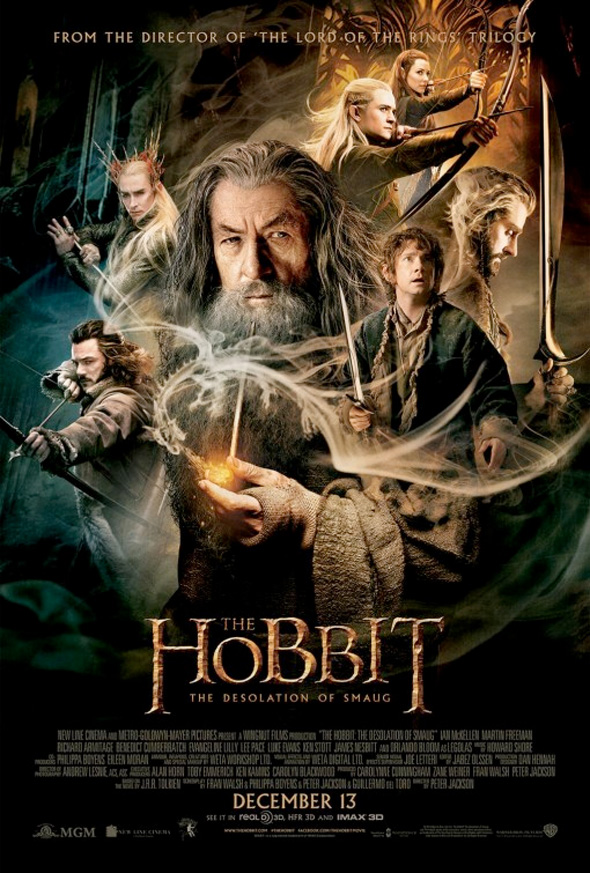
hobbit2-finalposter-fullSo last week I saw the new Hobbit movie, The Desolation of Smaug, and I really, really liked it … right up to the ending.  Why?

BECAUSE IT RESOLVED NOTHING!!!

Okay, sorry for the spoiler (though you probably should have guessed there would be spoilers in a post like this).  There’s going to be more in this post, so if you haven’t seen the movie yet, read on at your own risk.

Overall, I thought the movie was pretty good.  The action was fun, the fantasy elements were very well executed, and Benedict Cumberbatch was excellent as the voice of Smaug.  My only real hangups (beside the ending) are relatively minor, such as the impossible physics of Thorin’s luge run down the river of molten metal, or the fact that all of the gold ever mined in the history of the Earth would not fill a tenth of the stockpile in Erebor (seriously, all of the world’s gold would only fill a cube about 20 meters to a side … so maybe half of that big statue they melted at the end?).  Oh, and I thought the politics of Laketown were simplified to the point of caricature.  That was actually a fairly big issue for me, though I suspect the third movie will either make it or break it.

But all of those are dwarfed (no pun intended … okay, maybe a little) by the movie’s biggest flaw, which is that IT HAS NO RESOLUTION.

Seriously, none of the half-dozen subplots resolve in any meaningful way.  The one that comes closest is that love affair between the elf woman and the dwarf, since I guess she kind of saves him from his orc wound.  But he doesn’t even regain consciousness, which means that they aren’t even really reunited by the end.  And as for the other storylines … well, Smaug is still alive and about to burn Laketown, Gandalf is a prisoner of Sauron, Bard is a prisoner of that fat guy who wasn’t ever in the book and the dwarves still haven’t taken Erebor.

I understand that the middle installment in a series can’t resolve everything, but I still think it should resolve something.  Take The Empire Strikes Back, for example.  It ends on something of a cliffhanger, but there’s still enough of a resolution that it stands very well on its own.  Han Solo is frozen in carbonite, but Leia, Chewie, and the droids have escaped to safety.  Luke hasn’t defeated Vader, but he has learned something that completely changes the relationship between them both.  The Rebel Alliance hasn’t won yet, but they have gotten away from Hoth without being completely decimated by the Empire.

The Empire Strikes Back is not just part I of The Return of the Jedi–it stands on its own as a complete story.  It bridges A New Hope and Jedi by showing the tragic failure of Luke Skywalker to defeat Vader, rescue his friends, and become a Jedi.  By the end of the movie, he’s a very different person than he was at the beginning.  Could the same be said of Thorin, Bilbo, and the Desolation of Smaug?  Not really.

I suppose I have to be a bit cautious here, since there are those who would say that I’m guilty of this myself.  I’ll freely admit that I’ve written a few cliffhanger endings, most recently in some of the Star Wanderers stories.  However, I always try to resolve something, so that each book can stand at least partly on its own.

In Fidelity, for example, Jeremiah and Noemi haven’t found a home yet, but they do have one to work toward.  It starts with their arrival at Oriana Station and it ends with their departure–everything that they need to do there has been done.  In Sacrifice, the language barrier, cultural misunderstandings, and Jeremiah’s own personal shortcomings converge until he’s more or less forced to leave Noemi, at least temporarily.  It’s not a feel-good ending, but it is a resolution of sorts.  And in Reproach, Mariya comes to the horrifying realization that she’s destroyed everything that she was hoping to build.

I guess the key to bridging a series in such a way that the sequels stand on their own is to keep the individual conflicts and subplots distinct, especially the internal and external ones.  For example, I thought that The Unexpected Journey had a much better ending, not because the overall plot was resolved, but because Bilbo had transformed from a homebody to an adventurer.  The internal conflict had a satisfying resolution, and the growth arc had more or less come full swing.  The Desolation of Smaug could have done that with Thorin, and in some ways it seemed to be trying, but by the end it just fell short.

So am I going to see the third movie?  Well, yeah, so from a Hollywood perspective, I suppose the movie was a success.  But I’m not as excited for it as I was for Return of the Jedi.  And the lesson I’m taking from this is that cliffhangers are good, but you’ve got to deliver at least some satisfaction–you’ve got to resolve something.  Otherwise, people are going to feel cheated.

Novella woes and farmers markets

Today I wrote about 2.6 words in my current WIP (Sons of the Starfarers), which didn’t really feel like it because I was constantly getting distracted.  Still, 2.6 words is pretty solid–it’s about mid-range for me.  If I can hit that every day from here on out (which is doubtful, but hey), the rough draft should be finished before the end of the month.

The crazy thing is that I just hit the inciting incident at the end of today’s writing session, after passing the 6k word mark.  For a mid-sized novella, that’s pretty late.  In the classic three act structure, the inciting incident usually hits between the 12%-15% mark, but this one is well past 20% for a 30k word novella–and just barely at 16% for a 40k.

So in layman’s terms, how long is this book going to be?  Probably longer than any of the Star Wanderers stories, but not quite as long as Genesis Earth.  It probably won’t turn into a full-fledged novel, since there’s only one viewpoint character, but I can already tell that it’s going to flirt with the line between novella and novel.

We’ll see how it turns out.  I’m still really excited about this story, and even though I don’t have a clear idea how to write the ending, I do know exactly how it’s going to end, if that makes any sense.  I’ve got a clear idea of the series arc that this book is going to set up, but I don’t yet have a clear idea of the book’s self-contained arc.  Once I figure that out, maybe I’ll be able to trim it down to a 30k novella after all.

============================================================

I visited the Stadium Farmer’s Market in Provo for the first time today.  It was pretty neat–lots of great produce, a nice community atmosphere, and a few quirky things like Jalapeno Jelly and tie died baby jumpers that you can’t really find in a mainstream grocery store.  I came away with some excellent peaches and a hankering to come back next week for more.

Anyhow, the trip got me thinking how indie publishing is kind of like a farmer’s market.  You’ve got everything from the guys who sell their produce out of unmarked paint buckets (writers who toss their books up to amazon with hardly a thought) to the local farm operations with pretty banners, pretty baskets, and laminated fact sheets drilling down on every possible difference between Elberta and Briscoe peaches (writers who go to great lengths to organize their own small presses and become Facebook/Twitter/Blogging personalities).

Almost everyone gives away free samples, which actually does a lot to drive sales.  In a similar way, most indie writers either have a couple of perma-free titles or free-pulse their books.  Everyone at the farmer’s market tries to be friendly and reach out to the customers (kind of like authors on Facebook and Twitter), but for me personally this kind of drives me away.  A good entertaining sales pitch, though, can be quite interesting.  I listened to the guy selling honey for almost twenty minutes, going on and on about his wares.  It’s clear he’s in a business that he loves.

Even though the fruit in the farmer’s market tends to have more blemishes than the stuff you find in the mainstream store, it is WAAAY more fresh and delicious.  Similarly, the stuff from the mainstream presses might be a lot more edited and polished, but the true innovation and formula-breaking stuff is happening in the world of self-publishing.  Publishers want things to be more predictable and formulaic so that they can have a better idea how something is going to sell, but indies are free to try almost anything.

Those aren’t the only parallels, either.  The more I think about it, the more it seems that being a self-published indie writer (or “author-publisher,” a newer term that I think I actually prefer) is a lot like being a local small farmer.  I’m sure there are differences, but the similarities are quite striking.

And now I’m really wishing I’d bought some of that honey.