Is Star Wanderers for You?

Star Wanderers is a character-driven frontier space opera and science fiction adventure about loneliness, love, and the search for home on the far edges of human civilization. It delivers a quiet, emotional adventure centered on wandering starship pilots and fragile outworld communities—less about conquering the stars and more about what it costs to keep moving when you don’t know where you belong.

What Kind of Reader Will Love Star Wanderers?

If you love…

  • frontier space opera with a lone-trader or wandering starship feel
  • character-driven science fiction focused on relationships, marriage, and family under pressure
  • stories where faith, conscience, and moral choice shape the action
  • found family science fiction set against danger, exile, and cultural collision
  • quieter, thoughtful adventures that balance tension with hope

…then Star Wanderers is probably your kind of story.

What You’ll Find Inside

Star Wanderers follows Jeremiah, an independent starship pilot drifting from port to port, whose life changes when he rescues a young woman from a dying frontier station and becomes entangled with her people, her faith, and her future. As pirates, famine, and outworld politics close in, the story explores loneliness, commitment, belief, and the cost of choosing to belong. The pacing blends reflective, intimate moments with sharp spikes of danger, resulting in a hopeful but hard-earned journey.

What Makes Star Wanderers Different

Rather than focusing on galaxy-spanning wars or elite soldiers, Star Wanderers centers on ordinary people trying to do the right thing in an unforgiving frontier. Romance, marriage, and faith aren’t side plots—they’re core engines of the story, shaping every major decision. The book treats technology and heroism pragmatically, favoring ingenuity, sacrifice, and cooperation over brute force or spectacle.

What You Won’t Find

This is not grimdark science fiction, nor is it nonstop military action. You won’t find cynical nihilism, endless explosions, or characters who survive purely on luck. Instead, the tension grows from moral choices, relationships under strain, and the consequences of standing your ground when running would be easier.

Why I Think You Might Love Star Wanderers

I put more of myself into Star Wanderers than almost anything else I’ve written. I began the story as a single young writer wrestling with loneliness and finished it while married and preparing for parenthood, and that journey shaped its heart. If you’re drawn to science fiction that treats love, faith, and responsibility as real forces—capable of both wounding and saving—I think this story will resonate with you.

Where to Get the Book

Related Posts and Pages

Explore the series index for the Outworld Trilogy.

Return to the book page for Star Wanderers.

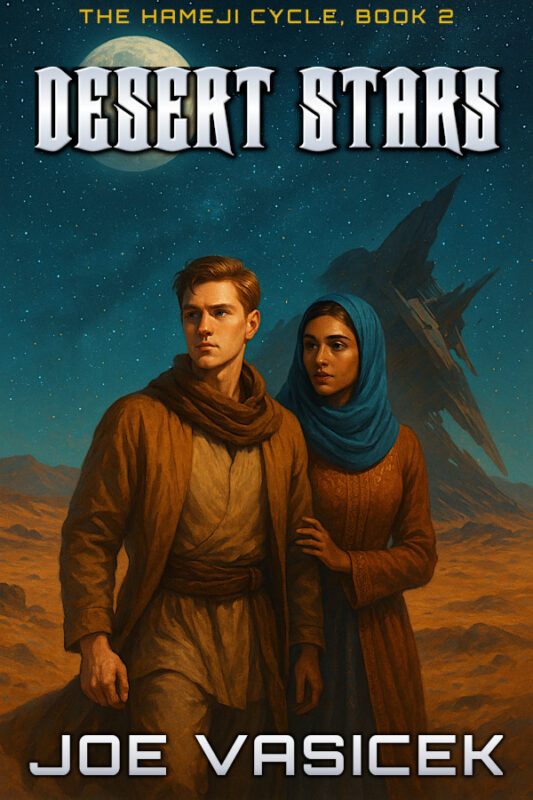
The Search for Home and Belonging in Desert Stars

At its heart, Desert Stars is a character-driven science fiction novel about the search for home in a universe defined by exile, migration, and loss under the shadow of war. The story asks a deceptively simple question: what makes a place—or a people—feel like home? Through pilgrimage, love, and loss, this character-driven space opera with religious themes explores how home is not something we recover from the past, but something we choose to build in the present.

Rather than treating home as a destination waiting to be found, Desert Stars presents belonging as a moral commitment—formed through responsibility, shared suffering, and the decision to stay when leaving would be easier.

Where the Idea Came From

The theme of home and belonging in Desert Stars grew out of a period of personal and spiritual transition in my own life. After returning home from full-time missionary service, I found myself re-entering a world that felt strangely unfamiliar, even though it was technically “home.” At the same time, I was studying Arabic and living in the Middle East, immersed in desert cultures shaped by pilgrimage, hospitality, exile, and sacred memory.

The spark for the novel came when the phrase “Temple of a Thousand Suns” entered my mind—an image of a holy place dedicated both to humanity’s future among the stars and to the memory of a lost Earth. That image opened a door to a deeper question: what happens to faith, identity, and belonging when sacred places are lost—not as a rejection of belief, but as a test of where meaning truly lives.

How the Search for Home and Belonging Shapes Desert Stars

Jalil’s journey is driven by displacement on multiple levels. Adopted into a desert tribe yet visibly marked as an outsider, he grows up knowing he does not fully belong—but also knowing that the desert is the only home he has ever known. His pilgrimage to the Temple of a Thousand Suns begins as a search for origins and answers, but it slowly becomes something deeper: a reckoning with the limits of bloodline, history, and inherited identity.

As the story unfolds, Jalil learns that finding his biological family does not resolve his longing. What brings peace is not reclaiming a lost past, but fulfilling his moral obligation to seek the truth—and then freely choosing where to stand afterward, even when no option offers safety or certainty. By the end of the novel, home is no longer a matter of citizenship or ancestry, but of responsibility, love, and the willingness to build something new in the aftermath of destruction.

Mira’s arc mirrors this theme from a different angle. Cast out from her community and forced into exile, she confronts the terrifying freedom of having no place to return to. Her growth lies in choosing agency over shame and hope over resentment, refusing to wait for restoration and instead claiming the right to shape her own future on her own terms. Together, Jalil and Mira embody the novel’s central claim: home is not found by going backward, but by committing forward—even when the future is uncertain and the cost is real.

What the Search for Home and Belonging Says About Us

At a human level, Desert Stars speaks to a universal anxiety: the fear that we don’t truly belong anywhere, or that the places we love might disappear. In a world marked by migration, war, cultural fracture, and rapid change—both real and imagined—many of us carry the quiet question of whether “home” is something that can ever be secure.

The novel suggests that belonging is not guaranteed by geography or heritage, but by moral choice. Home is created when people choose to care for one another, to stay when leaving would be easier, and to build meaning even when sacred structures fall. In that sense, Desert Stars is ultimately a hopeful book—one that insists home is still possible, even at the end of an age.

Why This Theme Matters to Me

I wrote Desert Stars while wrestling with my own questions about faith, identity, and belonging. I was stepping out of a highly structured, purpose-driven environment into a world where no one could tell me what came next, and where I had to decide for myself what kind of life—and what kind of home—I wanted to build. Writing this story became a way to explore that uncertainty honestly, without cynicism.

The idea that home is something we choose, protect, and build together—rather than something we simply inherit—still shapes the way I think about family, faith, and hope. It’s the conviction at the heart of this book, and one I continue to return to in my writing. Desert Stars is written for readers who love thoughtful, character-driven science fiction that treats faith, love, and moral responsibility seriously, even when the universe itself is coming apart.

Where to Get the Book

Related Posts and Pages

Explore the series index for The Hameji Cycle.

Return to the book page for Desert Stars.