Racism is trendy again

“People of color” is an inherently racist phrase.

There. I said it. I may get into trouble for saying it, but that doesn’t make it any less true.

Before we unpack the phrase “people of color,” let’s first define our terms. This is where the heart of the controversy lies.

According to the Merriam-Webster Dictionary, racism means:

: poor treatment of or violence against people because of their race

According to the Oxford English Dictionary, racism means:

Prejudice, discrimination, or antagonism directed against someone of a different race based on the belief that one’s own race is superior.

I refer to the Merriam-Webster Dictionary and the Oxford English Dictionary specifically because they are the two highest authorities in the English language. In the interest of impartiality, I’ll include the Wiktionary definition as well, which anyone can edit:

Prejudice or discrimination based upon race.

Seems pretty clear, right? Racism is discrimination based on race.

That is, unless you’re a progressive. To them, the only people who can ever be racist are whites, because racism is systematic and the systems of oppression benefit whites at the expense of non-whites. This is called “white privilege,” and the fact that most of us cannot see it is further proof that it is true.

(Pay no attention to the fact that a black man became President of the United States—effectively the most powerful man on Earth—in the face of these “systems of oppression.” How do the progressives justify this? I have no frickin’ idea. The mental gymnastics it must take… but I digress.)

Because the system is racist, and all non-white people are oppressed, according to progressive “logic” non-whites cannot be racist. This effectively gives them a free pass to discriminate in almost any way, shape, or form against people who are white.

This is where the term “people of color” comes in. It’s simply a more polite way of saying “non-white.” Don’t believe me? Check out the Wikipedia article. It’s right there in the first sentence:

Person of color (plural: people of color, persons of color, sometimes abbreviated POC) is a term used primarily in the United States to describe any person who is not white.

In other words, it is a term that was invented to discriminate against whites. What do African-Americans, Punjabs, Japanese, Mayans, and Australian Aborigines racially have in common? Nothing at all—except that they’re all non-white, and therefore fall under the catch-all term “people of color.”

I despise the progressive redefinition of racism as much as I despise the term “reverse racism.” There is no such thing as reverse racism, because racism doesn’t have a damned direction! When ANYONE discriminates against another person based on ANY race, whether black, white, yellow, red, green, or purple, it is racism pure and simple.

Lately, I’ve seen the phrase “people of color” come up in the submissions guidelines of a number of short story markets. Usually, it will be something along the lines of a call of submissions for a special issue, though it sometimes appears in their diversity statements as well. To me, it always raises a red flag.

When all of the major markets are regulary running “people of color” special issues, with diversity statements calling for more submissions from “people of color,” then we’ve achieved a system that is racist to the core. If it weren’t for indie publishing and the Sad Puppies, I would be very wary of this trend. And if things change in the indie world to really put the squeeze on writers (subscription services, exclusivity agreements, royalty cuts, etc), I would be very concerned.

Make no mistake about it: “people of color” is a racist term. It’s also quite trendy, but that doesn’t make it any less racist.

I’ll leave you with this hilariously topical video from Sargon of Akkad:
Response to Steve Davidson on Reconciling with the Puppies

So my last blog post about the Sad Puppies has turned into a kerfluffle of its own, which has been very interesting to watch as it unfolds. Mike Glyer of File 770 linked to it, Lou Antonelli’s File 666 picked it up, and Steve Davidson of Amazing Stories wrote a lengthy response to it, which I think is deserving of a response on my part.

Mr. Davidson’s post is interesting, and worth reading. We obviously don’t see eye to eye on a number of things, but it would be rather petty to go through our disagreements line by line. Instead, the part that I want to respond to is his call to action at the end:

Want to reconcile?  Here’s what puppies must do.

1: Stop scamming the system.  If you want to recommend works that you think are worthy of the award, go ahead and do so.  But drop the political agenda (you’re dragons are imaginary) and eliminate the hateful, snarky commentary

If you’re looking for “hateful, snarky commentary,” I’m sure that you’ll be able to find it. On the fringes of both sides, there are a lot of people with blogs and strong opinions. I’d count myself as one of them—while I align with the Sad Puppies, I’m not a leader or organizer by any stretch, just another guy with opinions and a blog. Don’t be so quick to look for ammunition, because there’s a lot of it lying around.

Kate Paulk, one of the Sad Puppy organizers, has pointed out that Sad Puppies 4 is open to nomination suggestions from anyone, which appears to be what you’re calling for. And honestly, I think a lot of us don’t want to see conservative writers edge out everyone else so much as to see them go head to head with more liberal writers on a more equal playing field. It’s not about slaying imaginary dragons so much as breaking down walls.

So on this first point, Mr. Davidson and I tend to be in agreement. This seems like a reasonable step for reconciliation, and it’s one that the Sad Puppies 4 already appear to be taking.

2: Stop attacking the very people who are offering you a bridge

If a bridge is being offered, I’m willing to take it. If people are just trying to get the last word in edgewise, which was the vibe I personally got from Mr. Martin’s original post, then it will probably just lead to more kerfluffles. Then again, if everyone’s fighting to get in the last word, the squabbling will never end, and while that may make for good sport, it makes for poor reconciliation. So again, fair point.

3: Please learn a little bit about the history of Worldcon and the Hugo Awards

I’m not entirely convinced that the Hugo Awards will continue to hold the same influential place in fandom in the next few years. Even with last year’s massive turnout, there were less than 6,000 ballots cast. With those low numbers, it wouldn’t take much for a rival convention to organize their own awards and eclipse the Hugos in short order—especially if a large contingent of fandom becomes disaffected.

This is why I think it’s important to distinguish between the Sad Puppies and the Rabid Puppies. A useful analogy can be drawn from Star Control II: The Ur-Quan Masters:



These are the Ur-Quan Kzer-Za. They want to make the galaxy safe by enslaving all intelligent life, either by encasing their home worlds in impenetrable slave shields, or by enlisting them as Heirarchy battle thralls to conquer and enslave other species.

These are the Ur-Quan Kohr-Ah. They want to make the galaxy safe by “cleansing,” or exterminating, all intelligent life. They are totally without mercy and cannot be pacified.

The Kzer-Za and Kohr-Ah are locked in a civil war over control of the Sa-Matra, an ancient precursor weapon that will enable the victor to conquer the galaxy. If you don’t find a way to stop them in time, then the Kohr-Ah will win the civil war and use the Sa-Matra to exterminate everyone.

The Sad Puppies are like the Kzer-Za, the Rabid Puppies are like the Kohr-Ah, and the Hugo Awards are like the Sa-Matra. The Rabid Puppies want to use the Hugo Awards to burn down the fan community, whereas the Sad Puppies want to reform the Hugo Awards to make Science Fiction less about political correctness and more about telling good stories.

Now, I am not a Sad Puppy spokesperson, so this may not be the most accurate or flattering analogy. Fellow puppies, please correct me if I’m wrong. But it’s worth pointing out that in the Star Control series, the Ur-Quan ultimately become pacified and join the New Alliance of Free Stars. This only happens after the Kohr-Ah have been defeated.

I think that’s what most of the Sad Puppies ultimately want: to have a place with the rest of fandom, where even if we sometimes have heated disagreements (has there ever been a time when all of fandom was in agreement about anything?), we aren’t cast out as “racists,” “Nazis,” or “misogynists,” as happened with Puppygate 2015.

The Rabid Puppies, on the other hand, just want to watch the world burn. And the more vociferous the rhetoric becomes, the more that it plays into their hands. Speaking as a Sad Puppy sympathizer who watched the 2015 Hugos from the sidelines, after all the abuse that I saw my friends receive, it kind of made me want to burn down the Hugos too.

You want to defeat the Rabids? Then reach out to the Sad Puppies, find commonalities with us, and make an alliance. If we can show the world that Science Fiction and Fantasy brings us all together in spite of our ideological differences, then all of fandom will win.

And so regarding Mr. Davidson’s third point, I don’t think it’s about respecting the prestige of the awards so much as listening to and understanding the other side of fandom. And I’ll admit, I can do a better job listening to the side of fandom that sees the puppies (sad or rabid) as the enemy. If they can return the favor, I think that will go a long way.

4: If you want to be counted as Fans, then be Fans.  Fans who care attend Worldcon, nominate their conscience and attend the business meeting to effect change they think is needed.  They work WITH and within fandom – they do not set themselves up as a cabal that engages in fear and hate.

If that’s a challenge to be more involved in the Hugo Awards, then it’s one that I can accept. In 2015, I largely watched from the sidelines, and if I do the same this year then my opinion is pretty empty. I do count myself as a part of fandom, and I can respect the call to put my money where my mouth is.

I’m not entirely convinced that “no one controls [the Hugos].” Overtly, of course not, but there are indirect ways to accomplish the same thing, through whisper campaigns and the manipulation of cliques. But as Mr. Davidson points out, it’s hypocritical to criticize that without also trying to get involved. And if that’s the invitation he’s extending, I am willing to accept—no hate required.

George R.R. Martin and Christmas Puppies

Sad-Puppies-4So it’s not yet 2016, and the first salvos in the Sad Puppies 4 campaign have already been fired, in the form of a kerfluffle over on George R.R. Martin’s blog.

For those of you who haven’t been following Sad Puppies, I can’t say I blame you. It’s basically an ongoing civil war within Science Fiction & Fantasy fandom, between those who believe that the genre should serve the cause of social justice, and those who believe that there should be room for writers on all sides of the political spectrum—that it should just be about telling good stories. Last year, the Sad Puppies (the ones who believe it should only be about the stories) swept the nominations for the Hugo Awards, the (onetime) most prestigious awards in the SF&F genre. The resulting brouhaha was not pretty.

Last year, George R.R. Martin was very aggressive in attacking the puppies. That’s what makes his latest puppy-related blog post so interesting. In it, he basically calls for an end to “puppygate” and for everyone to just get along. In his own words:

The last thing I want… the last thing anyone who truly loves science fiction, fantasy, and fandom would want… would be to have to go through the whole thing again in 2016. Whatever your view of how the Hugo Awards turned out at Sasquan, I think we can all agree that we would like MidAmericon II’s awards to be more joyful, less rancorous, less controversial.

Now, I don’t disagree with Mr. Martin’s sentiment. I too would like to see reconciliation and de-escalation of the ugliness that we saw from both sides in 2015. And to be fair, Mr. Martin does give a positive characterization of what’s going on right now with Sad Puppies 4. That’s a good first step.

The trouble is, you don’t achieve reconciliation by shouting at the other side to lay down their guns first. You achieve it by hearing and acknowledging their grievances. You might not agree that those grievances need to be rectified, which is fine—that’s what negotiations are for—but you do have to make an effort to listen to the other side. And it’s clear enough that Mr. Martin is not listening.

The core of the Sad Puppies movement is a rejection of elitism. In contrast, Mr. Martin’s position is that there are fans and there are Fans. Fans like him, for whom every aspect of their lives revolves around Science Fiction and Fantasy, should have more control, more respect, more ownership—in fine, they should matter more to the genre than the other kind of fans. When pressed, of course, he denies that any part of fandom is any better than the others, but that’s not what comes through in his other positions. “Separate but equal” is the phrase that comes to mind.

The problem here is that Mr. Martin wants to have his cake and eat it too. He wants the Sad Puppies to lay down their guns, but he doesn’t want to lay down his own. If he were genuine about burying the hatchet, he would acknowledge his own elitism, acknowledge that this is a grievance that the Puppies hold against him, and either recant his position or say “we’re going to have to agree to disagree.”

Personally, my position is the opposite of Mr. Martin’s. I think that SF&F should be a big tent that privileges or denies no one—that everyone who calls themselves a fan of the genre should be on equal grounds. After what happened in 2015, I’m as disgusted with the Hugo Awards as Feynman was disgusted with honors and epaulettes:

Am I willing to agree to disagree on that point? Sure, so long as I’m not cut out of the table—so long as I’m not branded a “racist,” or a “misogynist,” or a “neo-nazi” for aligning with the Sad Puppies. But the puppy-kickers and their SJW allies have deliberately mischaracterized us since the beginning, and I have no doubt that they will continue to do so in 2016.

Mr. Martin, if you’re reading this and if you’re genuine in your desire to avoid another “puppygate,” please don’t try to passive-aggressively handwave us away. I applaud your sentiment and believe that your heart is in the right place, but reconciliation requires genuinely listening to the people you disagree with.

Disagreement is not offensive

Is it just me, or is there an increasing tendency in today’s world to misconstrue anything and everything as “offensive”? This is especially true of the campus protesters, who take offense in everything from Halloween costumes to the name “Lynch.” But the most disturbing trend is when they find someone “offensive” simply because they had the gall to disagree:

When I saw this exchange between a professor at Yale and one of his students, I was frankly shocked at the intellectual laziness and moral dishonesty of the student. “It is not about creating an intellectual space here!” …seriously? You attend one of the most prestigious universities in the Western world and you don’t think it’s supposed to be “an intellectual space”? What did you expect to do here, weave baskets all day?

But notice that the part where she really flies off the hook is when the professor says “I don’t agree with that.” That’s telling. It shows that the student has no interest in engaging with the professor’s point of view, just in shutting him up. It’s as if she knows that her ideas can’t stand on their own, and need to be enforced by bullying.

Well, it appears that the bullying tactics have worked, because the professor’s wife has stepped down from her teaching position at Yale. The thing that started this whole mess was an email she wrote defending students’ rights to wear Halloween costumes that other students found—you guessed it—”offensive.”

Oh, and that racist Halloween party that launched the Yale student protests? It never happened, natch.

I could go into greater detail, but this is just one example of disagreement being conflated for offensiveness. I’m sure that you could cite others. But it’s not the crybully tactics that shock me, or the ideological blindness: it’s the sheer fragility of the intellectual framework on which the “offended” party’s argument is based.

Seriously, almost anytime anyone gets offended because someone else disagrees with them, their position is so flimsy that a high school dropout could poke holes in it. That’s certainly the case with the Yale student shown above. It’s just like the story of the emperor’s new clothes, where everyone can see that the emperor is naked except for the emperor himself.

In fact, that’s a perfect analogy, because all this talk of “safe spaces” and “right to be offended” is nothing less than an attempt to shelter these students from reality—just like the emperor was sheltered from the reality that his new “clothes” were an absolute farce. And seriously, how is it not farcical for a student to shout “it is NOT about creating an intellectual space!” at one of the world’s most prestigious universities?

This is on my mind right now for a couple of reasons: first, because of an online interaction I had recently with one of these overly-sensitive types, and second, because of an interesting post over on Mad Genius Club. This part of the post was particularly relevant:

I’m a very minor pro, and my tips are probably worth precisely what you pay for them. But here is mine: Pro tip for writers. Learn to put yourself in the shoes, thoughts and headspace of people totally unlike you. Learn to write from their perspective. […] If you can’t do this, you may have one or two good books in you – but essentially you’re writing one character, yourself, and those who are very like you. Unless that’s exceptionally appealing… people get a bit sick of it.

Even if you detest those other people who see the world differently, and wish nothing but ill on them, and plan to destroy them… you’ll write it a lot better understanding what they do and feel and why they think or act as they do.

If you take offense whenever people disagree with you, chances are that you’ll never be able to cut it as a writer. In order to write well, you have to be able to see things from inside the heads of people who aren’t like you and probably don’t agree with you.

This is why I support Sad Puppies: because the SJW types in Science Fiction are usually the first to cry offense over anything that doesn’t fit into their narrow worldviews. This naturally makes them as vehemently opposed to intellectual diversity as they (falsely) claim that the Puppies are to racial, sexual, and cultural diversity. When you look at the books and stories that these people uphold as shining examples of the genre, their rigidly ideological worldview is as plain as the emperor’s new clothes.

Disagreement is not “offensive.” In fact, it’s a sign of respect. If your opponent thought that your opinion or argument wasn’t worth engaging with, then they simply would have ignored you. By saying “I don’t agree,” they are acknowledging your position in an intellectually honest way. When you willfully misrepresent your opponent’s views, or bully them into silence, it is a sign of disrespect that warrants taking offense. And who is most guilty of that? I’ll give you two chances, and the first one doesn’t count.

SSF-V: Captives in Obscurity 2.0 is complete!

Yesterday I finished the second draft of Captives in Obscurity (Sons of the Starfarers: Book V). I’m extremely pleased with how it turned out, and I think you guys are really going to enjoy it!

Unfortunately, writing the book is only the first step. Publishing is going to take resources that I don’t currently have, so it’s going to be a few months before I can get it out. Right now, it looks like Captives in Obscurity will go up for pre-order sometime in April/May, for a release date in July.

In the meantime, I plan to start working on Book VI: Patriots in Retreat right away, in order to release it soon after. With luck, there should be three Sons of the Starfarers books published next year, with only two left to complete the series.

I’ve got so many awesome ideas for stuff to fit into the next few books. Captives in Obscurity and Patriots in Retreat fall squarely into the midpoint of the series, where the characters hit rock bottom right before the plot twist. In other words, this is where I really get to twist the knife, and if you’ve read my other books you know that that’s the part I like best!

So yeah, it’s going to be a while before these books come out, but they are really going to be awesome when they do. In the meantime, I’ve got some short stories coming off of submission in the next couple of months, including a Sad Puppies inspired piece that I want to have up before the Hugos are in the news again. So even if it takes some time for Captives in Obscurity to get out there, I’m definitely not going away!

Sad Puppies 3: A Play in Three Parts

PART THE FIRST

Sad Puppies: Wouldn’t it be great if the Hugo Awards weren’t about identity politics anymore? If conservatives and libertarians weren’t shut out by the blatantly liberal bias? If we didn’t care about a writer’s skin color, or their gender, or their sexual orientation, but about the quality of their stories?

Social Justice Warriors: EVIL RACIST CISGENDER SCUM! You only say that because you’re WHITE, MALE, and PRIVILEGED!

Sad Puppies: Actually—

Puppy Kickers: Haha! We beat you wrongfans last year, and we’ll beat you again this year! Sad puppies suck!

Sad Puppies: Oh yeah?

Sad Puppies sweep the 2015 Hugo nominations.

Puppy Kickers: What the hell, puppies? You violated the gentleman’s agreement that has governed the Hugos since time immemorial!

Sad Puppies: Of course we did! Your “gentleman’s agreement” was elitist and wrong.

Puppy Kickers: Oh yeah? THIS MEANS WAR!

PART THE SECOND

Flashback to before the nominations. Enter Vox Day.

Vox Day: Fear and tremble, denizens of fandom! I will wreak vengeance on my enemies and destroy the Hugo Awards for all time! BWAHAHAHAHA!

Social Justice Warriors: Vox Day is EVIL! THIS MEANS WAR!!

Sad Puppies: No, don’t destroy the Hugos, Vox! There’s still a chance they can be saved.

Vox: Hmm, very well. But I shall not march in lock-step with you.

Vox Day organizes the Rabid Puppies slate. Return to present.

Puppy Kickers: Look, the Sad Puppies slate is almost identical to the Rabid Puppies slate! The Sad Puppies are really just followers of Vox Day!

Sad PuppiesThat’s not true. We were actually the ones to convince him to—

Social Justice Warriors: RACISTS! NAZIS! MISOGYNISTS! RACISTS! NAZIS! MISOGYNISTS!

Sad Puppies: Actually, if you look at our slate, you’ll see that—

Puppy Kickers: RACISTS! NAZIS! MISOGYNISTS! RACISTS! NAZIS! MISOGYNISTS!

Rabid Puppies: It’s no use to try to reason with these people. Sinistra delenda est!

PART THE THIRD

Puppy Kickers: Slate voting is EVIL! We must defeat the puppies at all costs to prove that vote rigging has no place in the Hugo Awards!

Social Justice Warriors: Here is a voting guide for how to make the puppies lose.

Sad Puppies: You hypocrites! How is that not rigging the vote?

Puppy Kickers: Haha, we don’t care! We’ll vote the way the SJWs tell us to, and brag about how we haven’t read any of the books on your crummy slate.

Sad Puppies: But—but there are a lot of good people here that are overdue for recognition! Toni Weiskopff, Kevin J. Anderson, Jim Butcher… and there are a lot of great new authors too, like Kary English. Our slate isn’t remotely racist or sexist. We’ve got people from all across the political spectrum too, because all we really care about is telling good stories!

Social Justice Warriors: We don’t care! If we can’t have the Hugos, NO ONE CAN!

The 2015 Hugo Awards. “No award” sweeps five categories.

Social Justice Warriors: VICTORY!

Puppy Kickers: Um, yeah! What they said! Uh… guys?

Vox Day: BWAHAHAHA! You fell for my Xanatos Gambit, you pitiful mindless fools! I HAVE DESTROYED THE HUGO AWARDS!

Rabid Puppies: All hail Vox Day, slayer of worlds! Sinistra delenda est!

Sad Puppies: Wow. Just… wow.

Rabid Puppies: Join us, Sad Puppies. Yield yourselves up unto us, and unite with us and become acquainted with our secret works. Sinistra delenda est!

Social Justice Warriors: Next year, we should give Anita Sarkeesian a Hugo!

I AM A REAL PERSON

To whomever it may concern,

On June 8th, I wrote an email to Tor.com withdrawing one of my stories in response to the highly unprofessional and inflammatory comments made by Irene Gallo about the Hugo awards controversy. In the past week, it appears that many other writers and readers have contacted both Tor.com and Tor Books to express similar disconent. It also appears that some of the senior members of your organization are attempting to dismiss these responses as manufactured outrage propagated by bots, and not by real people.

I would like to make it clear to anyone at Tor.com and Tor Books that I am a real person, and that the email that I sent on June 8th was not solicited by Vox Day or any other person. Ms. Gallo has since apologized “to anyone hurt by my comments,” and while I appreciate the gesture, without a retraction of her original statements, the gesture is empty. Furthermore, repeated comments from Moshe Feder, the Nielsen Haydens, and other senior members of your organization demeaning large segments of your company’s clientele lead me to believe that the problem is not with a few individuals acting in poor judgment, but with the corporate culture at Tor.

In my first email, I stated that I could not in good conscience continue to support your organization by submitting my stories for publication at Tor.com. The events of the last seven days have made me reluctant to buy Tor books as well. In the coming months, I hope that we can move past this controversy so that we can get back to reading, writing, and publishing stories that we all love, without concern for politics. However, until the corporate culture at Tor has changed to be more inclusive of readers and writers like me, I do not see how that is possible.

Sincerely yours,

Joe Vasicek

My take on the Sad Puppies

There’s been a lot of mud-slinging in the past few months regarding the Sad Puppies, and it’s increasingly difficult to navigate the SF&F side of the internet without getting caught up in it. I’ve been reluctant to weigh in publicly on Sad Puppies 3, simply because I’ve been dissapointed to find that authors whom I otherwise love and respect saying things that I find reprehensible. As Mark Twain so famously said, better to keep your mouth shut and appear stupid than to open it and remove all doubt.

That said, I think we’re fast approaching the point (if we haven’t passed it already) where neutrality and silence are just as contemptible as outright partisanship. Lines are being crossed, and people are being bullied and defamed. In such an environment, I would rather have people know where I stand than to try to pretend that nothing is happening.

For the purpose of this post, I’m going to assume that you already know the basics about what’s going on. If you don’t, I would recommend you start by reading these two posts by Brad Torgerson announcing Sad Puppies 3 and explaining why it’s necessary, Larry Correia’s explanation for why he started the whole thing, and Eric Flint’s rebuttal to them both.

The Sad Puppies controversy is a bit complicated, and my position doesn’t fall neatly into any one camp. There are people like Brad Torgersen and Eric Flint that I respect on both sides of the controversy. That said, the people that I find toxic all fall squarely into the anti-puppy camp. They are the ones who define fandom the most narrowly, and in my experience they are the ones with the most intolerant views.

My own experience with Worldcon and the Hugos is rather limited. I attended Renovation 69 in 2011 and was actually rather struck with how small and insular the convention seemed to be. Until then, I had revered the Hugo Award as the most prestigious award in the SF&F field, and when I realized that the vast majority of readers were not represented at the con, that prestige was tarnished. But my response at the time was to shrug and say “oh well.”

I don’t say this to disparage Worldcon at all, because I enjoyed myself there and would genuinely like to attend as often as I could. But the Hugos themselves lost quite a bit of their allure, and I no longer felt it so important to participate in the voting or involve myself in them.

When Sad Puppies 1 happened, I therefore stayed mostly on the sidelines. I sympathized with Larry Correia, both because I’ve met him in person and found him to be an affable fellow, and also because we share similar political and religious views. However, I didn’t really get involved.

For Sad Puppies 2, I also mostly stayed out of it. There were quite a bit more rumblings the second year, and when the anti-puppies rubbed their victory into everyone’s faces following the 2014 Hugo, I was seriously unimpressed with their behavior (especially Scalzi’s).

So when the Sad Puppies swept the Hugo nominations in 2015, I have to admit that it felt pretty gratifying. I already knew that the Hugos didn’t really represent my side of fandom, and I’d had enough experience with the anti-puppies to see through their hypocrisy and intolerance. Then the SF&F corner of the internet exploded, and things became truly popcorn-worthy.

Which brings us to where we are today. In some ways, I still feel like I don’t have a dog in this fight. I don’t have a membership to Worldcon 2015, I have no particular interest in either killing or saving the Hugo Awards, and don’t really have any aspirations to win a Hugo or any other major awards for that matter. As a self-published indie author, my readers are my greatest reward.

But in another sense, I cannot avoid having a dog in this fight. Science Fiction and Fantasy is my livelihood, and the Sad Puppies controversy affects the very core of my field. Authors whom I look up to and respect have become targets of some of the worst smear tactics, and if no one stands up against these bullies, things are only going to get worse. The lines have been drawn, the wagons have been circled, and my voice, however small, is needed in this hour.

With that out of the way, here is where I stand:

I believe that everyone who loves science fiction and fantasy has and should have a place in this genre, no matter how reprehensible I find them or how vehemently I disagree with their views.

I believe that SF&F authors flourish best when there is no single dogma, political or otherwise, that dominates the field. Those who enforce their brand of social justice through bullying and smear campaigns are anathema to everything that makes science fiction and fantasy great.

I believe that TRUE DIVERSITY in the SF&F field is good and worth working toward. TRUE DIVERSITY includes women, people of color, other ethnic minorities, and people of every gender and sexual orientation. It also includes Republicans, Conservatives, Libertarians, residents of the “flyover states,” and devout practitioners of every faith, be they Christians, Mormons, Muslims, Jews, Buddhists, Sikhs, or supplicants at the temple of Athe.

I believe that sexism that is directed against men is still sexism.

I believe that racism that is directed against whites is still racism.

I believe that it is impossible to defeat racism and sexism through racist and sexist means. Those who attempt to do so are bigots and hypocrites of the worst possible stripe.

I believe that no one is entitled to any award. True recognition is earned, not bestowed.

I believe that books should be judged solely on the merits of the story itself, and not on the merits of the author.

I believe that readers should be free to read whatever they want, and not have to answer to anyone or feel guilty for their reading choices.

I believe that the Sad Puppies have legitimate grievances, and that they have done nothing wrong or dishonorable by pushing their Hugo slate. I’m not sure if I can say the same of the Rabid Puppies, but to the extent that they’ve played by the Hugo voting rules, I can’t say that I hold that against them.

I believe that people should be judged by their own words and actions, not by what others say about them.

I do not believe in guilt by association.

I do not believe in unsubstantiated accusations of racism, sexism, homophobia, or affiliation with the National Socialist German Worker’s Party or any of its ideological offshoots. In today’s climate, those are all four-letter words as far as I’m concerned.

I do not believe that gatekeepers add anything of value by excluding people from the field.

I do not believe that fandom is an exclusive club.

I do not believe that the Hugos are representative of the entire field, nor that any single award is or should be.

I do not believe that the Sad Puppies are out destroy all that is good in science fiction and fantasy (or the Rabid Puppies, for that matter). I doubt that any single faction could accomplish that even if they wanted to.

Above all else, I respect my readers. I am grateful for them. I would not be able to do what I do without them.

I understand that many of my readers may not share my personal views. I also understand that it is possible to respect someone and still disagree with them. I hope to always be worthy of respect. But whether others choose to respect me or not, I must live in such a way that I can always respect myself.

An open letter to Tor.com in reference to Irene Gallo

To whomever it may concern,

I am writing to withdraw my short story, “The Curse of the Lifewalker” (submission id: 55c13821ebd3) from the Tor.com slushpile effective immediately. In light of the highly unprofesional recent behavior of Ms. Irene Gallo, an associate publisher of your organization, I cannot in good conscience support or be associated with Tor.com.

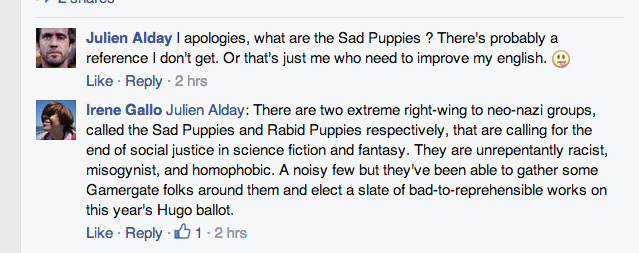
On May 11th, posting on Facebook in her official capacity, Ms. Gallo said the following of the Sad Puppies Hugo slate:

There are two extreme right-wing to neo-nazi groups, called the Sad Puppies and Rabid Puppies respectively, that are calling for the end of social justice in science fiction and fantasy. They are unrepentantly racist, misogynist, and homophobic. A noisy few but they’ve been able to gather some Gamergate folks around them and elect a slate of bad-to-reprehensible works on this year’s Hugo ballot.

Not only was her comment highly unprofessional (especially considering how many Tor authors have been nominated by the Sad Puppies), it also represents a grave insult to the honor of Mr. John C. Wright, one of the Tor authors that Ms. Gallo so flippantly dismisses as “bad-to-reprehensible.” On his blog, Mr. Wright commented:

My father in law, may he rest in peace, was a Jew serving in the US Military during World War Two in the European Theater. In fact, he won a Purple Heart medal for wounds to his hands he received while liberating a Nazi death camp. His unit was standing about idly, troopers on one side of the wall, ragged prisoners on the other, waiting for the carpenter to arrive with tools to tear down the planks, but in a fury of impatience he did it with his bare hands, like a superman. He turned down the award, thinking others whose wounds were from the enemy deserved it, not he. That is the kind of man he was, an odd mixture of towering ego and meek humility.

Irene Gallo should have been penning me polite notes of congratulation on receiving an historically unprecedented number of awards for the prestigious Hugo Award, and rejoicing that any victory for me or for Mr Anderson (who would be receiving his first ever Hugo for his life’s work producing over 50 bestsellers) would reflect well on our main publisher whom we both loyally serve, Tor Books.

Instead, Irene Gallo just said I was a member of the barbaric and racist National Socialist totalitarian political movement that my family fought, suffered, and shed blood to expunge from the earth.

In light of these recent events, I consider Ms. Gallo to be a toxic personality and therefore cannot, in good conscience, associate or do business with an organization in which she is an associate publisher. If she apologizes for her behavior or is dismissed from your organization, I will reconsider my decision. Until such time, I will no longer submit any of my stories to Tor.com.

Joe Vasicek

UPDATE

Since Ms. Gallo’s inflammatory statements went viral, she has issued an apology “to anyone hurt by my comments.” While I feel that this is a step in the right direction, without retracting her statements it amounts to little more than an apology for how other people feel—in other words, a non-apology. In my view, she should take responsibility for her statements and retract them, at which point I will accept her apology and encourage others to do the same.