Plans for Edenfall

I’m trying something a little different with Edenfall: I’m writing the first draft entirely in longhand.

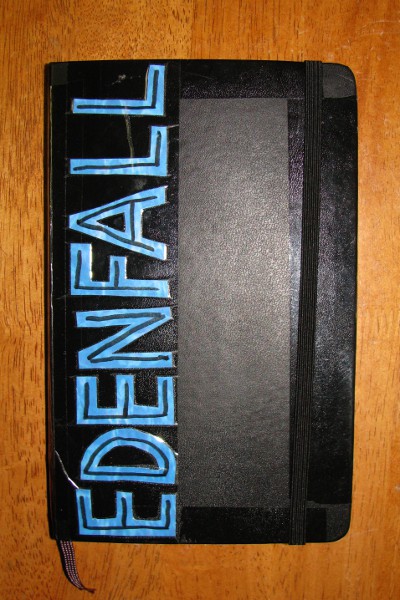
I first got the idea a couple of years ago, when I was camping in Moab.  The beautiful landscape of southern Utah made me realize that I wanted to write Edenfall while experiencing that sort of connection with nature, and pen and paper seemed to be the best format in which to do that.  This year, when I decided that I’d definitely write it, I ordered the notebook on the left and fitted it out for the project.

With every novel I write, I like to challenge myself in some new way.  In Genesis Earth, I tried out a first person POV with an unreliable narrator.  In Bringing Stella Home, I tried to write a believable female viewpoint character.  I also like to experiment with my writing process, trying out different outlining techniques and writing schedules.  Sometimes, these experiments fail spectacularly, but they also teach me a lot and keep me sharp.

The goal with this experiment is to see how divorcing myself from my computer (with all its myriad distractions) and getting out in nature changes my writing.  I live a short bike ride from the Provo River Trail, and weather permitting, that’s where I’ll probably spend most of my writing time in the next few days. Besides, I want to see how much of a difference the format makes.

Books existed long before word processors, so I have no doubt that writing a novel longhand is entirely possible.  How much of an adjustment it will be remains to be seen.  My handwriting is messy, and I can’t write as fast as I can type, but that hardly matters since rough drafts are slow going for me anyways.

In any case, it’s going to be interesting to see how it turns out.  It’s been a little slow so far, but that’s mostly because I haven’t settled into a routine yet.  By the end of this week, I hope to be fully immersed in the world of this story.

In other news, I sent off the manuscript for Sholpan to my editor, and he just got finished with his first pass, so I’m hoping to get the edits back in a couple weeks and have it epublished by mid-September.  More on that as things develop.

Also, an old friend from Brandon’s 318 class posted a favorable review of Bringing Stella Home up on Amazon.  He was one of my first readers back when the story had a lot of problems, so I’m glad he enjoyed the final version.  Thanks Stephen!  And yes, I’ve got a lot more novels forthcoming in the Gaia Nova universe, including a direct sequel to Bringing Stella Home.  Will the McCoy family save the universe from the Hameji?  Well…you’ll see. 🙂

Finally, I plan on participating in the Out of This World blog tour being organized by the SFR Brigade, which means you’ll be seeing some guest posters in the near future.  That’ll probably wrap up the Genesis Earth blog tour too, since it’s been winding down for the last month or so.  If I agreed to write a guest post for your blog and haven’t done so yet, let me know and I’ll do my best to get that out to you.  Sorry to be a bit of a flake these past few weeks; I’ll try to organize my next tour a little better.

And that just about does it for now.  I’ll be sure to keep you posted on how things go with Edenfall.  Until then, take care, and thanks for reading!
Breaking the Top 10, and a big thank you

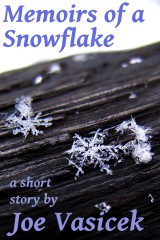
As I’m writing this, “Memoirs of a Snowflake” holds the #8 spot in the Kindle Store for the general short story category — #150 overall.  Almost 1,000 people have downloaded it since it went free over the weekend, and it’s already garnered some fantastic reviews!

All this positive attention makes me want to thank all those who have taken the time to post reviews of my work, so I thought I’d do that here.

Specifically, I’d like to thank L. Christensen for the early 5-star review of Genesis Earth, and her very favorable reviews of my other work.  Full disclosure: L. Christensen is one of my first readers; however, I did not solicit any of her reviews–she posted them on her own.  Also, I’d like to thank Katie Armstrong for the other 5-star review of Genesis Earth–I have no idea who you are (well, a vague idea maybe), but thank you!

Another reviewer who’s been very kind is EA Younker over at goodreads.  She’s posted some glowing 5-star reviews for “Memoirs of a Snowflake” and “Decision LZ1527” on that site, as well as a more critical but still encouraging 3-star review for “From the Ice Incarnate.” Thanks for taking the time to read my work!  I’m glad you enjoyed it.

Over on Smashwords, Ernest Winchester posted a nice 5-star review of “Decision LZ1527,” only a couple hours after I uploaded it.  More recently, Michelle Glorioso and Annie B posted some extremely gratifying reviews of “Memoirs of a Snowflake.” Thanks so much!

Of course, not all the reviews have been glowingly positive. “From the Ice Incarnate” has garnered some criticism from readers who feel that it was missing something, either sufficient character depth or a satisfying ending.  I appreciate the feedback; short stories aren’t my forte, so I’ll be sure to keep that in mind as I work on my short form.  Also, Genesis Earth has garnered a couple of critical yet well-reasoned reviews, most notably from the review site Science Fiction Addiction.  Once again, thanks for taking the time to respond so thoughtfully.  And thanks to all the other generally positive reviews which I haven’t mentioned specifically here.

So far, Bringing Stella Home hasn’t gotten any reviews, so if you’ve read it and enjoyed it, I would appreciate it very much if you would take the time to do that.  In the meantime, thanks for all your support!

Should authors respond to reviews?

In the last six days since it went free, “From the Ice Incarnate” has had almost 2,250 downloads, and with so much attention, reviews are starting to trickle in.  Amazon has a very elegant system, which not only allows other readers to vote on whether a review is helpful, but to comment and start a discussion.

This raises a question, however; when is it appropriate for an author to respond to a review?  I’ve seen answers that go all over the board; some readers love it, while others are adamant that writers should never respond in any way–that to do so would be consummately unprofessional.

From an indie writer’s perspective, this is especially tricky.  On the one hand, we want to engage with our readers, since that’s a crucial part of making this into a viable career (Seth Godin makes some excellent points on that subject).  On the other hand, because reviews are so subjective and judgmental, there’s a very real danger that any discussion involving the author could turn very nasty, very quickly.

Whenever anyone posts a positive review of my work, I want to thank them.  If I only respond to positive reviews, though, that could make me look like I’m ignoring the critical ones.  But if I acknowledge the critical reviews that are thoughtful and well reasoned, what do I do with the inevitable one star reviews written by someone who’s just plain crazy?

The last thing I want is to be forced into taking a reactionary position in a public discussion.  While I’m confident I can keep my ego in check and avoid outright argument, that’s not the only danger I foresee here.  Besides, I believe very firmly that the story should speak for itself, and for that reason I think it’s better for the author to be as invisible as possible.

At the same time, I really do want to thank those who take the time to post a glowing review.  Perhaps the best option is to acknowledge them here or on twitter instead of Amazon?  I’m not sure.  And sometimes, questions arise that aren’t related to the story, where responding directly to the review is the most efficient way to handle it.

In any case, I’m going to be cautious for now, at least until I find a position that makes sense.  If you have any suggestions for how I can balance these concerns, please let me know.

And for those of you who have posted kind reviews: thank you!

Why I am not afraid of the Noise part II

A recent op-ed in the Wall Street Journal titled “Cherish the Book Publishers–You’ll Miss Them When They’re Gone” has ignited a firestorm across the indie publishing community.  The post’s basic argument is that the ease of self publishing and the end of New York as the gatekeepers of quality will make it harder for readers to find the truly worthwhile literature amid the flood of crap that will inevitably overwhelm us all.

Joe Konrath fired the opening salvo; in characteristic fashion, he decried the op-ed as hogwash and blamed jealousy among traditionally published writers for the perpetuation of this myth.  He concluded that while the “tsunami of crap” is real, it is ultimately irrelevant.

His advice? “Don’t write crap.”

Michael A. Stackpole responded by examining the much more dangerous fear of authors worried about the coming flood; the fear that their own work is crap, and not worth putting out.  After examining what we mean when we call something “crap,” he concludes that the really bad stuff will sink to the bottom…

…not because of a rising tide of crap, but because they deliberately swim toward the bottom, open their mouths, and willfully suck.

And the rest of us will happily swim past the effervescent markings of their demise, moving on into the golden age.

Kris Rusch’s take on the issue was perhaps the most instructive of all.  First, she used her own experience as editor of The Magazine of Fantasy & Science Fiction to completely blow out of the water the idea that editors are arbiters of good taste.  Editors buy what they like; when they try to predict what the public will like, more often than not they fail–and when they try push their own reading tastes onto the public, they make themselves irrelevant.

She concluded that the only truly relevant “gatekeepers” are other readers–that word of mouth is still king, and because the traditional publishing system treats books “like produce, taking them off the shelf as if the book will rot after a month,” indie publishing is much better suited to help the good stuff rise to the top.

David Gaughran responded next by pointing out all the ways that indie publishing and the ebook revolution are enriching the literary world.  He concluded that the only people hurt by these changes are the middlemen–that both writers and readers only stand to benefit.

Well.  Like I said, it’s quite a firestorm.

So what’s my take? I already posted my thoughts on why the original argument is invalid–that fear of the Noise, aka the “tsunami of crap,” is a specious reason not to epublish.  However, I think that the real issue goes much deeper than that.

The most fundamental divide between those who embrace the ebook revolution and those who fight it is whether or not they trust readers to find the truly great works of literature on their own.

The obvious question, of course, is what exactly constitutes “great literature.” As a lover of genre fiction, I measure the quality of literature by the impact it has on readers; that when readers can’t stop talking about how awesome a book is, it’s a good book.  For that reason, I’ve never put much credence by Twilight bashers; paranormal romance might not be my thing, but Stephanie Meyer struck a chord in a lot of people, and that certainly counts for something.  In other words, story is King.

Putting it that way makes the argument somewhat circular.  Can we trust readers to find the good stuff on their own?  Yes, because readers read what they love.  But what about that literary piece about a depressed writer who has a sexual affair that completely changes his life?  Well, I guess it just wasn’t that good.  But they would have loved it, if not for all that genre crap flooding the system!

As for readers getting swamped, I think the system itself prevents that.

First, readers browse by means of tags, search terms, categories, top seller lists, “also bought” lists, etc.  They follow book bloggers and take recommendations from friends.  When they find a book with an attractive cover, they click on it, give the book description a cursory glance, and perhaps check a few reader reviews.  If their curiosity is still piqued, they download the free sample to their ereader.

Up to this point, no money has been spent.  Readers can download as many free samples as they want, of anything that catches their fancy.  When they finally get around to reading the sample, they can decide whether they want to buy the book.  If they do, all they need is to click a button on their ereader, and the book is theirs.

Once they finish the book, the ereader prompts them to leave a review (at least the Kindle does this–not sure about the others).  If they enjoyed it, they can give a favorable rating which helps other readers find the book.  If they don’t, they can give an unfavorable rating which warns others to stay away.

What is happening is nothing less than the democratization of literature.  Therefore, it should come as no surprise that those who trust readers will embrace the new system, while those who still cling to editors-as-gatekeepers will reject it at all costs.

But can we really trust readers?  Yes, if we believe that story is King.  If readers and writers are collaborators in the literary experience, and the truly great literature is that which has the greatest impact on its readers’ lives, then it stands to reason that readers must be the ultimate judges of quality.

Therefore, if we truly believe in the power of story, we cannot help but put our trust in the readers.  And if that’s true, why shouldn’t we rejoice in the revolution?

I sincerely believe that we are witnessing the dawn of a great golden age of literature.  The invention of the ebook is at least as revolutionary as the Gutenburg press, perhaps a great deal more.

The only ones who have anything to fear from the revolution are those who have built their livelihoods by pushing their own arbitrary tastes on others.  Frankly, that’s nothing less than cultural tyranny–and with the democratization of literature, we no longer have to put up with it.

Viva la Revalucion!

…WHUT

So this morning when I was getting ready for church, I realized that I couldn’t find my Kindle.  Anywhere.  Remembering that I’d left it at a Quark event in my apartment’s lobby, I started frantically calling people and knocking doors.  Unfortunately, no one had seen it.

A few hours later, after combing every place I could have possibly left it at least four or five times, I have to admit it’s completely lost.  I have a very good idea when and where I lost it, so the only remaining possibility is that someone picked it up.  The aggravating thing is waiting to see whether they return it, or whether they decide to run off with it.  ARRRRGH!

The amazing thing is how attached I’ve become to that device in the last month since I first got it.  I’m not a particularly voracious reader, but right up until I lost it I was carrying that thing around everywhere.  It’s so amazingly convenient–instead of lugging books around, I can read almost anything I want on a device that fits in my back pocket.  And the interconnectivity is really cool, too, although if I end up having to replace it, I’ll probably go with the more expensive 3g version, since hunting for wireless is a major pain.

But yeah…it’s lost, and I can’t currently afford to replace it.  I’m saving up for Worldcon 2011, so finances are tight; I’ll probably have to work this temp job through most of August just to be able to go.

However, all is not lost.  Yesterday, Genesis Earth got a stunning review on a book blogger / fellow indie writer’s blog.  My favorite part:

This is space opera of the highest caliber.  There are grand, sweeping ideas, the discovery of a new world, first contact with an alien species, an examination of the nature of humanity, the nature of the human mind.  Yet it’s always a personal story.  No matter how epic the backdrop, you are always reading about engaging, fully-realized characters.

It certainly qualifies as an adventure story, and keeps you wondering what will happen next.  Yet it’s also much more.  Genesis Earth will broaden your mind even as it delights your inner ten-year-old.  It has a kick-ass premise, executed with enviable skill, full of thought-provoking ideas couched in a thoroughly-entertaining story that’s just plain fun to read.

I kid you not, I stood up and did a little dance when I read that.  Someday, I’ll probably have a wife who will secretly videotape a moment like that and embarrass me by posting it to youtube or something…hehe.  Anyhow, the whole review is awesome, so check it out!

In other news, I finally got around to publishing Genesis Earth on the Nook: you can find it here.  And I don’t know whether I mentioned this or not, but I’ve also published it to smashwords, so if you live outside the US/UK and want to avoid the nasty $2+ surcharge that Amazon tags onto its international sales, you can find it there.

As far as the epublishing goals I set at the beginning of the week, I’ve accomplished all of them except the blog tour index and the 3+ guest posts…better get on top of that.  This week, here is what I want to accomplish:

  • Publish the short stories to smashwords for $0 and get Amazon to price match (since giving them out for free will *hopefully* drive readers to my novels).
  • Figure out how how the Kindle book forums work.
  • Query artists/illustrators for Bringing Stella Home cover art.
  • Send out Genesis Earth to another 5 review sites.
  • Write another 3 guest posts for the Genesis Earth blog tour.
  • Put up the index for the blog tour.

Oh, and one more thing…FIND MY &$%! KINDLE!!!

<< sigh >>

Another publication in Leading Edge!

That’s right!  My poem “Zarmina,” dedicated to Gliese 581 g (the first exoplanet discovered in its sun’s habitable zone) is published on page 98 of issue 61 of Leading Edge!

Also included in this issue is an excellent essay by Brandon Sanderson, in which he introduces his second law of magic systems.  It’s an excellent essay, and has made me rethink how I do FTL systems, especially for the Gaia Nova universe.  I’ll have to do a post a little later on that.

Besides this landmark essay by Brandon Sanderson, this issue features stories by Dan Wells and Dave Farland, as well as an interview with Howard Tayler.  And as always, it includes a number of excellent stories and illustrations.  Check it out!

(Full disclosure, I volunteer as a slushpile reader and occasional copy editor for the magazine.  However, my work always goes through the submission process under a pen name, where only the head editor knows who I am until the decision on whether to acquire the story has been made.)

In other news, Genesis Earth is now up on Goodreads, so go check that out as well!  The nice thing about Goodreads is that you can give the book a # star rating without having to write out anything else.  If you’re so inclined, I would very much appreciate an honest review–but if you do give it a rating, please be honest.  Don’t worry; even if you give me less than five stars, I won’t hunt you down like this crazy author (hint: get some popcorn and read the comments).

So anyhow, that’s what’s been going on here.  Desert Stars is coming along slowly but surely, and I’m working on getting some cover art for Bringing Stella Home.  If you have any ideas or suggestions on the art, please let me know.  I’ll probably go through my back issues of Leading Edge to search out good sf artists.  For some reason, I’m having a hard time finding anything that clicks on deviantart.  My goal is to epublish that book by the end of July.

The blog tour rolls on

I’m writing this post from Leading Edge (the internet is down at my apartment), so I don’t have much time, but I did want to take care of a few items of housekeeping.

First, my next guest post in the Genesis Earth blog tour is up, this one at Charles Millhouse’s blog.  Charles is a fellow sf writer whom I met on the Kindleboards, and the post basically explains my writing routine since last year.  Of course, since I’ve technically been unemployed since graduation, my routine is a little wacky, but I think you’ll find the post interesting. Check it out!

Desert Stars is coming along.  I took yesterday off to finish drafting the revision notes, but I’ve still got the last three chapters to go.  It’s going to be awesome, though–I’ve got so many ideas for how to improve the story.  Many thanks to all my first readers for your feedback!  It’s been immensely helpful.

Also, I decided to take down “From the Ice Incarnate” from Amazon.  I still think it’s a good story, but I don’t want someone to buy Genesis Earth, love it, then buy the story and feel ripped off.  Also, I think I might have more luck with my short stories if I send them out to print markets instead.  I’ve submitted “Decision LZ1527” to Escape Pod; if it sells, hopefully that will drive readers to my ebooks.

And on that note, if you’ve read Genesis Earth and enjoyed it, I would like to ask you to please post a review on Amazon.  I don’t want to be one of those guys who secretly boosts his stats by coercing people to write fake reviews, but if you did enjoy the novel, I would appreciate it a ton if you would take the time and share your experience.  At this point in my career, that’s probably the thing that would help me out the most.

So anyways, that’s what’s going on here.  Hopefully, the internet will be back before the weekend.  See you around!

First review and an announcement

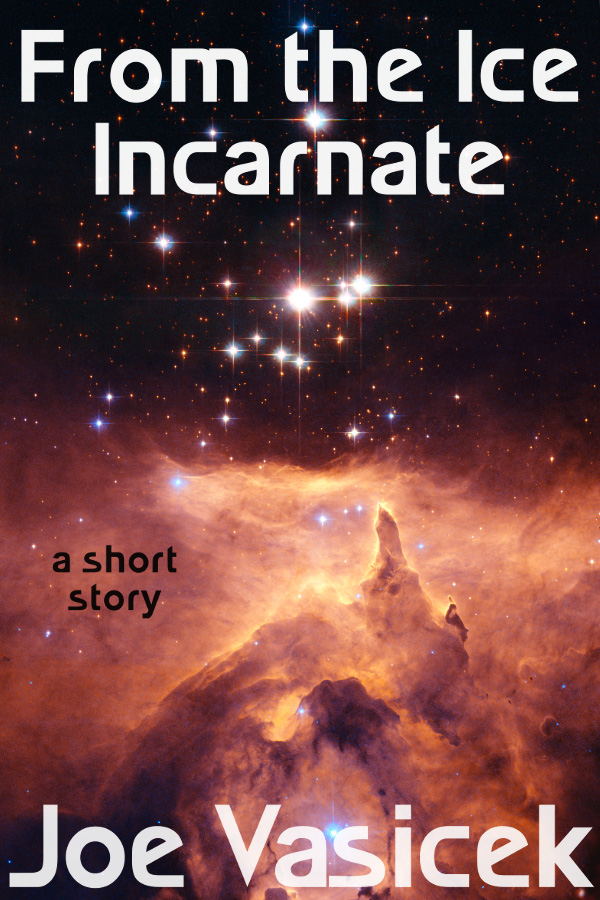
So shortly after I joined the Kindle Boards, Michelle from Red Adept Reviews contacted me for a blog interview to go along with a review she was doing for “From the Ice Incarnate.” The review and interview were posted over the weekend; you can find them here.

The review is generally positive, though I think the criticism is pretty fair; I’m much better at writing novels than writing short stories.  It was a pleasant surprise, however, to have a reviewer come to me, and to come so quickly.  I honestly wasn’t expecting that, so thanks!

“From the Ice Incarnate” is based on a scene from my novel Genesis Earth, which I will be epublishing very soon.  I just got the initial sketches from the cover artist I selected, and they look really good!  The only other holdup is my copy editor, and he should be finished by Wednesday, so hopefully the novel will be out in a week or so.

In order to spread the word, I’d like to put together a blog tour.  If you have a blog and would like me to write a guest post, that would be awesome!  Just email me with a subject to discuss, or a list of interview questions, and I’ll let you know when I can fit you in.  I’ll also post a link on this site, so my readers here can find your blog.

So anyhow, that’s what’s going on here.  I’m very excited to get Genesis Earth out, and also that my work is starting to get some attention.  Hopefully, that will continue to build; in the meantime, I’ll keep on doing what I always do: write.