Camp NaNoWriMo: Day Three

  • Words written: 1,778
  • Total stories written: 1
  • Total words written: 2,775
  • Total words remaining: 27,225
  • Total words behind: 129

Made good progress today. I’m still a bit behind where I should be, but not by very much. It’s a lot easier to write 30k words in a month than 50k words. Maybe I’ll make the full 50k nano word count my stretch goal.

Anyways, one short story down, and it’s a dark one. For that reason, I’m not too keen on it, but it was a story that needed to be written, to get it off of my chest if nothing else. The rough draft comes to about 4.1k words, but I think I can cut a solid 600 words out of it, or more, and it would probably be an improvement. But that’s going to wait until next month, at the earliest.

Also, I’m reasonably confident that this story will get me blacklisted at most of the pro-paying science fiction markets, or at least the ones that keep a blacklist. But I care less about that than the fact that most of them will flat-out reject it, on political grounds if not for the quality of the writing or the story, and I’m certain that most of them will. But whatever. I think my readers will like enough to make a splash when I self-publish it, and I care more about that at this point than about making a professional sale.

Navigating Woke SF, Part 1: Short Story Markets and Author Blacklists

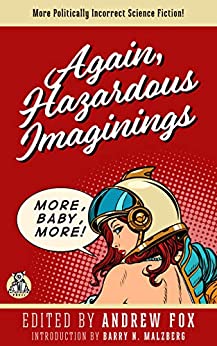
Last year, I had a short story published in the anthology Again, Hazardous Imaginings: More Politically Incorrect Science Fiction. Not only was it one of my highest paying short story sales to date, but it also made it onto the Tangent Online 2020 Recommended Reading List with a *** rating, their highest tier. Only 13 out of 293 stories on the list received that honor—and making the list at all was an accomplishment!

But a funny thing happened after the anthology came out: for a stretch of several months, I stopped receiving personalized rejections for my short story submissions, and instead got only form rejections. Normally when I write a cover letter for a short story submission, I mention the last three markets that I was published in. For example: “My stories have recently appeared in Again, Hazardous Imaginings; Twilight Tales LTUE Benefit Anthology, and Bards and Sages Quarterly (forthcoming).” In a typical month, I’ll get maybe a dozen or so form rejections and a couple of personalized rejections, depending on how many stories I have out on submission.

Back in March, I started to notice that I wasn’t getting any personalized rejections. Suspecting that my publication credit in Again, Hazardous Imaginings wasn’t helping me, I decided to change things up and only list my publication credits for stories listed in Locus Magazine’s Year In Review issue. My thinking was that all of the Hugo and Nebula eligible markets give their yearly reports in that issue, and since all of the editors want to acquire stories that are likely to win awards, a publication credit in one of those markets is more likely to get them to pay attention.

Lo and behold, I started getting personalized rejections again.

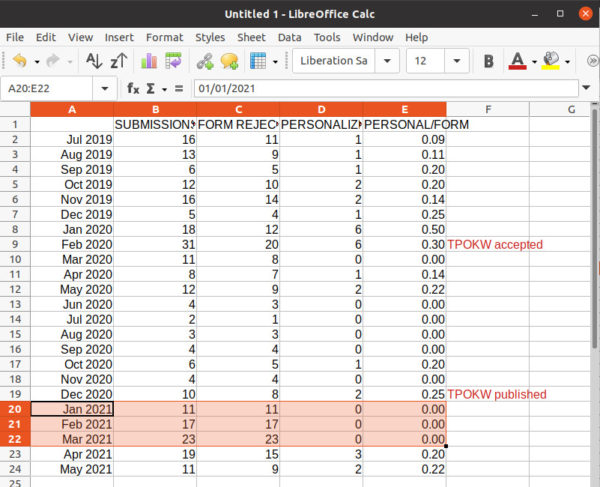
Just to make sure I wasn’t imagining things, I exported my data from The Submission Grinder and made a quick table of my submissions returned for each month going back to July 2019. Before “The Promise of King Washington” was accepted in February 2020, I was getting roughly one personalized rejection for every 5-8 form rejections. Then, for most of 2020, I went through a dry spell where I didn’t have many stories out on submission. Towards the end of the year, I got back in the saddle, and my personalized-to-form rejections ratio returned to what it had been earlier… but then Again, Hazardous Imaginings was published in December, and for the next three months, I received no personalized rejections at all. Then, around March-April, I stopped mentioning my publication credit in Again, Hazardous Imaginings… and I started getting personalized rejections again.

So what happened? Is there some sort of unofficial blacklist for stories published in Again, Hazardous Imaginings? Maybe, maybe not. I don’t know if any of the other authors in the anthology have had a similar experience, nor do I know for certain that mentioning the anthology in my publication credits caused this particular issue. It could be that I was submitting to higher paying markets at the beginning of 2021, and those markets just happen to be more stingy about personalized rejections. It could be that the pandemic has just sapped everyone’s energy.

But now that I’ve made this table, the one thing I cannot say is that the whole thing is just a figment of my imagination. There was a three-month period where I saw significantly fewer personalized rejections than usual, and it just so happened to coincide with the publication of the anthology Again, Hazardous Imaginings and my mentioning it as a publication credit in all of my cover letters.

It’s no big secret that most of the traditional short story markets in science fiction and fantasy trend somewhere between liberal and super woke. All you have to do to get a sense for this is subscribe to their podcasts or read their stories online. For most of 2020, I was subscribed to every science fiction podcast, and I frequently ended up skipping episodes because either the story was too woke, the author bio was little more than a checklist of intersectional victimhood groups, or the editor went off on some sort of political rant (typically of the “orange man bad” variety) that had little or nothing to do with the story. You can also get a good sense of the woke-ness by looking up these magazines’ submission guidelines and reading their diversity statements.

So for the last couple of months, I haven’t been listing Again, Hazardous Imaginings as a publication credit in any of my cover letters, and the response to my stories appears to have returned to the old normal… but it doesn’t sit right with me. Why should I have to hide that I was published in that anthology? Why shouldn’t I be proud of it? It did make Tangent Online’s recommended reading list with three stars, after all. Why should I waste my time submitting my stories to science fiction and fantasy markets that would see that publication credit as a black mark?

In other words, why not blacklist the blacklisters?

When an author decides not to submit their stories to a particular market, it’s often called a “self-rejection,” since the author has already decided that the story won’t be published before the editor gets a chance to consider it. But this is a little different. It’s not my own story that I’m rejecting, but the market as a whole. It’s making the conscious decision that if a magazine is too woke, I’m not going to have anything to do with it.

Here’s another way to think about it: why should I hold out for a year or longer, hoping to earn a couple of hundred bucks for it, when most of the markets that pay that well either aren’t interested in publishing the kind of politically incorrect stories that I tend to write, or aren’t going to publish an author like me who isn’t demonstrably woke enough? Even if I only end up selling it to a semi-pro market for less than fifty bucks, if it only takes a few months to make the sale because I’m not wasting time with the woke markets, does that make it worthwhile?

Or here’s yet another way to think about it: what other benefits do I get with my short story sales, besides how well it pays? If short stories are essentially advertisements for my other work, does it actually make sense to seek publication in the super woke markets, whose readers are mostly woke? Or does it make more sense to be published in the more conservative-leaning markets, with readers who are more likely to enjoy the other stuff that I write? And what about networking with similar-minded authors and editors? I made some really great connections through the anthology Again, Hazardous Imaginings, and even brought Andrew Fox, the editor, onto my newsletter for an interview. It was great!

All of this is happening as we’re starting to see an anti-woke cultural backlash gain momentum. Smarter people than me with a finger on the pulse of the culture say that the Snyder Cut is where the tide began to turn. The thing that tipped me off to it was the surprising waythat Coca-Cola walked back their critical race theory training after the “woke-a-cola” scandal. To my knowledge, there was no organized boycott, yet for a large corporation to backpedal so quickly tells me that they really took a hit to their bottom line.

In the coming months, I think we’re going to see a huge cultural shift against the woke moral panic that has gripped our nation for the last couple of years. That in itself is a subject for another post, but what it means for SF&F is that a lot of these woke awards and woke short story markets are well on their way to going broke. The few that endure will become niche markets for a very small audience that has completely divorced itself from the cultural mainstream—including the vast majority of SF&F readers.

Is it really worth hitching my wagon to such a horse? Or is it better to take a gamble on the up-and-coming markets that might not pay as much, but also aren’t carrying all the woke political baggage as magazines like Uncanny or Lightspeed?

Of course, if the answer to all of these questions is “yes, Joe—go for it!” the next big question is how to determine if a market is too woke? Because some of the markets have diversity statements that are fairly conservative-friendly, like “we welcome submissions from writers of all backgrounds!” and don’t use any of the woke value-signalling terms like “folx,” “latinx,” “QUILTBAG,” “indigenous,” “black bodies,” etc. In fact, I’m pretty sure that many of these markets only put out diversity statements to pacify the woke moral crusaders, in the same way that many boarded up stores and restaurants put up BLM signs hoping that the rioters sorry, the “peaceful protesters” would spare them.

One way to determine this is to look at which markets are chasing the wokest awards. The Hugos went woke in 2015, when “no award” swept the categories dominated by Sad Puppies nominees. That was really the moment when the fandom split, and the anti-woke readership abandoned the Hugos in disgust. The Rabid Puppies swept the 2016 nominations in what amounted to a hilarious sabotage operation (“Pounded in the Butt by Chuck Tingle’s Hugo,” hehe), but by 2017 that had all come to an end.

With that in mind, I went through all of the Hugo Awards to see which markets had either won an award or published a story that had won an award since 2015, and which markets had either been nominated or published stories that have been nominated since 2017. Here is what I found:

Hugo Winning Markets since 2015

  • Uncanny (5)
  • Lightspeed (1)

Markets with Hugo Winning Stories since 2015

  • Tor.com (5)
  • Apex (3)
  • Clarkesworld (2)
  • Lightspeed (1)
  • Uncanny (1)

Hugo Nominated Markets since 2017

  • Strange Horizons (5)
  • Beneath Ceaseless Skies (5)
  • Escape Pod (3)
  • Fireside (3)
  • FIYAH (3)
  • The Book Smugglers (2)
  • GigaNotoSaurus (1)
  • Cirsova (1)
  • Shimmer (1)
  • Podcastle (1)
  • Uncanny (1)

Markets with Hugo Nominated Stories since 2017

  • Tor.com (37)
  • Uncanny (18)
  • Clarkesworld (5)
  • Beneath Ceaseless Skies (3)
  • Fireside (2)
  • Lightspeed (2)
  • Asimov’s (1)
  • Strange Horizons (1)
  • Nightmare Magazine (1)
  • Diabolical Plots (1)

The counts for nominated markets/stories do not include the winners, but do include all of the nominations for 2021, even though the winners have not yet been decided.

I haven’t yet settled on a standard for deciding which markets are too woke for me to submit to. I suppose that’s something I’ll have to decide on a case-by-case basis, and for any who choose to follow my lead on this, it will have to be an individual decision. But I am rethinking the way I submit and publish my short stories, based on this experience. This post has already gone too long, and I still haven’t worked my new strategy out, but if you have any suggestions or ideas I’m interested to hear them.
So… what now? Where do we go from here?

For the last several months, I’ve struggled to put my thoughts together into something that I felt was appropriate for this blog. Even though I allow myself to be political here, I’m also keenly aware that I have many readers who might enjoy my books and yet disagree with my politics. I don’t want my politics to become a stumbling block or a litmus test for them, and yet, with all that’s happened since November 3rd (and indeed, is still happening), it’s been very difficult to figure out how to put those thoughts into words.

First there was the election. I expected voting irregularities, but not on such an incredible scale. Then, the Great National Gaslighting, which has been ongoing ever since. To be fair, there was also a great deal of conspiratorial nonsense spewed out by the Qanon folks on the Right, which only served to obfuscate and confuse the issue (for that reason, I tend to believe that Qanon was a psyop from the beginning).

And then, the mostly peaceful protest* at the Capitol changed everything.

I was disappointed by the storming of the Capitol, but not surprised. Disappointed, because tactically, it was the stupidest possible thing that the folks on Team Red could have done. It accomplished nothing of lasting political value, completely sabotaged the lawful and legitimate efforts to question the legitimacy of the election, and gave Team Blue all the ammunition they needed to close the Overton window on the election irregularities, weaponize the surveillance state against their political enemies, and bring the War on Terror to American shores.

I wasn’t surprised, though. From November 3rd to January 6th, the news cycle was filled with the sort of stuff that color revolutions are made of. The mostly peaceful protest* at the Capitol fit the script perfectly—almost too perfectly. Anyone who keeps an ear to conservative media could have told you that the MAGA folks weren’t going to simply bend the knee—not with all of the voting irregularities and other shenanigans.

(*And I use the phrase “mostly peaceful protest” deliberately—not to excuse the storming of the Capitol in any way, but to point out the hypocrisy and Orwellian doublethink of those who unironically used that phrase to describe the George Floyd riots over the summer, and who now call the riot at the Capitol “sedition” and “insurrection” perpetrated by “domestic terrorists.” 1984 was supposed to be a warning, not an instruction manual!)

And then, Big Tech cynically took advantage of the moment to crush Parler, silencing and deplatforming the conservatives who had migrated their from Twitter. “If you don’t like what we’re doing, build your own platform,” they said. So we did, and then… this.

You know, I’m actually not all that concerned about Joe Biden taking the White House and the Democrats controlling the House and Senate for at least the next two years. Am I happy with that arrangement? No, of course not—but on a certain level, the hyperbolic rhetoric on both the Right and on the Left is all just part of the same grift. Politics is what got us into this mess—it’s not what’s going to get us out of it.

But the crap that Big Tech is currently pulling? That stuff genuinely scares me, not the least because my livelihood depends on it. Without Amazon, there would be no indie publishing right now. So for AWS to take down Parler on woke ideological grounds, while flagrantly violating contract law and antitrust—and now, for the chief of that department to replace Jeff Bezos himself—yeah, that doesn’t bode well for authors like me.

I do have some hope for remedy in the courts, but not much. If we do get recourse through the law, it will take years or even decades to get it, and an ugly, uphill battle against corrupt, partisan judges in every level of the judicial system. Ultimately, I think the only thing that will take down Big Tech will be a majority of Americans simply refusing to use their services, deleting their social media accounts and getting smart about their personal data. But I don’t have much hope for that, either.

So what can we expect in the short to medium term? Where do we go from here?

First, if the storming of the Capitol genuinely surprised you, buckle up. When people feel that they have no recourse through peaceful, democratic means—that no one on the other side is listening to them, even as their way of life is being systematically destroyed—they turn to violence. But where the Left sees political violence as a dial that they can gradually turn up, the Right sees political violence as a switch that gets turned on. A lot of people on the Right are now thinking about flipping that switch.

It will start with a series of high-profile political assassinations. I do not condone or encourage this in any way, but I expect that many prominent Democrats will not survive the year. If the violence continues to escalate, we will see more unrest and chaos, ultimately culminating in either a mutiny of the nation’s armed forces, or the return of Donald Trump to the White House. Possibly both.

The “sanctuary state” phenomenon will expand dramatically as red state governors challenge the unconstitutional dictates of the Biden administration. To put it bluntly, red state America is going to become ungovernable. There will also be calls for secession, at first just to extract certain political concessions, but depending on how things go it could become a serious movement.

The migration from blue cities and states to red parts of the country will accelerate dramatically, and may turn violent. States like New York and California are trapped in a death spiral, where rising taxes are causing the rich to flee, which causes the politicians to raise taxes even more. The pandemic has made this much worse. I don’t think New York City is going to survive the coronapocalypse, and will go the way of New Orleans or possibly even Detroit. This will have interesting implications for the traditional side of the publishing industry, which is New York centric to a fault.

At some point in the next two years, I think the other shoe of the economic collapse is finally going to drop, and all of the cans we’ve been kicking since 2008 are going to hit the end of the road. In response, I expect the Biden (or at that point, probably the Harris) administration to make a hamfisted attempt at turning our Economic Impact Payments into some sort of permanent UBI, but it will either be too little, or it will lead to the sort of runaway hyperinflation that I wrote about in my short story “Payday.”

Ultimately, I see only three ways that all of this insanity ends:

1) A peaceful (if messy) divorce. Red states go their way, blue states go theirs, and the Great American Experiment comes to an end with a minimum of bloodshed. I consider this the least likely outcome, and not a very desireable one.

2) A civil war or revolution of some kind. We may already be in the opening phases of this, where the starting factions vie for position before the shooting begins in earnest. We may be reaching the end of the opening phase right now.

3) Everyday Americans from across the political divide join together to reconcile their differences and oppose the social and cultural forces driving us apart. I want to believe that this is the most likely outcome, but it requires that people leave their echo chambers and genuinely listen to those they see as the enemy, and I don’t think that’s going to happen unless something changes dramatically with Big Tech. It wasn’t just politics that got us into this mess: social media played a role in it, too.

What does all of this mean for our family and my writing? I’m trying to work that out right now. Even in a worst case scenario, I think that where we live here in Utah is a good place to weather the coming storm. And in a best case scenario, I would like to be a part of the reconciliation that brings this country back together. But in the meantime, I expect that I’m going to have to find alternative platforms to publish and sell my books, because the ban lists are coming, and it wouldn’t surprise me to learn that I’m already on one of those lists.

In the long term, though, I’m grimly optimistic that things will work out. I’m not quite sure how they will work out, but I know that the forces driving this chaos will ultimately be undone by their own pathologies. The important thing is to find the strength to get through this moment without falling into any of those pathologies yourself. Even with all of this talk of violence and civil war, I have hope that the Great American Experiment is more resilient than anyone gives it credit, and great faith in the goodness of the American people, regardless of political affiliation.

#GiveThanks Day Six

(73) I’m grateful that my only food allergy is chicken meat, and that I can still handle Turkey just fine.

(74) I’m grateful for books like The Fourth Turning and The Next Hundred Years, which really help to open my eyes to what’s coming, and prepare.

(75) I’m grateful for our renters and the blessing that we are in each others’ lives.

(76) I’m grateful for my ancestors who made the Mormon Pioneer Trek so that their descendants could grow up in Zion.

(77) I’m grateful for my ancestors who emmigrated to the United States, so that I could grow up in this great nation and understand the meaning of freedom.

(78) I’m grateful for my ancestors who fought for this country so that I could still have those freedoms enshrined in our Constitution.

(79) I’m grateful for all of the sacrifices that my ancestors made, especially my grandfather, to make sure that their children and grandchildren could have better lives than they did.

(80) I’m grateful for the opportunity that I have to pass on those blessings to a new generation, and to be another link in the chain.

(81) I’m grateful that the masks are finally coming off now, that the enemies of this country are revealing themselves for who they really are, and that tens of millions of Americans have just woken up and been red-pilled, as painful as that may be.

(82) I’m grateful that Winston Churchill was right about America: that you can always trust us to do the right thing, after we’ve done everything else.

(83) I’m grateful that my own red-pill experience happened from 2016-2017, so that I’ve already been mentally prepared to deal with the things that are happening now.

(84) I’m grateful for the fact that I live in a country where making ourselves ungovernable is a part of our cultural heritage.

(85) I’m grateful to be alive and able to have an impact in such a pivotal time in history.

(86) I’m grateful that I live in a red state that is very well positioned to ride out the coming collapse.

Any predictions for Trump: Season 5?

First off, how are you enjoying Trump: Season 4 so far?

I have to admit, I was pretty skeptical at first. Seasons 1-3 were all building up to the impeachment, and when the writers threw in the SARS-COV-2 pandemic, I worried that the show was about to jump the shark. I mean come on—a global pandemic? Really? I thought this was 2020, not 1918. But the writers did a really good job of tying the pandemic into everything else: US-China tensions, the trade wars, the Trump economy, the Democrats’ desperate need for another scandal to pin on Trump, etc.

As the season wound on, it was really interesting to see how the pandemic drove the story arc—or rather, how all the systemic rot and political corruption from seasons 1-3 made the pandemic far, far worse than it would have been if the country weren’t so divided and the people were more resilient. Then Black Lives Matter made a huge comeback, Antifa took to the streets, riots and wildfires broke out everywhere, and I thought to myself: “wow, the season is only halfway over and the country is literally on fire. What are the writers going to throw at us next?”

Then Ruth Bader Ginsburg died, and the biggest ticking time bomb from the start of the whole show went off at the worst—and also best—possible moment. The writers deserve an Emmy for that plot twist alone. It was so obvious in retrospect, and foreshadowed so perfectly, but it dropped when we were least expecting it—and yet, at the very moment when it would have the most impact. Very well played.

But we were still several episodes from the season finale, which made me wonder: what are the writers going to throw at us next? The Trump-Biden debate happened, and it was terrible, with Trump debating Chris Wallace more than Biden, and Wallace siding so obviously with Biden that it made you want to tear your eyeballs out. It was, without a doubt, the worst presidential debate in US history. And again, I began to wonder if perhaps the show had finally jumped the shark.

But then Trump himself came down with the covid.

And we’re still at least two episodes from the season finale.

And once again, I have to admit that the writers were absolutely brilliant. Because aside from RBG, Trump actually coming down with the virus was the biggest—and in retrospect, the most obvious—gun on the wall. And yet, it somehow managed to be both surprising and inevitable in all of the best ways. Brilliant.

So now that we’re all psyched up for the season finale, what are your predictions for season 5?

I know, I know—a lot of you are probably expecting the show to end with season 4, with Biden winning the election and Trump either conceding in a peaceful transfer of power or being forcibly removed from office—but come on. Does anyone really think that the writers will end this amazing show with such a boring and anticlimactic ending?

If there’s one theme that has run through every episode of this show from the very beginning, it’s the futility in relying on politics to solve the problems that were caused by politics in the first place. I really like how season 4 hammered that home with the impeachment, and how it all turned out to be utterly meaningless after the pandemic hit. All the people who suffer the most from Trump Derangement Syndrome are the ones who look to the government to solve all of their problems.

So is Biden going to ride in on the wings of a clear election victory that isn’t fraudulent? If he does, it will be even more disappointing than the finale of Game of Thrones.

But what if Trump gets sick enough that the race suddenly turns into a contest between Harris and Pence? If so, then I think Pence will come away in a landslide. Pence is everything that red state America has been yearning for that Trump cannot give them, and Harris is everything that blue state America has been taught to despise—aside from her gender and skin color, of course. But I just can’t see the Bernie bros and communists (but I repeat myself) pulling the lever for Copmala “let’s-enslave-nonviolent-drug-offenders” Harris. Besides, she has all of Clinton’s worst affectations.

Will Trump actually die from the covid? I doubt it. If anything, I expect he’ll be out of commission just long enough for Pence to carry the election for him, and then come back for season 5. But I can see Biden dying of covid during the season 4 finale. After all, Trump tested positive just days after that terrible debate. If he was presymptomatic during that time, there’s a significant chance that Biden could catch it from him—and I don’t think Biden is healthy enough to beat it. Certainly not healthier than Trump.

So if Trump pulls off an election landslide (ironically, by being out sick during the final weeks of the election), and the deep state / intelligence community’s plans to pull off a color revolution fail to launch, what comes next?

At some point, I think the Qanon folks who see Trump as the orange Jesus are going to have a major disappointment. That’s very much in keeping with the ongoing theme that when politics is the problem, you can’t solve it with more politics. I also think that the radical leftists pushing for a full-out communist uprising are going to suffer a major blow. That, or they actually are the blow to the establishment Democrats, and the DNC itself is going to collapse before the series is over.

A couple of episodes ago, I thought that season 5 would start with the civil war, but now I think the writers are going to thread that needle and leave that plot thread deliberately unresolved. Why? Because the other major theme of the show is that Trump isn’t actually the problem: we are. Trump is both a mirror to all the flaws of his many enemies, and an avatar to all the worst impulses of his friends. He’s a symptom of the fact that America has lost her Unum. That happened well before Trump took office, and I expect it will continue long after he leaves, peaceably or otherwise.

Then again, we could rediscover our Unum at the last moment and find a way to pull together again. That would make for a very American story. As Churchill said, “you can always trust the Americans to do the right thing—after they’ve done everything else.” Trump himself is a testament to that.

Do we even exist?

I subscribe to just about every science fiction and fantasy podcast, both the pro-zines and the semipro-zines, and on Saturdays I listen to all of the episodes from the last week while making waffles or doing chores. Since there’s usually about a dozen stories to listen to, and I rarely have the time to get through them all, I’m not shy about skipping a story when it becomes too boring, or too graphic, or too preachy, or if the sound quality is too poor.

Today, while listening to episode #36A of Uncanny Magazine, one of the editors started it off with this:

Well, Lynn, summer’s nearly done… it went into a, um, sad chasm of hopelessness and pandemic. Yay! I hope everyone out there is doing okay and holding on best they can, um, you know, there’s, it seems to be pretty much daily bad news or troubling news, but, you know, we are still fighting back, you know, make sure that you are registered to vote and you can go vote if you can in America and hopefully some things will improve once we change this regime into actual reasonable humans, so…

At this point, I rolled my eyes and skipped the episode. It really is insufferable when these crunchy progressive types bring their politics into everything that they try to create.

But it got me thinking: I don’t always hate it when people bring their politics into their fiction. In fact, I listened to an episode of Clarkesworld soon after this one that had some very alarmist undertones about climate change, but I listened to the end and thought it was a very good story. And I don’t think the editor who went off about the election was trying to gaslight his audience, or being at all insincere. So what was it about the episode of Uncanny that really turned me off?

(It’s an especially relevant question, because I recognize completely that I have a tendency to be that guy. I don’t always try to inject my politics into everything, but it does tend to come on strongly when I do, which is one of the reason why I’ve turned this blog into a place to discuss politics: so that I can get it out in a place where the people who want to read it can find it, and keep it out of my other reader-facing activities, so that the people who don’t want to read this stuff don’t have to.)

After thinking about it some more, I realized that the thing that got to me was how the comment from this editor deliberately failed to acknowledge that people like me exist. Both of my parents are Democrats. I voted for Obama in 2008. By the end of his second term, I vowed never to vote for another Democrat again. In 2016, I voted third party because I didn’t think Trump was fit to be president. But since then, I’ve come to realize that I misjudged the man, and that his enemies in politics and the news media are so batshit fucking insane that they are going to burn this country to the ground unless Trump wins in a landslide in November (and even then, I’m not so sure they won’t burn it all down anyway).

I recognize that there are good and reasonable people who disagree with me, but here’s the thing… I recognize that there are good and reasonable people who disagree with me. Does this editor? Apparently not.

And here’s another thing: even if Trump is the second coming of Hitler, there were good and reasonable people in Weimar Germany who were deceived by the Nazi propaganda machine into believing that Hitler was their only hope. The people at the time who recognized this, like Bonhoeffer and Sebastian Haffner, didn’t just dismiss their fellow countrymen. On the contrary: they were not afraid to make a deep and honest inquiry to understand exactly how Hitler and the Nazis came to power. Have these crunchy progressive types made such a deep and honest inquiry? The vast majority have not.

But it’s not just people like me that these Trump-deranged people aren’t willing to acknowledge. They often fail to acknowledge reality itself. How often have you heard them say “mostly peaceful protests?” How often have you heard them claim that Antifa doesn’t exist? Or here’s a good one that I’ve recently started to hear: there is no such thing as cancel culture, and no one can point to a single person who has been successfully canceled. I suppose the book So You’ve Been Publicly Shamed is just a figment of my imagination—that, or Jon Ronson is a white supremacist. Probably both.

And that’s when I realized that it isn’t the politics that turns me off. It’s the gaslighting.

I’m actually just fine with listening to people whose politics differ from my own, so long as they acknowledge the good and reasonable people like me who disagree with them. That’s why I have no problem listening to Tim Pool, or Joe Rogan, or Eric Weinstein. I’m hungry for it, even, because I recognize that so many of my other news sources skew so far to the right.

The conventional wisdom says that you shouldn’t ever discuss politics if you want to have a writing career. But I don’t think that’s precise enough. Rather, I think that you should never do anything to alienate your audience. That may mean avoiding politics, if that’s not what they’ve come for, but science fiction is the genre of ideas, including political ideas. We never would have had 1984 or Animal Farm if George Orwell had kept to the conventional wisdom about not discussing politics.

I’m sure that there are readers out there who are so disgusted with my politics that they’ll never buy any of my books after discovering this blog. But are they my audience? Probably not. Then again, there are other readers who probably disagree very strongly with my politics—readers like me and Uncanny Magazine—who are still willing to read my books, so long as I don’t alienate them by pretending they don’t exist.

On the other hand, I’m sure I have other readers like me who are sick and tired of all the gaslighting from the left, and are hungry for stories that push back against the reality-denying political narratives that currently dominate the field. They may be able to tolerate fiction that doesn’t take a side either way, but what they’re really hungry for are stories that tell them “no, you’re not the crazy one.”

At the very least, we want stories that acknowledge that we exist.

Denial and moral cowardice

I got into an interesting argument on a message board forum for writers in the last couple of days. We were discussing whether or not it’s a good idea to give Amazon exclusivity in order to sign onto Kindle Unlimited, and I pointed out that Amazon has donated tens of millions of dollars to the groups and organizations that are promoting the violent riots currently sweeping the country. My point was that it’s important to take Amazon’s corporate values into account before giving them exclusive control over your ability to have a career.

Immediately, a bunch of left-leaning forum members jumped on me for having the audacity to attack Amazon for their support of social justice. No surprises there. But the next thing really surprised me. A member of the forum who claims to live in Portland said:

Joe I have yet to see any riots. If you mean demonstrations, those are the right of any American citizen.

When pressed about that, she responded:

Many people have drank the right-wing Kool-Aid, including Joe.

How bad do I think it is in Portland? Well I happen to live here and the violence and incitment to violence comes from the Fed troops, not from anyone donated to by Amazon. No demonstrator has ever kidnapped someone in an unmarked van off the street or gassed someone. Stop listening to the lies put out by propagandists like Andy Ngo and Tim Pool because I know exactly how false their gaslighting is.

In fact, the demonstrations (there have been NO ‘riots’ here) in Portland would have long stopped if his adored Donald Trump hadn’t decided to send in Federal agents from the Homeland Security Agency (actually the Homeland Oppression Agency) to kidnap and rought people up.

The forum moderator had previously asked us not to get into politics, and in a previous post, I had stated that this isn’t a question of politics, but of violence, corporate values, and narrative control. In fact, no one had even mentioned Trump until this particular post.

Needless to say, the thread was soon locked.

But one thing still bugged me: the fact that this person could so emphatically claim that there are no riots sweeping this country. Does she not have two eyes and a brain? I know that the left-wing echo chambers run deep, but to say that there are no riots is like staring at the sun at noon-day and claiming that it’s midnight. Hell—there was a riot not ten miles from where I live here in Utah, where a person was shot by a member of Antifa. In Utah. UTAH.

So I sent her a private message with pictures of Kenosha Wisconsin (this was more than 48 hours after the shooting of Jacob Blake, by the way), and that video of the guy driving down 5th Avenue in New York City days after the George Floyd protests (aka the 1619 riots). Here was her response:

A man was also murdered by the police in Kenosha, WI within the last 48 hours. So that demonstrations there may have turned into riots is no surprise. Now take your right-wing extremism elsewhere.

Oh really? The fact that there are riots in Wisconsin isn’t a surprise? I thought you said that there are no riots, only demonstrations?

Here was my response:

Jacob Blake was not “murdered by the police,” because he is still alive. But thank you for admitting (1) that riots are happening in this country, and (2) that fact is not surprising to you.

And hers:

You’re right. It was only attempted murder. When people are oppressed they have been known to riot. A pity that you support the oppressors. Now go away before I block your messages.

At this point, I probably should have just stopped engaging. In fact, I probably shouldn’t have sent the private message in the first place. After all, it’s not like anything I could say would change this person’s mind that Trump is the embodiment of all evil in this country, and that everyone who opposes him is either a martyr or a saint.

But the mental gymnastics I’d just seen this person jump through really fascinated me. In the space of less than a dozen posts, she’d gone from (1) emphatically denying that riots of any kind are happening in this country, to (2) admitting that riots may be happening, to (3) implying that the riots (which are indeed happening) are justified, because the rioters are oppressed.

Here’s the problem with all of that: if you believe that the riots are justified and you’re willing to admit in private that they are actually happening, why would you publicly deny them? Either you lack the strength of your own convictions to stand up and defend them, or you don’t want to examine your own belief system too closely for fear that it will fall apart.

Either way, that makes you a moral coward.

I would have had a lot more respect for this person if she’d just come out and say “yes, some of these demonstrations are violent, but it’s right and just because racisexislamohomofacisgenderonazi” or some other such garbage. At least then she would be sticking by what she truly believes. Instead, her moral cowardice DEMANDS that she do everything she can to deny reality, even when it is staring her in the face.

I think that’s where we are in this country. There are only two sides: those who are willing to acknowledge the reality of what is happening right now, and those who are still determined to deny reality. There may be some people in the first side who do not vote for Trump in November. But of the people who vote for Trump, I don’t think there will be any moral cowards.

A clear pattern

A clear pattern is emerging in the ongoing violent unrest that is currently sweeping the United States.

It starts with a police shooting incident of a black or minority person. So far, it’s all been police, but I suppose it could also happen with a white-on-black shooting as well. Before the facts of the incident come out, a victim narrative gets pushed across all media channels. Within hours, rioters and looters descend on the community where the incident took place and begin to spread chaos and destruction.

If the municipal leaders are Democrats, the police are restrained from defending the community from the riots, and the rioters are released without charges or bail. If the state leaders are Democrats, they do everything they can to obstruct federal law enforcement and refuse to accept federal help in putting down the riots, even as their cities and communities burn.

The mainstream, blue checkmark-verified news sources downplay or ignore the violence. When forced to acknowledge it, they blame it on Trump, whose hands are tied by the governors. But if the members of the local community push back against the rioters, either in self-defense or otherwise in reaction to the violence, it gets covered as an act of “white supremacy” against “mostly peaceful protests.”

If the local community doesn’t push back, and Trump honors the governor’s orders not to send in the feds, then the violence steadily escalates, with Democrats and the news media continuing to run cover for the rioters until the “mostly peaceful protests” narrative can no longer be sustained. But before that happens, a new incident happens somewhere else in the country, the news cycle shifts, and the pattern begins all over again.

Whether or not the shooting incidents that spark these riots are spontaneous (I personally believe that they are), the pattern of events that follows each shooting appears to be coordinated, with the goal of provoking a violent backlash. Once the backlash happens, it will be spun as conclusive evidence that Trump is a fascist and that white supremacy in the United States is widespread, deep, and intractable. That’s exactly what happened with Charlottesville in 2017. It’s a false narrative, of course, but that doesn’t matter to the partisands who are coordinating this violence. The narrative has already been written: they just need to fabricate the evidence to support it.

Thus far, there hasn’t been enough of a backlash to give them anything substantial to point to. Which is remarkable, given that this violence has been happening almost nonstop since the shooting of George Floyd in May. But last night in Kenosha Wisconsin, there was a shooting that gave these people exactly what they’ve been looking for.

I expect that all of the blue checkmark-verified news outlets will give this shooting wall-to-wall coverage until the news cycle shifts, and that the Democrats will play it up the way they played up Charlottesville until the November elections. I also expect that the violence will escalate, and that the pattern of incident-riots-backlash will continue into November, and possibly beyond.

The scary thing is that this pattern could repeat itself almost anywhere in the country at this point. It’s more likely to happen in places where Democrats are in power on the state or local level, but it could also happen in Republican strongholds if the local Republicans are squishy enough. That’s probably what happened here in Provo, where a demonstration organized by Salt Lake City Antifa resulted in a shooting. Thankfully, there was no violent backlash, and the response from the local community was strong enough that the riots did not spread here.

If this pattern continues, I see one of three scenarios playing out in November:

If Biden is elected with a clear majority, the United States will descend into a hot civil war. The Left sees political violence as a dial to be turned up; the Right sees political violence as a switch to be turned on. The only reason that switch has not been flipped is because Trump is still in power. If he were replaced by a moderate or a centrist, things would probably be all right, but the Democrats have moved so far to the Left in recent years that I don’t see a compromise candidate emerging until the DNC goes the way of the Whigs and the Federalists, and is replaced by a third party. But that isn’t going to happen between now and November, so a Democrat victory will trigger the Right to flip that switch and throw the country into a civil war.

If Trump is elected with a clear majority, the Left will double down and the rioting and violence will escalate, at least in the short-term and in Democrat-run areas. With that said, Trump will also have the mandate he needs to go after his political enemies who are coordinating this cycle of violence. The DNC will either go defunct or become the minority party in this country for the next twenty years. Regardless, it will probably take most of Trump’s second term for the violence to abate.

If there is no clear winner in November, there will be absolute chaos in Washington. The Democrats will attempt to take power, Trump will refuse to give it up, and the violence sweeping the country will escalate until it is indistinguishable from a hot civil war. There may also be a secession crisis and a high profile political assassination or two.

Regardless of what happens in November, I don’t see any scenario where this pattern of violence de-escalates anytime soon.

What have we learned from the BLM riots?

  • The driving forces of Antifa, the BLM movement itself, and most of the violence on the ground are far-left Marxists who seek to bring a Bolshevik-style revolution to the United States. Having failed to start a class war in the most prosperous country in the world, they are now substituting race for class in their Marxist ideological framework and are seeking to divide the country along racial lines.
  • A majority of Americans are being exploited as useful idiots by these Marxist revolutionaries. We can see this from the popularity of the BLM movement and the fact that most of the public discourse revolves around racism, both real and perceived. These riots are not actually about racism; rather, they are exploiting the issue of racism to achieve their radical revolutionary ends.
  • The Democratic Party establishment still believes that they can control the far-left radicals within their party, and use them to achieve their political ends. They see political violence as a dial to be turned up and down, rather than a switch to be turned on and off.
  • The driving imperative of the Democratic Party establishment is the removal of President Trump, through any and all possible means. It is not an accident that all of the violence is happening in Democrat-controlled areas. They have demonstrated a willingness to sacrifice the lives and property of the people they represent to achieve their political ends, and we must assume that they would destroy the United States itself rather than allow Trump to remain in power.
  • The mainstream legacy news media, including CNN, MSBNC, the Washington Post, the New York Times, and NPR are nothing less than the propaganda wing of the Democratic Party establishment. We must assume that they are engaged in a massive psychological operation against the American people, and pay just as much attention to the news they refuse to cover as the way they cover the news.
  • The big tech companies of Silicon Valley have aligned themselves with the radical left wing of the Democratic Party, and are actively pushing the agenda of the Marxist revolutionaries. We must assume that no digital space controlled by big tech is safe for those who oppose this Marxist agenda, especially on social media.
  • At this point, the primary target of the Marxist revolutionaries is our history. The movement to tear down statues has nothing to do with slavery and everything to do with erasing our American history and heritage. We must assume that this will be followed up aggressively in the digital space by the Silicon Valley tech companies, as we are already witnessing the digital equivalent of book burning.
  • If we assume that the Marxist revolutionaries are operating according to the four-step subversion process described by Yuri Bezmenov, we have completed the demoralization and destabilization phases and have entered the crisis phase. This means that the violence will likely get worse between now and the November elections.
  • At this point, the primary battlegrounds in this uprising are the Democrat-controlled parts of the country. If you live in a blue state or city, now is the time for you to implement your bug-out plan.
  • As the revolution spreads across the country, violence will spread into purple and red areas as well. If you live in a red state or city, you should be prepared for a lengthy bug-in scenario.
  • The Millenial generation is lost. Once the demoralization and destabilization phases of subversion are complete, the only way to reverse it is to raise up the next generation outside of the subversive influence. Marxist ideology has infected every aspect of American society, and will take several decades to remove.
  • For this reason, it is absolutely imperative to preserve our history with physical documents and artifacts that cannot be digitally erased. If we lose our history, we lose our country.
  • Violence and chaos only plays into the Marxists’ hands. The only way to defeat them is through non-violence. We must push back against all of the forces seeking to divide us by uniting as Americans, regardless of color or race.
  • E Pluribus Unum. United we stand, divided we fall.

Do Black Lives Actually Matter?

Ever since the brutal death of George Floyd at the hands of the police, the Black Lives Matter movement has seen a dramatic resurgence, both on social media and on the American street. The movement’s titular message declares that America needs to place more value on the lives of its black citizens and no longer treat them as cheap or expendable.

On its face, the message is a good one. And the rejoinder “yes, but all lives matter” is not the correct response, because it implies that the challenges black Americans face are no different than the challenges that all Americans face. That is not true. Many of our nation’s black communities are in a state of crisis, with rampant crime, chronic poverty, and other systemic problems.

Do I believe that black lives matter? Yes, I certainly do. I also understand the need to emphasize that black lives matter, and applaud it.

But do black lives actually matter to the movement itself?

What about black police and law enforcement officers? They put their lives on the line every day to serve and protect their communities. Do their lives matter too?

What about black victims of black crime? In the last two weeks since the protests and riots began, the murder rate in cities like Chicago has skyrocketed. Because of the Ferguson Effect, more blacks are being murdered, not less. Do their lives matter too?

What about the tens of thousands of black lives that are aborted every year? The abortion rate among blacks is disproportionately high. In Manhattan, more black babies are aborted than born. Do those black lives matter?

Don’t get me wrong. I believe that the majority of supporters of Black Lives Matter genuinely have the best interests of black Americans at heart. But when you look at what the movement actually stands for, there are some glaring inconsistencies. For example, Black Lives Matter officially endorses the disruption of the traditional nuclear family. Yet according to black activists like Candace Owens and Larry Elder, the root cause of many of the problems in the black community is black fatherlessness:

If black fatherlessness is the root cause of so many of the problems in the black community, why does Black Lives Matter want to destroy the family?

If black-on-black crime is far too high, why does Black Lives Matter want to abolish the police?

If black babies are aborted at a disproportionately high rate, why is Black Lives Matter funneling donations to the party that advocates for abortion on demand up to (and even after) the point of birth?

Because black lives don’t actually matter to these people.

At best, Black Lives Matter is exploiting the issue of race to promote a far-left political agenda. At worst, it is a revolutionary Marxist front-group. Is it any wonder that they want to abolish the police? Why else would the movement be spreading internationally?

The message that black lives matter is a good one, and a lot of well-meaning people support it. Unfortunately, Black Lives Matter doesn’t believe their own message. They are manipulating us like useful idiots to achieve, through violence, their radical political ends.

And if they succeed, black Americans will be harmed the most.