There’s this clip from Tucker Carlson that’s going around right-wing alternative media right now, from a guest who made the claim that Winston Churchill was the true villain of WWII. The best (ie least hysterical) analysis of this claim that I’ve heard is probably from Michael Knowles, which you can see here:
I have to be honest, though: while most of the stories like this that make the rounds on the internet turn out to be cheap ragebait, I think that this claim deserves some actual reflection, especially when you consider the following:
World War I and World War II were essentially two phases of the same global conflict.
The main reason Hitler came to power in Germany was because of the total German defeat in WWI, which only happened because the US entered the war.
The US only entered the war because of the sinking of the RMS Lusitania by a German U-boat and the deaths of nearly a hundred US citizens on board (never mind that it turned out the Lusitania was gunrunning at the time, and therefore a legitimate military target, but that’s another story).
Winston Churchill was the First Lord of the Admiralty at the time, and deliberately withdrew the Lusitania’s destroyer escort knowing that U-boats were operating in the vicinity, because he (correctly) calculated that the sinking of the Lusitania would bring the US into the war. (For more on this, read chapter 12 of The Creature from Jekyll Island by G. Edward Griffin, which lays out the whole story.)
Of course, while this does throw some pretty serious shade on Winston Churchill, taken alone it’s not sufficient to make him the “true villain” of the period. For that, you have to accept a couple of other arguments, namely:
The true purpose of WWI was to tear down the existing global order (especially the Concert of Europe) and clear the ground for the rise of a global socialist movement, led by the British deep state and central bankers. The Fabian Society was especially involved in this process, and a rough sketch of their blueprint for the global order they hoped to create can be found in Brave New World by Aldous Huxley.
The Bolshevik movement was funded by the British deep state and central bankers. Once again, you can read about this in The Creature From Jekyll Island, as well as None Dare Call It Conspiracy by Gary Allen. The Bolshevik revolution was not a true uprising of the Russian people: it was a globalist coup that hijacked the true revolution, which occured in 1907.
In similar fashion, Adolf Hitler was a creation of the British deep state, who only became the villain after he threw off his leash and went rogue. Which is not to say that he wasn’t evil, only that he was, at least initially, a British puppet.
After WWI, the British deep state recolonized the United States by creating their own deep state across the pond, which is more or less under the control of British Intelligence. In fact, you can draw a straight line from the British socialist movement of the early 20th century to our current American deep state, through the Fabian Society, the Roundtable Group, and the Council on Foreign Relations.
This also gets into Ezra’s Eagle, because the first feather (according to Michael B. Rush’s interpretation) is Herbert Hoover, a founding member of the CFR.
So if you accept most of that, it’s actually not that crazy to entertain the idea that Winston Churchill was the “true villain” of WWII, given how he was clearly an agent of the British deep state during the most crucial decades of the 20th century.
Personally, I don’t think he was the “true villain” any more than I think he was the “true hero” of the war. He was a complicated character from a complicated time. And as tempting as it is to simplify WWII as an epic fight between the “good guy” Allies and the “bad guy” Axis, that narrative has run its course and is no longer a useful way of understanding the world. Most wars are bad guy vs. bad guy, at least in the top leadership, with the little people on both sides doing most of the actually fighting and dying.
2. The FBI and DHS will continue to stonewall the investigation into the assassination attempt until something even more explosive dominates the news cycle.
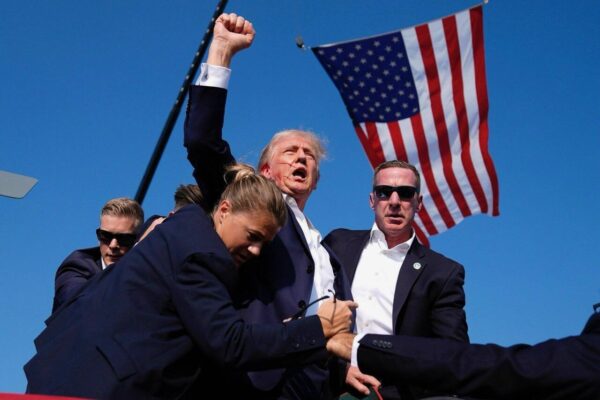
Remember how former President Trump was shot in the head at a rally in Pennsylvania? No, it wasn’t just a dream, though I wouldn’t blame you for thinking so, based on how deeply the story has been buried by now. After all, when was the last time you saw a mainstream media outlet publish this iconic photo:
As for stonewalling the investigation, the FBI and DHS have actually done much worse. Within a week of the failed assassination attempt, they hosed down the roof of the AGR building, dismantled all of the stands, cleaned up the crime scene, dismissed all of the law enforcement officers present without interviewing any of them, and cremated the would-be assassin’s body without conducting an autopsy. In short, they have not only stonewalled the investigation, but have done everything they can to prevent one from taking place.
And we still have no word on why a smartphone belonging to a member of the shooter’s household was present at an FBI office in Washington DC just months before the shooting.
This whole thing stinks to high heaven, which is probably why the mainstream media is doing everything they can to memory hole it. Fortunately, there are still some folks in the alternative media who are doing good work to make sure they don’t succeed. In particular, I highly recommend Chris Martenson, who has been running a thorough citizen’s investigation using the information that is open source. At this point, he’s leaning very heavily toward the LIHOP hypothesis (ie they let it happen on purpose).
4. The Democrats will nominate Harris for President.
By this point, the coronation of Kamala Harris should be official. Without winning a single primary vote in either 2020 or 2024, she has been elected selected to be the Democrat Party’s nominee… for the sake of “our democracy.” Some pigs are more equal than others, I guess.
This may be hard to remember, but at the time I made this prediction, it wasn’t at all clear that Harris would be the nominee. Three days had passed since Biden had (allegedly) issued his letter, announcing that he was withdrawing from the election—much to the surprise of his campaign staff. In a second letter, he had endorsed Kamala Harris as the nominee, but the Obamas had notably NOT endorsed her at this point, and the ultimate outcome of the DNC coup was still in doubt.
By now, of course, the party has locked ranks, with the propaganda wing mainstream media working 24/7 to manufacture consent and portray Kamala Harris as some sort of messianic figure. Which also means that it’s been over a month since Harris has given an actual press conference or answered any unscripted questions.
Just remember: whenever they say “our democracy,” they’re talking about THEIR democracy, not yours. As with pigs, some decmoracies are more equal than others.
There will not be a second assassination attempt against President Trump before the election. The original plan was to assassinate Trump before the Republican convention, in order to coronate Nikki Haley and guarantee that the proxy war with Russia would continue. With Vance now pegged as the heir apparent, removing Trump via assassination would be a much greater liability to those plans. This prediction expires November 5th, 2024 (remember, remember, the fifth of November!)
The FBI and DHS will continue to stonewall the investigation into the assassination attempt until something even more explosive dominates the news cycle. This will not prevent the alternative media and “citizen’s investigations” from continuing, but it will prevent them from reaching the normies. If they need to fabricate something to blow up the news cycle, they will do it. This prediction will expire August 31st, 2024.
Biden will be removed from office via the 25th amendment, and Harris will become the 47th President. At this point, I just don’t think that they can prevent this from happening. This may be the thing that gives them the cover they need to memory-hole the investigation. This prediction expires January 20th, 2025.
The Democrats will nominate Harris for President. I have no idea who she will pick for VP, but I don’t think it matters, because
Harris will lose badly and Trump will win the 2024 election in an electoral landslide. I think the Democrats have resigned themselves to a second Trump term, which is why they want to run Harris against him, since it’s the best way to get rid of her. At this point, they are playing for 2028, not 2024. Prediction 4 expires August 22nd, 2024. Prediction 5 expires November 5th, 2024.
Before Trump becomes president, NATO will become entangled in a direct war with Russia. This is the ultimate poison pill for the globalists/neocons. By getting us into a direct war, they will force Trump’s hand and make it impossible for him to negotiate any sort of peace with Putin. This prediction expires January 20th, 2025.
The war with Russia will not go nuclear, if only because Russia no longer has a functioning nuclear arsenal. However, it will be as scary as hell, because we will probably call their bluff. This prediction expires January 20th, 2025.
There will be a major shakedown of the administrative state in the first 100 days of Trump’s second term. Several national figures who were thought to be untouchable will be removed from power. This prediction expires April 30th, 2025.
In the first year of Trump’s second term in office, at least one of the following three things will happen:
A second global pandemic,
A domestic terrorist attack on the scale of 9/11, or
A major banking collapse and/or sovereign debt crisis that destroys the global economy. More poison pills that the deep state will try to use to sabotage Trump’s second term. I don’t know which one(s) they’re going to use, but I don’t think they’re going to stop with Russia. This prediction expires December 31st, 2025.
At some point in the next four years, the Federal Reserve will roll out a CBDC and will use a major crisis to force us to adopt it. I don’t know if they will succeed in this, but they certainly will try. I also don’t know how Trump will react to this, but if he makes Jamie Dimon his Treasury Secretary, I’m not very optimistic that he will stop it. This prediction expires January 20th, 2029.
As tempting as it is to run out the script for Ezra’s Eagle, which has proved surprisingly durable up to this point, I don’t believe it will actually play out the way Michael B. Rush has interpreted it. Even if it is a true prophecy, it may be that Ezra foresaw a possible future, not the future that will actually happen. There’s a reason why the book of 2nd Esdras is in the apocrypha.
Since each of these predictions has an expiration date, I will write another blog post at each of them to see how ridiculously wrong my predictions were. As a gentle reminder, I am a science fiction writer, which means that I tell lies for a living. Don’t hold my feet to the fire too much for any of these, as I’ll be shocked if I got more than 50% of them right.
With everything going on, I can’t help but wonder if/how this all plays into the Ezra’s Eagle prophecy, which I’m not entirely sure I believe, but which makes for a really fascinating (and terrifying) scenario moving forward. If you haven’t heard of the Ezra’s Eagle prophecy, check out my previous post on the subject, which for the last couple of months has been getting more views than any other post on my blog.
In any case, there is a very simple way that Ezra’s Eagle could play out, and it’s not only plausible, but it may actually be probable. Here’s how it goes down:
Trump wins the election, giving him +270 votes in the electoral college.
Congress passes a resolution declaring Trump to be an insurrectionist.
On January 6th 2025, Congress refuses to ratify the election because Trump is an insurrectionist. But since the Democratic ticket has less than 270 votes in the electoral college, the election gets thrown to the House of Representatives.
The House of Representatives is under no obligation to elect either Trump or Harris (or whoever ends up getting the Democratic nomination). In fact, they can elect whoever they want—even someone who wasn’t involved in the primaries at all.
The House selects a dark horse candidate for president, who turns out to be the first eagle’s head in the prophecy.
There was a second shooter, probably on the water tower. The first shooter, who was identified and killed by the counter-snipers, was obviously a fall-guy, with the second shooter on scene as insurance in case the first guy failed.
I don’t think the Secret Service agents on the scene were in on the plot. They demonstrated some glaring incompetence, but that’s actually become quite typical of the agency in recent years.
The reason the counter-snipers didn’t fire first was probably because there were trees obscuring their view. I don’t think they were in on the plot. However, the fact that they were positioned where they were is all kinds of suspicious, since it gave the first shooter a perfect position—and who put the counter-snipers on that roof in the first place? They should have been on the water tower, which commanded the whole area.
The first shooter could not have gotten into position without some kind of inside help. The level of official incompetence that it would take to allow him to get into position the way he did approaches the level of an Epstein suicide. He was on the freaking roof of the temporary police headquarters, for crying out loud—he had to cross a parking lot full of police cars to get to the effing ladder!
Kim Cheatle absolutely needs to take responsibility and resign as head of the Secret Service. The fact that she hasn’t tells me that she wants to hang on to power long enough to cover up her complicity.
I have zero faith in the FBI and expect them to use the “investigation” to cover up the truth and destroy evidence. Within a month, most of this stuff is likely going to be memory-holed by Google and all the other big tech companies. Take note.
However, with everything that has happened since the failed assassination, I am actually quite hopeful. Trump is demonstrating incredible leadership, and appears to be changing his message to a genuine call for unity. From what I can tell, this brush with death has deeply changed him.
Also, the Right is tremendously unified right now, to the point where I would be surprised if the people who plotted to take his life make another attempt. If the would-be assassins are indeed with the deep state / intelligence agencies (which makes sense, since a second-term Trump administration represents an existential threat to their power), then they’ve got to see that making him a martyr will blow up in their faces, especially now.
However, I could be wrong, especially if one of the goals of the would-be assassins is to blow up the country and drive us into a hot civil war. But who would that actually benefit, besides a foreign power? A post-Trump America would become totally ungovernable, even dangerously anarchic, if Trump were to become a martyr at this point.
The way the establishment appears to be in total disarray tells me that they are in retreat and making this sort of calculation right now. They will probably throw the Secret Service under the bus and do everything they can to hide just how far up the food chain this assassination plot really goes.
If Trump survives to November and the election is allowed to proceed, Trump will almost certainly become the 47th president. Since he represents an existential threat to the people currently in power, I think there’s a high likelihood that some sort of “crisis” will emerge that gives them an excuse to cancel the election. It could be a second pandemic. It could be a global war. It could be an October 7th-style terrorist attack on American soil. All of these are possibilities.
However, if none of this occurs and we somehow manage to get to November without a major crisis, I expect the people in power to do everything they can to plant some poison pills for the second Trump administration, in order to tie his hands. The most obvious of these would be to incite a direct military conflict between the US and Russia. It wouldn’t be easy for Trump to disentangle us from the Russia-Ukraine proxy war we’re currently fighting, but he could probably still do it. However, if the bombs are already flying between the US and Russia when he comes in on day 1, then the Neocons get the war they so desperately want, and there’s nothing he can do to stop it.
Assuming that Russia’s nuclear arsenal is still functional, the world has never been closer to a global nuclear war than it is right now—and with every second that passes, the likelihood only grows. It will probably take divine intervention to prevent that from happening between now and November, but we’ve already seen divine intervention in the fact that Trump is still with us. Which is not to make him out to be Jesus—if anything, he’s an American Samson—but it’s only by the grace of God that he is still alive.
Two days ago, our country was subjected to an ugly spectacle that forced us all, regardless of political persuasion, to confront the truth: that the alleged leader of the free world—the man in control of our nation’s nuclear codes, at a time when we are closer to nuclear war than any other time since the Cuban Missile Crisis—is unfit to lead the local HOA, let alone the most powerful nation on Earth. So what happens now?
We do not know who is actually leading our country, but we do know the people who are the next level down: the deep state and the cathedral. The deep state consists of the unelected bureaucrats who make up the administrative agencies, including what is commonly referred to as the intelligence community. The cathedral consists of the mainstream news media, commonly referred to as the fourth estate, the major studios in the entertainment industry, and the leading academics in our nation’s research and education systems.
What do we know about the deep state and the cathedral?
They have a complete disregard for the truth. We know this is true because these people have had unfettered access to Joe Biden since he took office, and they have done everything in their power to obfuscate, gaslight, and deceive us about his mental deterioration.
They hold the American people in contempt. Once again, we know this is true because of how they have done everything to obfuscate, gaslight, and deceive us.
They have no love for this country. We know this because of their efforts to rewrite our history along the lines of radical ideologues like Howard Zinn and Nikole Hannah-Jones.
They have seared their consciences with a hot iron. We know this because there has been absolutely no accountability or admission of fault for their numerous failures, including the pandemic response, the crippling lockdown policies, the so-called vaccine that is neither safe nor effective, the disastrous withdrawal from Afghanistan, the mishandling of Ukraine, the crisis on our southern border, etc etc ad nauseum.
The only thing they respect is raw power. We know this is true by their own admission.
Finally, we know that they believe that Trump represents an existential threat to their power.
In the immediate aftermath of the debate, it appears that these people are now turning on Biden, judging from the way they are calling for him to step down. But it is important to point out that the deep state and cathedral are not monolithic, and that the people who control these institutions are divided into multiple competing factions. The faction that revolves around Biden himself is likely to continue to resist these calls, as they have from the very beginning. In fact, they have shrewdly and cynically painted the other factions into a corner, leaving them with no good options.
To illustrate this, let’s list all of the possible scenarios in which Biden no longer faces Trump in the general election:
Scenario 1: Biden resigns.
Under this scenario, the VP, Kamala Harris, becomes the acting president, which also makes her the presumptive nominee. This would almost certainly lead to a Trump victory in the general election, since Kamala is even less popular than Biden—and perhaps even less competent, if that is possible. Seriously, the only reason she has a political career at all is because 1) she (literally) sucked her boss’s cock, and 2) she knows how to bully her subordinates. To see just how bad Kamala is, check out this satire piece from the Babylon Bee:
In any scenario where Kamala Harris becomes the nominee, Trump is likely to wipe the floor with her in the general election (assuming, of course, that we even have an election). Biden’s team knows this, which is probably why they made her VP in the first place: to deter their enemies from removing him from power.
Scenario 2: Biden serves out his term but announces that he is no longer running for re-election.
Because the primaries have already been held, this would turn the Democratic National Convention into a free for all, with no clear way to choose Biden’s successor. It would also be profoundly undemocratic, and likely demoralize the rank-and-file Democrat voters who buy into the cathedral’s narrative about “our sacred Democracy.” The hypocrisy at that point will simply be too much for them to ignore.
The only figure who likely has the power to unify the base is Michelle Obama, but the Obamas represent only one faction within the DNC, and it’s not at all clear that they’re in a position to win the game of thrones that will ensue under this scenario. Also, since the Biden faction has clung to power for so long, they are unlikely to give it up now.
Scenario 3: Congress invokes the 25th ammendment and removes Biden from power.
Under this scenario, Kamala Harris becomes the president elect and presumptive nominee, paving the way for a Trump victory in November.
Scenario 4: Biden dies.
This also leads to a disastrous Kamala Harris implosion.
Scenario 5: The deep state overthrows Biden in a coup, suspending the Constitution and cancelling the election.
Unfortunately, this is the scenario that seems most likely to me at this point in time. They already did everything they could to hamstring Trump’s presidency with the Russia collusion hoax and the special investigation, as well as the impeachment (in which Trump was literally impeached for Biden’s crimes). When we consider all the points we listed above, there is no reason to believe that these people won’t literally burn down the country to hold onto their positions of power.
The debate projected Biden’s weakness not only to a domestic audience, but to an international audience as well. Therefore, if our enemies (Russia, China, Iran, etc) calculate that a Trump re-election is likely, they are also likely to calculate that they have a limited window in which to take advantage of Biden’s weakness. This means that the odds of a major geopolitical crisis have increased dramatically, be it a terrorist attack against the US or our allies, a Chinese blockade of Taiwan, an escalation/expansion of the Russia-Ukraine War, or some sort of black swan event.
But every crisis is also an opportunity. And if our enemies move against us in a major way, this presents an opportunity for the deep state to sieze unprecedented power. In such a scenario, are they likely to exercise constraint and respect the lines set out by our Constitution? Remember, these are the same people who took advantage of the pandemic to sieze unprecedented (and also unconstitutional) powers. Why wouldn’t they do it again?
I really hope I’m wrong about this, and that the general election proceeds without any sort of deep state interference. But at this point, I think the most unlikely scenario is that the deep state / cathedral respect the election results and step down if Trump wins.
On the issue of abortion, I would consider myself to be very pro-life. I have written several explicitly pro-life stories, including “The Paradox of Choice,”“The Body Tax,” and “The Freedom of Second Chances.” My wife and I also donate monthly to Preborn, a charity / Christian ministry that provides free ultrasounds and support to pregnant women seeking abortions.
I was not always pro-life, however. In fact, if you’d asked me fifteen years ago where I stood on the abortion issue, I would have described myself as either pro-choice or leaning pro-choice. So what was it that changed my mind?
First, a little background about myself. I grew up in a comfortable middle-class home, with three younger sisters and a mother and father who were married and faithful to each other. Abortion was not a thing that I had any direct experience with; it was little more than a vague concept that I heard other people arguing with. And although I grew up in a religious household, we lived in a Democrat stronghold (western Massachusetts) and both of my parents were Democrats, so of course the default position that I grew up with was pro-choice.
I didn’t really hear the abortion issue debated until high school. I went to an elite preparatory academy in Pioneer Valley, so I was surrounded by people who were far left even by Massachusetts’ standards. My position, which I more or less absorbed from those around me, was that abortion was a tragic but sometimes necessary procedure, and that it wasn’t the place of men or the government to tell women what they couldn’t do with their own bodies. Basically, the “safe, legal, and rare” position.
However, there was one pro-life argument I heard at that time that planted a seed in my heart. The school paper printed a debate on the abortion issue, and the student who wrote the pro-life side argued not from the legal position, but from the moral position—specifically, asking the question “when does life begin?” Since we cannot know when life begins, the student argued, we should err on the side of preserving life and treat the unborn child like a full human being from the moment of conception. If we believe that murder is wrong, erring on the other side—that of preserving the mother’s autonomy—would risk committing an immoral act, since we cannot positively say that abortion does not take a human life.
It was an interesting argument, and I didn’t really have a counter to it. However, the abortion issue didn’t rank very high on my list of priorities, so I filed it away and forgot about it, reverting back to the default position which I’d more or less absorbed. If pressed, I would say that I didn’t like abortions, but that it was something best left between a woman and her doctor. I didn’t really give the “when does life really begin?” question any serious thought.
However, one thing I did give serious thought to was the atrocities committed by the Nazis during World War II. The liberal, post-modern position that I more or less absorbed from the air around me was that history (or at least the part that really mattered) began in the 1930s, that the Nazis represented the ultimate evil, and that “never again” was civilization’s most sacred value—not just for the holocaust, but for all forms of genocide, nuclear proliferation, and global war. As a kid, I read every (non-boring) World War II book that I could get my hands on, and was profoundly moved by several of the photographs that I saw, especially of the Nazi death camps. Later, in middle school, I read Jane Yolen’s The Devil’s Arithmetic, which further cemented my revulsion of the holocaust, and my determination that I was not and would never be the kind of person who would assent to that sort of atrocity.
Fast forward to the 2000s. After serving a two-year mission, I attended Brigham Young University from 2006 to 2010. The contrast was stark. In Massachusetts, I had been the odd “conservative” kid surrounded by liberals. In Utah, I was the odd “liberal” kid surrounded by conservatives. And though BYU is not the most conservative school in the United States (that would probably be Hillsdale), the air that I found myself in was much more conservative than anything I’d experienced growing up.
Overall, the experience was good for me. I found myself questioning a lot of my unspoken political assumptions and coming to conclusions that would have surprised my earlier teachers and mentors. For example, I independently came to appreciate the second ammendment and the right to self-defense, mostly from participating in BYU’s jujitsu club and learning how to physically defend myself. I also gained a deep appreciation for the principle of free speech, since studying contrasting viewpoints was so key in shaping my own worldview at that time.
However, I still didn’t give much thought to the abortion issue, since 1) it wasn’t directly relevant to my life at that time, and 2) it was just a really icky thing to think about. If pressed, I probably would have said that I was against using abortion as a form of birth control, and that some restrictions should be put in place to prevent that from happening, but that I didn’t think Roe v. Wade should be overturned. I had never known a world before Roe v. Wade, and thus was more comfortable sticking with the default that I’d grown up with. As a faithful Latter-day Saint, I knew that I would never put a woman in a position where she would consider getting an abortion, so the status quo was enough for me.
As a side note, I should point out that the official position of the Church of Jesus Christ of Latter-day Saints is that abortion is wrong in all cases except where rape, incest, or the health of the mother create extenuating circumstances. As missionaries, if we wanted to baptize someone who had either had an abortion themselves or had participated in one, we had to move it up the chain to a higher ecclesiastical authority to interview them and determine whether the prospective convert needed to demonstrate more repentance. Later, as a member of a bishopric, abortion was something we had to seriously consider when convening disciplinary councils. It is possible to get an abortion as a Latter-day Saint without getting excommunicated, or to come back into full fellowship after being excommunicated for abortion, but you have to go through your local (and sometimes area/general) authorities to work it out—and even then, they will strongly encourage you not to go through with it. But there is quite a bit of room for nuance in the church’s position on abortion.
Not that I ever really gave the deeper nuances of the issue any serious thought during this period. In fact, the one question that I never really asked myself was “when does life actually begin?” If pressed, I probably would have taken the position from that high school debate article, that since we don’t know we should probably err on the side of assuming life begins at conception, but I never really thought through the full implications of that position, again because 1) it didn’t directly impact my own life, and 2) the whole abortion issue was just icky.
Fast forward to 2015. I had graduated from college, traveled the world a bit, spent a few years bouncing around odd jobs and more or less living on my own, and made the best decision of my entire life: to not pursue a graduate degree. If I had gone on to grad school, I would have racked up a whole lot of debt, delayed my exposure to the “real world,” and failed to learn a number of important and life-changing lessons from the school of hard-knocks. And now that I finally felt like I was getting my feet back under me, I began to question all of my prior political assumptions, especially since the Obama years were coming to a close. I had voted for Obama in 2008, but vowed that I would never vote for a Democrat again, and was frankly disgusted with the intersectional coalition and its crusade for anti-racism and social justice.
It was around this time that I discovered Jordan Peterson. I was deeply impressed with Peterson’s earnest sincerity, intellectual honesty, and courage of his convictions. I was also intrigued by many of his arguments, which ran contrary to so many of the things I’d grown up with. One of these was his argument that most of us would have gone along with the Nazi atrocities, if we had lived in 1930s Germany. His argument was basically: “we’d all like to think that there was something unique about the Nazis that made them so evil, but that isn’t true. They weren’t so different from all of us. You may think that you wouldn’t have gone along with all of the atrocities that the Nazis committed, but the truth is that you probably would have gone along. After all, you’re not so special. You’re just as much a product of your times as the Germans in 1930s, and they really aren’t as different from us as you think they are. Don’t kid yourself. You’re just as capable of evil as they were.”
This argument struck something deep within me, partly because “never again” was such a core part of my own personal identity. Was I the kind of person who would have resisted the evils of the Nazis? Or in fact, was I not that special, and also not that different from those who had gone along with the Nazis’ terrible crimes? The only way to know for certain was to compare our times with the times of the Nazi regime, to see if there was anything comparable to the holocaust in our own time.
As soon as I asked that question, it was like my eyes were suddenly opened. There is indeed an atrocity comparable to the holocaust in our times, and it has become so ingrained into our culture that in many places—such as the blue state where I grew up—it is almost like part of the air that everyone breathes. That atrocity is the genocide of the unborn. If life truly begins at or near conception, then we have committed 10x holocausts since Roe v. Wade, a full order of magnitude more blood than the Nazis spilled. Moreover, we have slaughtered the most innocent, voiceless, and powerless people among us: our own children.
It all comes down to the question “when does a human life begin?” As far as I can tell, there are only two answers to that question that are logically consistent and scientifically sound: “at conception” and “I don’t know.” Viability is a moving target that changes with innovation and technology: in another decade, we may have found a way to grow children outside of the female womb, making them viable from literally the point of conception. Capacity for pain is also a moving target, since we’re still learning all sorts of new things as our technology improves. Sentience doesn’t work because people in comas are both alive and non-sentient. Heartbeat doesn’t work because it is possible to put an animal into suspended animation, where their heart has stopped beating, and successfully revive them. We can’t exactly do that to humans yet, but it’s only a matter of time and innovation before we can.
Now, I cannot say for certain that abortion is always wrong. Just like there are circumstances when it is just to shoot someone to death (such as during a violent home invasion), I understand that there may be circumstances where an abortion is similarly warranted. These are the edge cases like rape, incest, and health of the mother that the pro-choice pro-abortion activists always fall back on. The clearest of these is probably ectopic pregnancy, which is almost always fatal for both the mother and the child. But of course, what the activists never tell you is that almost all of the abortion bans that have been put into place since the end of Roe v. Wade have exemptions for ectopic pregnancies, which are not considered legally to be abortions. But I grant that there are other cases, such as depression and suicidal tendencies, that fall into a gray area morally. I also grant that a strict pro-life position has far-reaching implications for things like IVF and surrogacy that may or may not go too far. Frankly, I’m not at all sure where I stand on surrogacy and IVF.
But when you take a clear-headed and logical view at the way our culture practices abortion, focusing not on the legal intricacies but the simple question “when does a human life begin?” it becomes very clear that our current regime is not only comparable to the Nazi regime, but may actually exceed the Nazis in objective measures of evil. After all, what made the Nazi holocaust so evil? The sheer size of the death count? Ours is an order of magnitude larger. The innocence of the victims? No one is more innocent than the unborn. The motivations behind the killing? Hatred is one thing, but the worst evils have a quality of banality to them that our narcissistic and apathetic obsession with personal convenience captures better than almost anything else.
If it seems so unthinkable to claim that the evils of our own time exceeds the evils of the Nazis, that’s only because we are living so close to our own historical moment that we cannot see it clearly for what it is. Our modern liberal culture operates on the unspoken assumptions that 1) history only meaningfully began in the 1930s, 2) the Nazis represent the ultimate evil, and 3) “never again” is our civilization’s most sacred value (though with the October 7th massacre, that last one is beginning to fray). But if you can step back from that worldview and take a more objective look at our own historical moment, it quickly becomes obvious that we’re not as different from the Nazis as we think we are. After all, there is nothing new under the sun.
The overturning of Roe v. Wade was not the end of our culture’s abortion regime, but merely a shift in the argument and an opening of a new phase. And frankly, I am disgusted by the way that the Republicans have infiltrated and exploited the pro-life movement, cynically transforming it into a get-out-the-vote operation rather than treating this issue for what it is: the fundamental moral question of our times. In the 19th century, that question was slavery. Today, that question is the value of human life—and future generations will judge us just as harshly for our own position on that question as we judge the plantation slaveholders of the antebellum south. And well should they!
In sum, I wasn’t converted from pro-choice to pro-life until after I was confonted by an argument that forced me to take a good, hard look at my own worldview. At the heart of that argument was a very simple question: “when does a human life begin?” After considering that question deeply, I not only changed my position on the issue, but changed it so deeply that my wife and I now donate monthly to a Christian pro-life charity, even though we are not evangelical Christians. In fact, I’m fairly certain that I have deep theological differences with the people in the Preborn ministry, and that most of them have been taught to view my own Latter-day Saint faith as an abominable heresy. But I’m willing to lay all that aside, because in this day and age, I think that the value of life is a much bigger issue than any of that. And when my great great granchildren look back on my life, I hope that they can say that I rose above the evil of my times.
I just finished reading The Last Election by Andrew Yang and Stephen Marche. It’s a fascinating book, but not in the way that the authors probably intended.
The book basically presents a detailed account of the 2024 election, starting in November 2023 and ending with the results of a contingent election, after the (fictional) third party campaign disrupts things so thoroughly that no presidential candidate can get to 270 electoral votes. There’s violence in the streets, a supreme court justice who gets assassinated, a presidential debate that gets disrupted by a riot before it can really begin, a stealth military coup, and all sorts of insanity. And it ends (of course) with a Trump victory in the contingent election, where every state gets one vote and the representatives from each state vote behind closed doors. Cue the end of “our democracy.”
Partisan politics aside (and I am still genuinely undecided as to how, or even if, I will vote in 2024), there is sooo much to unpack in this book. The authors are totally ignorant about half of the country, and utterly clueless about the other half… and I can’t tell which half is which. That’s what I find so fascinating. Do the authors really believe that the average Trump voter hates and fears black people simply because they are black? Do they genuinely believe that sexual harrassment makes a better kick-the-dog moment than a coerced secret abortion ending in suicide? That such an abortion doesn’t even count as a kick-the-dog moment at all?
However, my purpose in this blog post is not to unpack all the myriad layers of willful and oblivious ignorance in The Last Election, but to point out what should be obvious by now: that most of the authors’ predictions are already failing to pan out.
By now, on the timeline, we should have had 1) an assassination of a justice of the supreme court, 2) RFK projected to win several states, and 3) street violence on the level of the George Floyd riots, with about as many casualties. Of course, none of those things have actually happened. And that, more than anything, makes me think that a hot civil war is unlikely to break out in this country.
Instead, people just seem to be exhausted. There are a few keyboard warriors, of course, but from what I can tell, most people on both sides are doing their best to tune them out. The memes aren’t anywhere near as good as they were in 2016. Of course, there’s still enough outrage for the political grifters to work with, but that outrage isn’t translating into lone wolves and false flags.
The 2024 election is shaping up to be the least important election in my lifetime. If our democracy were healthy, we would be debating the government’s disastrous response to the pandemic and whom we should hold responsible for it (of course, in a healthy democracy, the citizens would not have complied with those policies in the first place). Instead, the thing that’s sucking all the oxygen out of the room is the neverending lawfare against Trump—which is still important, don’t get me wrong, but is it really the most important thing happening right now? Inflation is crushing the economy, Europe is in the midst of its worst armed conflict since the Nazis, we are closer to a nuclear armed conflict with Russia than we were in the Cuban Missile Crisis, and Anthony Fauci is still both alive and free.
When I step away from the perpetual outrage cycle that passes these days for the news and look at the current state of the world, what I see is not a superpower that is careening toward a hot civil war, but a former superpower that is steadily disintegrating. Some parts of the country are in a greater state of collapse than other parts, but we are all in the midst of a collapse, and probably have been for years, perhaps even decades. Our dysfunctional politics is not the cause of any of this. It’s just a symptom.
As Americans, we like to think of ourselves as exceptional. We also like to obsess over the imminent fall of our cuntry. That’s probably why there’s been so much talk in the last few years about the possibility of a civil war. God forbid that America goes out with a whimper instead of a bang.
But the more I see, the more I think that that’s exactly how this country will fall apart: with a steady and unrelenting disintegration, until our politics are totally irrelevant, our military is unable to project power overseas, our national government is little better than that of a failed state, and our economy is so weak that no one bats an eye at rolling blackouts and empty grocery shelves.
Then we will pass through a period when things that cannot continue will not continue, and things that must happen will happen. Several states will become de facto autonomous, simply to survive. Many won’t. The dollar will collapse and the efforts of the global elite to replace it with a global digital currency will fail, but their depopulation efforts will succeed beyond their wildest dreams, and ultimately prove their downfall. The perpetual growth paradigm that the left calls “capitalism” and the right calls “progressivism” will unravel to devastating effect, and by 2100, there will be fewer than one billion humans on this planet (which will probably be significantly colder than it is now).
But there will not be a second American civil war, because that would require a level of dynamism that we simply do not possess. There is still a lot of ruin in this country, though, so we will probably endure longer than most other countries… kind of like how Japan is going on its fourth “lost decade” by now. But Japan had us to lean on. We’re not going to have anybody except ourselves.
I’ve been going back and forth on this post for almost a year now, wondering how exactly to express my thoughts. Some of the positive reviews on my fiction have expressed that I write “libertarian fiction,” and in some ways, I think that’s accurate: certainly, I value liberty very strongly, and support those government policies that are designed to safeguard our liberties while opposing those that seek to destroy it. That has not changed. But my views of libertarianism more generally have, perhaps in some ways that might surprise my longtime readers.
First, a little bit of my personal history. I grew up in one of the most liberal parts of the country, Pioneer Valley, Massachusetts, and considered myself a conservative while I lived there. Then, after serving a two-year mission for my church in Silicon Valley, California—what is probably the most progressive, leftist part of the country—I went to college at Brigham Young University, in the most Republican county of the most Republican state in the United States. At that point, I considered myself to be a sort of left-leaning classical liberal. When Dick Cheney spoke at BYU’s commencement, I blogged about the protests and attended the alternate commencement where Ralph Nader spoke.
I graduated in 2010, in the middle of the Great Recession, and made the fateful decision not to go to grad school at that time. To this day, I count that as the single best decision I ever made in my life (right up there with deleting my Facebook and Twitter accounts). Not only did this force me to learn how to navigate the real world, but it also got me out of the indoctrination factory that the national university system has become, even to a degree at my alma mater, BYU.
About five years after I graduated, I got red-pilled and started listening to right-wing commentators like Glenn Beck, Ben Shapiro, and Dennis Prager. I also looked seriously into Ron Paul and the libertarian movement, and became something of a libertarian. As fractitious as libertarianism is as a political philosophy, it seemed like the most logically coherent and intellectually honest way of understanding the world, whereas leftism and conservatism were both riddled with internal contradictions.
But then I got married and started a family. That experience has changed me in a lot of ways, perhaps even more than all the rest of my life experiences combined. But politically, the biggest thing it has caused me to rethink is this question:
What is the fundamental unit of society?
I’d always played lip service to the belief that the family is the fundamental unit of society, but starting a family of my own has made that real for me—indeed, has made me realize—in a way that simple bumper-sticker slogans never could. Before, I was living for myself. Now, I live for my children. Before, I was the hero of my own story, and that story was a single volume. Now, my story is just a single volume in an ongoing saga, a link in the chain of the generations that came before and will go on after me.
Libertarians believe that they stand in opposition to authoritarians of all stripes, be they communists, fascists, socialists, etc. But both libertarians and authoritarians operate on the unspoken assumption that the individual, not the family, is the fundamental unit of society. Leftists want to destroy the family and put the state in charge of raising and educating children, in order to make them obedient to government authority. Libertarians, on the other hand, romanticize this idea of the atomized individual who follows his own path and eschews all forms of collectivism, including the family. Ayn Rand’s books are populated by ubermensch who seem like they’ve sprung forth from the head of Zeus, and the children in her novels are basically just adults in miniature.
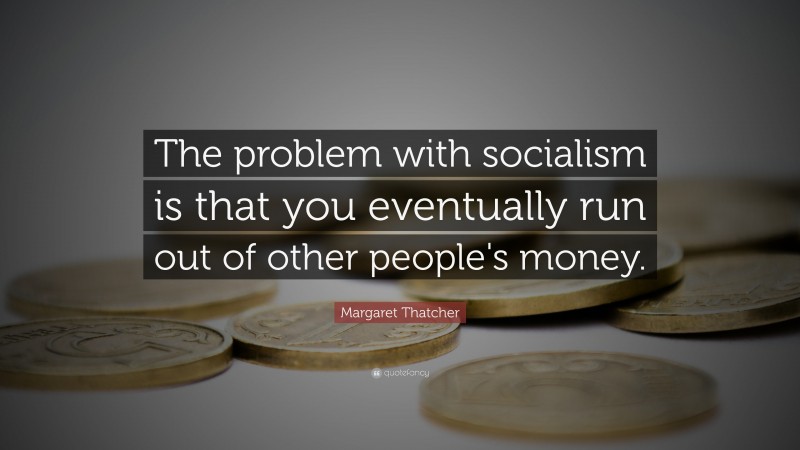
Allow me to put it this way: Margaret Thatcher had a brilliant quote about socialism that libertarians love to repeat. And from a purely economic standpoint, I believe that the libertarians are correct. But change that quote just a little, and you get this:
The problem with socialism libertarianism is that you eventually run out of other people’s money families.
Families don’t just happen. They take a lot of work to build and to maintain, and unless they are planted in a culture that nourishes them, they will wither and die. Libertarianism does not foster that kind of a culture, yet it depends on families in order to raise the kind of people who can make a libertarian society work. People from broken families often lack the mental and emotional maturity to take upon themselves the personal responsibilities that come with personal liberty—in other words, they lack the capacity for personal independence which libertarianism depends on. Growing up in a healthy family isn’t the only way to develop that sort of independence, but a society of broken families will invariably fail to produce such a people.
This is why libertarianism ultimately leads to authoritarianism. We aren’t all characters in an Ayn Rand novel: we aren’t all ubermensch all of the time, reshaping the world by the strength of our will. And when we inevitable fail, where can we turn to for help? If society is nothing more than a group of individuals, then ultimately the only place to turn to is the state. Perhaps there may be churches, companies, or other private civic organizations to which a person may turn, but any form of libertarianism that rejects altruism as a moral good will fail to foster these organizations as well. So, in the absense of anywhere else to turn, individuals will, over time, turn increasingly to the state, trading their libertarian freedoms for economic and social security. A society that exalts the individual at the expense of the family will always, in the end, devolve into a statist tyranny.
If you want to create a stable society that recognizes individual freedom, you have to recognize the family as the fundamental unit of that society, and you have to proactively enact policies that will foster a culture of strong families. Not only does this give you a social safety net that is totally apart from the state, but it also ensures that your society will be self-perpetuating, since one of the central purposes of the family is to create and raise children.
In fact, the family is perhaps the best antidote to government power creeping into every facet of society, which also makes it the best way to push back against woke leftism, ESG, and the Great Reset. Hence why everything about leftist progressivism is calculated to destroy the family. Parents concerned about CRT in their schools? Domestic terrorists. Kids who say that they’re transgender? Transition them without telling the parents, and take them away from their families if the parents object.
But it’s not just a partisan issue. If the family is the fundamental unit of society and needs to be strengthened, then there are things on both the left and the right that need to change. For example, poverty is a huge issue for families, since poor families are much more likely to break up due to the stress. But conservatives often ignore the issue of income inequality, mouthing platitudes about the free market while giving us socialism for the rich and capitalism for the poor. And the libertarians are little better, what with how they push for the legalization of drugs, prostitution, abortion, and pornography. Few things have done more to destroy the family than widespread substance abuse and the hypersexualization of our society.
This is why I’ve mostly given up on reading Heinlein anymore. He’s a brilliant writer with a fascinating take on some of science fiction’s most fundamental tropes, but whenever he writes about sex or sexuality, all I can think of is “the problem with libertarianism is that you eventually run out of other people’s families.” Heinlein and his boomer readership took the family for granted, neglected their own, and gave us a world of widespread sexual promiscuity, where society is falling apart.
So that’s why I don’t consider myself a libertarian anymore, even though there are many tenets of libertarianism that I still admire and believe, especially on the economic side. I suppose you say that I’m a conservative, but that isn’t really accurate either, because most strains of conservatism in 2024 really seem more about conserving the leftism of two or three generations ago. So I guess that means I’m politically homeless—just like most of my fellow Americans these days.