- The Broward County sheriff needs to resign or be fired immediately, and should also stand trial for criminal negligence. There’s something rotten in the state of Florida, and it all points back to this man.
- CNN has completely lost all credibility. As far as I’m concerned, they rank slightly above Alex Jones and slightly below the grocery store tabloids for journalistic integrity.
- The anti-gun activist shooting victims are political pawns. Nothing more, nothing less. Emotion does not give you credibility, and suffering does not give you authority.
- By the same, Donald Trump’s emotional reactions on Twitter have been disappointingly puerile.
- The only person who comes out looking good from all this is Dana Loesch.
- We obviously have a problem with mass shootings in this country. Instead of focusing on the gun issue to the exclusion of everything else, we should first try to fix all of the other contributing factors, such as mental illness, school security, psychotropic drugs, absent fathers, etc. Let’s focus on the areas where we can agree.
- The FBI has demonstrated criminal negligence in their failure to investigate the shooter, and what is even more disturbing, I don’t know that it isn’t politically motivated. If it is, it represents an existential threat to our republic.
- I don’t know that our nation has been this politically divided since the years leading up to the Civil War. The United States is deeply ill, and if we cannot come together—if we cannot find our e pluribus unum—I fear that this great nation will fall.
Tag: politics
Color Revolutions and Collusion News Network
For most of 2012, I lived in Georgia, a former Soviet Republic of the USSR. I came to know the people, the culture, and the politics of that part of the world first-hand. In particular, I was there for the 2012 elections, a watershed moment for modern Georgian politics.

A little bit of background. Georgia won its independence in the 90s during the fall of the Soviet Union, and immediately fell itself into a civil war. Three regions broke off: Adjara in the south, South Ossetia in the north, and Abkhazia in the northwest. It was a very difficult time, where the national army was little more than a deputized gang of thugs.

When the chaos settled down, the man in charge was Eduard Shevardnadze, a former high-ranking member of the Soviet Politburo. If you had to compare it to something, it would be like the United States falling apart and George W. Bush taking over Texas. An old establishment politician from a dynastic family returning to his newly independent home country to head it during troubled times.
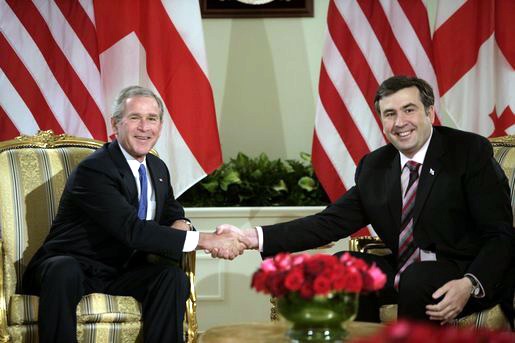
But then, in 2005, something interesting happened: a “color revolution” broke out. George Soros, members and allies of the Bush Administration, and other foreign actors began to stir up protests in Tbilisi against Shevardnadze’s government. The tensions culminated with Mikheil Saakashvili and other agitators storming parliament with roses in their hands, taking over the podium and forcing Shevardnadze to flee with his bodyguards. He later resigned, and Saakashvili ran unopposed in the following election. He won by 96.2%.

It was political theater of the highest order, accomplished by collusion with a meddling foreign power. Once Saakashvili was in charge, Georgian foreign policy took a hard turn towards the West, causing massive tensions with Russia that culminated in the 2008 Russo-Georgian War.
This was a very bad move. Georgia is basically the Mexico of Russia; the two countries are closely linked both culturally and economically, with a large volume of remittances flowing from expatriots in Russia back to their families in Georgia. By turning so sharply to the West—not to mention, starting an actual war—Saakashvili did his people a great disservice.
Fast forward to 2012. I was teaching English in a village called Rokhi, about half an hour south of Kutaisi. I knew the basic outlines of this history, but very few of the specifics. The people were generally friendly to Americans, but they were very quiet about politics, at least to me.
Then the elections happened, and against all odds the Georgian Dream party completely overthrew Saakashvili’s ruling party in the parliament. Politicians started fleeing across the border into Turkey. Those who didn’t flee were arrested, sometimes on spurious charges, sometimes on legitimate ones. The courts became weaponized in a political struggle between Saakashvili and the Georgian Dream. It wasn’t a transfer of power so much as an ongoing coup.
All of a sudden, people starting speaking up and telling me what they really thought. While Saakashvili was in power, people were always careful around me because they assumed (since I was an American) that I was some sort of spy. But when the Georgian Dream Party took over, people felt it was safe to share their true feelings about how much they hated this guy who had taken over their country and driven it into the ground.
This is what foreign collusion and meddling looks like. America does it all the time. There’s a saying in the former Eastern Bloc that goes something like this:
“Why has there never been a color revolution in the United States?”
“Because there is no US embassy in the United States!”
Except now, I’m not so sure. Because the hyperbolic media response to the latest mass shooting in Florida shares some very disturbing similarities with a color revolution, and it frankly scares the hell out of me.
Take the CNN town hall that happened earlier this week. That wasn’t democracy in action, or even journalism. It was political theater, pure and simple. It was a political witch hunt and full-on push for gun confiscation.
A lot of things about the Florida shooting don’t add up. The alleged gunman managed to slip away with the fleeing students, instead of getting killed by law enforcement on the scene as is the pattern with most mass shootings. The FBI knew about this kid, had a file on him, knew what he was planning, and did nothing—absolutely nothing—to stop him. His classmates just happen to be pro-gun control activists, and they just happen to put together this massive national children’s crusade literally before the funerals for all the victims have been held.
Look, I’m not saying the kids are crisis actors. I’m not saying that what they went through isn’t absolutely horrific, or that they don’t have a right to feel the way that they do. What I’m saying is that the politicization of this shooting is massively suspicious and full of red flags.
Consider the three major mass shootings that happened last year, and the differences in the media’s response to each of them.
The first was the Congressional baseball shooting in June. A Bernie Sanders supporter tried to assassinate most of the Republican caucus by hunting them down at a baseball practice. It was deliberate, it was planned, and it very nearly threw this country into a major political crisis.
Within a week, the major news outlets were no longer covering the story.
The Las Vegas shooting was next, in October. A horrible tragedy and watershed moment for mass shootings in America. And yet, after all these months, there are so many unanswered questions. Where are the Casino tapes? Why haven’t we seen them? What was the involvement of the shooter’s girlfriend? Who is the other person of interest that the FBI hasn’t revealed? Was there a second shooter? What about all of the problems with the timeline?
None of these questions have gotten much airplay outside of alternative media. Also, the fact that the shooter was on mood-altering drugs hasn’t factored into the public debate nearly as much as the guns that he used—or didn’t. We don’t really know.
A month later, in November, we had the Sutherland Springs church shooting. The shooter was stopped by a bystander with a gun. A classic example of how the right to bear arms protects and makes us safer.
Once again, the mainstream media buried the story within a week.
Now we have the Florida shooting, with its own set of details that don’t quite add up. Far from burying the story, the mainstream media has blown it up to eleven, with nonstop political theater, witch hunts, appeals to emotion, and above all else, unyielding demands for a total confiscation and ban on all guns.
Who benefits from the politicization of mass shootings? The people who want to destroy the right to bear arms. Who is that? No one so much as the people who want to sow chaos in this country.
If the feds attempted a total gun confiscation, it would spark a second American civil war. Russia would benefit greatly from this. And if the confiscation were ultimately successful, it would leave us that much more vulnerable to a foreign takeover in the style of a color revolution.
This is the stuff of political thrillers, and it’s happening in realtime before our very eyes.
Who’s behind this? I don’t know. I have my suspicions, but I cannot yet say anything with any degree of certainty. But because certain factions benefit from the politicization of these mass shootings, I believe they will continue, and will probably increase in frequency.
We hear of wars in far countries, and say that there will soon be great wars in far countries, but do we know the hearts of the people in our own land?
If ye are prepared, ye shall not fear.
Black Panther
 Pay no attention to the people trying to make this movie all about race or politics or whatever. They’re all just agenda-driven media whores trying desperately to hijack whatever’s popular at the moment in order to remain culturally relevant. This movie has nothing to do with any of them.
I really enjoyed Black Panther. Good story, good characters, lots of fun action, and a couple of really interesting twists. The music was fantastic: two hours of woodwinds and African drums. It wasn’t as comedic as Thor: Ragnarok, but it didn’t take itself too seriously either. For a Marvel movie, it was also surprisingly family friendly.
I thought it did an excellent job of acknowledging race and politics without allowing itself to be taken over by either. It isn’t race that makes the people of Wakanda different from the rest of the world: it’s the magical meteorite that fell in their country, with thousands of years of isolation that allowed them to follow their own cultural path. As for politics, it’s not so much about the struggle against the colonizers as it is a question of how to open up to the rest of the world: peacefully, or violently.
Honestly, if you don’t care about race or politics, you don’t have to worry because it doesn’t beat those over your head at all.
The story is really solid, which is par for the course for Marvel. The world is also really well done. Very different from what you usually see in these kinds of superhero movies. In fact, it didn’t feel like any of the other Marvel movies, even though it hit all of Marvel’s usual high standards.
The thing I liked most about it was probably the characters. T’Chaka is a genuinely good person trying to set right the mistakes of his father, and the friends who surround him are also good people trying to do right by their own as well. But they don’t always agree on what’s best: whether to keep the magical kingdom of Wakanda secret and isolated, or whether and how to reach out to the rest of the world.
Overall, it was a really fun movie and I’d definitely recommend it. Like I said at the top, pay no attention to the attention whores on mainstream and social media trying to make this all about race and identity politics. Star Wars may have been taken overy by wankers, but Marvel has not.
Bake the #MAGA cake
The US Supreme Court is hearing a case today that will decide whether or not a gay couple can force a cake artist to decorate a cake for a gay wedding. The issue at stake is not whether a business can refuse service to people based on sexual orientation (the baker was willing to sell the gay couple any out-of-the-box cake on his shelf), but whether the government can force a creative professional to use their talent to advance a message that runs contrary to the individual’s conscience.
Unfortunately, it looks likely that the court will rule against the baker. In other words, we will soon live in a country where artists can legally be forced to create propaganda that runs contrary to their beliefs. And yet, for even questioning this, I’m somehow the fascist??
This isn’t about discrimination. This is about free speech. If I, as an artist, don’t have the freedom to choose what kind of art I create, I no longer have freedom of speech. It really is that simple.
 So here’s what I propose. If the Supreme Court rules against the baker, then every bakery in San Francisco, Chicago, and New York City should be forced to make MAGA cakes from now until November 2020. We should fill them up with so many orders that a week won’t go by that they won’t be forced to push the message that put Trump into the White House.
We’ve already seen the power of 4chan and weaponized autism. I have no doubt that this is something that we can do. And maybe, just maybe, it will convince the few reasonable people on the Left to see just how hypocritically batshit insane their side has become. Because if we have to live in a country where conservative bakers are forced to make gay wedding cakes, shouldn’t liberal bakers be forced to make MAGA cakes too?
Please, internet gods. Make it so.
Undercover Antifa: This story needs to get out!
There’s a lot that I could say, but I think the video speaks for itself:
One question: when Antifa has their Charlottesville moment and somebody dies at their hands, how is the mainstream media going to cover it? What is the narrative going to be?
Good on team Crowder for exposing these domestic terrorists. Make no mistake, that’s exactly what they are.
To escape or to engage
A couple of weeks ago, I finally sat down and wrote a (semi-) formal business plan. It was an enlightening experience. I’ve kept it all organized in many different ways, but writing it all down in one place allows me to step back and take a wider look at what I do.
No business plan is complete without a mission statement. Here is mine:
To write and publish fiction that serves the truth, expands minds and hearts, and empowers my readers to be better men and women for reading my books.
To serve, expand, and empower. All of the books that have profoundly affected my life, from Ender’s Game and Lord of the Rings to The Neverending Story and A Wrinkle in Time, did those things.
“That’s very high and lofty, Joe, but what about just writing damn good stories that entertain people?” I don’t actually see a contradiction there. All of the best stories I’ve read that served, expanded, and empowered me were only able to do so because they entertained me first.
Entertainment is an important part of what I do. So is escapism. I have no idea how J.R.R Tolkien voted in the 1930s and 40s, nor do I care to know. I have a pretty good idea how Orson Scott Card voted in the 90s and 00s, but not from reading Ender’s Game. Sometimes I read authors for their politics (Ringo, Heinlein, Correia), but I didn’t read The Last Centurion to decide how I would vote in the last election; I read it because leading a stranded cavalry division across a post-apocalyptic Middle East sounded like a damn good story.
The surest way to kill a good story is to try to cram a message through it. The best stories never do this. They serve as a mirror that allows the reader to see themselves more clearly, whoever they may be. That’s what makes them timeless.
The world is becoming an increasingly scary and violent place. In the coming months, I expect that things will get a lot worse. This puts me in an interesting position. Should I try to write stories that engage with what’s happening in the world, or stories that provide an escape from it?
Or is there a contradiction between the two?
There’s a lot of outrage on social media from people who are trying to engage with the problems they see in the world. Unfortunately, the louder their outrage becomes, the more they seem to be part of the problem and not a solution to it. That’s part of why I deleted my Twitter account and radically scaled back my Facebook usage.
Does lashing out at injustice really make the world a better place? Adding outrage to outrage, pointing out everything that’s wrong? There’s a time and a place for that, sure. But there’s also a time and a place to disengage.
When times get hard, people need an emotional escape. That’s why they turn to things like sports, or movies, or books. But when this media instead tries to engage by bringing in politics or social justice or whatever, it deprives people of their escape. We see it all the time with the virtue signalling in Hollywood, or the issue dropping in TV and movies, or whatever the hell ESPN has become.
I don’t want to go that route. Not with my books, not with this blog—not with any aspect of my career. It’s tempting, sure, and I’ve flirted with it in the past, but it’s time to pull back. I may be convinced of my own views and opinions, but that’s not why I write. You don’t serve the truth by forcing it on other people. You don’t expand minds and hearts with moral outrage. You don’t empower people to become better by telling them that they’re wrong.
With the way the world is going, I think the best thing I can do is to focus less on trying to engage with it and more on providing an escape from it, through my books. Ultimately, I think that’s a better and more effective way to change the world.
Thoughts on the violence in Charlottesville
No one is right in any of this.
I tend to lean to the “right,” but it’s a completely different “right” than any of the protesters at this event. Constitutional conservatives and classical liberals are both increasingly endangered species in this country, and that’s a problem. Nothing in our Constitution supports Nazism and white nationalism.
Radical Islamic terrorism is evil, and needs to be called by its name. So does White supremacist terrorism and neo-Nazism. So does Black supremacism ala Black Lives Matter. So does neo-fascism and radical anarchism ala Antifa. All of it is evil. All of it needs to be named and recognized as such.
We live in a world where words and hate speech and so-called “micro-aggressions” are called violence, but where real violence is legitimized if it’s in the service of political ends. This needs to stop. The first step to stopping it is to call evil by its name. No one in Charlottesville this weekend was on the side of truth or righteousness. They were both fighting for two sides of the same evil coin.
Sarah Hoyt thinks this is our Fort Sumpter moment. I disagree. It may be our Harper’s Ferry moment, but I thought that the Oregon standoff was one of those, and apparently it wasn’t. Perhaps it’s just another wake up call, like the Washington DC baseball shooter who miraculously failed to kill any of his targets.
Regardless of what kind of moment Charlottesville was for this country, we need to wake up and take a step back from the brink.
I’m actually quite optimistic about this. None of those bozos represent the vast majority of us. We’re better than that. We’re the country that saved the world twice, from Nazism and from Communism. Yes, we don’t have a perfect track record, but Churchill was right: you can always count on the Americans to do the right thing, after we’ve tried everything else.
There’s a lot of scary stuff happening in the world right now, but I’m actually not too alarmed. We’ve been through worse. We’ll pull through this, “we” being those who are prepared. If ye are prepared, ye shall not fear.
Take care of yourself, dear reader. And thanks, as always, for reading.
An open letter to Google
To whom it may concern,
My name is Joseph Vasicek, and I have been a regular user of your company’s products since 2006 when I set up my first Gmail account. Until the events of the past week, I was also a satisfied user.
The recent firing of James Damore over the controversial internal memo titled “Google’s Ideological Echo Chamber” has profoundly shattered my trust in your company. I have read the memo and find it eminently moderate and well-reasoned. It is not an “anti-diversity screed,” as many in the traditional news media are calling it, and their characterization of the memo–as well as your own characterization, given by your vice president of diversity, Danielle Brown–is manifestly false to anyone who has actually read it.
Your handling of the controversy has been nothing short of Orwellian. I find this especially disturbing for the fact that your company controls almost every gateway to the internet that I use on a daily basis.
My phone is an Android device that is deeply integrated with your products. My personal and business email accounts are with your Gmail service. I use your search engine on a daily, almost hourly basis, and routinely default to the first three sites listed in the search results. Whenever I’m lost or traveling to an unfamiliar place, I use your maps and navigation service to guide me. Until this memo controversy, Chrome was my default browser. While I lived in Utah Valley, I even used your fiber network too connect to the internet.
It is abundantly clear to me now that I have been far too complacent in allowing myself to become wholly dependant on your company for almost every facet of my online connection to the world.
I cannot, at this time, fully divest myself from Google in the way that I have already divested myself from Facebook and Twitter. However, I can make gradual changes to lessen my dependence on your company’s products in the coming months and years. This principle will guide my future purchasing decisions, as well as the online products I use and the personal data I share.
In the world of tech, if you use a product or service without paying for it, then you are the product, wittingly or otherwise. This was not a problem for me when I still trusted your company. But you have profoundly violated that trust.
I won’t say that it is impossible for you to win back that trust. It would take an extraordinary act, but you are an extraordinary company. At the least, it would require an acknowledgement of the legitimacy of my concerns, and a reversal of the fascistic Orwellian turn that your company has taken. It would require, for example, changing the search results page for “Abraham Lincoln” to reflect that he was our first Republican president, not just a member of the National Union Party (which was simply the Republican Party, rebranded for the 1864 elections when Lincoln was the sitting president. He was elected in 1860 as a Republican, and calling him anything else is deliberately misleading.)
Without an extraordinary effort to win back the trust of the millions of Americans like me whose trust you have betrayed, in the coming months and years, you will see much less of me as I reduce my dependence on your products.
Sincerely,
Joe Vasicek
This guy hits the nail on the head
Financialization is what happens when the people-in-charge “create” colossal sums of “money” out of nothing — by issuing loans, a.k.a. debt — and then cream off stupendous profits from the asset bubbles, interest rate arbitrages, and other opportunities for swindling that the artificial wealth presents. It was a kind of magic trick that produced monuments of concentrated personal wealth for a few and left the rest of the population drowning in obligations from a stolen future. The future is now upon us.
…
Quite a bit of that wealth was extracted from asset-stripping the rest of America where financialization was absent, kind of a national distress sale of the fly-over places and the people in them. That dynamic, of course, produced the phenomenon of President Donald Trump, the distilled essence of all the economic distress “out there” and the rage it entailed. The people of Ohio, Indiana, and Wisconsin were left holding a big bag of nothing and they certainly noticed what had been done to them, though they had no idea what to do about it, except maybe try to escape the moment-by-moment pain of their ruined lives with powerful drugs.
And then, a champion presented himself, and promised to bring back the dimly remembered wonder years of post-war well-being — even though the world had changed utterly — and the poor suckers fell for it. Not to mention the fact that his opponent — the avaricious Hillary, with her hundreds of millions in ill-gotten wealth — was a very avatar of the financialization that had turned their lives to shit. And then the woman called them “a basket of deplorables” for noticing what had happened to them.
…
The accumulated monstrous debts of persons, corporations, and sovereign societies, will be suddenly, shockingly, absolutely, and self-evidently unpayable, and the securities represented by them will be sucked into the kind of vortices of time/space depicted in movies about mummies and astronauts. And all of a sudden the avatars of that wealth will see their lives turn to shit just like moiling, Budweiser-gulping, oxycontin-addled deplorables in the flat, boring, parking lot wastelands of our ruined drive-in Utopia saw their lives rendered into a brown-and-yellow slurry draining clockwise down the toilet of history.
I especially got a kick out of that last part.
Seriously, though, this guy hits the nail squarely on the head. We’re headed toward a massive economic reset, which is going to transform the world as we know it. I was in high school when the 9/11 terrorist attacks happened, and the Great Recession had a much bigger impact on my life. When the Greater Recession hits, it’s going to be a lot worse.
That said, I disagree that the only thing we can do is to sit back and watch the world burn. Every problem is also an opportunity. The bigger the disaster, the more opportunities that open up after it.
Without a doubt, though, now is the time to prepare.
The end of politics in America, part 2
How did Trump become the leader of the most powerful nation on Earth?
A lot of people are asking that question, while a lot of other people already know (hint: it wasn’t the Russians). But I want to get beyond the circus that is Washington DC, and answer that question by asking another:
Can politics solve our nation’s greatest problems?
I think there is a dawning realization among Americans that it doesn’t really matter who lives on 1600 Pennsylvania Avenue. Republican or Democrat, the outcome is pretty much the same.
Never at any point in living memory have we been so politically divided, but the party distinctions have become increasingly meaningless. Trump campaigned on providing universal healthcare. Clinton campaigned on escalating our military involvement in Syria. Which one was the Republican, and which one was the Democrat?
In the previous post, I said:
I am convinced that the grand key to understanding United States history in the 20th century—and by extension, current events in the 21st—is a deep knowledge of monetary policy and the financial system.
What is that system?
It is a system of debt. Pure and simple. We have turned our debt into money, and made every other form of money illegal. And the rest of the world has followed us gleefully off the cliff.
Washington is bankrupt. Literally bankrupt. Every year, the Treasury runs an internal audit, and every year, that audit fails. The government’s single biggest asset on their balance sheets is… $1 trillion in student loan debt. Social Security is insolvent and, according to the government’s own reports, will completely run out of money in less than twenty years.
So if Washington is bankrupt, why haven’t they declared bankruptcy? Because they can just keep printing money through the Federal Reserve.
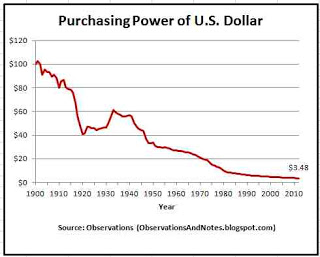
Because of this, the US dollar has lost about 97% of its value since the Federal Reserve system was established in 1913. A time traveler from the new Wonder Woman movie couldn’t buy $5 worth of stuff with $100 of our dollars today. And to keep up this Ponzi scheme we call “money,” Washington has gone nearly $20 trillion in debt.
How much longer can we keep that up?
If we could grow our economy fast enough, and never stop growing, we could keep up the Ponzi scheme for a very long time. But growth is no longer a solution, because the debt is bigger than the economy. The debt is the reason we can’t grow.
If we could innovate fast enough, we could lower the cost of living so much that the poor don’t realize that they’re poor. To some extent, we’ve already done that. But the effects are too uneven: startphones and computers are super cheap, but houses and health care are practically unaffordable.
Which brings us to serfdom.
Let’s go back in time a couple thousand years. Before the days of the empire, the Roman dream was that every family would have their own plot of land, making them independently wealthy, and the head of every family would take up arms in defense of his country whenever called upon by the state. This was not all that different from the Jeffersonian ideal of the yeoman farmer.
Then the Punic wars happened, which, for the Mediterranean world, was basically the ancient WWI and WWII. As Rome became a major world power, the military-industrial complex made a few select elites fabulously wealthy, who kept the masses pacified with welfare handouts.
But the endless cycle of foreign wars came at a heavy cost. Decades of budget deficits and an unsustainable national debt forced the Romans to debase their currency, which completely collapsed. Trade halted, the middle class lost everything, and the 1% became fantastically wealthy, buying up all the real estate and forcing everyone else out. The Roman dream was dead, replaced by a form of bondage called serfdom.
Serfdom came in a number of different flavors:
- Slaves, who had always existed in the Roman world and continued for some time in the Medieval. Landlords got tax benefits for holding slaves.
- Villeins, who were bound to the land and worked for the landlords. In exchange, they enjoyed protection and tax relief. Theoretically.
- Coloni, or sharecroppers, who leased land in exchange for labor and a portion of their harvest. They were eventually taxed out of existence.
- Freemen, who technically weren’t serfs, but were only a raid or a bad harvest away from becoming one. They were basically renters.
The corvée was a tax, paid in labor, that non-landowners owed by law. Basically, for every XX days out of the year, you worked for the state. It continued even after the abolition of serfdom, until the revolutions of 1848. My Czech ancestors paid the corvée, which is probably one of the reasons they and their children emmigrated to the United States.
But wait—we pay the corvée too! It’s called the federal income tax: for XX days out of the year, you work for the state. The taxes are even higher if you’re self-employed or a small business owner.
Except… not everyone pays the income tax. In fact, nearly half of Americans pay no income tax. Why? Because the politicans know that they can use the welfare system to buy votes. If you’re on welfare, who are you going to vote for: the guy who plans to cut your handouts, or the guy who says that the wealthy should pay their “fair share”?
And sitting at the top of it all are the central bankers.
The medieval serfs were bound to the land and worked for the landlords. In contrast, modern debt-serfs are bound to their debt—national debt, student loan debt, mortgages, consumer debt—and work for the banks.
So I ask again: can politics solve this problem? Can we find a political solution to our national debt?
Unfortunately, there is only one political solution: default on the debt. If we default on entitlements like social security, there would be chaos, riots, and anarchy… and we still wouldn’t pay down hardly any of the debt. If we defaulted on our treasury bonds, it would send a ripple of financial panics across the world, destabilizing the flashpoints in Europe and Asia before returning to our shores. Stocks, mutual funds, and pensions would all be wiped out. Almost the entire savings of the Baby Boomer generation, gone.
But there is another option, though it’s hardly a “solution”: kick the can a little further down the road. Print the money, devalue the debt, and inflate the currency to oblivion.
This is the path we’ve been on since 1913. This is the reason why our dollars buy a little less each year. And this is the reason why we, as a nation, are backsliding into serfdom.
We’ve seen this happen before. Rome fell because of it. Europe came under the yoke of serfdom as a result of it. Our ancestors fled to this country to escape it. And now, we are repeating it.
This isn’t a political problem: it’s a math problem. The numbers just do not add up. The next financial crisis could very well be the “extinction level event” that puts the final nail in the coffin of the US dollar, throws the world into a global war, and sends the United States into its greatest existential crisis since the Civil War. The Republicans don’t have the solution, and neither do the Democrats, because the problem is not political.
This is what the end of politics in America looks like. We’re watching it happen in real-time. Our politicians have become the clowns in the bread-and-circuses routine. Meanwhile, the central bankers are shackling us in chains with every dollar that passes through their hands.
What are you going to do about it?