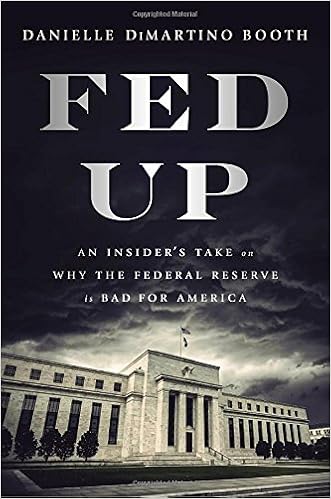
Fed Up by Danielle DiMartino Booth

When the economy crashed in 2008, few people were in a better position than Danielle DiMartino Booth to witness the crisis as it unfolded. At the Dallas Fed, she’d been sidelined for years for warning that housing was in a bubble. That changed very quickly when Lehman Brothers collapsed, and from 2009 to 2015, she became the eyes and ears for Richard Fisher, on of the most important dissenting voices within the Fed.

As Bernanke and Yellen flooded the market with helicopter money, massacred savers and pension funds with a decade of zero percent interest rates, exploded the Fed’s balance sheet to the tune of trillions, and dragged the US economy through one of the worst “recovery” periods in history, Danielle was there, right in the thick of it. And now, she’s written a book to explain what the hell happened—and what happens next.

This was the first in-depth financial book I’ve read. It did not disappoint. Danielle’s writing has a sarcastic and witty edge that is both insightful and incisive. She has the enviable ability to take dry technical analysis and make it entertaining.

At the same time, this is not a lightweight book. To someone who is unfamiliar with the financial world and is still confused by things like the subprime mortgage crisis or the housing collapse, this is not a good entry point (for that, I’d suggest The Big Short).

However, for someone with some passing familiarity on the subject, who understands the basics of finance and the Federal Reserve, and has a growing sense that something, somewhere, is very very wrong in our economy, this book is fantastic.

I’m not in total agreement with Mrs. Booth. The most pertinent point of disagreement was probably this:

Though [Ron] Paul made some good points [with his book End the Fed], America is not a banana republic. It needs a strong and independent central bank.

A country that grants a quasi-government entity a monopoly on the right to counterfeit money is much closer to a banana republic than the likes of the Roman Empire, which endured for one and a half millennia because their monetary system was anchored to gold. But if I only read books or listened to sources that I always agreed with, I would be locking myself in an intellectual prison of my own making.

Towards that end, Danielle DiMartino Booth offers a fascinating and unique perspective that I’ve found to be invaluable. If, like me, you feel that something is deeply wrong in our economy and want to know what it is, or if you believe that we’re on the verge of another economic collapse and want to educate yourself on the things that are driving it, I highly recommend this book.

Also, she posts a regular column on her site! Check it out!

Lights Out by Ted Koppel

About a year ago, while doing research for prepper-type stuff, I came across this interview of Ted Koppel, discussing his book Lights Out.

It piqued my interest, especially since Ted Koppel is not the kind of person I’d peg as much of a prepper/survivalist. The part about the Mormons sounded interesting too, so I reserved the book from my local library and checked it out.

I was not disappointed.

Lights Out is a fascinating examination of the possibility and ramifications of an attack on the US power grid, written by a veteran journalist with dozens of high-level connections across both the government and the private sector. It starts with a tour of the system’s vulnerabilities, quickly moves on to the government’s contingency plan (or lack thereof), then assesses the general preparedness of the rest of the country and what we could expect to happen if the power grid went down. Ted Koppel makes a compelling case that:

The infrastructure of the power grid is highly dependent on the internet.

This dependence has created a series of vulnerabilities that could destroy large portions of this infrastructure.

The private sector has failed to reliably safeguard against these vulnerabilities, mainly because the companies at the failure points have little incentive to develop the safeguards.

State and Federal agencies cannot impose sufficient safeguards because of lobbying efforts and privacy concerns.

Because most of the infrastructure is generations old and not standardized, it would take months or even years to replace key components in the event of a successful attack.

The Russians and the Chinese already have the capability to bring down our power grid, and with the proper expertise it is fully within the capability of rogue states like Iran or North Korea, or non-state actors like ISIS, to do so as well.

The Federal government fully expects an attack on our power grid in the mid to near future, but the various agencies do not have a clear plan for how to deal with such a contingency.

The general US populace is woefully unprepared for such an attack, except for certain communities such as the Mormons. They would not be able to provide for everyone, however, and would probably use force to defend themselves in the event of a collapse.

The only way our society could survive an attack is if everyone who can afford it would store three to six months of food, water, and emergency supplies. Otherwise, if the power grid went down, a collapse would be swift and catastrophic.

Freaky stuff. What was really freaky was the way that people who should have been taking more responsibility, such as the CEOs of major power companies or the directors of Federal agencies such as the DOD or DHS, all seemed content to pass the buck and give Ted Koppel the run-around. He described in detail some of his interviews, and the way in which various officials passed him off to one another like a hot potato.

And then he got to the Mormons.

I have to say, the chapters about the Mormons were some of the more fascinating parts of the book. Ted Koppel only expected to get a phone interview, but instead, Elder Henry B. Eyring flew him out to Utah and gave him a personal tour, including the welfare farms, the distribution centers, the canneries and home storage centers—they even found a local Utah family to cook him a food storage dinner! The gold-ticket treatment definitely impressed him, and that shines through in the book.

Of all the books about Mormons written by non-Mormons, I have to say that Lights Out gives one of the fairest treatments I’ve ever seen. Ted Koppel touches only lightly on church history and doctrine, but he makes it clear how these things tie into our emphasis on self-sufficiency and preparedness. While his impressions are quite favorable, he doesn’t shy away from asking the difficult questions, such as whether we would take up arms to defend our supplies if roving hordes threatened to take them from us by force. As he points out, there’s a great deal of constructive ambiguity from our leaders on that point.

If you’re as interested in potential doomsday scenarios as I am, or in emergency preparedness and self-sufficiency, this is a great book. It raises some frightening concerns without being too alarmist or devolving into sensationalism. For those who are concerned about this sort of thing but don’t have much experience with preppers or prepper culture, the book offers a fascinating look at this growing subculture and the motivations that drive it. Definitely worth a read!