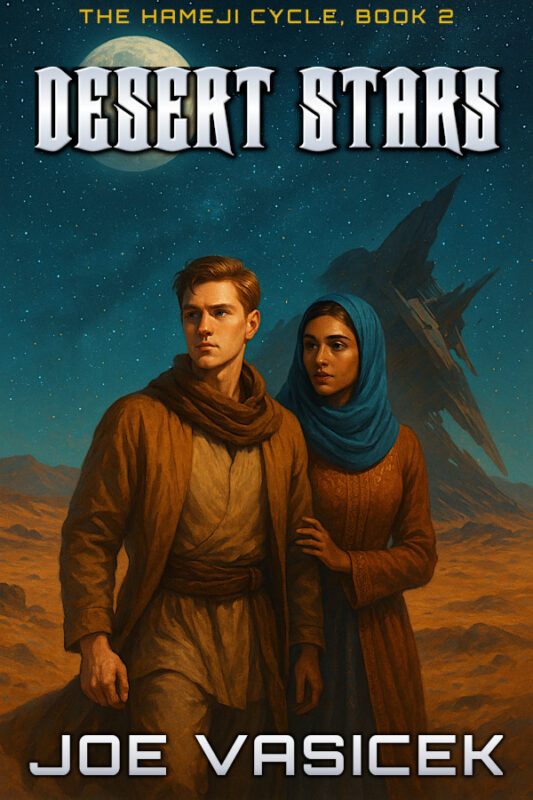
Desert Stars is a character-driven science fiction novel—and the second book in The Hameji Cycle—about displacement, faith, and choosing home in a universe being torn apart by interstellar war. It blends intimate desert-scale storytelling with sweeping galactic stakes, following ordinary people who must decide who they are when their world—and their future—can no longer be taken for granted.
This is a story about pilgrimage and exile, love tested by catastrophe, and the quiet heroism of holding on to what matters when everything else is stripped away.
What Kind of Reader Will Love Desert Stars?
If you love…
- character-driven science fiction that prioritizes relationships, moral choice, and inner conflict
- stories of refugees, exile, and found family set against large-scale wars
- science fiction that treats faith, tradition, and culture seriously rather than cynically
- slow-burn romance grounded in shared hardship and mutual trust
- frontier worlds, desert cultures, and “small people in big events” storytelling
- science fiction that blends space opera scale with intimate, human-scale storytelling
…then Desert Stars is probably your kind of story.
What You’ll Find Inside
At the heart of Desert Stars is Jalil, a desert-raised young man caught between the life he knows and the wider galaxy he barely understands. As war spreads and entire worlds are destroyed, Jalil and Mira are forced into a refugee journey that is part pilgrimage, part flight for survival, and part reckoning with what “home” really means.
The tone is reflective and emotionally grounded, punctuated by moments of intense danger and loss. The pacing alternates between quiet, human-scale scenes—conversations under the stars, hard choices made in private—and sudden, devastating reminders of the larger war closing in. The style leans hopeful without being naïve, and tragic without becoming bleak.
What Makes Desert Stars Different
While Desert Stars shares DNA with classic space opera, it resists the usual power fantasies and chosen-one narratives. The focus isn’t on saving the galaxy, but on saving people—and sometimes not even that is possible. Readers who enjoy the reflective, culture-forward science fiction of authors like Ursula K. Le Guin or character-focused space opera in the vein of Lois McMaster Bujold may find a familiar rhythm here.
Unlike many military or political science fiction novels, this story centers cultural identity, spiritual longing, and the cost of leaving one world behind for another. It also treats faith as a lived, motivating force rather than a background detail or a flaw to be outgrown.
Readers who enjoy the quieter, more contemplative side of science fiction—where worldbuilding emerges naturally through character and culture—will find this book especially resonant.
What You Won’t Find
You won’t find grimdark cynicism, graphic cruelty for shock value, or characters who abandon their moral center for easy wins. This isn’t a nonstop action thriller, nor is it a satire of belief or tradition.
If you’re primarily looking for snarky antiheroes, relentless combat, or stories that dismiss faith as naïve or obsolete, this may not be the right fit.
Why I Think You Might Love It
I wrote Desert Stars at a time when I was wrestling with questions of identity, belief, and what it means to re-enter the world after a period of deep spiritual focus. That tension—between the sacred and the practical, between inherited tradition and an uncertain future—ended up at the heart of this story.
If you’ve ever felt caught between worlds, unsure whether the life you came from can survive the life you’re moving into, I think you’ll recognize something true here. This is a book about choosing to belong—even when belonging comes at a cost.
Where to Get the Book








