Unpublishing “Payday”

In the next few days, I’m going to unpublish my short story “Payday.” It will still be available in the collection In Times Such As These, but I think it’s about time that its run as a free short story single should come to a close.

(For those of you who may not be familiar with how I do things around here, I typically publish my short stories first as free singles, then bring them down when I have enough to bundle into a collection. I’m actually going to take down a bunch of my short story singles over the next couple of weeks as I get ready to publish the second batch of stories that will appear in my fourth collection, Beyond World’s End, sometime this spring.)

I originally wrote “Payday” back in 2017, in response to an anthology call sponsored by the Economic Security Project, an NGO whose stated goal is to bring about a universal basic income. My story (which obviously did not win the contest) showcases all of the dangers of a UBI, such as inflation, supply chain shortages, and the breakdown of local businesses and communities.

I self-published the story in March of 2020, just as the pandemic was getting started. At the time, I had no idea that my warnings and predictions would soon become so prescient. The stimulus checks and unemployment benefits weren’t exactly a UBI, but they were regarded by many as a stepping stone to enacting that policy, and what did they lead to? Inflation, supply chain shortages, and the breakdown of local businesses and communities.

In January 2021, I unpublished “Payday” so as to include it in the collection In Times Such As These the following month, but then the other shoe of the pandemic began to drop. The threat of rampant inflation, which the authorities claimed would be “transitory,” convinced me that this story was too timely to take down, so I put it back up as a free short story single, where it remains until today.

At this point, however, the story is less of a prescient look at a troubling possible future than an obvious, and perhaps too “on the nose” (I tend to get that criticism a lot) extrapolation of our present situation. For that reason, I don’t think it’s worthwhile to keep it up any longer. It had a very good run, garnering more than 5,000 downloads, which isn’t enough to have a significant impact on the national discussion, but is still greater than the circulation of most science fiction magazines and podcasts (including, most likely, the original anthology call).

“Payday” will still be available in my collection In Times Such As These, and I do still plan to keep it on submission to the traditional magazines as a reprint, but the free short story single will come down in the next couple of days. If you haven’t already picked up a copy, now is the time to do it.

A Change in Direction

This is going to be a rather long post. I’ll preface it with some demographic trends among my generation, then tie that in with my situation and how I got here. From there, we’ll see where it goes.

I was born in the early 80s, which technically makes me a Millennial, though it doesn’t always feel that way. Millennials get maligned for a lot of things, which is pretty typical of all generations as they rise, from what I can tell. Civilization is constantly under attack by barbarians, most of whom we call “children,” which is really just another way of saying this:

So how is my generation currently reinventing the world?

Thus far, not very well. The Great Recession hit us just as we were coming of age, and it shows. We were much more likely to move back in with our parents than previous generations. We’re putting off marriage and home ownership, some because we’re more focused on our careers, others because we just can’t seem to launch.

At the same time, not all of this is bad. In spite of the fact that most of us were never taught home economics or personal finance in high school (thanks, Baby Boomers, for all the participation trophies), we are rapidly learning more responsibility than our parents. Where six out of ten Americans would have to beg, borrow, or steal to cover a $500 emergency expense, nearly half of us Millennials have $15,000 or more in savings.

And yet, the problems we’ve inherited are truly daunting. Our national debt is $21 trillion and counting, and without facing a recession, war, or other emergency event, our deficit is still set to exceed $1 trillion per year for the forseeable future. Just this month, we learned that Medicare is set to run out of money in eight years, and Social Security is not far behind that. And don’t even get me started on the house of cards that is our national pension system.

Up until the 60s, previous generations saved and invested so that their children could be better off than they were. The Baby Boomers not only squandered this wealth, but they stole their children’s and grandchildren’s inheritance as well. History teaches us that there will be a terrible price to be paid for all of this. Our parents have proven themselves incapable of doing anything other than kicking the can down the road to oblivion.

That probably sounds more bitter than I intended it to be. Unfortunately, it’s the truth. Our parents just don’t understand the world that we’re living in. We’ve come of age in a world with far less opportunity than they did.

I had a conversation with my mother last year that demonstrates this. My mother likes to make cascarones for special events, like Easter or birthdays. To make them, however, you need a hollowed-out eggshell, which requires removing the yolk and whites in a very particular way. If you’re accumulating shells through normal consumption, it can get to be rather tedious.

One day, I came into the kitchen to find my mother blowing out eggshells and dumping the whites and yolks down the sink. She’d bought a whole bunch of them for 35¢ a dozen, and decided to just make the cascarones all at once instead of accumulating the shells over time. When I saw this, I was horrified.

“How could you waste all those eggs?” I asked.

“It’s not a waste,” she said. “They were 35¢ a dozen.”

“Yes, but we could have eaten them. That’s perfectly good food you’re dumping down the drain.”

She shrugged, as if it didn’t really matter. But I pressed her a bit further, until I came to a disturbing realization:

My mother has never been as poor as I am.

When I pointed this out to her, her answer was even more disturbing. With anger in her voice, she snapped “that’s because you choose to be poor.”
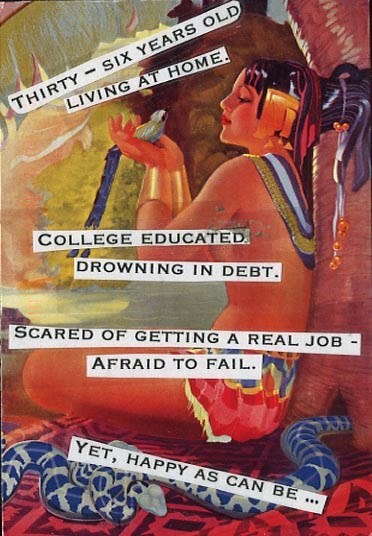
Is that true? Am I, a Millennial, poor because I choose to be poor? Perhaps. I’m not so irresponsible that I won’t own up to my life decisions, which have brought me to this place. But I think there’s this perception in the minds of our parents and grandparents that Millennials are generally like the person who wrote this postsecret above. Drowning in debt, living at home, so afraid to fail that we’ve utterly failed to launch, and yet blissfully oblivious to all of it. Perhaps that’s true for some of us, but not for those who will reinvent the world after our parents are gone.

To be clear, I love my mother and father. I don’t hold any of this against them personally, or anyone else of my parents’ generation (except the politicians who sold our Constitutional birthright, but that’s another rant altogether). Unfortunately, hard truths do not become softer because we choose to ignore them. And hard truth is this:

Hard men make good times.

Good times make soft men.

Soft men make bad times.

Bad times make hard men.
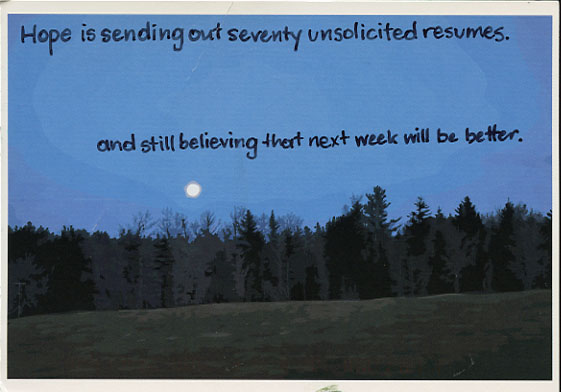
I graduated college in 2010. Through a combination of scholarship money, campus jobs, and (yes) generous parents, I was fortunate enough to graduate without any student debt. At the same time, it was the height of the Great Recession, and jobs were nearly impossible to come by. I can’t tell you how many of my writing friends put their dreams on hold, or abandoned them altogether. Almost all of them.

As a side note, I agree with Mike Rowe that “follow your passion” is bullshit advice. It ranks right up there with “be yourself,” and “you can be anything if you put your mind to it.” Don’t follow your passion. Follow opportunity, and take your passion with you.

But in 2010, I had an opportunity. Without any debt, and without any dependents or other obligations, I decided to pursue a writing career. And unbeknownst to me at the time, the industry was undergoing a revolution that would open the doors to make that possible.

I indie published my first short story, Memoirs of a Snowflake, in March 2011 and never looked back. Since then, I’ve published dozens of novels, novellas, short stories, and other works. It’s been an exhilarating journey. At the same time, it’s been the most difficult struggle of my life. And that is why I must now confront one of my most crippling fears.

Unlike the girl in the postsecret, I am not crippled by the fear of failure. If I were, I would never have published that first story, let alone all the others that followed. Instead, I have a fear of admitting failure, both publicly and to myself. It feels too much like an admission of defeat.

It’s an important distinction to make, though. The Romans admitted failure often and early—it’s how they learned from their defeats, ultimately going on to build one of the most powerful militaries in the ancient world. But they never admitted defeat. Even after Cannae, when Hannibal threatened the republic with utter extinction, the Romans refused to be defeated. And so, while Carthage fell into decline and decadence, the Romans endured until Scipio finally gave them victory at Zama, paving the way for the rise of Western Civilization.

I haven’t had a personal Cannae moment yet, but I do feel like I’ve been fighting a war of attrition. In 2014, the market shifted with the launch of Kindle Unlimited, and I failed to adapt. At that point, I was just on the cusp of going full-time with my writing, though looking back I can see that I didn’t yet have the foundation for a lasting career. Still, to have that dream snatched away when I was just on the verge of catching it, you can understand why I kept plugging along, believing that I was just a month or two from turning things around.

That’s basically what I’ve been doing for the last four years: writing full-time even though the writing doesn’t pay full-time wages. Maybe my mother is right. Maybe I have chosen to be poor.

And yet, while I now believe that I do have the foundation for a lasting career, I need to confront the fact that it may be ten years or more before I achieve it. Should I continue, like so many of my peers, to delay major life decisions until my career reaches that point? Is it worth it to put off marriage, family, and home ownership until my forties or fifties, if that’s what it takes? Or is it time to admit failure so that I can leave this dead end and find another way?

Back in 2010, I had no plan B. It was the Great Recession. I didn’t have a day job because I couldn’t find one—hardly anyone could. And from 2013 to 2014, writing paid well enough that I didn’t need one. Things were looking up, and I was just a couple months away from a sustainable long-term career.

Well, it’s time to admit that that line of thinking has turned out to be a trap. I’m approaching my mid-thirties and I’m still single and poor. I need some kind of long-term backup, because I can’t count on the writing career to take off like I need it to, at least not anytime soon.

So I’ve moved my writing onto a part-time footing. I’m limiting the number of words I write each day, leaving time for other pursuits. And I’m looking for a day job, preferably one that teaches me something useful and pays well enough to make ends meet.

I haven’t been defeated yet, though. Failure is not final until you decide to give up. I have not given up, and will continue to write, even if only on a part-time basis. And when I am making enough to go full-time, I have the foundations in place to do so.

In the meantime, though, I’m not going to put my life on hold for a dream.
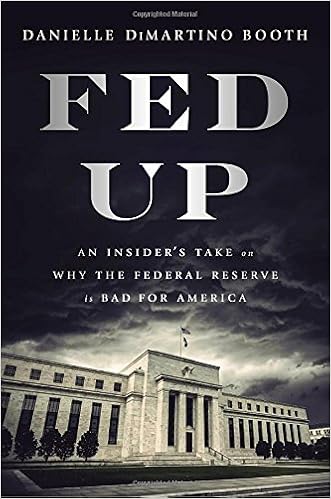
Fed Up by Danielle DiMartino Booth

When the economy crashed in 2008, few people were in a better position than Danielle DiMartino Booth to witness the crisis as it unfolded. At the Dallas Fed, she’d been sidelined for years for warning that housing was in a bubble. That changed very quickly when Lehman Brothers collapsed, and from 2009 to 2015, she became the eyes and ears for Richard Fisher, on of the most important dissenting voices within the Fed.

As Bernanke and Yellen flooded the market with helicopter money, massacred savers and pension funds with a decade of zero percent interest rates, exploded the Fed’s balance sheet to the tune of trillions, and dragged the US economy through one of the worst “recovery” periods in history, Danielle was there, right in the thick of it. And now, she’s written a book to explain what the hell happened—and what happens next.

This was the first in-depth financial book I’ve read. It did not disappoint. Danielle’s writing has a sarcastic and witty edge that is both insightful and incisive. She has the enviable ability to take dry technical analysis and make it entertaining.

At the same time, this is not a lightweight book. To someone who is unfamiliar with the financial world and is still confused by things like the subprime mortgage crisis or the housing collapse, this is not a good entry point (for that, I’d suggest The Big Short).

However, for someone with some passing familiarity on the subject, who understands the basics of finance and the Federal Reserve, and has a growing sense that something, somewhere, is very very wrong in our economy, this book is fantastic.

I’m not in total agreement with Mrs. Booth. The most pertinent point of disagreement was probably this:

Though [Ron] Paul made some good points [with his book End the Fed], America is not a banana republic. It needs a strong and independent central bank.

A country that grants a quasi-government entity a monopoly on the right to counterfeit money is much closer to a banana republic than the likes of the Roman Empire, which endured for one and a half millennia because their monetary system was anchored to gold. But if I only read books or listened to sources that I always agreed with, I would be locking myself in an intellectual prison of my own making.

Towards that end, Danielle DiMartino Booth offers a fascinating and unique perspective that I’ve found to be invaluable. If, like me, you feel that something is deeply wrong in our economy and want to know what it is, or if you believe that we’re on the verge of another economic collapse and want to educate yourself on the things that are driving it, I highly recommend this book.

Also, she posts a regular column on her site! Check it out!

The thousand year view

How will your life impact the world in a thousand years?
It’s an easy question to dismiss. After all, how can one person possibly shape the course of history? Even if we accept the impact of certain great men, how can we have the hubris to think that we might one day join them?

But the truth is that our lives have more impact than we realize. Each one of us is literally a product of our ancestors. Their decisions, for good or for evil, have put us where we are today. We also have a hand in shaping the people we come into contact with. That impact can be felt through multiple degrees of separation—and how many degrees does it take to encompass the world?

In the year 1017, Europe was rising out of the ashes of the Viking age. Kievan Rus was ascendant in the east, vying with the Romans who dominated the religion and commerce of Europe (we know them today as the Byzantines). However, tensions were rising between Constantinople and the bishopric of Rome, where one of the last vestiges of the Roman state in the West would soon break communion and form the Catholic Church. Meanwhile, an apocalyptic Muslim death cult known as the Fatimids had swept from North Africa all the way to Baghdad, the cultural and scientific capital of the world. From the harsh steppe wilderness of central asia, the Seljuk Turks were building an empire that would save Baghdad from destruction, while in China, the Song dynasty had invented the first paper currency.

In short, it was a completely different world. How different will things look a thousand years from now?

By the year 3017, we will probably have established an independent colony on Mars. Other parts of the solar system will probably also be colonized, and we may have even begun our expansion to the stars. After all, faster than light starship drives are about as fantastic to us as cars, airplanes, and space stations would be for medieval serfs.

It is highly unlikely that the United States—or any other country, for that matter—will exist with its current borders. In fact, it’s highly unlikely that the majority of countries extant today will even exist at all. China is probably an exception, but let’s not forget that China is a civilization pretending to be a country.

Pessimists will say that there’s a good chance humanity won’t exist at all. They point to things like climate change, pandemics, and global war as challenges we may not overcome. But in the last millennium, we faced all those challenges and rose above them (little ice age, Mongol hordes, black plague). Same with the millennium before (extreme weather and crop failures of 535-536, Muslim conquests, plague of Justinian).

So how will your life impact the world a thousand years from now? What sort of impact do you want your life to have? How have the things you’ve done today brought you closer to leaving that legacy?

I’ve thought about this a lot over the past few weeks. I want to impact the world through my books, but it’s unlikely that most of my books will still exist. My family and descendants will, though. I want to leave them with the best foundation I can. Here’s how I plan to do it:

Step One: Master the Basics of Provident Living

Provident living is more than just learning how to do your laundry and keep up with the maintenance of your car. It’s learning how to live sustainably, with a degree of self-reliance that can see you and the ones you love through hard times. It’s all the stuff I’ve been writing about in the Self-Sufficient Writer blog series.

I’ve made a lot of progress in this area, but there’s still a lot of progress left to make. Here are the next few steps I want to take in this area:

  1. Establish a rotating 90-day food storage for dry goods.
  2. Establish a herb garden.
  3. Expand food storage to canned goods.
  4. Buy a chest freezer and expand to meats and dairy.
  5. Plant a garden and expand to fresh fruits and vegetables.
  6. Learn how to can.
  7. Learn how to hunt.
  8. Begin keeping livestock (chickens, goats, etc).

A lot of these steps are going to have to wait until I have my own land, which brings us to:

Step Two: Live Debt-Free and Own the Place Where You Live

When you live on someone else’s land and owe them a portion of your labor, that’s a form of serfdom. In both historic and modern times, this has been the norm for the vast majority of people.

It shouldn’t be.

When my ancestors came from Europe to the United States, one of the first things they did was buy land. There was a reason for this. In the old country, they were serfs. They paid the corvée. They were not free.

They knew that unless they lived on land that they owned, in a home that was theirs, their children would not be free either.

We’ve enjoyed a century of prosperity in the United States. It’s led us to believe that home loans and mortgage payments are normal. They aren’t. When your home is the collateral for a loan you’ve taken from the bank, and you spend most of your adult life paying it back to the tune of 250%, that is a modern form of serfdom.

Until you own it outright, your house is a liability, not an asset. And in some places, true ownership is impossible. After all, if the government has the power to seize your house for non-payment of taxes, did you really ever “own” it to begin with?

It’s a similar thing with debt. All debt is a form of bondage. “Leverage” is when someone else has control over you or something that belongs to you. Unless you can get out from under it, you will never truly be free.

If most of your life is spent in serfdom and bondage, the thousand-year impact of your life will be muted.

The Habsburg dynasty started with a small castle on the top of a hill. From that starting point, the family went on to shape the development of Europe into the modern world. The castle was so important in that effort that the family took their name from it.

I know how to live debt-free. I’ve been doing it for several years. But I do not currently live in a place that I own. That is my overriding goal: to own the place where I live within ten years.

The government isn’t making it easy. Neither are the central banks. A decade of 0% interest rates has ravaged the middle class. As a direct consequence, home ownership rates are dropping to historic lows. 70% of Millennials have less than $1,000 saved for a down payment on a house, while at the same time, the helicopter money from the Fed has inflated a new housing bubble larger than the one that burst in ’08. In California, Google employees with six-figure incomes are living out of RVs because they can’t afford to buy a house.

It’s brutal. These are the same economic pressures that led to the rise of medieval serfdom in Europe. But there are also opportunities, for those who know how to take advantage of them. Which leads to:

Step Three: Build Multi-Generational Wealth

Poor people buy luxuries. Middle class people buy necessities. Rich people buy investments. If I want to leave something behind for my children and descendants, I need to master the skills of investing and managing wealth.

This goes back to the thousand-year view. The biggest impact I’m probably going to make on the world is going to be through my children and descendants. Raising them will be the most important investment I can ever make. I want to give them a life of opportunity, so that they, like me, can make a thousand-year impact on the world.

This is what my ancestors did for me. My Mormon ancestors crossed the plains in the Willie handcart company so that their descendants could grow up in Zion. My first-generation immigrant Czech ancestors invested in Texas farmland that still pays a small dividend to their descendants (greatly increased now because of oil royalties). There are many other countless others who made great sacrifices so that I could enjoy a life of privilege and opportunity. I’m sure that’s not unique to me.

We seem to have forgotten, here in the United States, how important it is to make sure that our children enjoy better lives than we have. To some generations much is given, while of others much is required. I fear that we are transitioning from the former to the latter. Nations are born stoic and die epicurean, surrounded by mountains of debt.

This is why it is so important to build wealth: not for your own personal consumption, but for the security of your children and descendants.

The most important investment you can make is in your education. If I’m going to develop these skills, that’s what I need to do: invest in my own financial education.

I also need to learn by experience, so I’m taking $100 of my book earnings each month and investing them. I’ll probably experience a couple of big losses, but that’s called paying tuition. The knowledge I gain from doing this will hopefully help to accomplish this goal: to build wealth that will bless the lives of my children and descendants for generations to come.

A lot of things fall into perspective when you take the thousand-year view. When you focus on the challenges of the present, it’s easy to become pessimistic, but when you take a clear-eyed look at the future—not just the immediate future, but the long-term future as well—you cannot help but take an optimistic view.

How will your life impact the world in a thousand years?

This guy hits the nail on the head

Financialization is what happens when the people-in-charge “create” colossal sums of “money” out of nothing — by issuing loans, a.k.a. debt — and then cream off stupendous profits from the asset bubbles, interest rate arbitrages, and other opportunities for swindling that the artificial wealth presents. It was a kind of magic trick that produced monuments of concentrated personal wealth for a few and left the rest of the population drowning in obligations from a stolen future. The future is now upon us.

Quite a bit of that wealth was extracted from asset-stripping the rest of America where financialization was absent, kind of a national distress sale of the fly-over places and the people in them. That dynamic, of course, produced the phenomenon of President Donald Trump, the distilled essence of all the economic distress “out there” and the rage it entailed. The people of Ohio, Indiana, and Wisconsin were left holding a big bag of nothing and they certainly noticed what had been done to them, though they had no idea what to do about it, except maybe try to escape the moment-by-moment pain of their ruined lives with powerful drugs.

And then, a champion presented himself, and promised to bring back the dimly remembered wonder years of post-war well-being — even though the world had changed utterly — and the poor suckers fell for it. Not to mention the fact that his opponent — the avaricious Hillary, with her hundreds of millions in ill-gotten wealth — was a very avatar of the financialization that had turned their lives to shit. And then the woman called them “a basket of deplorables” for noticing what had happened to them.

The accumulated monstrous debts of persons, corporations, and sovereign societies, will be suddenly, shockingly, absolutely, and self-evidently unpayable, and the securities represented by them will be sucked into the kind of vortices of time/space depicted in movies about mummies and astronauts. And all of a sudden the avatars of that wealth will see their lives turn to shit just like moiling, Budweiser-gulping, oxycontin-addled deplorables in the flat, boring, parking lot wastelands of our ruined drive-in Utopia saw their lives rendered into a brown-and-yellow slurry draining clockwise down the toilet of history.

I especially got a kick out of that last part.

Seriously, though, this guy hits the nail squarely on the head. We’re headed toward a massive economic reset, which is going to transform the world as we know it. I was in high school when the 9/11 terrorist attacks happened, and the Great Recession had a much bigger impact on my life. When the Greater Recession hits, it’s going to be a lot worse.

That said, I disagree that the only thing we can do is to sit back and watch the world burn. Every problem is also an opportunity. The bigger the disaster, the more opportunities that open up after it.

Without a doubt, though, now is the time to prepare.

3am thoughts, or why everyone says to be an accountant (Blast from the Past: October 2013)

A lot of my blog posts this week had to do with money, wealth, and politics, so when I was searching for an old post to bring back, this one made me stop and reflect for a while.

My opinions and perspective have changed a bit since I wrote it, but the fundamental message is still one that I agree with. I’ve trimmed out some of the parts where I think I was wrong, and left the stuff that still resonates. Hopefully it resonates with you as well. Either way, feel free to let me know.


I’ve been reading in bed on my smart phone recently, which is probably a bad idea because it makes it harder to go asleep. At the same time, it tends to get my mind rolling, and at 3am my thoughts tend to go some really interesting places. Sharing those thoughts is probably going to get me into trouble, but hey, you might find them interesting, so why not?

When I was eight years old, I knew I was going to be a writer.  There was never any question about that. I spent all my free time making up stories.  However, I knew I never wanted writing to be my job, because 1) everyone hates their jobs, and 2) everyone knows that writers can’t make a decent living. Even at eight years old, I had bought into some of society’s most pervasive myths about jobs, careers, and how to make money.

Americans are generally horrible with money. We struggle to keep budgets and put all sorts of things on credit, and pay more than twice what our houses are worth by signing mortgages we barely even read. Because we’re so horrible with money, we tend to see it as a magical force, something that can solve all our problems and make us happy. Rich people are like wizards or sorcerers, so far above the rest of us that we can hardly fathom their ways.

Nowhere is this stupidity more apparent than in the fact that most of us spend our lives working for some sort of hourly or salaried wage. Wages and salaries are basically the same, in that they convert time into money. That’s why we all measure income in terms of dollars per hour, or salary per year.  But for anyone who understands how money works, that is stupid, stupid, stupid, stupid. Money comes and goes, but time? Time is one of the most finite and precious resources known to man.

All of us are going to die someday. Most people are scared shitless by that fact, so we try to ignore it or put off thinking about it until we have to. But not all of us get the opportunity to put our affairs in order before we die. And even if we do all live to be centenarians, our time on this Earth is still finite. It’s non-renewable, too—you can’t go back and relive that day or that hour or that minute once it’s passed.

Converting time into money is basically trading gold for lead, or wine for water. Yet that’s exactly what we do, because money is this strange, magical force that so few of us understand.

Questions like “where do you work?” “what is your job?” and “what do you make?” are much more common than “what do you do for a living?” That’s because most of us have bought into this idea that money comes from working for someone else. While we’re on the clock, the company owns us and anything we produce. That’s the pact we make in exchange for this magical substance we call money.

It wasn’t until college that I started to become disabused of my childhood notions about writing for a living. First, I came to realize that lots of people love their work—that just because you do something as a job doesn’t mean that you’ll come to hate it. But it wasn’t until I graduated unemployed in the middle of a recession that I was disabused of the notion that writers can’t make a living.

People say that about every career—that is, every career except accounting. That’s because accountants are the ones who count the magical money. They’re the ones who know where it comes from. Their jobs are the ones that the people with the magical money will always need.

But there are other ways to make money—thousands of ways. Millions, even. It’s not about time it’s about producing something that people want and need. But when you’re working for yourself, that’s hard. You have to own up to your work—the failures as well as the successes.

When you work for a corporation, it’s easy to shift the blame. It’s a rare case where one person is solely responsible for bringing down the whole collective enterprise. But when you work for yourself, you can’t blame anyone else when things go wrong. You’ve got to take the risk.

That’s why everyone says that you can’t make a living as a writer. They say the same thing about any career where you strike out on your own.

In the end, though, it’s all just silly. Money isn’t a vague magical force—it comes from the value you create. It comes from producing something that people are willing to pay you for. And you don’t need to sell your time at $11 an hour or $44,000 a year to do that. You just need hard work, a great idea, and the ability to learn from your mistakes.

So can you make a living pursuing your dreams? The answer to that question depends entirely on you.

The end of politics in America, part 2

How did Trump become the leader of the most powerful nation on Earth?

A lot of people are asking that question, while a lot of other people already know (hint: it wasn’t the Russians). But I want to get beyond the circus that is Washington DC, and answer that question by asking another:

Can politics solve our nation’s greatest problems?

I think there is a dawning realization among Americans that it doesn’t really matter who lives on 1600 Pennsylvania Avenue. Republican or Democrat, the outcome is pretty much the same.

Never at any point in living memory have we been so politically divided, but the party distinctions have become increasingly meaningless. Trump campaigned on providing universal healthcare. Clinton campaigned on escalating our military involvement in Syria. Which one was the Republican, and which one was the Democrat?

In the previous post, I said:

I am convinced that the grand key to understanding United States history in the 20th century—and by extension, current events in the 21st—is a deep knowledge of monetary policy and the financial system.

What is that system?

It is a system of debt. Pure and simple. We have turned our debt into money, and made every other form of money illegal. And the rest of the world has followed us gleefully off the cliff.

Washington is bankrupt. Literally bankrupt. Every year, the Treasury runs an internal audit, and every year, that audit fails. The government’s single biggest asset on their balance sheets is… $1 trillion in student loan debt. Social Security is insolvent and, according to the government’s own reports, will completely run out of money in less than twenty years.

So if Washington is bankrupt, why haven’t they declared bankruptcy? Because they can just keep printing money through the Federal Reserve.

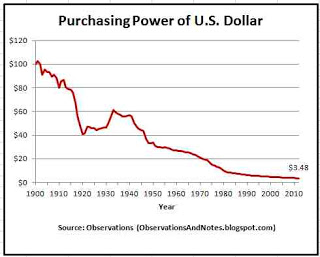
Because of this, the US dollar has lost about 97% of its value since the Federal Reserve system was established in 1913. A time traveler from the new Wonder Woman movie couldn’t buy $5 worth of stuff with $100 of our dollars today. And to keep up this Ponzi scheme we call “money,” Washington has gone nearly $20 trillion in debt.

How much longer can we keep that up?

If we could grow our economy fast enough, and never stop growing, we could keep up the Ponzi scheme for a very long time. But growth is no longer a solution, because the debt is bigger than the economy. The debt is the reason we can’t grow.

If we could innovate fast enough, we could lower the cost of living so much that the poor don’t realize that they’re poor. To some extent, we’ve already done that. But the effects are too uneven: startphones and computers are super cheap, but houses and health care are practically unaffordable.

Which brings us to serfdom.

Let’s go back in time a couple thousand years. Before the days of the empire, the Roman dream was that every family would have their own plot of land, making them independently wealthy, and the head of every family would take up arms in defense of his country whenever called upon by the state. This was not all that different from the Jeffersonian ideal of the yeoman farmer.

Then the Punic wars happened, which, for the Mediterranean world, was basically the ancient WWI and WWII. As Rome became a major world power, the military-industrial complex made a few select elites fabulously wealthy, who kept the masses pacified with welfare handouts.

But the endless cycle of foreign wars came at a heavy cost. Decades of budget deficits and an unsustainable national debt forced the Romans to debase their currency, which completely collapsed. Trade halted, the middle class lost everything, and the 1% became fantastically wealthy, buying up all the real estate and forcing everyone else out. The Roman dream was dead, replaced by a form of bondage called serfdom.

Serfdom came in a number of different flavors:

  • Slaves, who had always existed in the Roman world and continued for some time in the Medieval. Landlords got tax benefits for holding slaves.
  • Villeins, who were bound to the land and worked for the landlords. In exchange, they enjoyed protection and tax relief. Theoretically.
  • Coloni, or sharecroppers, who leased land in exchange for labor and a portion of their harvest. They were eventually taxed out of existence.
  • Freemen, who technically weren’t serfs, but were only a raid or a bad harvest away from becoming one. They were basically renters.

The corvée was a tax, paid in labor, that non-landowners owed by law. Basically, for every XX days out of the year, you worked for the state. It continued even after the abolition of serfdom, until the revolutions of 1848. My Czech ancestors paid the corvée, which is probably one of the reasons they and their children emmigrated to the United States.

But wait—we pay the corvée too! It’s called the federal income tax: for XX days out of the year, you work for the state. The taxes are even higher if you’re self-employed or a small business owner.

Except… not everyone pays the income tax. In fact, nearly half of Americans pay no income tax. Why? Because the politicans know that they can use the welfare system to buy votes. If you’re on welfare, who are you going to vote for: the guy who plans to cut your handouts, or the guy who says that the wealthy should pay their “fair share”?

And sitting at the top of it all are the central bankers.

The medieval serfs were bound to the land and worked for the landlords. In contrast, modern debt-serfs are bound to their debt—national debt, student loan debt, mortgages, consumer debt—and work for the banks.

So I ask again: can politics solve this problem? Can we find a political solution to our national debt?

Unfortunately, there is only one political solution: default on the debt. If we default on entitlements like social security, there would be chaos, riots, and anarchy… and we still wouldn’t pay down hardly any of the debt. If we defaulted on our treasury bonds, it would send a ripple of financial panics across the world, destabilizing the flashpoints in Europe and Asia before returning to our shores. Stocks, mutual funds, and pensions would all be wiped out. Almost the entire savings of the Baby Boomer generation, gone.

But there is another option, though it’s hardly a “solution”: kick the can a little further down the road. Print the money, devalue the debt, and inflate the currency to oblivion.

This is the path we’ve been on since 1913. This is the reason why our dollars buy a little less each year. And this is the reason why we, as a nation, are backsliding into serfdom.

We’ve seen this happen before. Rome fell because of it. Europe came under the yoke of serfdom as a result of it. Our ancestors fled to this country to escape it. And now, we are repeating it.

This isn’t a political problem: it’s a math problem. The numbers just do not add up. The next financial crisis could very well be the “extinction level event” that puts the final nail in the coffin of the US dollar, throws the world into a global war, and sends the United States into its greatest existential crisis since the Civil War. The Republicans don’t have the solution, and neither do the Democrats, because the problem is not political.

This is what the end of politics in America looks like. We’re watching it happen in real-time. Our politicians have become the clowns in the bread-and-circuses routine. Meanwhile, the central bankers are shackling us in chains with every dollar that passes through their hands.

What are you going to do about it?

The end of politics in America, part 1

I am convinced that the grand key to understanding United States history in the 20th century—and by extension, current events in the 21st—is a deep knowledge of monetary policy and the financial system.

In 1913, two things happened: Congress established the Federal Reserve, and the Constitution was amended to allow for an income tax. This established a new monetary system in direct opposition to the gold standard, which in turn had replaced the bi-metallic standard established by the Constitution. In time, the Federal Reserve system would replace the gold standard altogether, becoming our sole form of legal tender.

Before the Federal Reserve system, every dollar represented a fixed weight of gold—a real, physical asset. Today, what does a dollar represent?

Dollars are created when Washington runs a deficit. The government spends more money than it takes in through taxes, so it has to borrow the difference. It does this by issuing treasury bonds, which it sells to the banks. The Federal Reserve then buys them, but with money that it creates by issuing a check against an account with nothing in it. In other words, the Fed creates money out of nothing to buy our national debt.

These dollars, called “base money,” then trickle down into the banking system as government contractors deposit their money. Through fractional reserve banking, this base money multiplies by ten-fold, or even a hundred-fold or more.

In other words, every dollar in existence represents a dollar’s worth of debt. Some of it is our national debt, owed by current and future generations of taxpayers. The rest of it is owed by private citizens in the form of mortgages, car loans, student loans, credit cards, etc.

But if every dollar represents a debt, where do you get the money to pay the interest?

You borrow it, of course. The only way to create more money is to create more debt. This is why the US dollar has lost 97% of its value since the creation of the Federal Reserve. This is why inflation has been a fact of life for the past century. This is why income inequality has widened so dramatically. And this is why our politics have become so insane.

I titled this post “The end of politics in America” because I’ve come to realize that the greatest problem facing this country is not political, and that no political solution can fix it. The problem is economic. It’s financial.

Our country has bought into a massive Ponzi scheme that we like to call “money.” We measure our wealth in a debt-based currency that steals prosperity from future generations and transfers wealth and power to an elite class of unelected bankers and bureaucrats. As with every Ponzi scheme, it only works so long as new capital enters the system. This happens in three ways: growth, innovation, and serfdom.

Growth is obvious. So long as our economy is growing, debt isn’t a problem because we’re creating more wealth to pay it off with. This is where debt actually makes sense: when it goes towards building future prosperity. An example of this that people often point to are the infrastructure projects of the 1950s.

Unfortunately, when your debt level reaches a certain point, it goes from stimulating growth to inhibiting it. Our debt-to-GDP ratio is now 104.17%. That means that if we took the sum total of all the goods, services, investments, tax revenue, deficit spending, and net exports, and we spent it ALL on paying off the debt, we still couldn’t pay it all off.

Think about that. Your entire paycheck. Warren Buffett’s paycheck, and all the millions he made last year on his investments too. All of the money spent on Amazon. All of our grocery bills. All of the ticket sales for every blockbuster movie, and the production costs as well.

Even with a whole year of that, you still couldn’t pay off the national debt.

Ever since the Great Recession, our GDP has never seen more than 3% annual growth. This, in spite of deficit spending that from 2009 to 2012 was higher than the deficit we ran in World War II! We have gone even deeper into debt than we did to defeat the Nazis, and all we got was this crappy economy.

We’re not going to grow our way out of this debt burden. The debt is the reason the economy can’t grow.

Innovation is, in some ways, another form of growth. Instead of making more mousetraps, you’re building better ones. This is why computers are cheaper now than they were in the 1980s. This is why we have no idea how people survived before mobile phones.

Twenty-five years ago, data storage cost nearly $10,000 per gigabyte. Email was a novelty. Mobile phones were revolutionary. Only the military had GPS. Satellite imagery was top secret spy stuff. “Facebook” was a printed directory of addresses and phone numbers for your local college or high school.

And yet, with all of these incredible innovations in just the past few decades, does it feel that your life has gotten any easier? Is it any easier to make ends meet? Have we entered the leisure society yet?

The truth is that we’re caught in a tug-of-war between inflation and innovation. In some areas, innovation is winning. This is why computers and smart phones are getting cheaper. In other areas, inflation is winning. This is why cars and housing are so much more expensive.

Can we innovate our way out of our national debt burden? Not without fundamentally changing our monetary system first. Until then, we’re just putting patches on a broken operating system. We can delay the inevitable collapse for a while, but not forever.

Which brings us to the third way our Ponzi money stays afloat: serfdom.

I have a lot more to say, but this post has gone long enough and already sucked up way too much writing time. I’ll post part 2 sometime next week, taking the risk that events in Washington will make me regret the post title. But I don’t think that they will. Hopefully you’ll soon see why.

Writing is not a business

I recently read Rich Dad, Poor Dad by Robert Kiyosaki. It’s a fantastic book, not only because it gives you a basic education on financial literacy, but because it gives you a solid foundation for making money in general. It’s one of those books that really deserves its bestseller status.

About midway through reading it, I realized that I’ve been thinking all wrong about my writing. Everyone always says that if you want to write professionally, you should treat your writing as a business. But that’s not entirely correct.

Writing is not a business, it is an investment. Publishing is a business.

The basic argument of Rich Dad, Poor Dad goes like this: if you want to be wealthy, don’t work for money—make your money work for you. How? By owning more assets than liabilities. An asset is something that puts money in your pocket. A liability is something that takes it away.

When you write a book, you are creating an asset. A book is an intellectual property that generates money. Dean Wesley Smith compares it to a piece of pie in a magical bakery, where you can cut infinite pieces for your customers. With online publishing through ebooks and print-on-demand, that’s not a bad analogy.

If I were to cease all of my publishing activities right now, including all marketing and promotion whatsoever, my books would still generate income. It probably wouldn’t be a lot, but it would still be something. Even starting from zero, with a single book on Amazon under a totally unknown name, over time it will generate a small trickle of income.

A book is an asset. Writing is how you create that asset. Publishing is how you service that asset to make it more profitable.

As an indie writer, I am my own publisher. The business that I own is a publishing business, not a writing business. It’s a subtle but important distinction. I could still create books if I weren’t my own publisher, but at that point I’d be a contractor, not a small business owner.

Writers are not paid by the hour. As an indie, I’m still earning money on work I did ten years ago, and I fully expect to continue earning income on that work for the rest of my life. That’s because writing is an investment. Not a job. Not even a business. An investment.

Which is not to say that the publishing aspect—or in other words, the business aspect—is less important. Quite the contrary. A rental property is an asset, but it won’t make any money unless you find renters and take care of the upkeep. Similarly, a prime plot of farmland is an asset, but it won’t make any money unless you work it.

So how do you “work” your books? By publishing them, of course. Publishing is your business. This includes marketing, promotion, branding, and the like. Publishing is the business that makes your assets—your investments—profitable.


The implications of this are really interesting. For example, suppose you have a book that doesn’t sell very well, or that gets a bunch of negative reviews. Does that make you a failed writer? Does it spell doom for your career? It’s easy to think so if you think of writing as your business.

But when you think of writing as an investment, everyone changes. Got a book that tanked? That’s okay, it’s just that book. Every investor gets it wrong every once in a while. Learn from the mistake and pick a better investment next time.

If all your books are tanking, is that a sign that you’re just not cut out for this writing thing? Possibly… or it could just be that you need to work on your publishing. Even the richest farmland needs to be tilled, and fertilized, and watered properly. Perhaps you just need to learn how to market better, or brand your books better, or do a better job of finding and connecting with your readers.

On the flipside, suppose you have a book that used to do well, but now it isn’t selling as well as you would like. You’ve clearly done a good job of marketing it in the past, but what can you do now? Market it even harder? Or recognize that this is just a normal part of the investment cycle and go out to develop a new asset?

If writing is your business, then the success or failure of your books is a direct reflection of yourself as a writer. With that kind of mindset, it’s easy to fall into some traps. On the one extreme are those who believe that publishing well is secondary to writing a good book, and that therefore they should devote the bulk of their time and energy to writing. On the other extreme are those who seek validation so hard that they put all of their effort into the publishing aspect and neglect the writing. The truth is NOT somewhere in the middle, because both extremes grow out of a faulty premise: that writing is your business.

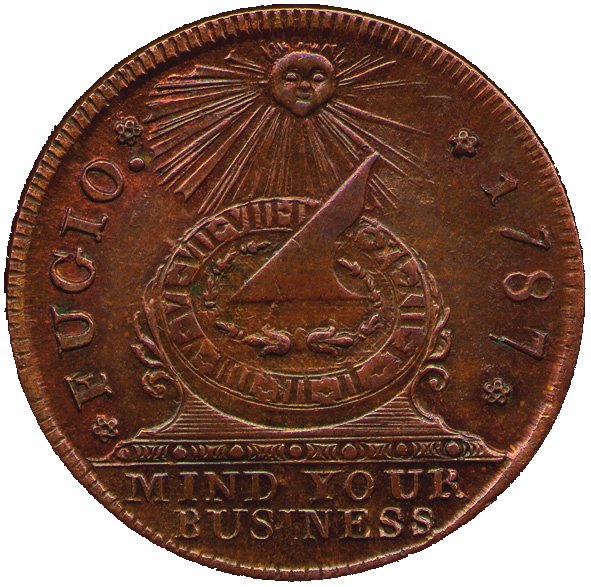
This is the Fugio cent. It was commissioned by the Continental Congress before the ratification of the Constitution, and designed by Benjamin Franklin. Fugio means “I fly,” referring to the sundial, which represents time. Taken with the inscription below, it is a reminder that we can all leave the world a better place by doing our best in whatever line of work we choose to pursue.

For many of us, writing is more than just a hobby, or a job, or even a career. It is a vocation. It is our calling. And yet, we live in a commercial world, where the price of a thing is often conflated with its value. How, then, can we best fulfill our calling as writers? By ignoring the demands of the market? By fancying that our books are simply unappreciated by those of inferior tastes? Or by losing sight of our calling for that lucre that will perish with us?

Benjamin Franklin’s message is that we can best fulfill our calling by pursuing excellence in every aspect of it. That includes the commercial aspect as well as the artistic, the practical as well as the spiritual. When we truly learn how to excel, we will see that there is no contradiction between the two sides.

Writing is our calling. Publishing is our business. Our books are investments, many of which may very well outlive us. By understanding this, I firmly believe that we can mind our business as well as Franklin admonished us, and truly fulfill our calling.

A fascinating journey of discovery

I had a really fascinating experience last year that has turned into something of a journey of discovery. It’s still ongoing, and I’m sure it will affect my writing in years to come.

It started with family history. Long time readers of this blog will know that I’ve been interested in family history for some time. My sister is a professional genealogist who specializes in Czech records (she keeps a blog here), and I got started by helping her.

In the United States, the census records are only useful to about 1850. Before that, you have to get into land records, probates and wills, and local courthouse type stuff to really go anywhere. But in the Czech lands, the Catholic Church has kept meticulous parish records going back to the 15th and 16th centuries. They’re handwritten in old German and totally unindexed, but the books are all digitized and available online.

As I worked on this research with my sister, I started to wonder: how far back can we push these lines? What are the limits?

The Czech lands were part of the Holy Roman Empire, under the Austrian Habsbugs. In the 15th century, the Hussite Wars shook things up quite a bit, and that’s about as far back as the Catholic parish records go. But the noble genealogies were very well kept, and go back quite a bit further. If one of your lines connects to the nobility (which is very possible, given how many bastard children were running around), you can push back really far.

But past the 8th century, things start to get sketchy. Most of the nobility in Europe are descended from the barbarian tribes who invaded the Roman Empire: the Goths, the Franks, the Vandals, etc. Same thing with the Slavs and the Byzantine Empire, though the Byzantines held out much better than the Western Roman Empire (it was the Turks, not the barbarians, who eventually did them in).

The trouble is that when these barbarians took over, they tried to establish their legitimacy by fabricating genealogies. Plenty of royal European lines go back all the way to Adam and Eve, but how reliable is that really? As rulers of Christian lands, of course they would try to connect themselves to famous characters from the Bible.

The Dark Ages might not be as dark as we think they are, but in terms of records and record-keeping, they certainly are. The largest and most civilized empire in the world had just collapsed, with barbarians running amok in the countryside and the Persians threatening the last vestiges of the empire in the east. Very few historians have documented this era, and it was a huge dark spot in my own understanding of the world.

So I set out to study it. I scoured Wikipedia, subscribed to the Western Civ podcast, and listened to the entire History of Rome by Mike Duncan (excellent podcast, by the way). The Roman Empire had dominated Europe right up to the early middle ages, and I wanted to learn why it had fallen.

That led to a journey of discovery all in itself. Roman history is a fascinating subject in its own right, and the four or five centuries from the Punic Wars through the reign of Marcus Aurelius are very well documented. Rome faced a lot of challenges, and even a few existential threats, but for more than a thousand years they dominated the known world.

So why did they fall?

The more I studied about the Romans, the heavier this question weighed on me. I learned about Diocletian and the Tetrarchy, the crisis of the third century, and Constantine the Great—a period of Roman history that was much less familiar to me. And then things started to click.

My Czech ancestors were serfs. They emmigrated to Texas shortly after the last vestiges of serfdom were abolished in 1848. Under serfdom, they were little better than slaves. The land they lived and worked on was owned by the Hukvaldy Estate, and they were bound to it by feudal law.

When Diocletian became Augustus, the Roman Empire was reeling from half a dozen existential crises, including an economic collapse. The money was so worthless, most of the empire had resorted to a barter economy. Diocletian established a system of exchange where people could pay their taxes with trade goods rather than money. However, the only way for that system to work was 1) for everyone to take the profession of their parents, and 2) for no one to move without Imperial permission. Otherwise, you might have too many pig farmers in one province and not enough blacksmiths in another.

In other words, the system of feudal serfdom that my ancestors labored under had its roots in the reforms of Diocletian. But it went much deeper than just one man. Diocletian reforms were necessary because the Roman economy had collapsed, and the economy had collapsed because for more than a hundred years, the Empire had been in massive debt, and had serviced its debts by devaluing its currency.

Sound familiar?

The Roman Empire fell because of deficit spending, government debt, and currency devaluation over the course of several generations. In 1913, the United States established the Federal Reserve, beginning our own process of currency devaluation. Our national debt has doubled every eight years since 2000, when the stock market peaked as measured in gold. Right now, our debt-to-GDP is 104%. One hundred four percent.

And that’s just our sovereign debt. Our household debt is north of $12 trillion, or another 73% of our GDP. The largest portion of that is student loans, which cannot be resolved through bankruptcy.

Seven out of ten Americans have less than $1,000 in savings.

Half of Americans would have to beg, borrow, or steal if slapped with an unexpected $400 expense.

Twenty percent of American households do not have a single person that is working.

Fully one-third of America is in debt collections, meaning that they have an unpaid debt more than 180 days past due.

Is it any wonder that the middle class is shrinking? We’re following the same path that Rome followed, except where they merely walked, we’re running headlong. With our modern communications, the pace of life is so fast that I suspect we’re completing the cycle in a fraction of the time.

And then you realize that what passes for money these days isn’t “money” at all, but government paper backed by government debt. What happens when we default? What happens when the credit markets freeze up and contagion spreads across the global economy? What happens when you wake up one morning, only to find that all the ATMs are down, the banks are all closed, and everyone’s accounts are all frozen?

So what started as an interest in family history took me down a rabbit hole where I learned all about how Rome fell, and how we’re following in the footsteps of Rome. It led to a keen interest in monetary policy and our global monetary system. It also gave me a new hobby: coin hunting.

The Romans devalued their currency by melting down the old gold and silver coins, and minting new ones mixed with copper. Over time, the melt value of the coins went down, and that’s exactly what’s happening to our US currency now.

Before 1965, dimes and quarters were made from 90% silver. After, they were made from copper with a thin nickel coating. Nickels have always been made from a 75/25 copper-nickel alloy, however, and pennies were all 95% copper until 1982. Right now, the melt value of a US penny is actually 1.8¢. At the height of the “jobless recovery” it was closer to 4¢.

Now, it’s illegal to melt down pennies because they are currently legal tender. However, as the currency continues to inflate, the penny will become even more worthless, eventually reaching the point where it doesn’t make sense to make anymore. Right now, the material cost alone of each zinc penny is 70% of the face value. Canada has already discontinued minting pennies, and we aren’t far behind.

I started dabbling in copper hoarding. But as I went through lots of pennies, I started coming across some really old ones. Which got me to wondering if maybe the numismatic value of some of these coins eventually might be more than their melt value. After all, when everyone’s melted down their copper pennies, a complete collection of Lincoln cents is going to be something special.

So I started building a collection of Lincoln cents. Then I got into state quarters, first as a cool Christmas gift for one of my nephews, then for myself. Then I got into Jefferson nickels, and started finding silver.

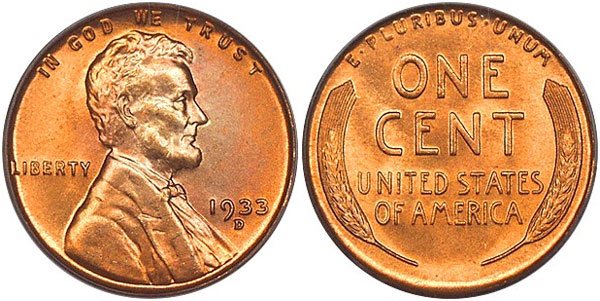
Right now, I have a complete set of Lincoln Memorial cents. They’re all from circulation, and some of them are pretty beat up, but there are a few really nice ones in there too. My wheat cents collection is much less complete, but the coolest piece is a 1909 VDB in very fine condition, with all the wheat berries still showing. That’s a $10-$15 penny that I found in a normal coin roll.

It’s a fun hobby, and it comes around full circle to what got me started down this rabbit hole in the first place. Each one of these coins is a small piece of history. That 1909 VDB is more than a hundred years old. I’ve got coins that my parents and grandparents would have used, and a penny for every year of my father’s and mother’s lives. With a bit of luck and a lot of patience, I’ll be able to find a penny for every year of my grandparents’ lives as well.

So yeah, it’s been a fascinating journey of discovery, and it’s still ongoing too. I just got started with Roosevelt dimes, and I’m catching up on Mike Duncan’s Revolutions podcast, which is just as interesting as his History of Rome. Turns out that the French Revolution also happened because of deficit spending and a runaway government debt. Surprise, surprise.

Life is a giant rabbit hole when you’re curious about everything!