“Who would have thought…”

I would like to address this post to my fellow Mormon readers.

A couple of days ago, I got a discouraging message from some old mission friends of mine.  It said, more or less: “who would have thought that the missionary that taught us the gospel would write such a lurid book?” They were referring to my latest release, Sholpan.

To be honest, it’s been very difficult for me to publish it, because I knew that this sort of thing would happen.  I worry that my friends and family will think that I’ve done something inappropriate, or violated some moral standard, or made myself unworthy in some way.  It’s very difficult to put your writing out there under normal circumstances, much less with complications like these.

However, I would like you to know that I have prayed about this, and that the answer I’ve received is that this is a story worth telling.

Sholpan is about a girl who lives essentially LDS moral standards and falls into what may be the worst situation any of us could imagine for such a girl: slavery in the harem of a powerful warlord who has the power not only to rape her, but to kill her.  By refusing to compromise her values–and risking death to do so–she makes friends in unexpected places and gains a whole lot more power than she ever would have if she’d taken the easy path and compromised.

In other words, it’s a little bit like the story of Esther.  Yes, there are sexual themes, but they aren’t there to be gratuitous or titillating; they’re there to show that even in the face of such horrible immorality, you don’t have to compromise your values.

I know this kind of story isn’t for everyone, which is why I’ve put up warnings in the book descriptions and made it abundantly clear that this book has adult content.  And if you decide you don’t want to read it, I won’t be offended at all.  But please, don’t assume that I’ve gone off the deep end or betrayed my faith, because that’s not the case at all.

It’s a difficult position to be in; I’m sure that Stephanie Meyer’s and Orson Scott Card’s bishops get a lot of mail from fellow Latter-day Saints who feel that they ought to be excommunicated.  But these are the kinds of stories that I feel driven to write: stories that address difficult moral issues and don’t shy away from portraying evil for what it really is.

I appreciate your concern on my behalf, but my faith and spirituality are still quite strong.  You may or may not believe that after reading my books, but please don’t feel like you have to save me.  The best thing you can do is continue to be a positive influence, and let me be a positive influence for you.
How do you know when you’ve succeeded?

With books and publishing changing so quickly, a lot of writers are wondering how they can tell when they’ve actually “made it.” It’s a valid question, one that I think we all need to answer if we want to write seriously.  For myself in particular, as an indie writer, how will I know when I’ve achieved success?

The question made me think about my experience as a Mormon missionary in California, and the definition of success that my mission president (the ecclesiastical leader and father figure for the missionaries) often quoted:

Success is peace of mind which is a direct result of self-satisfaction in knowing you did your best to become the best you are capable of becoming.

— John Wooden

This definition taught me that success isn’t just about external things that may or may not be in your control (for example, the number of convert baptisms per month), but is more about doing the things that are in your control to stretch yourself and reach your full potential.  To be sure, external factors are important measures of success, but at the end of the day, it’s not just about the numbers.

That said, for a writer like me who hopes to make a living at it, the numbers are pretty dang important.  At my current standard of living, I need to sell between 550 and 750 ebooks per month priced at $2.99 and $3.95 to accomplish that goal.  Right now I’m doing about 30 to 50, so I still have a ways to go.

But is that the best measure of commercial success?  If I have 10 titles selling around 55 to 75 copies each per month, will those books be hitting their full potential?

Probably not.  For that reason, I’ll probably end up signing a deal with a publisher at some point in my career; there’s only so much that I can do by myself.  However, in order for me to do that, the terms have to be right; I’m not going to sell myself short just to see my name in print.

(This is one thing that bugs me whenever I hear writers discuss whether traditional or indie publishing best fits their goals.  If all you want is “to see my name in print,” or “to see my book in a bookstore,” how is that any different from vanity publishing?  If that’s really your goal, fine, but don’t think it somehow puts you above indie writers–many of whom have goals that are much more pragmatic than yours.)

Artistically, I think the best way for me to achieve success is to take on a new challenge with every project and still feel like each book is better than the one before it.  Contests and reviews have their place, but going back to the definition, success is all about self-satisfaction and peace of mind.  I don’t want to tie any of those to someone else’s opinion about my work–that way lies madness.

But really, I think it all comes down to the readers.  Unless you stuff your manuscript in the closet, writing is never a solitary act: it is an act of collaboration with the reader.  If I have any measure of success, it will be because someone took the time to read my words.  To be sure, I can’t please everyone, but that doesn’t matter; it only takes one person to make a story come alive.

When I was a missionary, I constantly asked myself whether I was doing the will of God in the life of every person that I met.  That’s how I knew that I had succeeded: when I felt the peace of mind that came from knowing I’d made that personal difference in someone’s life.

I expect it to be similar with my writing.  Commercial success is great, but numbers aren’t everything.  What really matters is telling a story that connects with people on a deep and personal level, transforming them in some meaningful way.  If I can do that and make a living at it, that’s how I’ll know I’ve succeeded.

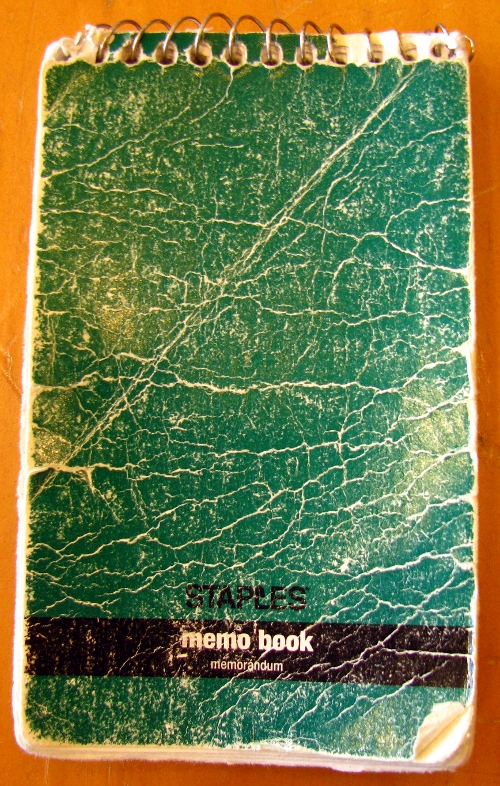
Old story notebook–found!

Guess what?  Last night, when I was looking through old boxes at my parents house (looking for my old ratty copy of On My Way to Paradise, specifically) I found my very first story notebook–the one I thought I’d lost on the Jordan study abroad two years ago!

Wheeeeee!!!

This notebook is a real gold mine–not just of story ideas, but of some of my oldest thoughts on writing.  I started keeping it back in the 90s, long before my mission.  I kept it up sporadically for a little while, but it really took off in 2007 when I decided I was going to pursue writing professionally.

For the 07-08 school year, I kept this notebook with me all the time.  I had a huge burst of story ideas as I finished my first novel, and I wrote the majority of them in here.

When the summer came around, I got a couple new notebooks in preparation for the study abroad.  Later, when I was established in the homestay, I searched everywhere for this notebook and couldn’t find it.  I thought it was lost.  The whole time, it turns out, it was in my shoebox of momentoes in Provo.

Wheeeeeee!!!!!!!!!!!

Ahem.  So now, without any further ado, let’s go through this thing.

A boy learns how to consciously control his dreams and visit other people in theirs.

For a long time, this was my one big idea–the one that I was sure would turn into a fantastic book and make my entire career, if I could just keep it secret long enough to write it. It’s a pretty good story idea, but I’ve got so many other, better ideas by now that I’m not too concerned about making it public.

A girl falls overboard from a colony ship and is stranded on an island.

Kind of like a female Robinson Carusoe, I guess. I actually wrote the first fifty pages of this story, in the summer before I left for my mission. Never finished it, but at least I ran with it.

A secret organization of warriors fights to keep a mysterious enemy from taking over the land.

Hehe, sound familiar? I think every other fantasy story has some kind of subplot like this.

A kidnapped girl fights to make her way home.

Kind of like the Odyssey, but with the genders reversed. Hmm, maybe I haven’t changed all that much…

A band of foreign, elite warriors sells their services to a population, then slowly begins to corrupt the society’s morals to satisfy their lusts.

Kind of like Seven Samurai meets Ibn Khaldun.

Two brothers find themselves fighting for opposing armies.

Already done: Gettysburg, the movie.

A general fights to save his people and then his daughter is kidnapped by asymmetrical terrorists.

I’m not sure what the significance is with the terrorists–maybe conventional warfare vs. asymmetrical warfare or something like that.

The next few are all ideas for non-science fiction stories; I tried to brainstorm as many of them as I could, in case (for some absurd reason) I decided to write mainstream fiction. I’ll give them all at once:

A guy finds a girl and they click, but he has to convince her that the people she dates are bad for her (which is true).

A guy and a girl go on a road trip to find out more about themselves.

A guy tries to improve himself to attract a girl, then discovers he’s not interested.

A boy is chauffering people around and doing errands, then finds a life-changing thing.

A homeless runaway is taken in by a wise truck driver and learns to reconcile himself with the world.

A boy goes on a road trip to do research to reunite a dying relative with an old friend.

Moral of the story: If it’s not science fiction, it’s got to involve a road trip. Otherwise, it’s dead boring.

A soldier away from home makes his way back to his country, which has fallen into warlordism, and tries to rebuild his life and his homeland.

This was the novel I tried to write the year after my mission. It tanked really bad, but it got me to the point where I could write Ashes of the Starry Sea and actually finish it. If I were to try this idea now, I would take it in a completely different direction than I did then.

That concludes all the ideas in the notebook before October 15, 2003. The notebook then took a hiatus until the summer of ’07, which is where I’ll pick up next time.

Polishing is harder than it looks

It is.  This is the final revision of Genesis Earth before I submit this novel everywhere, and it’s tough.  I’m changing a lot more than I thought I would, and it’s going a lot slower than any other process so far.

Plus, on my way to Murray for my mission reunion, the service light for my engine flipped on.  What the heck?  I just had the car serviced a month ago!

At least I know about it now, before I attempt to drive to San Jose for World Fantasy.

Long story short, showed up at 9pm to the reunion just in time to say hi to President and Sister Heywood as they were getting ready to leave.  So worth it, though.  They’re both getting older, and I don’t know when I’ll be seeing them again.  Listened to From Cumorah’s Hill on the way back, and it was awesome.  I mean that in a religious way.

I’ve got a research proposal due tomorrow, and I kid you not, I was working on that thing in my sleep last night.  All night, while I was dreaming, I was thinking “should I use this author in my paper?  How should I tie that in?  What controls do I need to use?  Will this dataset cover the same years as that dataset?” All. Night. Long.

And then I forgot it all when I woke up!

I did get some time to write, though.  Took the netbook up to the laundry room in the FLSR (I still go there–much cheaper than my current apartment) and worked on my novel while waiting for the laundry to finish.  Good times–some of my best writing has come out of that laundry room.  Award winning writing.

In tangentially related news, I still have not heard back from Writers of the Future.  I’m guessing that’s a good thing <crosses fingers>.