Lindsey Stirling, Nichieri, Susan Boyle, and thoughts on discoverability and greatness

I saw a couple of things on Youtube that made me think recently about the importance of quality work, especially in the arts.

I’m a casual fan of Lindsey Stirling–I’ve watched most of her videos, put them on in the background from time to time, and get a kick out of following her career. For those of you unfamiliar with her, she’s a Youtube sensation who combines violin music, dance, and dubstep/electronica, often in some interesting and beautiful places. This is her most popular video, and probably her best work so far:

Her career is interesting because it follows a path very similar to a lot of self-published authors. She started by putting out videos on Youtube, built up a huge following that way, turned down a number of deals from traditional record labels and put out her first album herself. Now, she’s touring all over the world, collaborating with a bunch of other Youtube artists, and doing a lot of other amazing stuff completely independently.

The other day, I was really surprised that she was on America’s Got Talent back in 2010. Apparently, this was before she got really big, and the connections she made while on the show helped her find success later on:

Two things stood out to me from that video.  First, the judges were right–even though she was pushing herself, this was not her best work, and it showed in a way that was rather glaring. I hate to say that because I like so much of her stuff, but it’s really true–her performance fell short.

The second thing that stood out to me was her response to the criticism. It must have been incredibly painful to stand up there in front of everybody and get hammered like that, but she still managed to smile, be gracious, thank the judges, and focus on the positive without being confrontational. That takes class.

When I was in Georgia, I watched a lot of TV, especially on the Rustavi 2 channel. One of the most popular shows is Nichieri (ნიჭიერი), a talent competition show set up much like The X Factor or America’s Got Talent. Even though I didn’t really understand anything the people were saying, I could still really tell when a contestant did some truly amazing.

There’s something about greatness that makes you sit up and pay attention–something that makes it stand out on its own. It’s something timeless and stirring, something that drives you to keep coming back to it, or at least to remember it long after it’s passed. With poor quality stuff, like bad writing, clumsy performance, or the like, you tend to forget it (unless of course it’s a spectacular failure, which in a weird way gains a sort of greatness of its own to a certain extent). But good quality stuff sticks with you–indeed, it’s almost like it becomes a part of you. It certainly becomes part of the culture.

When it comes to talent shows like Nichieri, The X Factor, and America’s Got Talent, the greatest moment has to be Susan Boyle. Everything about it is just perfect, from the awkward, homely way she started out to how she blew everyone away with her stellar performance. She didn’t look like she had it, and she certainly didn’t act like she had it, but she did, and she knew it. She didn’t settle for anything less than her best, and she didn’t let anyone else put her down.

In a lot of my discussions with other indie writers, we talk a lot about discoverability. We’re all anxious to be read, to be heard, to be discovered–to get our shining moment. The thing is, though, that moment is not enough if you don’t have quality work. It’s not going to keep you down or “ruin” your career, necessarily–Lindsey Stirling has come a long way since her disappointing performance on America’s Got Talent. But that’s only because she produces quality work.

I think I need to spend a lot less time trying to boost my discoverability and a lot more into producing the best work that I possibly can. The thing to remember, though, is that quality is subjective and you can’t please everyone. As Lindsey later said, “A lot of people have told me along the way that my style and the music I do … is unmarketable. But the only reason I’m successful is because I have stayed true to myself.” You can’t compare yourself against others, either–you can only really compete against yourself.

How do you know when you’ve done your best? That can be a little tricky, partly because it’s a moving target. I think Genesis Earth and Bringing Stella Home represent my best work at the time, though when I look back at those books I see things that could be improved. I tend to think that Desert Stars is my best work to date, though I’m not so sure anymore. Do I only think that because I struggled so much and for so long with that book? Just because something is a joy to create doesn’t mean that it’s any less than something you toiled and suffered over.

Star Wanderers was both a gift story and an experiment. The novella format was new to me at the time, so I did a lot of learning on it. Outworlder, Dreamweaver, Homeworld, and Deliverance came to me in a white-hot creative heat, but Sacrifice and Reproach were a real struggle. Is there a discernible difference in quality between them? Not that I can tell. I do think that the later stories hold together better on their own, though. I didn’t really hit my stride with the novella format until I started branching off into other characters’ viewpoints.

This is all on my mind because my next big project, Sons of the Starfarers, is something that I really want to do right. I don’t just want to write it for the sake of putting it out there (though I recognize that writing quickly doesn’t always mean sacrificing quality). I don’t just want to put it out so that I can make my work more “discoverable,” though that’s certainly a motivation. I don’t even just want to do my best. I want to improve my writing and storytelling so much that this becomes the best thing that I’ve ever written.

At LTUE a few years back, Tracy Hickman said that as writers, it is important for us to believe that we have not yet written our best book. That’s so incredibly true. You have to always believe that you can do better, not to make you depressed when you look back, but to make you enthusiastic as you look forward. Imagine what would have happened if Lindsey Stirling thought that her performance on America’s Got Talent was the best that she’d ever do! Her career hadn’t even dawned yet.

I think it’s the same with me. I’ve gained a little exposure, suffered a few setbacks, and experienced a small measure of success, but the big stuff is yet to come. And even though I may not want to be the next Brandon Sanderson or Orson Scott Card in terms of popularity, I do need to shoot high in terms of quality. Before I work on my discoverability, I need to make sure that I’m putting out some truly amazing stuff. I need to shoot for greatness.

Things to do before June 8th

BYU’s Writing and Illustrating for Young Readers conference is coming up in less than a week, and I’m pretty excited for it! I’m signed up for the afternoon sessions only, but it should still be a great experience. From what I’ve heard, this conference is several steps up from CONduit and LTUE in terms of professionalism, and I want to be ready. Here’s my list of things to do to prepare:

  • Spot edit Genesis Earth for the really major stuff that I can reasonably fix in the next few days–especially the first three chapters. A lot of the feedback I’m getting suggests that this novel might comfortably fit in the YA genre, which means that I’ve actually got something I can market to these agents and editors. I want it to be ready (or, barring perfection, at least as ready as I can make it).
  • Work out a good elevator pitch for Genesis Earth. I’m not going to ambush anyone with it, but I want to be ready in case I get into a conversation with an agent/editor and they ask about it.
  • Research all of the agents/editors/authors coming. The list is here.
  • Polish shoes.
  • Do laundry.
  • Iron shirts.
  • Shave. Probably every day of this thing.
  • Get business cards? I’m not entirely sure about this. I suppose it couldn’t hurt. Anyone know where I could get a few dozen cheap/free ones on short notice?
  • Brush up on recommended conference etiquette. Miss Snark has several great posts on this in the archives of her blog.
  • Buy/reuse a cheap notebook and get ready to take lots and lots of notes. Sorry, guys, I probably won’t be recording or posting mp3s of this conference. It’s not a fan event, after all, and I don’t want to do anything that would get me in trouble.

Anything else I’m leaving out?

“That’s what it looks like when the infection sets in.”

So said Howard Tayler at CONduit today when he saw the expression on my face at the Aspiring writers Q&A panel.  We chatted a bit afterward, and he said something very encouraging: that if I continue to pursue my writing career with the same hunger he saw on my face, he believes I will be successful.  Awesome!

This weekend, I attended CONduit 2009 in Salt Lake.  It was my first con experience, and I had a great time!  Besides being just plain fun, it was very educational and inspiring.

I felt a bit unnerved at first to be surrounded by so many people that I barely knew, in a comfort-zone shattering kind of way.  I went up with  Charlie and Laura, though, and it helped to have friends sharing the experience.  By Saturday, we were all getting around very well.  By the end, I figured that I did know a lot of people there–and, surprisingly, that a lot of people recognized me.

I came away with a TON of ideas and things learned!  Here are just a few of them:

  • One of the panelists on Friday suggested this revision method: use search-and-replace to color all filler words (such as “really,” “just,” “very,” “was”; basically, the words I always overuse on this blog).  That way, you can easily see which sentences you need to rewrite.
     
  • Howard and Sandra Tayler mentioned, almost in passing, how they made it a matter of prayer before deciding to go full time on the web comic thing.  I definitely need to include the Lord more as I try to figure out how this writing thing is going to fit into my life.
     
  • In their Saturday panel, Howard made a very interesting remark about cultivating your personal image.  I realized that if I want to be seen as a professional by editors and agents, I need to adjust my wardrobe and appearance accordingly.  I don’t necessarily have to go the suit-and-tie route–Howard’s  image involves jeans and a button-up shirt–but my dress and appearance should say “I am competent, sharp, and serious about what I do.”
     
  • Dan Willis had a very interesting suggestion for writers: get and use business cards.  Networking is one of the most important business activities that aspiring writers can, should, and must engage in, so using business cards at conventions is very important.  It sounds so obvious, but I’d never given it much thought.   I’ll have to get some printed up for myself before I go to World Fantasy and Worldcon later this year. 
     
  • Between panels, I got into a fascinating conversation with Eric James Stone about networking at these conventions.  From that conversation, I learned how important it is to be genuine and personal as you network, to listen more than you talk, and to never see people as mere stepping stones for your career.  He got an anthology contract with Kevin J. Anderson through a con, and he never approached him with that attitude–ever.  Other people he saw who did, Anderson treated politely but never contacted.  You should certainly have a pitch ready, but you should also give time for contacts to develop.  Over time, people will remember your face and recognize you at these events.

conduit2009-jawaConventions are definitely great for networking, but I absolutely hate walking up to a stranger and asking for favors.  It makes me very nervous.  As a result, I’ve adopted the philosophy of asking myself what I can offer the person I’m trying to connect with, rather than asking something of them.  I tried to follow this philosophy at CONduit, even if all I could offer was a compliment on something they’d said on a panel.

Using this strategy, I was able to get into a lot of interesting, genuine conversations with some of the big names at the con.  Charlie, Laura, and I got into a long, interesting conversation with L. E. Modessitt at one point.  He gave me some advice on women, which Charlie found hilarious (he must have seen us bickering/bantering earlier).  Had some good conversations with Dave Wolverton as well–he probably recognized me as the crazy fanboy who had him sign a poster of his first (now out of print) novel.  It was also good to see Brandon and talk with him–I thanked him for his helpful (if harsh) comments on my English 318 final.  Other people like James Dashner and Julie Wright recognized me from LTUE, which was really cool.

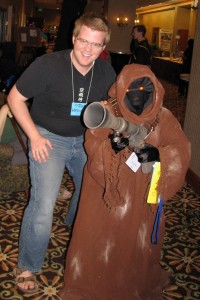
If people in the local scene are starting to recognize my face and my name, I must be doing something right.  That’s very encouraging.  Plus, the convetion was just plain fun. To top it off, the guy in the jawa costume was awesome.  All around, good times.  Very good times.

LTUE 2009 mp3s

Alright, like I promised, here are the mp3s of the panels I recorded at Life, the Universe, and Everything 2009. I can’t promise that the sound quality will be perfect, and there might be a few jarring noises when I had to pick up the audio recorder to move it somewhere else, but for the most part I think they are all listenable. Also, FYI, the first two minutes of the main address is a ridiculous conversation I had with my friends just before the panel started.

I think my server can handle all the people who want to download this stuff, but to reduce the strain please download and save them to your own computer, rather than opening the file through your browser each time you want to listen to it.

Also, I’m making these recordings available publicly through a creative commons license. For more information, check out the link at the bottom of the post.

Enjoy!

Life, the Universe, and Everything 2009

Thursday, 19 February 2009

Looking Through a Glass Darkly: Cautionary Tales and Post-apocalyptic Fiction

Reality in Science Fiction

Friday, 20 February 2009

Latter-day Saints and Science Fiction & Fantasy

Putting Romance into Your Fantasy

Writing Romance

The Principles of Suspense

Podcasting for Writers

Blurb Boiling 101

Following Through on Your Plot Promises

Making a Living as an Artist

Saturday, 21 February 2009

Current Trends in Science Fiction & Fantasy

The Problem of Sequels

Keynote Address: Creative Reading 201

What Every Writer Needs to Know about Archaeology

How to Fill 100,000 Words and Not Be Boring

Worldbuilding 101

The Golden Age of Science Fiction

Editing Do’s and Don’t’s

Creative Commons License
This work is licensed under a Creative Commons Attribution-Noncommercial-Share Alike 3.0 United States License.

LTUE 2009

Wow. Life, the Universe, and Everything 2009 is over, and it’s hard to believe that only three days have passed. It feels as if this symposium has been going on for a week, and that’s a good thing. Friday and Saturday, I spent practically every waking moment in the Wilk, the student center where the symposium was held. By the end, I think some of the professionals there were starting to recognize me and strike up conversations with me instead of the other way around. Kind of interesting. Way fun. Loads and loads of helpful advice and information to process. I’ll be lucky if I can soak it all in before the end of the year.

I’m glad to say I was able to open up and talk with a lot of people these past few days–in fact, I got a chance to talk with just about everyone who was on a panel that I’d attended. It was fun to shake their hands, compliment them on what they said, and strike up a conversation around that. It was surprisingly non-threatening, to be honest. I definitely feel more prepared for World Fantasy 2009 now–definitely.

By far, my favorite part of the convention was Tracy Hickman’s main address. It was titled Creative Reading 201, and it was all about how the reader and the writer are both collaborators in the creative experience, something that’s fascinated me for a long time. The implications of this simple fact are tremendous. First of all, it means that a story does not come to life until it is read. Anyone can get published, especially with the technology today, but all of those words are empty symbols until someone takes the time to read it. Second, it means that the spirit speaks to us in the white spaces between the lines. Just as people with different needs take the unique message they need from the scriptures through the power of the holy spirit, so each work of fiction speaks differently to us. Finally, all of this means that stories change as we change, even as they inevitably change us. As we grow, the stories that touched us the most simultaneously grow with us even as they help us to become better people.

Tracy Hickman then shared an incredible story about a book signing he and collaborator Margaret Weis had recently at a veteran’s home. A man in a wheelchair came up to them with an extremely tattered copy of one of their earlier works, about a knight who sacrifices his life in battle to save the order, even though all of his fellow knights in the order look down on him as less than a true knight. This wounded soldier then told them that this tattered book had traveled with him in his pocket throughout his military career, through parajumps, underwater operations, and into war theaters like Afghanistan. While fighting in Afghanistan, this soldier was shot in the lower back. As he went down, his first thought was “what would the knight in Tracy’s book do?” He saw the Taliban forces setting up a mortar on the opposite ridge, and in spite of his wounds and the risk to his life, he took down the enemy and saved twelve of his fellow soldiers fighting in that battle. The soldier then presented his purple heart and bronze star to Margaret Weis and Tracy Hickman, for writing the story that inspired him to be a hero.

Sometimes, as I’m sludging away with my writing and wondering what I’m going to do in 2010 when I finally graduate, I wonder if I’m somehow being lazy. I worry that I’m somehow being irresponsible by not going into some other profession, some kind of respectable 9 to 5 job in an office, the kind of thing that everyone else goes into. I wonder if I’ll ultimately become some kind of a parasite on society, trying to make it big as a writer. In the worst moments, I worry that even if I make it big, I’ll still be some kind of parasite, not really producing anything respectable or useful. After all, fiction is entertainment, especially in genre fiction–don’t we have enough of that already?

Then I remember the impact that one good book can have on people–the way it changes us, the way it opens our eyes and helps us to become better people than we were before we picked up the book. Then I realize: what could possibly be more respectable than telling good, honest, life-changing stories? And then, as I think about it a little more, I realize that that 9 to 5 office job isn’t what I think it is. I realize that I’m not slacking off by trying to be something more than a cog in the corporate machine, producing widgets.

If I strive to tell the truth as a storyteller, and to write the kinds of stories that truly inspire people to do marvelous things and become better people, what greater career is there than that? Teaching, I suppose, comes close to having a similar impact, as well as some kinds of therapy work. Certainly there are other careers that have tremendous opportunities to sacrifice and have a meaningful impact on one’s fellow men. However, my talent is in writing and telling in stories–and it’s a talent that I cannot suppress, from which I cannot escape. So long as I live, I will always tell stories–it’s just hardwired into who I am. Certainly I can use this talent to serve my fellow men in a way that is both respectable and meaningful. And really, for me personally, what else could be better?

It doesn’t mean that it isn’t scary. However, thanks to LTUE this year, I feel that I’ve learned a lot that can help me break in and make it. Whether it was something said in one of the panels or just the experience of attending, it was a truly awesome experience for an aspiring writer like myself.

As far as the files, I’ll post links to the audio files from the conference after I get them uploaded. I should be able to do that sometime within the next 24 to 48 hours, so look out for that.

Quick update

Just a quick update on what I’ve been up to, since I don’t write often enough on this blog anymore.

The past week was really busy–at least, it seemed to be, because I was constantly doing things. Whether those things were productive or not remains to be seen. However, I’ve broken the 37,000 mark on my novel, and moving along steadily. Things going fairly well there.

Still, I figure I’m about a week behind where I’d like to be in the novel. Still on the first chapter of part II. I had to do a lot of thinking and conceptualizing to figure out what needs to happen next, but I’ve come up with a plotline that I find really satisfying. Now I just need to write the thing. 😛

Life, the Universe, and Everything has been going on these past few days, and it has been AWESOME!!! I don’t know if I can emphasize that enough! Tons of writers, tons of interesting panels, lots of interesting people…it’s been great! I went up to the first panel at 9:00 am (a panel on being LDS and writing SF&F–the challenges, the strengths, etc. Skipped a class to attend it), and honestly I did not leave the Wilk until 8:00 pm. How crazy is that? The only hour I wasn’t at a panel of some kind was 6:00 pm to 7:00 pm. It was tiring, but definitely worth it! I’m so glad I went!

More updates on LTUE later. In fact, I’ve recorded just about every session I’ve been to, and plan on recording the rest, so if there’s enough interest I may post some links to the recordings on my site. I have my own hosting, and I’m fairly sure that my hosting service can handle all the bandwidth and other issues, so if you guys are really interested, I’ll put them up for you to download.

I’m a little bit worried that I’ve been too shy this conference. Since I plan on going to World Fantasy 2009 to sell my novels there, LTUE is good practice for approaching editors and authors and other notable people within the publishing industry. All morning, though, I pretty much kept to myself, kept at bay by sheer awe from all of these awesome people–however, by the afternoon, I figured out that it does absolutely no harm to shake hands with someone in the hallway and compliment them on something they said on a panel you attended.

So that’s the approach I plan on taking tomorrow, more for myself and to get used to talking with these people than to actually try to sell anything of mine. Because really, even with all the famous writers, there aren’t a whole lot of editors or publishers here. A handful, but mostly for YA, and that’s not what I write.

I’m sooooo looking forward to tomorrow! Another long day of SF&F awesomeness!