Trope Tuesday: I Choose To Stay

The hero’s journey can be divided into three basic phases: departure, intiation, and return.  In the departure phase, the hero receives the call to adventure and eventually leaves the familiar world.  In the initiation phase, the hero passes through a series of tests and trials eventually leading up to the climax and final confrontation with the Big Bad (if there is one).  But after the hero wins and receives the ultimate boon (aka MacGuffin), there’s nothing left except to go back home and share that boon with the rest of mankind.

Except…after having such an awesome adventure, he just doesn’t wanna.

Joseph Campbell called this stage the Refusal of the Return.  It’s a lot like the Refusal of the Call in the departure phase, except in reverse: instead of being reluctant to cross the threshold of adventure into the unfamilar world, the hero doesn’t want to cross the threshold in the opposite direction going back home.  Campbell put it this way:

When the hero-quest has been accomplished…the adventurer still must return with his life-transmuting trophy. The full round, the norm of the monomyth, requires that the hero shall now begin the labor of bringing the runes of wisdom, the Golden Fleece, or his sleeping princess, back into the kingdom of humanity, where the boon may redound to the renewing of the community, the nation, the planet or the ten thousand worlds.

But the responsibility has been frequently refused. Even Gautama Buddha, after his triumph, doubted whether the message of realization could be communicated, and saints are reported to have died while in the supernal ecstasy. Numerous indeed are the heroes fabled to have taken up residence forever in the blessed isle of the unaging Goddess of Immortal Being.

Anyone who’s ever been two years old should know the feeling.  You’re at the playground, having fun, when out of the blue your mom says that it’s time to go.  So what do you do?  Throw a hissy fit, of course!  Grab onto the cold hard steel of the swingset, and don’t let go until she drags you kicking and screaming all the way to the car.

The hero may have fallen with the new world the moment he left his home behind, but he might also have hated it initially.  In stories where the hero actually does stay, this allows the author to give him a character arc: at first, he hated the new world, but gradually he warmed up to it, until by the end he was changed so much by the adventure that he decided to settle down there.

In milieu stories (see Orson Scott Card’s MICE quotient), this often manifests as Going Native, while in stories that are more plot or character driven, it’s more likely to manifest as Can’t Stay Normal.  When the hero eventually comes around and goes home anyway, it frequently morphs into Stranger in a Familiar Land.  The polar opposite is But Now I Must Go, though that trope tends to apply more to side characters than the main protagonist.

Ultimately, however, adventures are like stories: they all have a beginning, a middle, and an end.  The hero may want it to keep on going forever, but that is not this trope.  Even if the hero does stay in the lands of adventure, those lands eventually become his new home.  It just can’t be avoided.

For that reason, there’s an important element of bittersweetness to this stage of the hero’s journey–one which, if done well, can add a crowning moment of heartwarming or turn the story into a real tear jerker.  Or both, actually.  It all depends on how invested the reader is in the story by the end.  If the reader feels like she’s been right there with the hero all this time, then you can expect the tears to flow no matter which way he ultimately goes.

I pretty much played this trope straight in Genesis Earth.  Most of my other books feature a Refusal of the Return moment of one kind or another, but the hero usually ends up going home anyway.  If there even is a home to return to, of course.  I don’t know why, but a lot of my stories are about characters who are searching for home.  Maybe that’s because at heart, I’m still a wanderer.  It will be interesting to see how that changes over the coming years.

The song at the top, by the way, is from Disney’s Tarzan, a movie which plays this trope straighter than most.  In fact, this trope is practically Disney’s bread and butter.
Trope Tuesday: MacGuffin

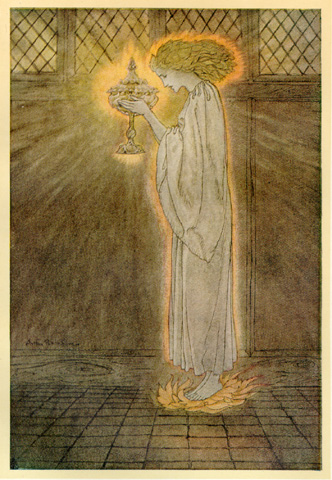
The Holy Grail of MacGuffins. Literally.

So the hero has crossed the threshold of adventure, thwarted the trickster, evaded the vamp, and met with the goddess.  He may have lost his mentor and descended into the deepest dungeon, but by calling on the supernatural aid he received at the beginning of the quest, he has passed the final test, found atonement with his father, and come back stronger than he ever was before.

So now that that’s all done, what’s left?  Just one thing, really–he has to receive the ultimate boon, or in other words, get the MacGuffin that he came out questing for in the first place.

A MacGuffin is an object whose main (sometimes only) purpose in a story is to motivate the plot.  It is usually something that everyone is chasing after, whether it be a ticking time bomb, a briefcase full of money, a priceless artifact, or some sort of superweapon.  Basically, it can be almost anything–that’s kind of the point.  If you can replace an object with something completely different that serves the exact same plot purpose–for example, a priceless stolen Picasso with a priceless stolen Dead Sea scroll–then it’s a MacGuffin.

Like it or not, MacGuffins are everywhere in fiction.  It’s such a prevalent trope, it even has its own Wikipedia page.  One of the most famous examples, at least in the Western literary tradition, is the Holy Grail.  Another example is the One Ring from Lord of the Rings–it could just as easily be a bracelet, or earring, or any other wearable artifact (though admittedly, if it were a necklace and Gollum had to bite off Frodo’s head, that would change the story quite a bit).  The MacGuffin page on tvtropes lists nearly 30 subtropes, from Egg MacGuffin to I’m Dying, Please Take My MacGuffin.

So what does this have to do with the hero’s journey?  The last phase of the initiation cycle (basically, all the stuff between the departure and return) is known as the Ultimate Boon.  It not only represents the achievement of the hero’s quest, it represents receiving something to bring to the people back home.  As Joseph Campbell pointed out:

The gods and goddesses then are to be understood as embodiments and custodians of the elixir of Imperishable Being, but not themselves the Ultimate in its primary state. What the hero seeks through his intercourse with them is therefore not finally themselves, but their grace, i.e., the power of their sustaining substance…This is the miraculous energy of the thunderbolts of Zeus, Yahweh, and the Supreme Buddha, the fertility of the rain of Viracocha, the virtue announced by the bell rung in the Mass at the consecration, and the light of the ultimate illumination of the saint and sage. Its guardians dare release it only to the duly proven.

According to Vogler, the hero has to return home with something to benefit himself or the community–otherwise, the whole journey has been a waste of time.  Before entering the return phase, then, the hero has to receive the object of his quest.

At this point, it’s worth pointing out that tropes are neither good nor bad.  Just because a story revolves around a MacGuffin doesn’t automatically make it cheap or formulaic.  Tropes themselves are value neutral–what matters is how you, as the author, use them.  Some of the greatest and most inspiring stories of all time make heavy use of MacGuffins.

Because the MacGuffin is a plot-centric trope, when you really understand how it works, you can do some interesting writerly things with it.  Michael Moorcock, for example, used this trope to formulate a method for writing a novel in just three days.  Would you like to be able to write a novel in three days?  Gosh, I’d like to.  And before you write that off as formulaic crap, remember, it wasn’t just anyone who came up with this method–it was Michael Moorcock.

In my own work, the best example of this trope would have to be Stella from Bringing Stella Home.  As you might have gathered from the title, Stella serves as a MacGuffin for her brother James (specifically, in The President’s Daughter flavor).  She does have her own character arc, of course, but as far as James’s storyline is concerned, she could just as well be his mother, or cousin, or <insert kidnapped loved one here>.  I did a similar thing in Stars of Blood and Glory, an as-yet-unpublished sequel to Bringing Stella Home, but it should be coming out in January or February of next year so you’ll have a chance to read it then.

Trope Tuesday: Belly of the Whale

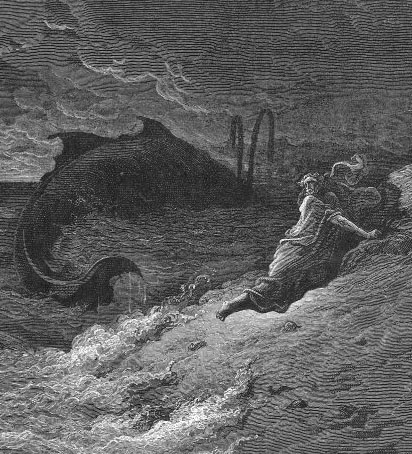
The last stage in the departure phase of the hero’s journey is called the Belly of the Whale, after the Biblical story of Jonah.  After receiving the call and passing the threshold to the land of adventure, the hero faces what may quite possibly be the darkest hour of his life and dies in some way to the home he has just left behind.

I know what you’re thinking: “Huh? Why does the hero die at the beginning of the story?  Isn’t that supposed to happen later?” Well…yes, it does, but the symbolic death at this point is important, too.  At its core, the hero’s journey is a story of transformation and growth.  When the hero comes back from the lands of adventure, he isn’t the same person he was when he first left–he’s been changed in some way.  And in order for that change to take place, the hero needs to let go of who he was and move forward.

Joseph Campbell describes it like this:

The idea that the passage of the magical threshold is a transit into a sphere of rebirth is symbolized in the worldwide womb image of the belly of the whale. The hero, instead of conquering or conciliating the power of the threshold, is swallowed into the unknown and would appear to have died. This popular motif gives emphasis to the lesson that the passage of the threshold is a form of self-annihilation. Instead of passing outward, beyond the confines of the visible world, the hero goes inward, to be born again.

Of course, the death and rebirth doesn’t have to be literal (though it can be, as it was with Dionysus).  The point is to show that the hero has fully crossed the threshold, cutting all his ties with home and burning his ships on the shores of the land of adventure.  Once the hero passes through the belly of the whale, there’s no going back–it’s all or nothing now.

So how common is this trope really?  Actually, it occurs more often than you might think.  In Harry Potter and the Sorcerer’s Stone, it happens when Harry boards the Hogwarts Express and realizes he’s leaving his old world completely behind.  It happens in The Lion, the Witch, and the Wardrobe when Peter and the others decide to go after Mr. Tumnas instead of returning to their own world through the wardrobe.  It happens in Star Wars IV when the Millennium Falcon gets sucked into the Death Star, and in Final Fantasy IV when Cecil washes up in Mysidia.

The main theme running through all these examples is that adventures are hard.  If they were easy, anyone could go on them–and no one would be changed by them.  They may be fun, and they’re definitely worth it, but to set out on one, you always have to give up something close to you–and that’s hard.

Trope Tuesday: Threshold Guardians

In an indirect way, this guy pretty much saved the galaxy.

So the hero gets the call, refuses it at first (or jumps at it, as the case may be), but one way or another he eventually sets out on the adventure.  As he soon discovers, though, one does not simply walk into Mordor.  Adventures are not the sort of thing that anyone can do, and in order to prove his mettle, he first has to pass a few tests and confront some sort of challenge.  Only then can the adventure really begin.

At the edge of the familiar world lies a threshold, the boundary separating the peaceful, boring land of the hero’s home from the dangerous and exciting lands of adventure.  The threshold might be literal, such as the wall in Stardust and Sabriel, or it might be more symbolic, such as the field in Lord of the Rings that marks the furthest that Samwise has ever gone.  Either way, the threshold is often the site of the hero’s first significant challenge–and the one who offers that challenge is the threshold guardian.

According to Joseph Campbell:

The ‘threshold guardian’…[stands] for the limits of the hero’s present sphere, or life horizon. Beyond them is darkness, the unknown and danger…The adventure is always and everywhere a passage beyond the veil of the known into the unknown; the powers that watch at the boundary are dangerous; to deal with them is risky; yet for anyone with competence and courage the danger fades.

In terms of story, the purpose of the threshold guardian is not to present some impossible test or to pose some sort of world-altering threat.  Rather, they exist to mark the boundary between the familiar world and the unfamiliar, and to show how the hero is different from all the other people who chose to stay at home instead.  In other words, their main purpose is to kick-start the adventure.

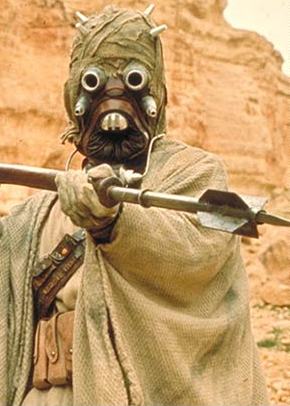
For example, in Star Wars Episode IV: A New Hope, the threshold guardians are the Tusken Raiders who roam the Jundland Wastes surrounding Luke Skywalker’s home.  Venturing out into the wastes is dangerous–yet Luke does it, to bring back R2D2 after the droid runs away.

When R2D2 warns Luke that the Tuskens are approaching, Luke doesn’t run away from them–he crawls to the top of the ridge to get a better look.  This leads to his first real encounter with danger, and almost gets him killed.  Fortunately, Obi Wan Kenobi rescues him and takes him home, telling him about the ways of the force and presenting him with his father’s lightsaber.  The adventure is off to a good start.

If Luke had never ventured out into the Jundland Wastes, or if he had run from the Tuskens at the first sign of danger, he never would have been rescued by Obi Wan, never would have learned about his father, never would have left his home and probably would have died when the Imperials attacked his uncle’s homestead.  If the Tuskens had never attacked him, he would have loaded R2D2 into the speeder and gone back home, never meeting Obi Wan as well.  Without the Tusken Raiders, the whole story never would have happened.

In Harry Potter and the Sorceror’s Stone, Draco Malfoy plays a similar role.  If Harry Potter had joined House Slytherin, Voldemort would probably have taken over before the end of the first book.  Instead, the early animosity between Draco and Harry’s newfound friends pushed him to take sides, setting the stage for everything else that was to come.

The threshold guardians don’t always have to take an adversarial role.  In a lot of stories, defeating the guardian means winning an ally, even sometimes a best friend.  That’s what happens when Robin Hood spars with Little John–in fact, the trope is subverted because Little John actually wins.  Or perhaps the whole thing was a secret test of character, because it’s Robin Hood’s good-natured reaction to losing that wins Little John over.

Not every instance of the hero’s journey has a threshold guardian, but many of them do.  It’s a clear and compelling way to mark the threshold between home and adventure, which is present in every hero’s journey, simply by definition.  When done well, it’s a great way to show what makes the hero different from all the other would-be adventurers who chose to stay home.

Trope Tuesday: The Hero’s Journey

For the next few Trope Tuesday posts, I’m going to pick apart one of my favorite story patterns, the monomyth or “hero’s journey.” Other tropes come and go, but the hero’s journey is truly timeless.  If you can get it to work for you, it can do wonders for your ability to understand and tell stories.

In many ways, this is the trope to end all tropes. it is the source of almost all the major story archetypes, and can be found in the myths and folklore of almost every human culture–hence the term “monomyth.” It was first formulated by Joseph Campbell, who outlined it in his book The Hero with a Thousand Faces.  He summarized it like this:

A hero ventures forth from the world of common day into a region of supernatural wonder: fabulous forces are there encountered and a decisive victory is won: the hero comes back from this mysterious adventure with the power to bestow boons on his fellow man.

Campbell was an academic who studied mythology and folklore, and his book, though insightful, is pretty friggin dense (not to mention scientifically obsolete–he references a lot of Freud’s theories that have largely been discredited).  Later, writers like  Chris Vogler, Phil Cousineau, and David Adams Leeming analyzed and simplified the monomyth for popular audiences.

Enough background–what is it?  Basically, it’s a story pattern that resonates powerfully with readers across all genres.  In its simplest formulation, it follows three steps:

  1. Departure: The Hero leaves the familiar world.
  2. Initiation: The Hero learns to navigate the unfamiliar world.
  3. Return: The Hero masters  the unfamiliar world and returns to the familiar.

Campbell himself identified 17 stages, some of which are interchangeable:

  1. Call to Adventure: The Hero learns that he must leave the familiar world.
  2. Refusal of the Call: The Hero balks, for any number of reasons.
  3. Supernatural Aid: The Hero receives something to help him on his quest.
  4. Crossing the Threshold: The Hero ventures into the world of adventure.
  5. Belly of the Whale: The Hero passes the point of no return.
  6. The Road of Trials: The Hero’s resolve is tested, and he begins to grow.
  7. The Meeting with the Goddess: The Hero experiences the power of love.
  8. Woman as Temptress: The Hero faces and overcomes temptation.
  9. Atonement with the Father: The Hero passes the final test.
  10. Apotheosis: The Hero dies and is reborn.
  11. The Ultimate Boon: The Hero receives a gift to take home.
  12. Refusal of the Return: The Hero doesn’t want the adventure to end.
  13. The Magic Flight: The Hero uses his newly mastered skills to escape.
  14. Rescue from Without: The Hero is saved by his newfound friends.
  15. The Crossing of the Return Threshold: The Hero leaves his new world.
  16. Master of Two Worlds: The Hero reconciles the old ways with the new.
  17. Freedom to Live: The Hero uses what he has learned to live the rest of his life.

Do any of those sound familiar?  Yeah, I thought so.  It might be hard to think of a story that fits all 17 points at once, but it’s not uncommon to find one that hits seven or eight (or possibly more).

A simpler formulation by Leeming goes like this:

  1. Miraculous conception and birth
  2. Initiation of the hero-child
  3. Withdrawal from family or community for meditation and preparation
  4. Trial and Quest
  5. Death
  6. Descent into the underworld
  7. Resurrection and rebirth
  8. Ascension, apotheosis, and atonement

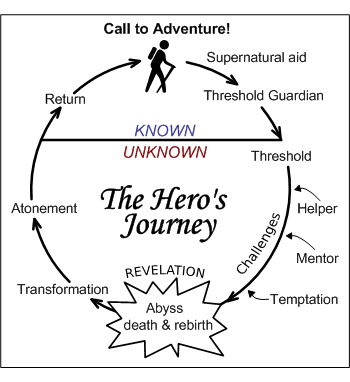
My personal favorite, though, is Vogler’s:

So how useful is this trope really?  Well, consider this: Orson Scott Card’s Ender’s Game was the first novel to win both the Hugo Award and the Nebula Award in the same year…and it hits up all eight points listed above.  The following year, Card published Speaker for the Dead, which also hit all eight points, and also won both the Hugo and the Nebula award.

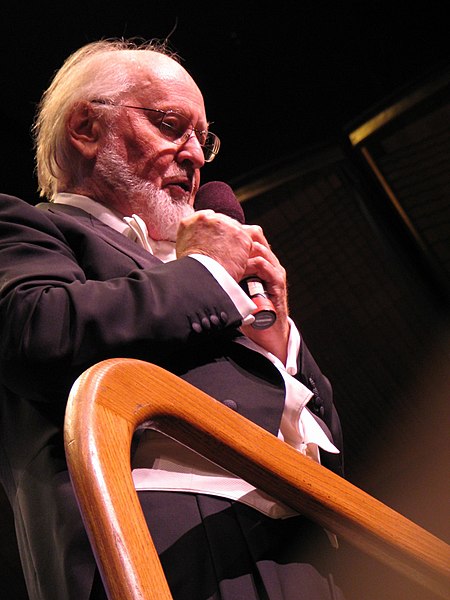
The thing that made Star Wars more than just another campy sci-fi b-movie with (let’s face it) terrible acting and hokey dialogue is the fact that George Lucas drew so heavily from Joseph Campbell and the hero’s journey.  Think about it: Luke Skywalker passes through almost every one of the 17 points, right up to the awesome throne room finale at the end.

Well, this guy certainly helped.

Of course, it’s possible to go too far.  Lucas also tried to use the hero’s journey in the prequel trilogies, and failed miserably.  Why?  Many reasons, but mostly because he used it as a rigid checklist rather than a dynamic set of flexible guidelines.  The hero doesn’t have to have a literal miraculous conception; he just needs to be chosen in some way.  The goddess doesn’t have to be literal, and neither does the father–those stages can be represented quite loosely, or merged with others.

In my own writing, I’ve found that the best way to use the hero’s journey is to use it to understand what I’ve already written, and to trust my subconscious to fill in the next step.  In every book I read, or every movie I watch, I constantly pick it apart, looking for each of the steps.  This trains me to recognize the hero’s journey in my own work without having to break out the hammer or force things too much.

So how do you use the hero’s journey in your own work?  Do you find yourself hitting up all the points subconsciously, or do you use some other method?  Or do you hate the hero’s journey and try to avoid it altogether?  If you do hate it, I hope that my next few Trope Tuesday posts will help you to change your mind.