Worldcon 2011: Thursday

Wow, the last couple days have been packed with awesome con-stuff, but I’ve got a short break so I thought I’d blog about it.

Thursday was great, attended a few panels but mostly just wandered around meeting people.  I’m a little surprised with how many people read this blog.  Got Brandon to sign my Kindle, and he was really supportive about my decision to epublish.  I seem to be one of the only Utah writers going full-steam with indie publishing, but a handful of others are considering it, though for now they’re in the minority (which surprises me).

Anyhow, Thursday had a couple of really notable panels.  The first was on faith and science fiction, and had both Eric James Stone and Moshe Feder on it, among others.  Excellent discussion, though a couple of the commenters tried to derail it.

I found it surprising that the panelists didn’t have a good answer to my question: how do you reconcile far future sf with millenialist religions?  That’s exactly what I’m trying to do with my Gaia Nova universe–create a far future epic that isn’t incompatible with the major western religions (Islam, Christianity, Judaism, etc).  From the after-panel discussion, I got a strong recommendation to read C.S. Lewis’s space trilogy, so I’ll definitely be checking that out soon.

The other notable Thursday panel I attended was on ebook art, and featured John Picacio and Lou Anders, among others.  John feels pretty strongly that indie writers are seriously devaluing cover illustration, and within the first ten minutes someone in the audience literally told him to f___ off!  Wow, talk about tension–but even though it almost fell apart, the panel turned out to be very enlightening.

Let me just take a moment to say that I’m very impressed with what Lou Anders is doing over at Pyr.  While the rest of the publishing world seems to have their heads in the sand when it comes to the ebook revolution, Lou is one of the few who sees it more as an opportunity than a threat.  I’m not currently looking for a publisher, mostly because I’m waiting to see how things shake out, but I would be very surprised if Pyr is one of the publishers that goes under.

The parties in the evening were pretty good–as always, the Tor party was literally packed.  Brandon saw a group of us clustering together, so he broke us up and sent us off to talk with editors and agents.  He tried to point me out to an agent, but…you know, I’m not really looking for one right now.  Brandon keeps telling me not to believe DWS when it comes to agents, and while I’m certainly not fundamentally opposed to them, I feel that I can better build my career by going in other directions.  At some point in the future, maybe, but for now…not so much.

Speaking of Dean, I spent the whole evening hunting for him, then gave up around midnight only to find out the next day that he showed up at the SFWA suite fifteen minutes after I left (nooo!). And now that it’s 9pm in Reno and the parties are just getting started, I think I’ll cut this blog post here and recap Friday sometime later.

See you around!

Should authors respond to reviews?

In the last six days since it went free, “From the Ice Incarnate” has had almost 2,250 downloads, and with so much attention, reviews are starting to trickle in.  Amazon has a very elegant system, which not only allows other readers to vote on whether a review is helpful, but to comment and start a discussion.

This raises a question, however; when is it appropriate for an author to respond to a review?  I’ve seen answers that go all over the board; some readers love it, while others are adamant that writers should never respond in any way–that to do so would be consummately unprofessional.

From an indie writer’s perspective, this is especially tricky.  On the one hand, we want to engage with our readers, since that’s a crucial part of making this into a viable career (Seth Godin makes some excellent points on that subject).  On the other hand, because reviews are so subjective and judgmental, there’s a very real danger that any discussion involving the author could turn very nasty, very quickly.

Whenever anyone posts a positive review of my work, I want to thank them.  If I only respond to positive reviews, though, that could make me look like I’m ignoring the critical ones.  But if I acknowledge the critical reviews that are thoughtful and well reasoned, what do I do with the inevitable one star reviews written by someone who’s just plain crazy?

The last thing I want is to be forced into taking a reactionary position in a public discussion.  While I’m confident I can keep my ego in check and avoid outright argument, that’s not the only danger I foresee here.  Besides, I believe very firmly that the story should speak for itself, and for that reason I think it’s better for the author to be as invisible as possible.

At the same time, I really do want to thank those who take the time to post a glowing review.  Perhaps the best option is to acknowledge them here or on twitter instead of Amazon?  I’m not sure.  And sometimes, questions arise that aren’t related to the story, where responding directly to the review is the most efficient way to handle it.

In any case, I’m going to be cautious for now, at least until I find a position that makes sense.  If you have any suggestions for how I can balance these concerns, please let me know.

And for those of you who have posted kind reviews: thank you!

Publishing in 2016 by David Gaughran

If you’re a writer with any interest in indie publishing at all, David Gaughran is someone you should be following right now.  He’s an up-and-coming Irish writer with a better handle on the changes in publishing than most.  I’m about halfway through his book Let’s Get Digital, and it’s quite good.

For today’s post, I asked him if he could map out some of the major competing predictions for how the ebook revolution will play out.  At this point, no one really knows, so any person’s speculation by itself isn’t all that useful.  He responded with an excellent analysis which I think you will find quite fascinating.

So without further ado, here he is!

==================================

Publishing in 2016

Predicting the future is always a mug’s game, as the historical advocates for paper clothes, jetpacks, time-travel, and hoverboards will tell you, if you can find them.

But Joe has been kind to me here. He’s not asking specifically for my predictions of what publishing will look like in five years. Rather, he wants diverging views of how things will play out, and the logic behind them.

I‘ve tried to be fair here, and made what I think are quite strong arguments for things I don’t think will happen, but the whole exercise is probably colored by my own views. Feel free to disagree in the comments. I’ll probably join the chorus of boos.

There are hundreds of potential scenarios, but here are two competing visions of publishing in 2016.

SCENARIO #1 – The Empire Strikes Back

Publishers were slow to embrace the digital future, but they learned. They stopped chaining the release of the e-book to print versions, instead releasing digital when ready (sometimes a year ahead of print), vastly reducing publishing time, and allowing them to build up an audience of fans, some of whom would also go on and buy expensive limited edition hardcovers, which proved very lucrative.

They also greatly increased the revenue split with authors which had two effects. First, they stopped losing writers to self-publishing. Second, writers became more motivated to go out and directly promote the book to readers – as the returns they got from each copy sold increased.

Finally, as most agents stopped accepting submissions for anything other than their publishing arms, instead scouring the Kindle Store for prospective clients, the gargantuan slush pile moved online. The ensuing decrease in quality of the average self-published book made readers actively avoid indies and cry out for some form of quality seal.

The publishers, keen to exploit their position as trusted tastemakers, banded together with furloughed newspaper reviewers to create “curation” sites, where readers could safely browse only “quality” works.

The online retailers, fearful of losing customers to the new, popular curation sites, started granting concessions and building storefronts for all the publishers, vastly reducing the visibility of self-published work.

The only indie authors that thrived were the expert self-promoters. As soon as they struggled out of the morass, they were co-opted by the large publishers, while the rest only sold a handful of copies to family and friends.

When enhanced e-books took off, most self-publishers couldn’t afford the initial investment to create all the extra audio, video, and gaming components that readers demanded. Ironically, the first indies to monopolize the e-book market – writers of thrillers, fantasy, and science fiction – suffered most.

Publishers, after merging with gaming companies, returned to their former position at the top of the pyramid, the retailers now cowed and forced to operate on the publishers’ terms, as they controlled all the top quality content.

WHY THIS WILL HAPPEN:

Once the format battles are settled and once the e-reader device war is over, the next fight will be over content. The large publishers still own most of the content, and are getting new content submitted to them every day, mostly by authors who would license it on pretty much any terms.

Publishers are locking down not just current rights, but lots of future potential rights, and e-books will never go out of print like books used to, meaning that authors without some kind of “sunset” clause will never get their rights back.

Some publishers are in trouble, but some are doing quite well out of the digital revolution. Some will learn the lessons, some will compete at lower prices, some will bring digital versions out first. And we shouldn’t forget that most of the major publishers are owned by large conglomerates with very deep pockets.

WHY THIS WON’T:

Any battles between agents, publishers, and authors are only a side-show. The real battle for control of publishing is between the tech giants: Google, Apple, Amazon. Apple are sitting on a cash pile of $78bn. Google have the resources to compete with anyone, in any area, once they make it a priority. Amazon have a lock on the market now and are investing most of their considerable revenue in aggressive expansion.

The notion that readers want “curated” selection is outdated. That has been chipped away at for years by the millions of books available on Amazon. The prize usually goes to the bookstore with the largest selection. Nobody can compete with Amazon here now, and it’s hard to see who can (outside of Google and Apple) in the future.

Readers are voting with their feet. Amazon are on the way to controlling over 50% of the overall US book market by 2012. Readers clearly want an uncurated selection.

This idea of a flood of terrible slush drowning out all the good work is built on a fundamental misunderstanding of how people actually buy books online. Most readers (around 80%) go to an online store with a purchase in mind (usually a recommendation, or another work by an author they have previously enjoyed).

They may add more before they pay, but these are things that caught their eye along the way (as recommended by a powerful algorithm based on their buying and viewing history). That won’t change. In fact, those recommendations will get smarter.

And I’m not convinced that enhanced e-books are the way of the future. Readers want to read a story. I think they will find those extras intrusive. Books may become like DVDs – with extras that can add to the enjoyment of a book after you are done reading, but not something that would normally make or break a purchase. Children’s books may be different, and when that generation grows up they may well have a different idea of what a book is or should be, but that’s far past 2016.

Finally, owning content is one thing, but you need somewhere to sell it. And the publishers have proved singularly unable or unwilling to develop a retail arm to compete with the giants. JK Rowling may be able to do it, but few other content owners could, and anyway, many analysts feel that she could make more by distributing to all the major retailers.

SCENARIO #2 – A Golden Age For Authors

Authors were slow to embrace the digital future, but they learned. They stopped submitting to agents that weren’t reading their work anyway, and started publishing online. Armed with sales records and a proven platform, they found publishing deals much easier to come by. Some used self-publishing as a springboard to a lucrative deal, others preferred to keep going it alone and keep reaping 70% royalties.

Publishers had to downsize rapidly to remain in business. Those who didn’t went under, with the loss of many jobs. But all those editors, designers, and publicists quickly found lucrative work as consultants, advisors, and service providers to the growing band of self-publishers who made investment in professional quality publications a priority.

The publishers themselves saw the flight of the mid-listers. Those authors saw their advances and royalties dwindle as further bookstores closed, and the surviving ones morphed into general merchandize operations which happened to have a selection of books at the back. Those stores only stocked bestsellers – many of whom remained with the publishers.

Initially, forward-thinking publishers saw great success with converting indie stars to trade deals. With a stellar sales record, and an untapped audience in print, these prolific self-publishers were as close as you could get to a sure thing in publishing, and they made a lot of money for themselves and their publishers, as their readership exploded in print.

Agents had mixed fortunes. Some made money spinning off successful self-publishers to publishing houses but, increasingly, the publishers found they could do this job themselves. Others attempted to move into publishing either as service providers to self-publishers or by launching full-blown publishing companies. Some succeeded, but most did not. By 2016, “literary agent” was an archaic term.

Authors, however, thrived. After e-books began to outsell all print in Christmas 2012, their rosy future was sealed. No longer did they have to submit to the query process or struggle to get their self-published work into bookstores. Everyone was buying e-books, and those who weren’t were buying print copies online.

By 2016, e-book growth had plateaued in the US, with print only holding on to 20% of the market. However, as new markets opened up in Brazil, Indonesia, Mexico, India, and China, authors poured in, leading to a boom in translation and local language marketing services.

This was quickly co-opted by the tech companies who hired armies of translators to clean up the text that the translation software spat out. Authors uploading to Amazon, Apple, and Google began to moan about the week it would take before their books appeared in Hindi, Mandarin, and Brazilian Portuguese.

WHY THIS WILL HAPPEN

The genie is out of the bottle. More and more authors are switching to self-publishing every day. Once they get a taste of 70% royalties, complete creative control, prices they set (and their fans love), and the ability to publish whatever they like, whenever they like, they won’t go back.

Some will get tempted by a publishing deal. However, with each bookstore closure and with each group of readers that switches to e-books or starts shopping for print online, the main reason to sign with a publishing company (print distribution) becomes less and less valuable.

Savvy self-publishers may sign a one-off trade deal to expand their readership into print. And once their new publisher does all the heavy lifting, they can switch back to the more lucrative royalties of going it alone, while keeping their higher profile and new readers.

Publishers don’t seem to be learning from their mistakes. They continue to fight the digital revolution, which is like trying to hold back the tide. Instead of offering writers better terms, they are inserting rights-grabs into publishing contracts. This will come back to bite them.

E-reader ownership has doubled in the last six months. It will explode in the run up to Christmas as all those new models come out from all the major manufacturers. Readers will continue to be lured to e-books by lower prices and greater selection, and the defection of their favorite authors to self-publishing.

WHY IT WON’T

Most self-publishers saw a drop in income when Amazon ran a sale of 600 bestsellers from large publishers in June. All of John Locke’s books were knocked out of the Top 100. Amanda Hocking saw a severe drop in rankings. Joe Konrath’s sales fell by 15%. Other self-publishers reported drops of up to 50%.

Amazon covered the cost of that sale, but it was so successful that they ran another in July, with even more publishers onboard – this time sharing the cost burden. These experiments could show publishers once-and-for-all that Amazon were right, that they would make lots more money with lower priced e-books.

Publishers could drop prices across the board, removing one of the prime advantages that self-publishers have: lower prices.

And, if one of the tech companies gets a permanent lock on the retail market, and sees off all competitors, the first thing they could do is demand exclusivity and cut the royalties, leaving writers back at square one.

***
David Gaughran is an Irish short story writer and novelist. His latest book Let’s Get Digital: How To Self-Publish, And Why You Should is available from Amazon and Smashwords for $2.99. The PDF version is available as a free download from his blog, so you can try before you buy.

Copyright (c) 2011 by David Gaughran.
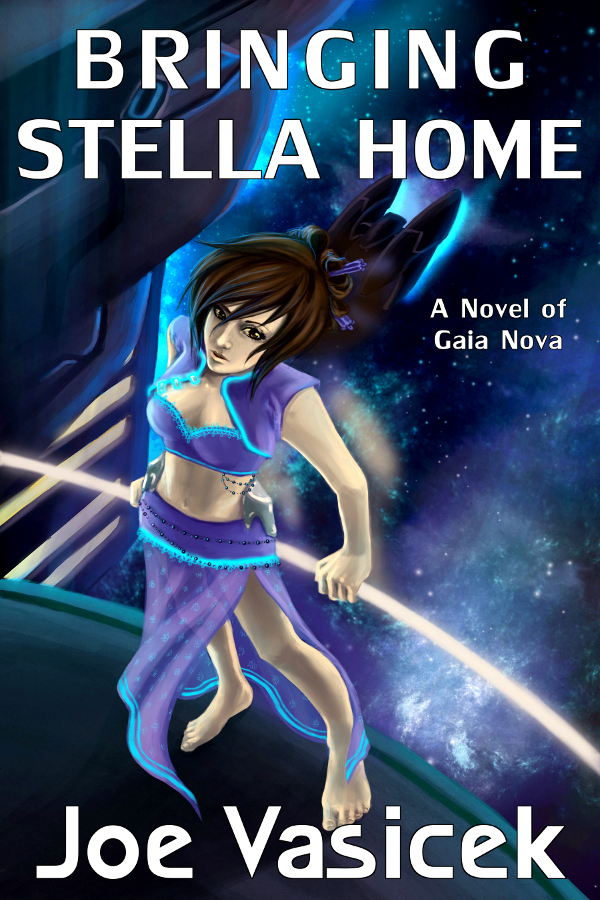
Bringing Stella Home is now up on Amazon!

That’s right–after a whole lot of work, my novel is now up on Amazon for $3.95.  Check it out!
This novel is the first of a much larger series that I have planned.  It’s not a series like Ender’s Game or Song of Ice and Fire, though; all of the novels are supposed to stand alone, though they share the same setting and feature recurring characters.  In that sense, it’s more like Gemmell’s Drenai series.

Even though the series is space opera, I tried to keep the science plausible at least on a high school level.  So while there’s “magic” like FTL and artificial gravity, I’ve tried to bend rather than break the laws of physics.

At its core, the story is more about the characters than the setting or even the plot.  It follows a young boy who is determined, at all costs, to save his brother and sister, even as his world quite literally falls to pieces all around him.  Along the way, he meets up with a mercenary captain who is running from some demons of her own.  The way they help each other overcome their personal challenges is a major driving force throughout the book.

Anyhow, I suppose that’s enough.  I could ramble on forever, but I don’t want to get in the way too much.  Thanks so much, and I hope you enjoy it!

T minus 24 hours and counting…

That’s right!  After much wrangling, I formatted it this morning and published it to Amazon this afternoon.  In less than 24h hours, it should be up for sale!

In many ways, Bringing Stella Home is a lot different from Genesis Earth.  For one, the scope is much larger, with the rise and fall of galactic empires and a war leaving billions dead in its wake.

At the same time, however, the stakes are very personal.  It’s not about turning the tide of human history or saving millions of lives; it’s about one boy who doesn’t want his world to fall apart, and will do anything to save the people he loves.

I put a content warning in the description because there’s a lot of darkness in this book.  It’s not for everyone; I know that some of my friends would find it shocking and offensive.  However, it isn’t my intention to glorify evil or celebrate immorality; rather, by portraying it honestly, I hope to make the struggle against it that much more meaningful.  There is, after all, an opposition in all things.

Writing this book was a watershed moment for me.  Not only is it the first book in a series which I hope to continue across many books, but it marked a shift in my writing.  Before the rise of indie publishing, I thought this would be the one that finally broke through the iron gates of the publishing industry and made my debut.  Perhaps that was why I was so reluctant to send it out; I didn’t want to experience the crushing blow of rejections from agents who didn’t think they could sell it, or editors who think that science fiction is dead.

But now, I don’t have to break through those iron gates; now, I can send this story out into the world and let the readers decide whether it’s any good.  And that’s exactly what I intend to do.

For all those of you who have helped bring this project up to this point, I want to sincerely thank you by giving you a free copy of this ebook.  I’ll be sending it out tomorrow, most likely; if for some reason I miss you, please email me and I’ll correct the mistake.  They say that writing is a solitary art, but this day and age, that’s no longer true.  So once again, thank you.

It’s been an exciting journey thus far, and something tells me that it’s only getting started.  I can hardly wait to see what the future will bring!

Getting ready for publication

So the edits for Bringing Stella Home came in just a couple days ago, and I’m hoping to finish running through them either today or tomorrow. After that comes formatting, then uploading to the various ebook vendor platforms.

I have to admit, even though this is my second full-length ebook, I’m a little terrified.  Formatting is always tricky, and I want to try out some new stuff (such as interior images and a logical TOC) that might not carry over well into other formats.  That, on top of all the usual fears associated with sending your work out into the world, is pretty nerve-wracking.

It doesn’t help that I’m currently working full time–or that a bazillion other things are conspiring to totally eat away this weekend.  However, I’m determined to get this book out, and to get it out right.

I don’t currently have any plans for promotion, but I’m not too worried about that.  I’ll probably put something together when I finish Sholpan.  On that front, I’ve finished the first draft of the novella, but decided to run it through a pretty substantial edit to make it more satisfying for people who read the novel first.

But…yeah.  I’ve got the cover art, got the blurb, got the edits, got the interior map…the only thing left is to write up the author’s note and acknowledgments, format the book, and put it up.

Crazy!


Sholpan, or The Great Novella Experiment

So now that I’m finished with Desert Stars, the next project I’m working on is a companion novella to Bringing Stella Home titled Sholpan.  While Bringing Stella Home is about James and his quest to rescue his brother and sister, Sholpan is entirely from Stella’s point of view and traces her rise in Hameji society, from prisoner and slave to…well, I won’t ruin it for you.

I started writing it on Monday, and so far it’s been a lot of fun.  In some ways, it’s kind of a break for me, since I already know the story (most of the material is lifted straight from Bringing Stella Home, with a few extra changes to make the viewpoint tighter and build more character development).

At the same time, though, it’s a challenge because I’ve never written in the novella format before.  The definition as given by SFWA, has mostly to do with length:

For the purposes of the Nebula Awards, the categories are defined as follows:

  • Novel — 40,000 words or more
  • Novella — 17,500–39,999 words
  • Novelette — 7,500–17,499 words
  • Short Story — 7,499 words or fewer

However, I can’t help but feel that there are many other artistic elements to consider.  For example, the Oxford Dictionary of Literary Terms gives this definition:

novella [nŏ‐vel‐ă], a fictional tale in prose, intermediate in length and complexity between a short story and a novel, and usually concentrating on a single event or chain of events, with a surprising turning point.

Other sites I’ve browsed (including this post from The Galaxy Express, this review from 2009 of several small press novellas, and another interesting post on short stories vs. novellas vs. novels) leave me with the impression that novellas typically

  • can be read in one long sitting, such as a train ride,
  • center around one major conflict, idea, or issue,
  • have more room for rich settings and lavish descriptions,
  • tend to focus more intimately on character,
  • are compact enough to take risks with voice and theme, and
  • can end without a definitive conclusion to the central idea or conflict.

I must confess, I’m not an avid reader of novellas.  I’ve read some of the classics, of course: Dr. Jekyll & Mr. HydeThe Time Machine, Animal Farm, etc, but in terms of modern sf novellas, all I’ve really read is I Am Legend (and a few golden/silver age “novels,” if you count them).  Point is, I’m not an expert on novellas by any means.

However, the novella seems like a very promising format for epublishing, especially in conjunction with a novel.  Readers can pick up the novella for $.99 and get both a sample of the writer’s longer novel-length stuff, as well as a complete story in itself.

That’s what I want to do with Sholpan.  I want to write a less-expensive derivative work that’s artistically sound in its own right, while also driving interest in the full length novel.  Besides, it’s just fun to experiment with new styles and formats.

If this is successful, I can see myself writing a companion novella to most, if not all of my novels.  And who knows?  Maybe I’ll be able to sell some of those to more traditional print and electronic markets.  It’s worth a shot, and no matter what happens, I’m bound to learn something new.

So yeah, that’s my current writing project.  If all goes well, expect to see it out sometime this fall.  And if you have any comments or suggestions regarding novellas, please share!  I’m very interested to learn anything I can.

Blurb for Bringing Stella Home and thoughts on Borders

One of the essential elements for a successful in epublishing is a killer book description, and I think I’ve got a pretty decent one for Bringing Stella Home.  However, I could use some feedback, so if you could read it and tell me what you think, that would be great. Here it is:

It is a dark time for the galactic empire. Rebellions at Tajjur and the New Pleiades sap the empire’s strength from within, while hordes of spacefaring Hamiji warriors from the outer reaches sweep ever closer to the Imperial capitol, slagging entire worlds in their wake.

When the Hameji forces conquer his homeworld, young James McCoy runs away to rescue his older brother and sister, Ben and Stella, from their grasp. Though he faces an enemy undefeated in battle and feared throughout all of inhabited space, James will stop at nothing–not even death–to get his brother and sister back.

Things start to look up when he meets Danica Nova, a Tajji mercenary captain who takes him in and becomes his mentor. James reminds Danica of her own brother, whom she failed to protect when the empire slaughtered her family years ago. Now, she hopes to find some redemption from her demons by saving James from his own.

Unfortunately, neither of them realizes that Stella has become a concubine to the main Hameji overlord–and that Ben has been brainwashed and made into an elite shock trooper in the empath squadron sent to hunt them down.

So what do you think?  Too long, too confusing, too cliche, or too boring?  The genre (if you can’t tell) is space opera / space adventure, so I’m hoping it will appeal to fans of Orson Scott Card, C. J. Cherryh, Lois McMaster Bujold, Star Wars & Star Trek, etc.  It’s also got a slight military science fiction bent to it, though I wouldn’t presume to be qualified to write true military sf.

In unrelated news, I recently did an interview with Charlie of Playground51, which appears to be down for some reason (the link is on my Blog Tour page above).  Topics discussed include how I got the idea for Genesis Earth, which parts were inspired by real life, and thoughts on book promotion.  Hopefully the site will be up again soon!

Also, I’m thinking it’s time to do a major overhaul of my blog template.  As much as I love the current one with the purple stars and nebulae, I need something with two sidebars so that my books don’t push everything else to the bottom.  If you have some ideas for a good WordPress template that still keeps the sci-fi feel of this one, please let me know!  I’m very much open to suggestions.

Finally, since the Borders liquidation is all over the news, I thought I’d share my $.02.  It’s sad, certainly, but I don’t think that the fallout will be nearly as gloomy as Joshua Bilmes claims.

Corporate-run big box stores are certainly on the way out, but there will always be a market for good stories, and in many ways the new ebook technology is causing that market to expand at a wonderful rate.  So while the predictions of the print death spiral appear to be coming true (David Gaughran did a great post recently on that), new models will emerge–indeed, are already emerging–which will fill the vacuum.

The thing that gives me great reason to hope is that these new business models give so much power back to writers.  Instead of relying on the mercies of large media corporations to build a viable career, we can now make a living by publishing independently or going with any number of small independent presses.  Readers have more choices and writers have more options.  It’s glorious.

If anything, the Borders bankruptcy has confirmed to me that I’ve made the right choice to go indie, rather than wait for New York to anoint me before launching my career.  Will I ever go with a traditional publisher?  I’d like to someday, but I no longer feel dependent on the old system to accomplish my dreams.  Instead, it’s my readers who will decide my fate, and that’s exactly as it should be.

So thanks for reading!

Desert Stars 3.0 is finished!

That’s right; after almost exactly two months of writing, the third draft of Desert Stars is now complete!

This is the first draft where I feel that things are truly coming together the way they should be, where the story is transforming into something that not only works, but is actually fairly awesome. I’m probably not the best judge, though, so I’ll have to send it out to another round of first readers to get their reactions to it, but I don’t think this will need more than one more draft before it’s ready to go to a copy editor.

Anyhow, here are the stats:

ms pages: 505
words: 108,468
file size: 246 KB
chapters: 22, prologue & epilogue
start date: 16 May 2011
end date: 18 Jul 2011

And the Wordle:

Wordle: Desert Stars 3.0

The most influential song in the writing of this draft comes from an mp3 cd of Arabic music that a friend in Jordan gave me while I was studying over there in 2008. The title is فرحة عمرانة بالدار, which apparently translates to “The Joy of _____ in Casablanca.” I know absolutely nothing else about it, other than it sounds very Arab. Since Desert Stars is essentially about a far-future Arab society, it resonated quite well.

The hardest part of writing this draft was probably at the very end, when my daily routine fell to pieces and I completely lost my stride. This seems to happen a lot whenever I’m trying to finish something, which reflects in my daily word count charts.

But the ending itself was not particularly hard to write; in fact, it was quite fun. A bunch of previous changes came together in a way that just clicked, including some spontaneous ones that I hadn’t planned for at all. As a result, I’m really excited about this draft and hope to get it out as an ebook before Christmas.

One question, for those of you who have read the previous draft: do you think I could justify splitting the story into two separate novels and selling them each at a lower cost? I hate books that end on a cliffhanger, but one of my first readers thought that this might work, and it would certainly give me more stuff to epublish.

Also, if you haven’t read a previous draft and would like to be a first reader, please let me know. I only send my rough work out to people I know in real life, however, so if our only interaction has been online, please don’t ask. I’ll probably start the fourth draft sometime in September, so you’ll have until the end of the summer (and possibly a little more) to finish it.

Next project? Publishing Bringing Stella Home and putting together the spin-off novella Sholpan. Shouldn’t take more than a couple weeks. After that, I think I’ll start the indirect sequel that I mentioned before. In the meantime, on with business as usual.

Shoot your fans?

Today’s issue of Dave’s Daily Kick was titled “Hooking Credibility,” and I’m not sure what I think of it.  At the end, Dave’s brother Tailspin Jim had the following to say:

What I’m about to add is so basic that [Dave] would never think to include it, but you may be like the vast majority of Kick readers who just don’t have his depth of background on this subject or who would be benefited from taking a look at it.

Each hook or marketing ploy is like firing a bullet at your reader. You probably won’t kill their resistance with the very first shot. You want to fire bullet after bullet until they collapse and make the decision to buy.

Not only does this statement smack of everything I hate about sales and salespeople, but it seems to fundamentally clash with the new reality of publishing.

With social networking and the internet, writers can now connect directly with their readers.  For those going the indie route, this is absolutely essential.  The key element to success, from what I can see, is developing an ongoing relationship with your fans–one in which they take the role of patron, not merely consumer.

There’s a huge difference between thinking of readers as patrons and thinking of them as consumers.  If they’re just consumers, then the end goal is to get them to buy your product, and there’s nothing wrong with spamming them or shamelessly plugging yourself if that’s what works.

But if they’re patrons, the end goal is to develop that relationship–to connect with your readers on a meaningful level, both before and after they buy your work.  And in this brave new world of publishing, that seems like the best coarse to take.  Consumers have to be sold on each individual book; patrons are sold on you, so they’ll read everything you put out.

And as a reader, that’s how I buy.  Whenever I find an Ende or a Wilson or a Le Guin in the bookstore, I rush to grab it, because those are the writers who speak to me.  I’ve bought just about every Sanderson in hardcover because I love his work and want to support him.

That’s why this comparison of bookselling to “a series of bullets being fired from an automatic rifle at the prospective buyer” rubs me in all the wrong ways.  I’m not just peddling widgets; I’m creating art and sending it out into the world, waiting patiently for it to return back a hundredfold.  And if I work hard to create the best possible art and treat my readers (aka you guys) as my patrons, I sincerely believe that it will.

So to all of you who have read my books, regardless of whether you bought them or downloaded them from Smashwords for free, I just want to say thank you!  The greatest honor any writer can have is to be read, period.

I also want you to know that I’m never going to “shoot” you with a bunch of cheap sales tricks or “hooks” that get in the way of the story.  I’m just going to write damn good books and put them out where you can find them, trusting you to rate, review, like, and share them if you feel they truly deserve it.

I will never, ever, EVER put a gun to your head to get you to buy my work.  I’d much rather you jump at the chance to read a Vasicek, because that’s what speaks to you.