Sackett’s Land by Louis L’Amour

I first heard about Louis L’Amour’s Sackett series from a hiking buddy, and I’ve wanted to read them ever since. This is the first one, and it takes place in the late 1600s with the ancestor of the Sackett clan, Barnabas Sackett, as he discovers the untamed wilds of America while on the run from people back in England who want him dead.

Like most of Louis L’Amour’s books, this is a quick, fun read. Lots of action, and never a dull moment. I also really liked the 17th century slang and mannerisms of speech—it felt like L’Amour really hit it on the head.

But the book’s strengths are also the flipside of its weaknesses. There’s a lot of plot and conflict, a decent amount of setting, and a little bit of character… and that’s about it. The story moved a little too fast to create a sense of immersion, and I also found it lacking in emotional resonance. It was a fun read, but I probably won’t remember much of it.

That said, it was a really fun read, and definitely lays the foundation for a very interesting series. The parts that did resonate with me were the ones that reflected my own family history. Several of my ancestors came to Virginia and the Carolinas during the colonial era, and I can imagine that they felt very much like Barnabas Sackett when he saw the blue mountains for the first time and yearned to go beyond them.

Fun stuff, especially you’re into historical fiction and early Americana. I give it 3.5 stars.

Thoughts after finishing The Last Full Measure by Jeff Shaara

WOW.

This was an amazing book. A highly memorable book. A book I will return to again and again in the future.

There comes a moment when reading a truly amazing book when you don’t think that it can possibly get any better. It’s a ten out of ten, easily five stars. And then … it gets even better.

The Last Full Measure by Jeff Shaara was one of those books. It’s the third book in a trilogy that technically starts with Gods and Generals, but really it started with the middle book, The Killer Angels, which was written by the author’s father, Michael Shaara.

The Killer Angels covers the events of the Battle of Gettysburg, and is definitely one of the best Civil War novels ever written. Years later, Jeff Shaara decided to write a prequel to his father’s book, showing all the events of the war leading up to Gettysburg. The Last Full Measure picks up immediately where The Killer Angels leaves off, and follows the war to its conclusion at Appomattox and the beginning of the Reconstruction.

This book is amazing. It really made me feel like I was there, from the bloody confusion at the Wilderness to the brutal hand-to-hand combat at Spotsylvania, from Grant’s terrible mistake at Cold Harbor to the long, hard siege of Petersburg. And then, at the very end, when Brigadier General Lawrence Chamberlain surveyed the monuments from Little Round Top just before the fiftieth reunion of Gettysburg, I realized that I actually have been there!

It was such a crazy moment, to read about something in a novel and then have it merge with my own memories of the place. It made the whole thing come alive in a way that was just fantastic.

There were a lot of other amazing moments in the book. When General Lee finally surrendered, it very nearly brought me to tears. And later, when Chamberlain accepted the arms of the Army of Northern Virginia and had his men salute the Confederate soldiers in a show of brotherhood and respect, it was amazingly touching.

Chamberlain’s storyline in general was fascinating throughout the whole trilogy. His father wanted him to be a soldier and his mother wanted him to be a priest, but he chose a career in academia instead at the insistence of his wife. But the academic lifestyle left something unfulfilled in him, and he didn’t realize it until the war broke out. He volunteered without telling anybody, not even his wife, and was soon swept up in some of the bloodiest battles in the war. At Fredericksburg, he spent the night on the bloody fields within sight of the enemy lines, shielded and kept warm by the bodies of his men.

Then, at Gettysburg, there was that was that glorious charge on Little Round Top that saved the Union flank, and quite possibly the entire battle. When he came home from that, he’d gained something that he’d never had before in his life: his father’s respect and approval. From Gettysburg, he rose to command a battalion, but at Petersburg the ineptitude of the Union command left him without support at a critical moment, and he was nearly killed. But he came back, taking command of a brigade upon his recovery, and turned the tide of battle at Five Forks and Appomattox.

By the time the war was over, not only had he won great honor and glory, he’d tested and proven himself, learned something about his inner character that he would always take with him, and that would always give him strength. The afterword starts with a quote from Lawrence Chamberlain that sums it all up amazingly well:

War is for the participants a test of character; it makes bad men worse and good men better.

I’m not going to lie: this book almost made me wish that I could go off to war like Chamberlain did. It’s not that Jeff Shaara glorified the Civil War war–just the opposite, in fact. The horrors and brutality and awful tragedy were all depicted in full measure, with the pain and death and suffering. It wasn’t glamorized at all. But there’s something deep, something primal about going through an experience like that–something that strips away all the luxuries, all the securities of modern life and forces you to find out who you really are, what you’re really made of. For all the horrors that those soldiers went through, I envy them for that part of their experience.

I feel like I’ve been channeling that recently in some of my short stories, like that orc story I wrote recently. I have an idea for another one that I’ll probably write while I’m out at Cape Cod. It’s also what drives me to heroic fantasy, to stuff like David Gemmell’s Drenai series. There’s something about taking up a sword, or an ax, or a musket and charging headlong into battle that rouses the spirit–that makes you feel truly alive.

I would love to write a book as good as this one; it’s one of those things that I dream of. I’m not sure if it’s possible to pull off a story as tremendous as this in short story or novella form, though. Maybe, but all of the stories that have had this powerful of an impact on me were all novels. The shortest one that I can remember was The High King by Lloyd Alexander, but that was the fifth book in a series (and it was still a novel). Short stories and novellas are great, but at some point I need to return to novels.

In any case, those are some of my thoughts after reading The Last Full Measure. There were a lot more, but this post is already starting to ramble so I’ll cut it short here. I’ll leave you with the opening credits from the movie Gods and Generals, a great piece that really captures what so many of the common soldiers were fighting for: home.

Take care and be well.

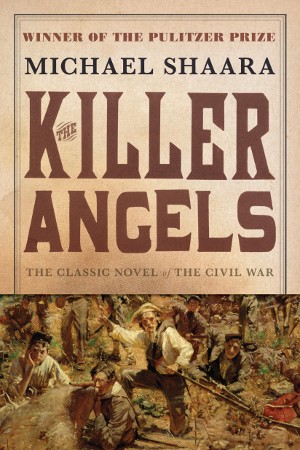
The Killer Angels by Michael Shaara

June, 1863.  In a bid to destroy the Army of the Potomac, Robert E. Lee invades Pennsylvania with an army of 70,000 men.  Using the mountains to screen his movements, he advances toward Harrisburg, fully expecting to secure a victory that will end the American Civil War.

But two weeks into the campaign, Stuart’s cavalry still hasn’t reported back, leaving the Confederate army blind.  Deep in enemy territory, with reports of the Union advance beginning to trickle in, Lee moves his forces to converge on a small town named Gettysburg.

In the titanic clash that follows, friend will fight against brother, generals will knowingly send thousands of men to their deaths, and the fate of the United States of America will lie in the hands of farmers and mountain men, immigrants, West Point classmates, and a New England professor.

This book is awesome.  Epic, in the best and truest sense of the word.  I’m not a civil war buff, but it reduced me to tears.  The scope is tremendous, and yet at the same time the characters feel like real people.

For some, like Chamberlain, the war is about slavery and equality–something that disturbs him when he comes across a black man for the first time.  For others, it’s about states’ rights and self-government.  But for most everybody else–including Robert E. Lee–it’s about a myriad of other things, like honor, duty to country, boredom, a desire to prove one’s manhood, and a hunger to be part of something greater.

What’s remarkable is how so many good people, who more often than not respect the opposing side and hold them in the highest regard, end up getting swept into such a horrific and bloody battle.  No one, especially the generals, have the power to prevent any of it–all they can do is leave it in the hands of God.  And the tragedy of it all is summed up so perfectly in the film rendition of this book, when General Armistead reaches the high-water mark of the Confederacy and falls, only to hear that his friend and classmate on the Union side, General Hancock, has fallen too (skip to 23:15):

“Not both of us!  Not all of us!  Please, God!”

I’ve been to Gettysburg several times, and stood on the ground where the most critical parts of the battle were decided.  And yet, I feel that living as an expat on  the other side of the world has given me a much greater appreciation of my country’s history.  Perhaps that’s one of the reasons why this book was so moving to me at this time.

Here are some of my favorite quotes:

He was a man to depend  on, and there was this truth about war: it taught you the men you could depend on.

According to the now retired General Schwarzkopf, The Killer Angels is “the best and most realistic novel about war that I have ever read.” You really get a sense of what it’s like to be in command–what it’s like to depend on the actions of your men, and what goes through your mind as you lead them.  The only other novel I’ve read that comes close to capturing that is Ender’s Game.

If the war goes on–and it will, it will–what else can we do but go on?  It is the same question forever, what else can we do?  If they fight, we will fight with them.  And does it matter after all who wins?  Was that ever really the question?  Will God ask that question, in the end?”

Robert E. Lee’s words after the Confederate defeat on the third day.  There is, of course, some criticism about how much artistic license Michael Shaara took in portraying the central historical figures.  Regardless, this novel gave me a much greater respect for Lee and his men.  There are no “bad guys” in this book–and therein lies the heart of the tragedy.

In the presence of real tragedy you feel neither pain nor joy nor hatred, only a sense of enormous space and time suspended, the great doors open to black eternity, the rising across the terrible field of that last  enormous, unanswerable question.

Well put.  I’ve never experienced any tragedy on the scale of the American Civil War, but I do know what it’s like to lose family and loved ones, and this captured a bit of that for me.  I can only imagine what it must be like to experience the tragedy of war.

This novel is a classic.  If you have any interest in American history, it is absolutely a must-read.  And even if you don’t, if you enjoy reading stories about war, whether modern, historical, or fantasy, you will almost certainly enjoy this book.