A Change in Direction

This is going to be a rather long post. I’ll preface it with some demographic trends among my generation, then tie that in with my situation and how I got here. From there, we’ll see where it goes.

I was born in the early 80s, which technically makes me a Millennial, though it doesn’t always feel that way. Millennials get maligned for a lot of things, which is pretty typical of all generations as they rise, from what I can tell. Civilization is constantly under attack by barbarians, most of whom we call “children,” which is really just another way of saying this:

So how is my generation currently reinventing the world?

Thus far, not very well. The Great Recession hit us just as we were coming of age, and it shows. We were much more likely to move back in with our parents than previous generations. We’re putting off marriage and home ownership, some because we’re more focused on our careers, others because we just can’t seem to launch.

At the same time, not all of this is bad. In spite of the fact that most of us were never taught home economics or personal finance in high school (thanks, Baby Boomers, for all the participation trophies), we are rapidly learning more responsibility than our parents. Where six out of ten Americans would have to beg, borrow, or steal to cover a $500 emergency expense, nearly half of us Millennials have $15,000 or more in savings.

And yet, the problems we’ve inherited are truly daunting. Our national debt is $21 trillion and counting, and without facing a recession, war, or other emergency event, our deficit is still set to exceed $1 trillion per year for the forseeable future. Just this month, we learned that Medicare is set to run out of money in eight years, and Social Security is not far behind that. And don’t even get me started on the house of cards that is our national pension system.

Up until the 60s, previous generations saved and invested so that their children could be better off than they were. The Baby Boomers not only squandered this wealth, but they stole their children’s and grandchildren’s inheritance as well. History teaches us that there will be a terrible price to be paid for all of this. Our parents have proven themselves incapable of doing anything other than kicking the can down the road to oblivion.

That probably sounds more bitter than I intended it to be. Unfortunately, it’s the truth. Our parents just don’t understand the world that we’re living in. We’ve come of age in a world with far less opportunity than they did.

I had a conversation with my mother last year that demonstrates this. My mother likes to make cascarones for special events, like Easter or birthdays. To make them, however, you need a hollowed-out eggshell, which requires removing the yolk and whites in a very particular way. If you’re accumulating shells through normal consumption, it can get to be rather tedious.

One day, I came into the kitchen to find my mother blowing out eggshells and dumping the whites and yolks down the sink. She’d bought a whole bunch of them for 35¢ a dozen, and decided to just make the cascarones all at once instead of accumulating the shells over time. When I saw this, I was horrified.

“How could you waste all those eggs?” I asked.

“It’s not a waste,” she said. “They were 35¢ a dozen.”

“Yes, but we could have eaten them. That’s perfectly good food you’re dumping down the drain.”

She shrugged, as if it didn’t really matter. But I pressed her a bit further, until I came to a disturbing realization:

My mother has never been as poor as I am.

When I pointed this out to her, her answer was even more disturbing. With anger in her voice, she snapped “that’s because you choose to be poor.”
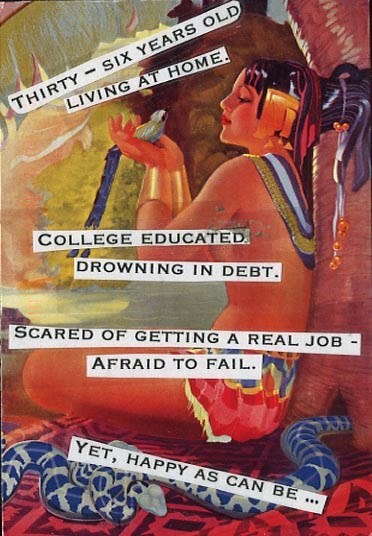
Is that true? Am I, a Millennial, poor because I choose to be poor? Perhaps. I’m not so irresponsible that I won’t own up to my life decisions, which have brought me to this place. But I think there’s this perception in the minds of our parents and grandparents that Millennials are generally like the person who wrote this postsecret above. Drowning in debt, living at home, so afraid to fail that we’ve utterly failed to launch, and yet blissfully oblivious to all of it. Perhaps that’s true for some of us, but not for those who will reinvent the world after our parents are gone.

To be clear, I love my mother and father. I don’t hold any of this against them personally, or anyone else of my parents’ generation (except the politicians who sold our Constitutional birthright, but that’s another rant altogether). Unfortunately, hard truths do not become softer because we choose to ignore them. And hard truth is this:

Hard men make good times.

Good times make soft men.

Soft men make bad times.

Bad times make hard men.
I graduated college in 2010. Through a combination of scholarship money, campus jobs, and (yes) generous parents, I was fortunate enough to graduate without any student debt. At the same time, it was the height of the Great Recession, and jobs were nearly impossible to come by. I can’t tell you how many of my writing friends put their dreams on hold, or abandoned them altogether. Almost all of them.

As a side note, I agree with Mike Rowe that “follow your passion” is bullshit advice. It ranks right up there with “be yourself,” and “you can be anything if you put your mind to it.” Don’t follow your passion. Follow opportunity, and take your passion with you.

But in 2010, I had an opportunity. Without any debt, and without any dependents or other obligations, I decided to pursue a writing career. And unbeknownst to me at the time, the industry was undergoing a revolution that would open the doors to make that possible.

I indie published my first short story, Memoirs of a Snowflake, in March 2011 and never looked back. Since then, I’ve published dozens of novels, novellas, short stories, and other works. It’s been an exhilarating journey. At the same time, it’s been the most difficult struggle of my life. And that is why I must now confront one of my most crippling fears.

Unlike the girl in the postsecret, I am not crippled by the fear of failure. If I were, I would never have published that first story, let alone all the others that followed. Instead, I have a fear of admitting failure, both publicly and to myself. It feels too much like an admission of defeat.

It’s an important distinction to make, though. The Romans admitted failure often and early—it’s how they learned from their defeats, ultimately going on to build one of the most powerful militaries in the ancient world. But they never admitted defeat. Even after Cannae, when Hannibal threatened the republic with utter extinction, the Romans refused to be defeated. And so, while Carthage fell into decline and decadence, the Romans endured until Scipio finally gave them victory at Zama, paving the way for the rise of Western Civilization.

I haven’t had a personal Cannae moment yet, but I do feel like I’ve been fighting a war of attrition. In 2014, the market shifted with the launch of Kindle Unlimited, and I failed to adapt. At that point, I was just on the cusp of going full-time with my writing, though looking back I can see that I didn’t yet have the foundation for a lasting career. Still, to have that dream snatched away when I was just on the verge of catching it, you can understand why I kept plugging along, believing that I was just a month or two from turning things around.

That’s basically what I’ve been doing for the last four years: writing full-time even though the writing doesn’t pay full-time wages. Maybe my mother is right. Maybe I have chosen to be poor.

And yet, while I now believe that I do have the foundation for a lasting career, I need to confront the fact that it may be ten years or more before I achieve it. Should I continue, like so many of my peers, to delay major life decisions until my career reaches that point? Is it worth it to put off marriage, family, and home ownership until my forties or fifties, if that’s what it takes? Or is it time to admit failure so that I can leave this dead end and find another way?

Back in 2010, I had no plan B. It was the Great Recession. I didn’t have a day job because I couldn’t find one—hardly anyone could. And from 2013 to 2014, writing paid well enough that I didn’t need one. Things were looking up, and I was just a couple months away from a sustainable long-term career.

Well, it’s time to admit that that line of thinking has turned out to be a trap. I’m approaching my mid-thirties and I’m still single and poor. I need some kind of long-term backup, because I can’t count on the writing career to take off like I need it to, at least not anytime soon.

So I’ve moved my writing onto a part-time footing. I’m limiting the number of words I write each day, leaving time for other pursuits. And I’m looking for a day job, preferably one that teaches me something useful and pays well enough to make ends meet.

I haven’t been defeated yet, though. Failure is not final until you decide to give up. I have not given up, and will continue to write, even if only on a part-time basis. And when I am making enough to go full-time, I have the foundations in place to do so.

In the meantime, though, I’m not going to put my life on hold for a dream.
3am thoughts, or why everyone says to be an accountant

I’ve been reading in bed on my smart phone recently, which is probably a bad idea because it makes it harder to go asleep.  At the same time, though, it tends to get my mind rolling, and when 3am comes around my thoughts tend to go some really interesting places.  Sharing those thoughts is probably going to get me into trouble, but hey, you might find them interesting, so why not?

When I was eight years old, I knew I was going to be a writer.  There was never any question about that.  I spent all my free time making up stories, and my favorite stories were the ones I found in books.  However, I knew I never wanted writing to be my job, because 1) everyone hates their jobs, and I didn’t want writing to ever become something I hated, and 2) everyone knows that writers can’t make a decent living.  Even at the young age of eight, I had bought into some of society’s most pervasive myths about jobs, careers, and how to make money.

Americans are generally horrible with money–we struggle to keep budgets and put all sorts of things on credit, and pay more than twice what our houses are worth by signing mortgage contracts we barely even read.  Because we’re so horrible with money, we tend to see it as a sort of magical force, something that can solve all our problems and make us happy.  Rich people are like powerful wizards or sorcerers, so far above the rest of us that we can hardly fathom their ways.

Nowhere is our stupidity about money more apparent in the fact that most of us spend our lives acquiring it by working for some sort of hourly or salaried wage.  Wages and salaries are basically the same, in that they convert time into money.  That’s why we all measure income in terms of dollars per hour, or salary per year.  But for anyone who understands how money works, that is stupid, stupid, stupid, stupid.  Money comes and goes, but time?  Time is one of the most finite and precious resources known to man.

All of us are going to die someday.  Most people are scared shitless by that fact, so we try to ignore it or put off thinking about it until some unspecified time in the future, like when we’re retired.  But not all of us get the opportunity to put our affairs in order after retiring comfortably from the workforce.  In fact, any of us could die tomorrow, or the next day, or at any other time.  And even if we do all live to be centenarians, our time on this Earth is still finite.  It’s non-renewable, too–you can’t go back and relive that day or that hour or that minute once it’s passed, no matter how much you regret it.

Converting time into money is basically trading gold for lead, or wine for water.  Yet that’s exactly what we do, because money is this strange, magical force that so few of us understand.  And the machines that do all the converting for us are businesses and corporations.

Questions like “where do you work?” “what is your job?” and “what do you make?” are much more common than “what do you do for a living?” That’s because most of us have bought into this idea that money comes from working for someone else, exchanging your time directly for a salary or paycheck. Sure, we do stuff with that time, but we don’t actually own it–the company does. While we’re on the clock, the company owns us and anything we produce. That’s the pact we make in exchange for this magical substance we call money.

It wasn’t until college that I started to become disabused of the childhood notion that I shouldn’t pursue writing as a career path. For one thing, I came to realize that plenty of people love their work–that just because you do something as a job doesn’t necessarily mean that you’ll come to hate it. But it wasn’t until I graduated unemployed in the middle of a recession that I realized how much of a myth it is that writers can’t make a living.

You see, people say that about every career choice–every career, that is, except accounting. That’s because accountants are the ones who work for the businesses and corporations, counting the magical money. Since we all get our money from businesses and corporations, exchanging our time for money, the only career with complete security is the one that the businesses and corporations will always need. After all, they’re not going to go belly up, are they? Not the big ones, anyway. They can’t–they’re the magical machines where all the money comes from.

Of course, anyone who knows anything about money knows that the only real way to make a lot of it is to produce something of value that can scale. It’s not about time at all–it’s about producing something that people want, and producing it in such a way that the more you sell, the more you make. At no point in that equation does time become a variable. It’s certainly a variable in the production equation, but even there, it’s not necessarily the most important one.

The most important thing, though, is that you have to really own what you produce–and that means owning all the failures as well as the successes. When you work for a corporation, it’s easy to shift the blame. It’s a rare case where one person is solely responsible for bringing down the whole collective enterprise. But when you work for yourself, you can’t blame anyone else when things go wrong. You’ve got to be ready to take the risk, and the bigger the payoff then chances are the bigger the risk.

That’s why everyone says that you can’t make a living as a writer. They say the same thing about making a living as a sports caller, or a musician, or a political activist. I’ve even had people tell me that there’s no money in math or in Arabic. They say that because they think that money is supposed to come from corporations, and corporations only really need people who can count their money. Every other part of the business they can either figure out how to do it with robots or outsource the work to India. They might not outsource all of the jobs, but there’s always a risk that they’ll outsource yours (unless you’re an accountant, of course, because corporations always have money).

In the end, though, it’s all just silly. Money isn’t some sort of vague magical force, and it doesn’t come out of the void from businesses or corporations–it comes from making something that people are willing to pay you for. It comes from producing something of value, or at least convincing people that you have something of value. And you don’t need to sell your time at $7.25 an hour or $24,000 per year to do that. You just need hard work, a great idea, and the opportunity to succeed as well as fail.

So can you make a living as a writer/artist/blogger/activist/global nomad/whatever your dream happens to be? Of course! It won’t be easy–you’ll probably fail a lot, perhaps even spectacularly–but it is possible. So why not give it a try? At the very least, you shouldn’t buy into the myth that accounting is the only career path guaranteed to make you any money.

What’s your backup?

...have you?

So I just got back from Easter vacation in Turkey, at Trabzon and Lake Uzungöl.  It was pretty awesome–I’ll definitely be blogging about it in the next couple of days!  First, though, I wanted to share something interesting that happened on the way back.

While I was hanging out in Batumi with some other TLG volunteers eating Adjarian khatchapuri (an experience in itself), we got to talking about what we’re going to do with our lives after we get back to the States.  Most of them didn’t really want to think about it, which surprised me, so I asked why.

They told me they didn’t want to have to figure out the rest of their lives–that coming out to Georgia to teach English was a way of putting off those major life decisions.  Fair enough.  They then asked me if I’ve figured it out.   I said yes: that I want to be a full-time writer, and that I’m out here to see the world and get some cultural experience as I try to make that dream a reality.

One of the girls then asked what my backup was if that didn’t work out.  To be honest, I had no idea what to say.  My plan at this point is to just keep teaching and traveling until the dream becomes a reality.  Am I confident that it will?  Eventually, yeah–as long as I keep writing, which I certainly will.

I thought about it a bit on the way back, and realized that my mindset has shifted tremendously in the past few years.  When I was back in college, and to some extent for the first year after I graduated, I used to worry a lot about my “backup plan.” It was a way of addressing the fear of failure, of creating an illusion of safety by having a “fallback.”

I’m sure there are careers where that’s a good idea.  Generally, those are careers with definite paths, where if you don’t pass a certain number of checkpoints, you’re basically screwed.  With writing, though, there is no set path that everybody follows–especially now with ebooks and epublishing.  Because of this, it’s impossible to really fail–either you keep on trying until you make it, or for one reason or another you give up.

Ever since I graduated in 2010, I’ve been structuring my life in such a way that I can continue to pursue my writing.  Every job I’ve taken has just been a stepping stone, a bridge to allow me to keep pursuing this dream.  Have I made it yet?  No, but I haven’t given up yet either, so I haven’t had to fall back on my backup–whatever that would mean at this point.

From the outside, it probably looks like I’m being hopelessly responsible–that, or willfully oblivious to a hundred things I should be worried sick about.  However, I’m actually quite confident that I’m on the right path and things will work out–and that surprises me.  It’s like that moment when you realize you’re actually swimming, not just kicking and thrashing about the pool.

Worst case scenario, I fall head over heels in love with an awesome, wonderful girl, and after a few heady months filled with blissful romance, I wake up one morning and realize that I’m married.  If that happens, I might have to put my writing on hold for a while until I get things sorted out so that I can support both myself and my wife–but then again, with her help, I might be able to do twice as much, or even more.  Perhaps that will help my writing career even more than trying to go it alone.

So really, there is no back up plan or worst case scenario–just the future.  And as Georgians are so fond of saying, “no one can know what will happen in future.”

What a relief.

What I’ve been up to recently

I thought it would be a good idea to do a quick post explaining what I’ve been up to the past month or so, since a lot of things have changed and I’m sure they will be changing a lot more in the future.  So, here’s what’s up:

As you may or may not know, I decided about four or five months ago to leave the USA to teach English abroad.  For the past few little while, I’ve been applying for a program to teach English to elementary school kids in Georgia.  I had the interview over Skype just yesterday, and I think it went pretty well!  I should hear back in the next couple of days, so fingers crossed on that.

If they decide to hire me, I’ll leave in three weeks and stay until at least mid-June.  At that point, I’ll either sign up for another semester or go somewhere else, either the Middle East or Eastern Europe. The pay isn’t great, but it seems like a good cultural experience, and I’m a lot more interested in the Caucasus than I am in East Asia (no offense to Asians).

Ever since I graduated in 2010, I’ve been looking for a fulfilling career that I can balance with my writing aspirations.  I learned pretty quick that that simply doesn’t exist in Washington DC; either you sacrifice everything for your career, including your family, or you end up trapped in an office pushing papers all day.  In Utah, I bounced around a lot of temporary jobs while struggling to make ends meet, but I never found anything more permanent that seemed to strike a balance.

I hope that teaching English will help me to find that balance, and from what I’ve heard from some of my former expat friends, I’m optimistic that it will.  Perhaps more importantly, it will probably enrich my writing by exposing me to new peoples and cultures.  Desert Stars was certainly enriched by the time I spent in Jordan; without having lived in that culture, I don’t think I would have been able to write it.  Besides, English is something I’m good at, and so is teaching–so why not capitalize on the skills I already have?  It certainly sounds better than wasting my 20s in a warehouse.

So that’s the plan: launch a TEFL career and spend at least the next three to five years abroad.  At least.  I might not get married until my 30s–or who knows, I might find someone out there and go native–but this is something I want to do as a career, not just as temporary filler before I figure out what I want to do with my life.  I’m through with filler.  Whether it takes one year or ten for my writing career to take off, I’m going to get out and do something useful and worthwhile.

That’s the plan, anyway.  And of course, I’ll always keep writing.

Right now, I’m finishing up Stars of Blood and Glory; I’m on chapter 15, with only three more and an epilogue after that, so I should finish that well before I leave.  After that, the next big project is Star Wanderers, which is already about halfway finished.  I’ll probably take some time off and work on polishing part II, then release parts I and II sometime in the spring–unless by some weird fluke it wins Writers of the Future.  I’ll know in February.

And after that?  Well, I’m thinking it’s almost time to pick up Edenfall again, but I can’t say for sure. Probably, though–I definitely want to finish that one before the end of the year, and preferably get it published.  After Stars of Blood and Glory, I’ll probably take a break from the McCoy continuity in the Gaia Nova universe, though I may pick up something from Jeremiah’s timeline in Star Wanderers.  I really want to do a parallel novel from Noemi’s point of view–maybe that’s the one I’ll do in seven days, just to hit that resolution.  Everything has to be ready fist, though, and right now it isn’t.

So much is changing–I have no idea where I’ll be in the next six months, creatively or physically. But right now, I’m just enjoying a relaxing time with my parents and getting ready for the next big transition.  Life is good.

Difficult choices and keeping perspective

So I have some news, and it’s probably going to freak my parents out a little bit…I decided to turn down the full-time job offer that I mentioned a few weeks ago.

The company is great, they treat their employees well, I got along well with everyone there–so why not take the job?  Because it wasn’t helping me make progress toward my long-term goals, it wasn’t teaching me any new or useful skills, and it wasn’t in a field where I’d like to make a career.  After weighing the benefits vs. the costs, especially the opportunity costs, it just didn’t make sense to stay.

I know what a lot of you might be thinking: “Dude, a job’s a job.  In this economy, you should take it and count yourself lucky!” I reject that, though.  Last year, I managed to cut my expenses to less than $950 per month.  I’ve been saving up my paychecks, and I’ve got enough to float me for a couple of months until I find a job that fits better, hopefully part-time.

The big thing I’m worried about is whether I’m digging myself into a hole.  Since graduating in April 2010, here are the jobs I’ve held:

  • Conducting unsolicited phone interviews at a call center.
  • Picking, packing, and shipping at a costume company warehouse.
  • Delivering phone books from my car.
  • Miscellaneous unskilled labor at a candy factory.
  • Miscellaneous unskilled labor at an alarm company warehouse.
  • Processing inventory and shipments at an alarm company warehouse.

So yeah, nothing all that great.  I’ve been doing some volunteer stuff in the interim, though, especially with Leading Edge and the “class that wouldn’t die” article from last year.  But in general, it feels like I’m getting stuck in a rut, and that the longer I stay stuck, the harder it’s going to be to break out.

What I really want is something that will expand my mind and/or give me another major cultural experience.  That’s why I’m thinking seriously again about teaching English abroad.  But grad school is definitely another attractive option, especially if it gives me a chance to work on my Arabic.

With that in mind, here are the options I’m considering right now:

  • Travel to the Caucasus in January and volunteer teach English with the TLG program.  It’s not particularly lucrative, but if I can balance my writing career on the side while having an awesome cultural experience in a region of the world that interests me, it might be perfect.
  • Study Arabic and/or Middle Eastern Studies at a university in the Middle East, ideally AUB or AUC.  I don’t really want to be a security analyst, but I would love to make a career as an Arabist of some sort–provided, of course, that I could balance it with my writing.
  • Pursue a graduate degree in History, Anthropology, or Sociology in the United States.  I’m less sure of this option, mainly because I don’t know if I’m passionate enough about any of those subjects to really succeed at them.
  • Take a chance and travel to the Middle East to teach English.  I’d probably go to Jordan or Oman, where I actually know people, but Egypt, Libya, or Tunisia might be good too, especially with the Arab Spring opening them up.  It might also be dangerous…but hey, at least it’s an adventure.
  • Finding a graveyard desk job, like night auditor at a hotel, and use that to support myself until the writing career start to take off.  Even though this is the most boring option, it’s probably the most likely one I’ll follow…which probably isn’t a good thing.

The main goal, of course, is still to go full time with the writing career.  That’s like the holy grail.  I’m still optimistic about that; it’s just a matter of finding something useful to do in the interim.  The last thing I want is to settle, or to get stuck in a comfort zone, or lose sight of my long term goals…

…I don’t know.  I’m still figuring all this stuff out.  But regardless, I just don’t think working full-time at an unskilled labor job is going to get me anywhere–and that’s an opportunity cost I can’t afford to take.

The blog tour rolls on

I’m writing this post from Leading Edge (the internet is down at my apartment), so I don’t have much time, but I did want to take care of a few items of housekeeping.

First, my next guest post in the Genesis Earth blog tour is up, this one at Charles Millhouse’s blog.  Charles is a fellow sf writer whom I met on the Kindleboards, and the post basically explains my writing routine since last year.  Of course, since I’ve technically been unemployed since graduation, my routine is a little wacky, but I think you’ll find the post interesting. Check it out!

Desert Stars is coming along.  I took yesterday off to finish drafting the revision notes, but I’ve still got the last three chapters to go.  It’s going to be awesome, though–I’ve got so many ideas for how to improve the story.  Many thanks to all my first readers for your feedback!  It’s been immensely helpful.

Also, I decided to take down “From the Ice Incarnate” from Amazon.  I still think it’s a good story, but I don’t want someone to buy Genesis Earth, love it, then buy the story and feel ripped off.  Also, I think I might have more luck with my short stories if I send them out to print markets instead.  I’ve submitted “Decision LZ1527” to Escape Pod; if it sells, hopefully that will drive readers to my ebooks.

And on that note, if you’ve read Genesis Earth and enjoyed it, I would like to ask you to please post a review on Amazon.  I don’t want to be one of those guys who secretly boosts his stats by coercing people to write fake reviews, but if you did enjoy the novel, I would appreciate it a ton if you would take the time and share your experience.  At this point in my career, that’s probably the thing that would help me out the most.

So anyways, that’s what’s going on here.  Hopefully, the internet will be back before the weekend.  See you around!

Looking for a life experience

This week, I got hit by some good news and some bad news.

The good news was that I got a short term seasonal job, delivering phone books.  That should keep me solvent for the rest of the month, at least until I can find something slightly more permanent.

The bad news?  I heard back from the company with the wilderness job, and it turns out I didn’t get it.

So now I’ve got to figure out what to do with my life for the next  year.  My writing career, as always, is plan A, but that’s more of a mid- to long-term thing.  And honestly, that’s how I want it.

I feel that I need to do something big–to go on some kind of adventure.  I’ve been working hard to hone my craft, but I feel that I need to acquire some kind of significant life experience, not only to boost my writing, but just to grow as a person.  It’s tempting to look for a comfort zone and camp out in it, but I don’t think that would be the best thing for me to do right now.

Before I graduated, I decided not to go to graduate school yet for a few reasons.  First, I was sick of school, and felt that I needed a break. Second, I didn’t know what to go in for, and didn’t want to go to grad school just to postpone figuring things out.

Third, I wanted to get out of the cloistered halls of the university and gain some real world experience.  I’d spent my whole life up to that point in academia, and was sick and tired of being sheltered from the “real world.” I wanted to get out and see what things were really like on the other side of the ivy.

For the past eight months, I’ve been bouncing around in Utah, working odd jobs to get by.  It’s a different set of stresses and problems, and while I can’t say I’m unhappy, I certainly can’t say that I’m fulfilled.  Being unemployed is about as unfulfilling as you can get and still be breathing.

I could probably find and hold down a graveyard job until my writing career takes off, but somehow that doesn’t seem much better.  I don’t just need a job to facilitate my writing–I need a major life experience to broaden my perspective on things.  I was hoping the wilderness job would provide me with both of those, but unfortunately that’s no longer an option.

So what next?  Here’s an idea: maybe I could go abroad and teach English for a year.

I used to joke with all my friends that if I didn’t get the wilderness job, I’d probably leave the country and go on an adventure–but really, why not?  A chance to see the world, use the teaching and language learning skills from my degree, and acquire new skills that might come in handy later on.  Plus, when I come back, I’ll sure have a lot of interesting things to write about.

The big question in my mind is what I need to do to get ready.  I suppose the best thing would be a TEFL certificate–I could probably get one of those in a month or two through online classes.  But…is that really the best path?  And what is the best program to go through?  A couple of friends of mine who have taught English abroad for the past couple of years say you don’t need a certificate to get a job, but they were working with kids, not adults.  And for the English teaching jobs in the Middle East (especially the gulf), you really do need certification.

So I guess I still need to think it through.  Right now, my top three destinations would probably be Japan/Korea (for the earning potential), Saudi Arabia (for the Middle East experience), or the Czech Republic (for the chance to connect with my roots).

I don’t know, though.  I’ve still got to weigh the pros and cons.  I’ll probably do that in a later post–but for now, that’s what I’m thinking about.  And the more I think about it, the more attractive it becomes…

Am I an “emerging adult”?

I read a fascinating article in the New York Times today about “emerging adulthood”– basically, the modern trend of twenty-somethings (such as myself) who aren’t growing up and settling down. Says the article:

It’s happening all over, in all sorts of families, not just young people moving back home but also young people taking longer to reach adulthood overall. It’s a development that predates the current economic doldrums, and no one knows yet what the impact will be…we’re in the thick of what one sociologist calls “the changing timetable for adulthood.”

The debate goes like this: on the one extreme are those who claim that the age range of 18 to ~30 represents a distinct stage of life, similar to adolescence, in which people are still developing their goals, plans, and worldviews, and should not be expected to take on the full weight of adult responsibilities. They use neurological studies to back this up, showing that the brain is not fully developed until roughly the age of 25.

On the other extreme are those who basically argue that such a definition would give twenty-somethings just another excuse to postpone growing up–that they need to stop leeching off of others and face the real world. They point to the fact that those who skip this phase, starting careers and families in their early twenties, don’t miss anything “universal and essential” for their development.

Cole Thomas, "The Voyage of Life: Youth"

Of course, the debate is much more complex than these two extremes.  I won’t describe it in depth here: do yourself a favor and peruse the article for yourself.

My own views on this issue are mixed.  I tend to think that most of my peers are putting off adulthood more because they’re scared or lazy than because of anything else, but at the same time, I do believe that there are others who would like to grow up and move on, but don’t feel like they have a secure footing on this slippery thing we call the “real world.” I’d put myself in that category.

As an example, let’s examine how I’m doing with the transition to adulthood.  The five traditional milestones of the transition, according to the article, are:

1) Completing school
2) Leaving the home
3) Achieving financial independence
4) Getting married
5) Having a child

How am I doing with each one?

1) Completing school

I graduated in April of this year with a bachelors in political science and a bachelors in Middle Eastern studies & Arabic.  If that’s sufficient schooling to consider my education complete, then I’ve passed this mark.

In today’s world, however, many career paths require an advanced degree.  Political science especially is considered little more than a stepping stone, either to law school or a masters in public administration or public policy.

Middle Eastern studies is the same; most students go on to study Arabic at a graduate level, or else work in Washington DC for a while before getting a masters.  The only path that bypasses further education is the military, though I’m not sure if you can start working at the State Department with just a bachelors.  I doubt it.

None of those paths appeal to me, so as far as education is concerned, I’m basically stranded on a stepping stone in the middle of the river, unsure where to go.  I could get a generic job that only requires that you have a bachelors, but without an advanced degree, my career possibilities at this point are extremely limited.

Of course, in terms of my writing career, the educational requirements aren’t quite so stringent–you just need to write well.  However, I don’t think my creative writing is going to pay the bills anytime soon.  Eventually, I hope, but not yet.

2) Leaving the home

This is one I can solidly say that I have achieved.  I officially left home in 2003 and I have never stayed there for more than a couple of months since.  I have my own apartment and don’t plan on ever moving back in with my parents.

This is a very important thing to me.  When I was nineteen and preparing to leave on my two-year LDS mission, I remember thinking distinctly to myself that I was ready to leave home and set out on my own.  Saying goodbye was tearful and emotional, but I never struggled with homesickness on my mission (except in one apartment where I couldn’t bring myself to use certain silverware because it was the exact same kind we had at home).  In college, I never experienced homesickness at all.

I love my parents, but I will never move back in with them.  If I did, I would consider myself a failure.  That’s not that I consider others who move in with their parents to be failures–their circumstances are not mine–but I would never do it.  I’d go to an old family friend who occasionally takes in transients before I went to my parents.

3) Achieving financial independence

This is a milestone that I’m working to achieve.  For the past three months, I’ve been living completely independent of my parents, but I’ve just barely been able to make ends meet.  I have yet to find a mid- to long-term job, and a significant portion of my income currently comes from donating plasma.

In absolute terms, however, I am currently 100% financially independent.  I graduated from BYU with no debt whatsoever and a significant sum of money in the bank.  Right now, I’m paying for my own car and health insurance, my own rent, my own groceries, and from month to month I’m not losing any money.

Of course, I’m also living in a 6-person student apartment in Provo, which (hopefully) isn’t going to be the case a year from now.  When I move on, will I still be financially independent?  That’s certainly the plan, but only God really knows.

4) Getting married

Ha. Ha. Ha.  Definitely not there yet.

Not that I don’t want to be there.  Finding and marrying the right girl is definitely on the agenda, but it generally requires three things: 1) another person, 2) finding that person, and 3) winning that person over.

Historically, I have a remarkably poor track record on the “winning over” variable of the equation–it’s one of the reasons why Chloroform by Flickerstick is my favorite love song. However, I think the faulty variable in this case is the “finding,” and that’s totally my fault.  Here in Utah, there is no shortage of girls my age willing to get married–I just haven’t been putting in the effort to find them.

Why?  Because I’m lazy?  Because I’m scared?  Because I don’t know what I want?  Because I’m naturally independent and don’t feel a compelling need for an intimate relationship?  Probably some combination of all four.

The truth is, I just can’t see myself in a married relationship yet.  I can’t envision it.  How can you set goals when you lack any kind of vision?

I don’t blame anyone but myself for any of this.  Regardless, marriage is a milestone that I have yet to reach.

5) Having a child

To my knowledge, I haven’t done this yet.  Considering certain laws of biology, as well as the fact that I’m saving myself for marriage, it would be extremely disturbing (to say the least!) if it turns out that I have.

But even if I were married to a female of the human species capable of assisting me in accomplishing such a thing, is this something we would really want to do at this stage of our lives?  Raising children requires a lot of time, energy, maturity, and money.  The first three, we could probably manage, but is it really a good idea to start a family when you don’t have a steady, well-paying job?

Regardless, this milestone is so far ahead on the map that I haven’t given it hardly any thought.  The last time I tried to imagine what it would like to be a father was probably on my mission or shortly thereafter.

Is that a bad thing?  A sign of immaturity?  Maybe.  I don’t know.

Cole Thomas, "The Voyage of Life: Manhood"

Conclusion

I suppose, if there is such a thing as “emerging adulthood,” I would fall squarely in that camp.  Does that mean I just need to stop being irresponsible and grow up?  No–it’s much more complicated than that.

So many factors in the transition to adulthood depend on outside factors over which I have little control.  Financial independence, for example, hinges on getting a steady job.  Marriage depends on the right person saying “yes.” Responsibly having children requires both a spouse and financial independence.

At the same time, there is more that I could be doing–indeed, more that I should be doing.  The danger of society treating emerging adulthood as a legitimate stage of life is that it will inadvertently create a comfort zone that keeps otherwise capable adults too sheltered to deal with the real world.

I don’t want to be sheltered.  I want to do battle with this elusive “real world” on its own terms and kick its backside.  But am I ready to settle down?  I’m not sure.

I suppose the only thing that can be said for certain is that according to the five milestones, my younger sister Kate is more of an adult than me.  Ouch.  But if she can do it…I’m not even going to finish that statement.

One of these days, I’ll get there.  In the meantime, I’ve got a long way to go.

Second Quarter 2010 report

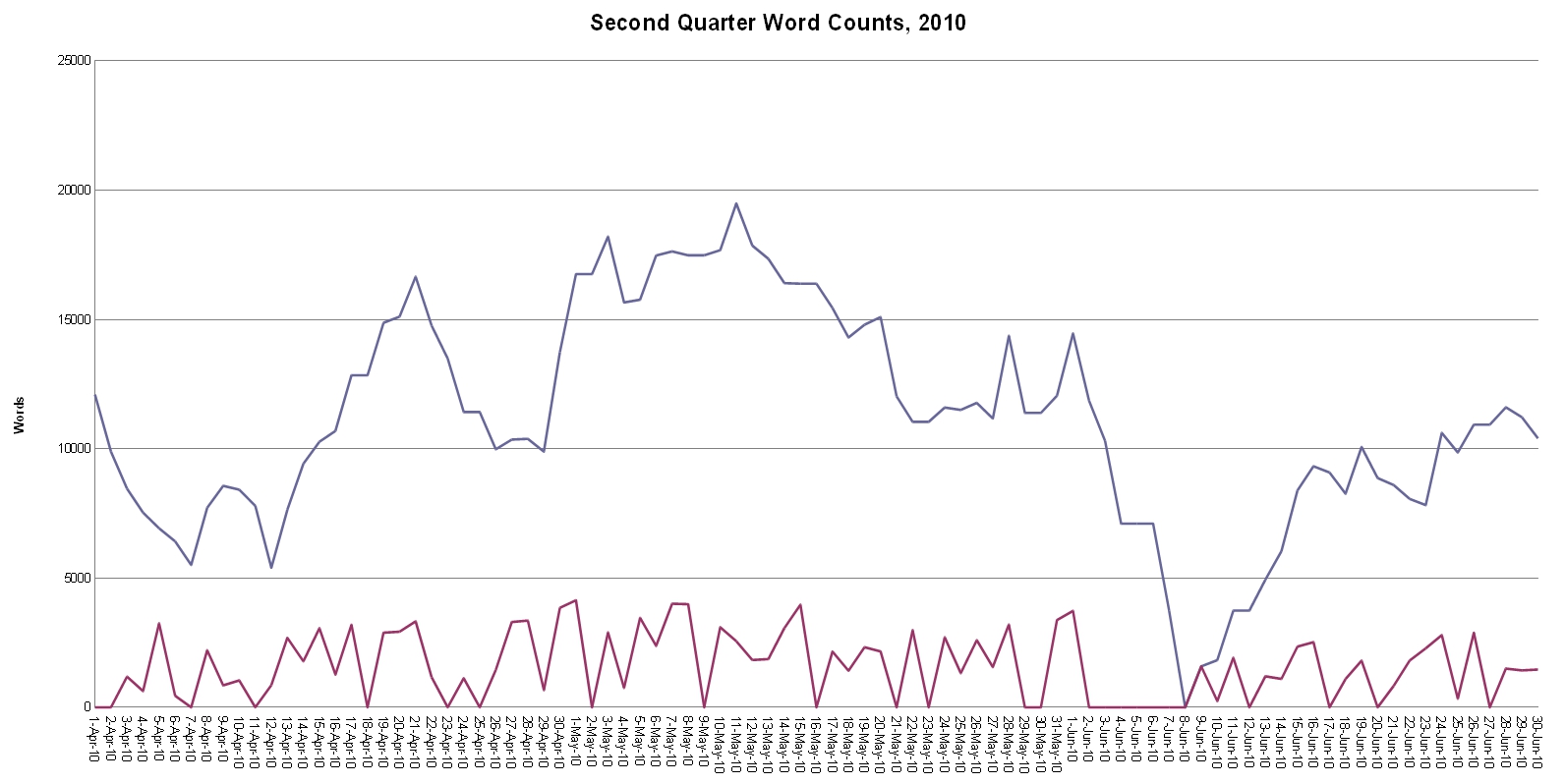
As you may or may not know, I keep a spreadsheet of my daily word counts.  Nerdy, I know, but you’d be surprised how helpful it can be with keeping goals and staying motivated.  As part of that, I’ve decided to do a quarterly report here on my blog.  Here’s my report for April 2010 through June 2010:

The red line shows my daily word count, and the blue line shows a running 7-day total.

At the beginning of April, I was somewhere in the middle of writing Mercenary Savior 3.0. I was also in the middle of a long and strenuous debacle with BYU’s Washington Seminar.  Long story short, I got kicked out under disputed circumstances.

Anyway, that explains the sharp dip in the first couple of weeks.  I returned to my parents’ house in Massachusetts on April 6th and spent a week there before moving out to Utah; that explains the short lived bump from April 6 to April 12.

So three weeks before graduation, I came back to Utah with no job, no apartment, no transportation besides my own feet–nothing.  Fortunately, some friends helped me out, and for the rest of April and most of May I at least had transportation (bike) and a roof over my head.

Without a job, I had lots of writing time, and I used it well, as you can see.  The sharp dip at the end of April corresponds with graduation, when all the family was over and I was spending most of my time with them.

Things dropped off the second half of May, though, and I’m not sure why.  Perhaps it was writing fatigue?  I was coming up on the end of Mercenary Savior, and as I remember, the revision was fairly tough.  Also, I was stressed out about not having a job, and spent much of my free time looking for work.  I found my current part-time job at the end of May, and had a few spikes, but my output never totally recovered.

As an experiment, I took a week off from writing after finishing Mercenary Savior on the first of June.  I thought that this would help me recharge my creative batteries and get off with Worlds Away from Home on a good start.  Instead, I found that taking the time off made it harder to get back into creative writing mode, and so I struggled for the first week or two to really get that project off the ground.

Lately, I’ve been trying to bump up my output above 10k per week, without much success.  For some reason, I seem to have fallen in a rut where I can’t write more than 2k per day.  2k is good, but it’s not the level where I want to be.  I want to finish Worlds Away from Home in the first couple weeks of August, so that I’ll have plenty of time to polish Mercenary Savior for World Fantasy in November.

I think that part of the problem lies in the nature of the work.  Mercenary Savior was all straight up revision, with very little new content.  Worlds Away from Home, however, involves a ton of new content.  Yes, I’ve got all that stuff I wrote back in the fall of 2008, but I’ve also added a new viewpoint character and significantly changed the basic storyline.  Only about half of the old stuff is recyclable, and I’ll run out of it in 100 pages, roughly at the midway point of the novel.

After revising for so long, it’s hard to get used to writing a first draft.  I’m not sure how to describe it, except that it takes a lot more mental energy–a LOT more.  Plus, there’s always the nagging voices that tell you what you’re writing is crap–and when you’re writing your rough draft, the voices are usually right!  Tuning them out is starting to be a challenge.

Overall, though, I’m very optimistic.  My main goal is to produce one solid, polished novel a year, and I’m still on schedule to accomplish that.  Mercenary Savior requires AT LEAST another revision before it’ll be good enough to send out to editors and agents, but I’ve got half a year to do that.  As for 2011, I’ll almost certainly have the first or second draft of Worlds Away from Home before January 1st.  Things are going well.

And on that note, I think I’m going to take a shower and go to bed.  Night.

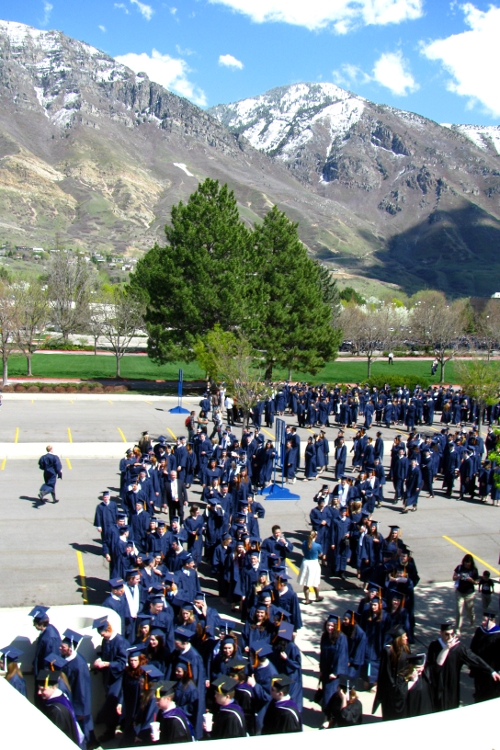
Graduation!

So last week, I graduated from college!  That’s right: college is OVER!  No more papers, no more homework, no more tests or quizzes or theses or final projects…at least until I decide I miss it all and go back to grad school.
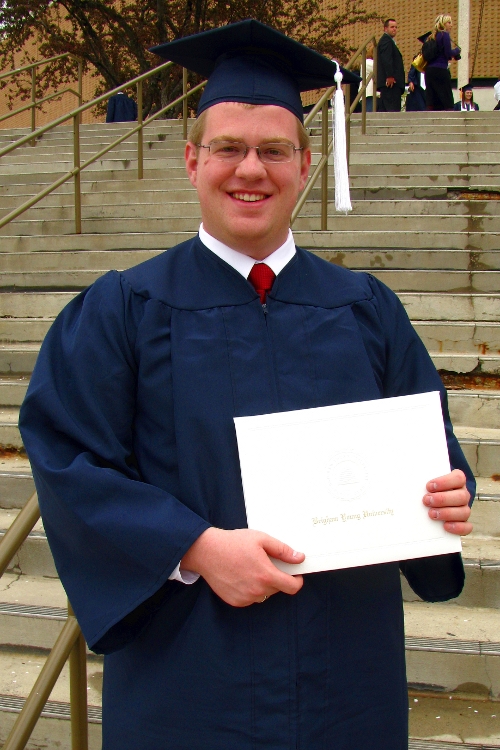
It was a big week, not only because of the ceremonies, but because of all the family that came down for the event.  It was great to see all my sisters, baby Jane, a bunch of my cousins who came down for our Italian barbeque (salad, lasagna, and garlic bread on the porch), and everyone else who came.

The ceremonies were interesting too.  Elder Christofferson gave the commencement speech, and I was very pleased that he referenced Hugh Nibley.  Man, if Nibley were still alive (or maybe if he could come back from the dead), it would be absolutely awesome if he could give the commencement address, but Elder Christofferson was pretty good too.

The convocation Friday was very long, but fortunately I snuck a novel in: Dying of the Light by George R. R. Martin.  Made some decent headway in it, too.  There was a very interesting talk, though.  One of the retiring faculty told a story from when she was a student in a wilderness class.

As they were making their way down a river canyon and came to the end of the bank, she thought to herself “it will be alright if I can just keep my boots dry.” As the water became deeper, that changed to “it will be alright if I can keep my pack dry.” Eventually, however, they had to swim, and everything got wet.  Still, they made a fire, dried everything out, and had a good time.

The story was meant to illustrate that life in the real world is like that.  When you start out, you worry about a lot of things, but when you look back after many years have passed, those small setbacks don’t seem like anything to worry too much about.

Well, that’s where I am right now: unemployed, looking for a plan for the next five years.  My plan A is still to break into publishing, but I’m going to need a secondary career or day job to  get by in the short to medium term.  I have no idea what that entails,  but at least I’m graduating debt free, with money in the bank.  That helps.

Two years ago, I was terrified of graduating and setting out into the “real world.” A year ago, I realized I had grown out of college life and needed to move on.  Now, I have no idea what I’m doing, but life is an adventure and I’m confident things will work out for the best.