Trope Tuesday: Dreaming of Things to Come

When a character in a story has a dream, there’s almost certainly a reason for it.  If it’s not thrown in just to show how scarred or tortured he is (or alternately, how repressed he is), chances are good he’s dreaming of things to come.

I’m a huge fan of this trope, as you may be able to tell if you’ve read any of my books.  It’s a special form of foreshadowing that lends a mystical, otherworldly flavor.  It’s also something that we can relate to: how often have you had a dream that was so powerful, so moving, that it just had to mean something?

When played straight, this trope often implies some sort of all-seeing being who sent the dream on purpose.  However, this doesn’t have to be the case.  I often find it much more satisfying when we don’t know where the dream came from.  It’s very easy to shatter the sense of wonder by over-explaining things, especially when it comes to the dream world.

Of course, the character doesn’t just have to dream of things to come to capture that sense of wonder.  They can also dream of times gone by, discovering something previously unknown about the past, or dream of the truth, working through a previously unsolvable problem in their sleep.  The mystical, otherworldly flavor still holds true for all of them.

As you might expect, this is a fairly common trope in fantasy.  Some prominent examples include:

  • Lord of the Rings
  • The Silmarillion
  • A Game of Thrones
  • The Black Cauldron
  • American Gods
  • Most of the Redwall books
  • Dragonsflight
  • Watership down

Why is so popular?  Even though dreaming is such a common, universal experience, it’s still shrouded in mystery.  It resonates deeply with us because we can all relate to it, and at the same time it opens all sorts of windows into the fantastic because there is so little we understand.

Like I said before, this is sort of a pet trope for me.  Consciously or not, I tend to throw in at least one dream sequence in every book I write.  It seems to have worked pretty well so far, so I don’t think I’ll be changing that anytime soon.
Trope Tuesday: Slap Slap Kiss

There aren't enough scoundrels in your life.

Unless you have an unhealthy aversion to kissing books, you’re probably familiar with Slap Slap Kiss.  It’s common in genre romance, but you’ll often find it in science fiction & fantasy too.  When done well, it’s a great way to make sparks fly, but when done poorly…I think you can fill in the rest.

The basic underlying concept is that love and hate are just two sides of the same coin.  Both involve strong feelings for another person, the kind that drive you crazy and make it hard to think straight.  According to this theory, it’s a lot easier to fall in love with someone you hate than to fall in love with someone you don’t really care about.  And once you fall in love, the rest is easy. <snark!>

Kiss Kiss Slap is the Tsundere’s standard MO.  An effective way to end the will they or won’t they? phase, though the trope is so common that you can spot it almost as soon as the slapping starts (Dinosaur Comics has a good commentary on that).  Sometimes happens in conjunction with Foe Yay, though the couple doesn’t have to start out as sworn enemies.  The kiss itself is usually one of those “lovely trick[s] designed by nature to stop speech when words become superfluous.” When set up properly, is often accompanied by a Love Epiphany.

Of course, it’s possible to go too far.  There’s a fine line between “all’s fair” and kicking the dog, and if you cross it…good luck.  Alternately, if the slapping doesn’t cross the line, but the kiss doesn’t live up to expectations, it’s also going to fall flat.  And if the main reason you invoke this trope is because the plot demands it…let’s just say, you’re doing it wrong.

In general, I think it’s important to keep the following in mind:

  • The attraction needs to be properly foreshadowed.  If the characters start slapping each other without even a hint of sexual tension first, no amount of backpedaling is going to make up for it.
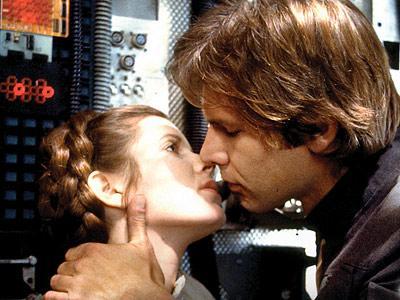
  • Neither of the characters should tear each other down.  There’s a big difference between a slap and a punch (and a roundhouse kick, for that matter).  Even though the characters may abuse each other, they have to have at least some mutual respect.  After all, Han still called Leia “your highness,” and Leia still complimented Han on his “bucket of bolts” (albeit sarcastically).  Once the respect is gone, so is any hint of romance.
  • The kiss needs to be proportional to the slap.  Lots of slap with an innocent little peck is going to feel anticlimactic, while a tap on the chin with a giant make out moment immediately afterward is going to feel melodramatic.  The two need to be balanced in order for the trope to work.
  • The couple should have at least something in common. “Opposites attract” is often just an excuse for shoddy character development.  In real life, if the two people don’t have at least something in common, value-wise and personality-wise, the romance is pretty much doomed to fail.  As always, however, Your Mileage May Vary.

Finally, even though there are a lot of reasons to hate this trope, there’s a reason we keep coming back to it.  What that reason is exactly, I can’t say, but I know it when I see it.  After all, you really shouldn’t over analyze some things.  Like this video:

I think my work here is done.  What sayest thou?

Trope Tuesday: The Cavalry

Things look bleak: the Big Bad is on the verge of conquering the world, and the heroes have gathered for one last stand.  Just when it looks like all hope is lost, a horn sounds in the distance, and the cavalry arrive to save the day.  Whether a ragtag bunch of minor characters, an army of unlikely heroes, or the ultra-heroic Eagle Squadron, the timely reinforcements use their overwhelming force to crush the villains and save the day.

When done right, this trope can be one of the defining moments of greatness of the entire work.  When done wrong, however, it becomes little more than a Deus Ex Machina of the most unsatisfying kind.  How, then, can this moment be done right?

As with any Deus Ex, one of the keys is to adequately foreshadow the end.  This often takes the form of Gondor Calls For Aid, when the heroes petition the cavalry for assistance before going into battle. To make things interesting, the relationship between the two parties is often complicated and ambiguous, making it doubtable that the cavalry will actually show up.

However, I think it goes deeper than this.  In order for the arrival of the cavalry to be satisfying, it needs to not invalidate everything that the heroes have already gone through.  If the cavalry shows up after the heroes have defeated the Big Bad, and essentially rescue them from a heroic sacrifice, that’s satisfying.  If the heroes are still fighting the Big Bad and the cavalry comes out of nowhere to hand them an unearned victory, that’s cheap.

In English 318R, Brandon Sanderson often used the film versions of the Lord of the Rings Trilogy to illustrate this.  The Battle of Helm’s Deep was satisfying, because the entire premise was to hold out until the third day.  When Eomer arrived with the Rohirrim on the morning of the third day and swept away the Uruk-Hai, that didn’t invalidate King Theoden’s efforts because all he was trying to do was survive.

In the Battle of Minas Tirith, however, Aragorn’s arrival with the unbeatable army of the dead was kind of cheap, because the premise was to defeat the orcs, not to hold out for reinforcements.  Gondor could have just stood down and let the orc army capture the city, and they still would have won in the end.

The two genres where you’re most likely to see this trope are westerns (trope namer) and heroic fantasy. Just about every David Gemmell novel involves a cavalry moment of some kind, and I looove it.  It’s also quite common in military science fiction, too–basically, any story where war is a major part of the narrative.

The variations on this trope are also quite fascinating.  For example:

Trope Tuesday: Big Damn Heroes

You know the drill.  The clock is ticking down to zero, the evil hordes are swarming through the gates, the virgins are about to be sacrificed and the damsel in distress is about to be lost forever–and then the  heroes show up in all their glory to save the day.

This happens all the freaking time, which means that if you want to make a living telling stories, this is not a trope that you should ignore.  And with good reason.  Not only does it give the writer ample opportunity to play with suspense and action, but it arguably lies at the very core of what makes a hero a hero:

David Gemmell, according to this interview with Ian Graham, defined a hero simply as “someone who does heroic things.” They might not always take the right side, or they might not even care about doing what is right, but when the universe conspires to bring them to a moment of decision, they make the choice that all of us would like to think that we would take and do something extraordinary.

I like this definition of a hero.  It strikes me as a lot more honest than the perpetual do-gooder whose only motivation is Truth, Justice and the American Way (though those characters can–and do–have Big Damn Hero moments of their own).  Also, it means that true heroism is not contingent upon actually winning.  History may be written by the victors, but that doesn’t cheapen the experience of those who actually lived it.

Of course, if the heroes don’t save the day, it’s pretty hard to pull off a crowning moment of awesome without bringing in the Bolivian Army.  Either the heroes find out that they’re too late, or they make things worse, or (as is so common with Othar Tryggvasson of Girl Genius) they just prove that their ego is too big for its own good.  When taken to the extreme, the heroes may even be in danger of turning to the dark side.

The biggest danger with this trope is turning it into a Deus Ex Machina.  The thing that makes Big Damn Heroes so incredibly satisfying is the sense of climax when they show up to save the day.  Thus, proper foreshadowing is key.  Yes, the rule of cool still applies, but if that’s all you rely on, you’re not going to be able to pull it off to maximum effect.

One of my favorite examples of this trope is Liam Neeson in Taken.  Plenty of action movies are more violent, but few are more satisfying.  It’s the perfect pick-me-up after a long crappy day at the office–not that I work in an office anymore.  I wonder why…

In any case, this is a great trope to look out for, and definitely one to master, especially if you’re writing any sort of action-adventure story.