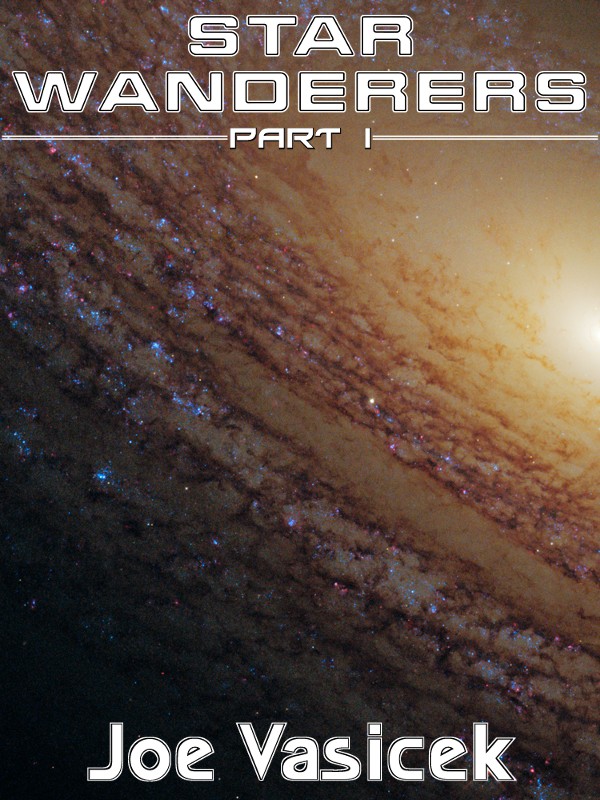
Blurb and cover for Star Wanderers

So the first quarter finalists for the Writers of the Future contest were finally announced (finally!), and I wasn’t among them.  Oh well.  But the good news is that I can move ahead now to publish part 1 of Star Wanderers!

First, though, I need to work out a killer blurb.  This is what I’ve got so far:

When Jeremiah arrived at Megiddo Station, all he wanted was to make some trades and resupply his starship. He never thought he’d come away from the frontier outpost with a wife.

Before he knows it, he’s back on his ship again, alone with his accidental bride. Since neither of them speak the same language, he has no way to tell her that there’s been a terrible mistake. And because of the deadly famine that has ravaged her home, there’s no going back either. The only way forward lies across a dozen parsecs of cold, empty space.

Jeremiah wasn’t looking for someone to keep him warm on the long voyages, and he certainly isn’t ready to settle down. He’s a star wanderer, roaming the Outworlds in search of his fortune. But there’s a dark side to his wandering–a loneliness that threatens to destroy him. His unexpected passenger may be willing to end that, but how can she when they barely understand each other?

So what do you think?  Does it tickle your fancy?  Are you intrigued to read more?  Or are you thinking it’s kind of “meh”?  Any feedback would be much appreciated, even if it’s just “this reminds me of _____.”

By the way, here’s the cover:

I’m experimenting a lot with this next novel.  The plan is to release it in a serial format first, then publish the full-length novel once I’ve serialized the sequel (more of a parallax actually.  The tentative title for that one is Star Home, and it’s the story from the girl’s perspective).

Here’s how I plan to publish it:

  1. Release Part I for $2.99.
  2. Give newsletter subscribers a two week coupon code on Smashwords to download Part I for free.
  3. Release Part II for $2.99 and drop Part I to free.
  4. Give newsletter subscribers a two week coupon code on Smashwords to download Part II for free.
  5. Release Part III for $2.99 and drop Part II to $.99.  Keep Part I at free.
  6. Give newsletter subscribers a two week coupon code on Smashwords to download Part III for free.
  7. Release Part IV for $2.99 and drop Part III to $.99.  Keep Part II at $.99 and Part I at free.
  8. Give newsletter subscribers a two week coupon code on Smashwords to download Part IV for free.
  9. Publish the full-length novel  at $4.95.

This way, no one has to pay more than five bucks for the whole thing, and people who subscribe to the newsletter get a really sweet deal.  There shouldn’t be more than a month or two between release dates–Part II is almost ready to go, and I plan on finishing the complete first draft in the next couple of days.

So yeah, that’s the plan.  I’m excited to finally get this story out to you!  I really had a blast writing it, and I think you’ll enjoy reading it, especially if (like me!) you’re a fan of science fiction romance.

More to come!

Why I’m not a fan of writing groups

I was listening to a recent episode of I Should Be Writing today, and it got me thinking about writing groups and how my philosophy on them has changed.  Long story short, I used to love them, but now I’m not such a huge fan.

I should probably start out by mentioning that I lead a college writing group for two years, and I don’t regret the experience at all.  The Quark writing group was extremely helpful, both in terms of my own growth as a writer, and the connections it gave me with other writerly people.  I still keep in touch with many of them.

But now…I just don’t think writing groups are all that great.  In fact, I think that they often do more harm than good, not just for experienced writers, but for the beginner who lacks the confidence to strike out on their own.  Here’s why:

The group dynamic gives inexperienced critiquers a false sense of authority.

Most writing groups consist of writers who are at roughly the same level of expertise.  For beginners, this means that the people critiquing your story might not know any better than you whether the story is broken.  However, because of the dynamics of the whole thing (captive audience, desire to impress peers, etc), these people are likely to act as if they have more authority than they really do.

To be fair, I’ve had plenty of critique partners who have managed to be modest and down-to-Earth when offering their critiques.  However, I’ve also seen plenty of others get puffed up and offer some really dumb advice.

Beginning writers often naively look for someone to show them the answers–some mentor or authority figure whose every word is true, who will light the path and show them the way.  Put a bunch of them into a writing group together, and more often than not you’ll end up with the blind leading the blind.

The weekly submission process does not simulate the reading experience.

Logistically, most writing groups have to set a limit on the size and number of submissions.  For the Quark writing group, our limit was three submissions of four thousand words each.  It worked out fine for short stories, but most of us were writing novels, which meant that we had to workshop our books in little four thousand word chunks.

The problem is that nobody reads novels at that rate.  Either they get hooked and finish the thing, or they get bored and stop reading.  Therefore, while the feedback you receive might be good for helping out with craft issues, by the time the next week rolls around either everyone has forgotten what happened already, or they remember it wrong, or they were expecting something different and are ticked off because they have to wait another week.

After I revised Bringing Stella Home a couple of times (after–see below!), I workshopped it through a writing group I’d put together after leaving the Quark writing group.  I can’t tell you how many times I heard “why are we in James’s point of view this week?  I hate James!  I want to get back to Stella!” I got this comment so often, for a while I thought the book was really flawed.  However, when I got the feedback from my first readers, no one had this problem at all.

The reason?  They read the book the way it was actually meant to be read.

Workshopping a work in progress is the surest way to kill a book.

Committees might be good at doing some things, but they’re absolutely horrible at producing anything innovative or original.  Make no mistake: if you’re workshopping something you haven’t already finished and you follow most or all of the feedback you receive, you’re writing your book by committee.

Most writers agree that when you write your first draft, you should not revise anything until it’s done.  This is because the act of revision makes you so critical of your own work that it’s very easy to get discouraged or “fix” something that was actually a good idea.

Workshopping a work in progress does exactly the same thing: it puts you in a critical frame of mind that will literally kill your book.  Even if you manage to finish it, it won’t be nearly as good as it could have been because you’ve probably nipped all your best ideas in the bud, before they had time to grow and develop.

A truly great book does not appeal to everyone.

There’s a word for something that appeals to everyone equally, that runs about middle of the road and doesn’t upset anyone.  That word is “average.”

No truly great work is loved by everyone.  This isn’t just true of controversial stuff–it’s true of everything.  For every one of your favorite books, there’s a one-star review of it on the internet somewhere.  So if everyone tells you your book is good, that might not actually be the case.  In fact, it’s a much better sign when some people hate it and others can’t stop raving about it.

The trouble with writing groups is that the group dynamic can lead to a herd mentality, where everyone goes along with the first opinion that gets expressed.  Ever played Werewolf?  The same thing happens there.  One person throws out an accusation, the vote gets called, everyone starts looking around to see who is raising their hand and before you know it, all the hands are in the air.

So unless one of the seven or eight people in your writing group loves your work enough to stand up and defend it, chances are the feedback will err on the side of being too negative.  This makes it very difficult to tell whether your story actually sucks, or whether it’s just above average.

Writing groups teach you to write to rules, not for readers.

One of the dynamics of writing groups is that they encourage people to find and latch on to certain writing rules, where people can say “this story is broken because of x” or “this writing is flawed because of y.” Over time, this becomes so ingrained that people stop reading to see whether the story actually works and instead read to see whether the story follows the rules.

The truth, however, is that there are no hard and fast rules when it comes to writing.  For example, you’ve heard of “show, don’t tell”?  Yeah, go and read Ender’s Game.  The entire book is one giant tell–and it’s brilliant.  It was the first sf novel to win both the Hugo and the Nebula awards in the same year, and has remained a perennial bestseller ever since.

Nothing hit this home for me more when the cryo scene excerpt from Genesis Earth won first place in the 2009 Mayhew contest at BYU.  Parts of the scene lapse from first person past tense to second person present tense, and the members of my writing group pointed that out as a major no-no.  However, even though it broke the rules, it worked well enough to win an award.

To be fair, there are some things that writing groups are very good for.  They can be a good way to learn the basics of craft (ie “the rules”), and they do give you a sense of community that can be very encouraging when you’re just starting out.  However, the drawbacks are so great that I don’t think I’ll ever go back.

Personally, I’ve moved from writing groups to a core group of first readers whose feedback I value and whose opinions I trust.  I finish my project, send them the entire manuscript with a deadline in which to read it, and thank them graciously for whatever feedback I receive.  Most of them aren’t even writers, in fact–but all of them are readers.  Most of them don’t know who the others are, and none of them ever see any of the feedback from the others.

Criticism is good; if you want to grow as a writer, you should welcome criticism and constantly solicit it.  But I do believe it’s possible to grow out of a writing group–or to succeed without ever being a part of one at all.

Thank you readers

I appreciate my first readers very much, even when it hurts.  Especially when it hurts.

Today I got the comments back from a longtime Quarkie friend on Genesis Earth, and she told me that, in her opinion, the book still needs a lot of work.  However, she made it very clear when (and why) she was bored, when (and why) she was interested, and where (and why) she would stop reading.  Thankfully, she kept reading and gave me useful feedback right up to the end.

My friend’s comments helped me to rethink several weak points  of my novel.  In particular, her anthropology experience helped her to pick up on some racist undertones that I didn’t intend and hadn’t realized were there.  If my story would have appeared in print like that, I would have been flamed up and down the sf community!  Without her feedback, I probably wouldn’t have picked up on that.

The feedback did more than point out problems, however; it helped me to rethink these problems and begin to find new, innovative solutions.  Rather than getting me angered or depressed, the criticism stoked my creative engines by getting me to take a step back and rethink my story from the ground up.  Though the feedback was harsh (basically, “I’d throw this book across the room at this point”) it was extremely helpful and got me more enthused than ever to write.

Receiving criticism and advice is a very delicate thing, especially for a budding writer.  If you try to follow every peice of feedback you recieve, your book will inevitably tank.  However, rejecting criticism is also tough because you don’t always know why you’re doing it.  There is a fuzzy grey area between rejecting a comment because it’s not right for your story, and rejecting it because it rubbed your ego in the wrong way.

I don’t ever want to reject critical feedback because it hurts.  After all, it’s not about me at all–it’s about the story.

Criticism is never “right” or “wrong,” “good” or “bad.” It is only “useful” or “not useful.” To pick out the useful feedback, you always have to listen to–and appreciate–every piece of feedback that you get.  Only after you’ve done this can you can say (in private!) “no, this isn’t right for my work.”

In the meantime, thank everyone who takes the time and effort to read your work and comment on it.  They’ve done you a huge service, and the last thing they deserve is to be attacked by an egocentric, peurile, self-righteous amateur.  Honest criticism, no matter how much it hurts, is the best thing any writer can receive.

On that note, I want to thank all my first readers for helping me with my novel, Genesis Earth!  I genuinely appreciate all of your comments. You’ve helped me to step back and see my work for what it is.  You are helping me to make this novel a stronger, better book, and that means more to me than you know.  So thank you!

Slow but steady

Okay, quick post before I go to bed.

Things are progressing in this novel, slowly but surely, as you can see from the wordcount.  Unlike past weeks, I’m not pushing myself too hard, mostly because I’ve got a lot of schoolwork right now and if I were to spend much more time on this novel, I would neglect a lot of the more important stuff.  Even though my course load is relatively light this semester, I’m a senior and I’m really not as motivated to do this stuff as I used to be.  I get done what needs to get done, but just barely.

I have been successfully getting up early, however.  And I’ve discovered something very interesting: I’m more productive when I have less free time.  Thursday, I didn’t have class until noon, so when I got on the computer at about 6:30 to write, I opened up the email, opened up facebook…and, by the time I had to leave for class, I had only written about 430 words.  Disgusting.  But today, when I had class at 9:00 am and still had my Arabic homework to do, I got in about 700 words in half an hour.

I still have a lot of self discipline to learn, I guess. 😛  The scary thing is that my idea, up to this point, has been to keep my time open in the summer so that I’ll be able to write.  Err…yeah.  We’ll see how that goes.

I’ve been getting a lot of comments back from my alpha readers on Genesis Earth, and it’s been REALLY fun!  Even the criticism–as long as it’s helpful criticism, I really appreciate it.  This one girl in my ward asked me if she could be an alpha reader, then read the whole thing in only a couple of days.  She had a LOT of positive comments–in fact, almost all of her comments were positive–and she said she really loved it!  So much so, in fact, that she said she was having withdrawals, so I sent her The Phoenix of Nova Terra v1.2.  Hopefully, getting her comments back will give me motivation to pick up that old thing and rework it…goodness knows it needs it.  Needs it bad.

My first two novels, The Phoenix of Nova Terra and Genesis Earth are completely different in some ways, but very similar in others.

<spoiler alert>

They both have an important romantic element, and they both have generally positive endings.  The book I’m writing now is something of a tragedy, at least at it’s core, and there is a completely different dynamic there.  No love stories, no happy resolutions–lots of pain, lots of violence, lots of grappling with difficult issues.

</spoiler alert>

I suppose it’s good to try out a lot of different things early on in your writing career.  That’s what I’m doing.  At the same time, though…I get feedback on the one novel, and I kind of want to work on it instead of the one right in front of me!  And when I think about what I did right in the one I finished, I look at the one I’m currently writing and I think “man, this is crap.” Of course, I keep working on it because I recognize that I ALWAYS think “man, this is crap” at some point before I’m done.  Knowing that doesn’t make it easier, however.

Jason from the FLSR writing group said something interesting about that, however.  He said that writing a draft of a novel is like climbing a mountain: you do it three times.

The first time, you climb it in your mind as you plan it out.  You’re excited and motivated, and busy with all the preparations.

The second time, you actually physically do the work of climbing.  It is long, hard, and frustrating, you get lost a few times, the summit is anticlimactic, and the return is boring.  You can’t wait until you’ve finished and it’s all over.

The third time is when you look back on the experience after you’re safely back down.  No matter how excruciating the climb was, you look back on it fondly and remember all the best parts.  You thrive on the memories and wish that you were back up there, standing on the summit, enjoying the experience.

Right now, I’m on my third climb for Genesis Earth and my second climb for Bringing Estella Home. I can remember how miserable I was when I was still in the middle of Genesis Earth–for a while I seriously thought about throwing the whole thing out and doing something else.  However, now that I’ve been letting it sit for a while, I’m getting really, really excited about it!  I can hardly wait before I can get back and write the second draft.

But that’s not going to happen until I finish Bringing Estella Home.  And, no matter how difficult it gets, I swear I WILL finish this book!  I’m a chapter away from act III, and that’s too deep into the thing to quit and start something else!  This book WILL be finished–if not by April, then by sometime in May!