Extra Sci-Fi S3E8: Dune – Maud’dib

I thought this was a really good episode, though I’m not convinced that it’s better (or even possible) to lead through ideas rather than charisma. You need both, and I would argue that principles are more fundamental to human society than ideas. But still.

The part about the Harkonnens ruling through decadence and indulgence was particularly interesting. I see a fair bit of that in society today. Ten-plus years of suppressed or negative interest rates, with trillion-dollar deficits during a supposed economic boom? If that isn’t decadent, I don’t know what is. But I digress.

Everything rises and falls on leadership. A shitty job with an awesome supervisor can be amazing, but even a dream job can be ruined by a really shitty supervisor. I learned that the hard way.

My favorite example of charismatic leadership is probably Genghis Khan. I totally mean that, too. Genghis Khan’s story is amazing. He went from abject poverty and slavery to founding the largest land empire in history, all through the strength of his leadership. Extra History did a series on him, but the best version of his story that I’ve found thus far is from the History of China podcast:

The series is still ongoing, which is why the last two episodes don’t have links. You can find them in the podcast feed, though.

Now, I don’t necessarily advocate making Genghis Khan a role model. The man was responsible for a lot of death and destruction, and his empire did not endure. That said, it’s impossible to question that he was one of the most charismatic and effective leaders in the history of the world. As to whether he was a positive leader, well…

My favorite example of a positive leader is probably Shackleton. Endurance was a fantastic book. The biggest thing that blew my mind was the fact that he hired his crew entirely on the basis of five minute (or less) interviews, where they basically shot the breeze. He was so good at reading people that he could hand-pick a crew that would survive and pull together under the harshest conditions of the planet, and he did it entirely by hanging out with them for a couple of minutes. That’s incredible.

And it gets back to the tension between ideas, principles, and charisma. You need all three. Charisma is basically people skills, and all of the best ideas in the world won’t avail you much as a leader if you suck with people.

Everything rises or falls on leadership.
Extra Sci-Fi S3E7: Dune – Wandering in the Desert

So the problem I have with most “ecological science fiction” is that it draws almost exclusively on the ideas of Malthusian economics—essentially, the argument that Thanos was right. The problem with this is that Malthusian theory has been disproven by every generation of humans to live on this planet for the last 150 years. It’s even more discredited than Marxism, which is another unscientific philosophy that “ecological science fiction” draws heavily from.

I remember an old 70s novel I picked up from the local used bookstore, where by the year 2000, Earth had warmed so much that Antarctica was the only habitable continent, and resources were so scarce that the main character—a buxom blonde—had to go topless. Yeah, very 70s. The premise of the novel was so absurd on its face that I couldn’t finish it.

I also remember an Octavia Butler book that I read. It was the sort of book that makes you chuck it at the wall once you’re finished. The plot went something like this: the main character has been abducted by aliens and drafted into their breeding program, and she spends the whole book trying to escape, only to learn that she’s already pregnant and never will. The end. The writing was pretty good, but the story was so horribly unsatisfying that I haven’t read anything by her since.

From what I can tell, most “ecological science fiction” is like that. Very pretty sentences, but horribly unsatisfying stories, with way too much preaching about how capitalism is evil and humans are destroying the planet. That’s probably why these books tend to win so many Hugo Awards.

Red Mars was okay, but it was less about Earth and more about Mars itself. I was personally more interested in the political intrigue among the colonists than the terraforming project, but both were pretty good. The characters all seemed a little bland to me, though, and I never really latched on to any of them, which is probably why I didn’t read the other books. From what I can tell, they got more preachy toward the end.

Everyone praises Dune for being an “ecological” novel, but to be frankly honest I never really got into that. The political intrigue and the struggle of Paul Atreides with his prescience was a lot more interesting to me, and while the ecological bits certainly played into the plot, I didn’t really care enough to pay much attention to that.

Also, the parts that I did pick up seemed pretty unbelievable to me. From what I remember, there was a second, much smaller type of worm that produced a certain kind of excretion which, if mixed with the spice, would cause a chain reaction that would completely destroy the Arrakis ecosystem. Something like Kurt Vonnegut’s ice 9, which instantaneously freezes any water it comes into contact with, which makes it the most dangerous substance on Earth because a single drop could freeze all the water on the planet. In my (albeit limited) experience, ecosystems always find their own equilibrium, which makes them resiliant against that sort of thing. But of course, that would probably interfere with the preaching that “ecological science fiction” tends to indulge in.

From what I can tell, Dune is one of the few pieces of “ecological science fiction” that hasn’t aged poorly, and that’s not because of the “ecological” bits, but in spite of them. Because the truth is that we live in a fantastically rich and abundant post-scarcity world, where “global warming” had to rebrand as “climate change” because none of the predictions came true, and the science has been so ridiculously politicized that the Green New Deal makes the Communist Manifesto look sane and reasonable.

Thanos was wrong. So too, apparently, is the entire field of “ecological science fiction.”

Extra Sci-Fi S3E6: Dune – Plots and Plans

In Future Mrs. Vasicek’s writing group, we were talking about plotting and I remarked that plotting didn’t seem to be one of Frank Herbert’s strengths in Dune. Looking back on it, though, I think that the plot was pretty solid, but he chose to focus on other things instead—such as all of the machinations and ultimate downfalls of all of the characters, which Extra Credits discusses in this video.

When they brough up the “competent man” trope in the last season, and argued against it, I wasn’t quite sure how to take it. I know people in real life who fit the competent man trope very well, and who actually live up to Heinlein’s ideal:

A human being should be able to change a diaper, plan an invasion, butcher a hog, conn a ship, design a building, write a sonnet, balance accounts, build a wall, set a bone, comfort the dying, take orders, give orders, cooperate, act alone, solve equations, analyze a new problem, pitch manure, program a computer, cook a tasty meal, fight efficiently, die gallantly. Specialization is for insects.

In this episode, the folks at Extra Credits argue that Herbert subverts the competent man trope in Dune by showing a bunch of characters who fit that trope failing because they fit it too perfectly. But as you can see from the quote above, that’s actually not the case.

The empaths and mentats in Dune are specialists. In fact, the world of Dune is full of specialists, from the pilots of the spacing guild to the Imperial Sardaukar to the Bene Gesserit—even the Fremen, to a certain extent, are specialists rather than Heinleinian competent men.

The video isn’t wrong to point out that specialization and hubris is the ultimate cause of all of these characters’ downfall. But they miss the trope when they argue that this is a critique of Heinlein and golden age science fiction. If anything, it’s a vindication. Heinlein’s competent man is all about being a jack of all trades, master of one (or two, or half a dozen, as the case may be). In Dune, the characters who do best are the ones who figure this out.

I do have to say, though, it’s kind of fun to revisit Dune, seeing as it’s been so long since the last time I read it. Future Mrs. Vasicek didn’t like the book at all, but I enjoyed it, especially on the second read. Very few things made sense on the first read. My favorite character is probably Jessica, though the folks at Extra Credits are absolutely right about the way that Yueh played her.

Extra Sci-Fi S3E5: Dune – Origins

It’s always fascinating to learn how the big name authors got their start. As a fan, it pulls back the mystique a bit and makes those authors more relatable, and as a writer, it’s enormously encouraging to learn that even the big names had to pay their dues too.

I wonder what Dune would have become if it were published today? It seems that most of the earlier hurdles had to do with publishers rejecting the manuscript, which wouldn’t be the case in today’s indie publishing world. Of course, it would also take a lot of promotion to give it traction, but Herbert and Lanier did that as well… but would Herbert and Lanier have even met if the book had been self-published first? And would their own promotion efforts have been enough without the boost the book got by being serialized in Analog?

Impossible questions, I know. A middling level of indie success might have prevented Herbert from developing his contacts in journalism and publishing which led to his later success. Or it might have given him more time to write, allowing him to expand Dune into something even greater than what it eventually became. Without having to work with an editor like John Campbell, Herbert might have killed off Alia, or published the story before it was truly ready. Or he might have written a better story.

There are two big takeaways that I took from this video:

First, that the slow-burn path to success is still a legitimate path. We have this idea that books are like produce: after a certain space of time, they spoil. Such is not the case. This was one of the big things that Kris Rusch always harped on, about how indie publishing is different from traditional. In recent years, it seems that indie has taken on a bit of the produce model itself, with authors turning to rapid release strategies to stay relevant. But even in the old world of traditional publishing, books still made it from time to time on the slow-burn model—even classics like Dune.

Second, that publishing well isn’t something you do alone. It takes other people, not just readers, but editors, publishers, and other people with connections, sometimes unlikely connections. This isn’t just on the marketing end of things, or even the publishing end, but on the writing end as well. No man is an island, and no successful indie is ever totally alone.

What are your thoughts?

Extra Sci-Fi S3E4: The Return of the King

Okay, I think the folks at Extra Credits got it wrong with this one in a really big way.

Gollum didn’t redeem himself. That’s the entire point. Redemption is an important and very Christian theme of Lord of the Rings, but so is the problem of evil. Several comments on the video point this out:

I disagree about Gollum. He gave into the temptation of the Ring. I think more he is there for how God can turn evil into a good.

MJBull515

Gollum is more a Judas figure. Judas was not redeemed for betraying Jesus, but his evil actions did allow for the salvation of Man through Christ’s sacrifice.

Isacc Avila

“A traitor may betray himself and do good he does not intend.” Judas betraying Jesus was the catalyst that led to salvation. Gollum’s final act of greed was the catalyst that led to the destruction of the Ring.

Jet Tanyag

The thing that really gets to me, though, and the part where I think the folks at Extra Credits really do a disservice to these books, is how they argue, very subtly, that Gollum shouldn’t be held responsible for his own actions, that it wasn’t really his fault that he was addicted to the ring—that he “couldn’t escape his own sin.” (4:50)

No. Just, no.

The entire point of redemption is that we CAN escape from our sins. We see that with Theoden, we see that with the Dead Men of Dunharrow, and we see that in all the other examples of redemption that were not discussed in this video, like Boromir. In fact, Boromir is a far better example of “redemption through a single, all-important act.”

But it goes much deeper than that. In order to be meaningful, sacrifice must be intentional. It’s not just the act that matters, but the intention behind the act.

With that in mind, consider Gollum’s intentions when he bit off Frodo’s finger. The only way you can argue that his intentions weren’t evil is that the Smeagol half of his split-personality overcame the Gollum half, and flung him into the lava. But the support for that reading is ambigous at best. And if that isn’t true, and Gollum simply fell into the lava by accident, then it wasn’t a sacrifice on his part, and therefore there was no redemption.

To say that Gollum made an “accidental” sacrifice is nonsense. And to say that he redeemed himself through that sacrifice is not only a faulty argument—it completely undermines the themes of redemption and sacrifice throughout the entire book.

Gollum was never redeemed. Through him, Middle Earth was saved, but he was never personally redeemed, and that’s the point:

I’ve heard a different interpretation where Gollum’s sacrifice wasn’t an act of redemption, and was never meant to be. In the end, it was the ring’s own power that caused it to be destroyed; not Frodo, not Gollum, it was an accidental suicide. As far as I understand it, the message wasn’t “good triumphs over evil”, instead it was “evil is more powerful than good, but all it can do is destroy; in the end it will always destroy itself”.

EvilBarrels

Extra Sci-Fi S3E3: The Two Towers

This episode of Extra Sci-Fi got me to thinking about a speech that Orson Scott Card gave when he visited BYU back in 2007. He said a bunch of interesting things that have stuck with me over the years, including (to paraphrase) “conservatism is the new counterculture.” He was probably ten to fifteen years before his time on that one. But the thing that struck me the hardest was this:

Fiction is the culture talking to itself.

This goes along with what I talked about in my commentary on the last Extra Sci-Fi episode: that every generation reinvents the world. How do they reinvent it? Through story. And because there’s a necessary give-and-take as part of the process, the bestselling fiction that a culture produces is a reflection of that culture’s values, the issues of the day, and the zeitgeist as it changes and evolves over time.

We can see this in the themes discussed in this video. While Tolkien denied that Lord of the Rings was allegorical in any way, I agree with the folks at Extra Credits that the world wars and the rise of fascism almost certainly influenced his depiction of good and evil. It’s probably also true that the conflict between industry and nature influenced the book too. This isn’t because Tolkien set out to tell a story about these things; rather, because Tolkien himself was a product of the culture of his day, that culture shines through in his works.

This makes me wonder about the stories that don’t become bestsellers. Are there lots of amazing, well-written stories out there that don’t succeed simply because they’re out of step with the ongoing cultural conversation? Kind of like Orson Scott Card’s argument, back in 2007, that “conservatism is the new counterculture.” He made that argument a decade before we reached peak social justice, and got pushed more or less into cultural irrelevance because of it.

Card might not be the best example, because of his role as a culture warrior as well as his fiction writing career. With his Ornery American column, he was basically a shitposter before shitposting was a thing. But I wonder: what are the stories that aren’t getting traction only because they don’t really speak to the culture?

Or is it even possible to write a story that doesn’t speak to your own culture? Since you are a product of the culture that you live in, does that mean that your stories will be a product of that culture too? That certainly seems to be the case with Tolkien. Hindsight is 2020, though, and it’s really tricky to account for unknown unknowns.

I don’t know. I guess the big takeaway is that if you want to be a sucessful writer, you should do everything you can to immerse yourself in your own culture, not only because that’s the best way to improve your storytelling instincts, but because all of the most successful stories contribute something meaningful to the culture’s ongoing conversation with itself.

Extra Sci-Fi S3E2: The Fellowship of the Ring

Another fascinating episode from Extra Credits, this one focusing on the themes of generational passing and the diminishing of ages that is present in Tolkien’s Lord of the Rings. I have a lot of thoughts on this episode, but they all basically boil down to one thing:

Every generation reinvents the world.

It’s a theme that’s also present in my favorite novel of all time, The Neverending Story. The Childlike Empress of Fantastica is dying, and the only way to save her is for someone from the human realm to give her a new name. Fantastica, of course, is the realm of all fictional stories, and the Childlike Empress receives a new name when the next generation makes the old stories their own. There is nothing new under the sun.

This is also a theme present in Star Wars: The Last Jedi. I’m not a huge fan of the movie, but the best argument I’ve heard in favor of it basically boils down to this theme: that the old generation has to pass away in order for the new one to rise and take its place. I’m still not entirely convinced that The Last Jedi did this well, but I can see how someone who loved the movie would see it that way.

As a writer, this theme weighs especially on me because I feel that I’m personally living it with ever book that I write. All of the greats of the genre, like Tolkien, Herbert, Heinlein, Asimov, Bradbury, Card, Le Guin—the list goes on and on—loom over me every day. With their passing, the world feels somehow diminished. They left us with a great gift—their books—and yet as time passes and the old world crumbles into dust, these gifts from the previous generation feel increasingly out of place. It is time for a new generation to rise and give the Childlike Empress a new name.

I want my books to be a part of that. I hope that one day, mine will be one of the voices that helps to reshape the world. I hope to one day leave behind a gift as great as the ones that we were given: stories and books that made us feel deeply and taught us meaning and love. Is there anything greater than this? Raising a family, perhaps, but that too is a form of generational passing.

I’m sure this theme of generational passing applies to a lot of fields too, not only in the arts, but in trades, and crafts, and sciences too. Indeed, it is a fundamental part of the human story, because of this singular truth: that every generation reinvents the world. There are curses as well as blessings that are passed down from generation to generation, but it is up to each of us to decide whether those curses and blessings stop with us, or whether we will continue to pass them down.

Lots of interesting stuff to ponder and think about. That’s part of what makes Tolkien so great. He spent an entire lifetime writing Lord of the Rings, and that time was not wasted.

Extra Sci-Fi S3E1: Tolkien and Herbert, the World Builders

So I really enjoyed the first two seasons of Extra Sci-Fi, and since they’ve just started up with season three, I’d like to do a blog series where I react to the episodes.

From the first episode, it looks like the main focus of this season is on Lord of the Rings and Dune, two SF&F classics which I’ve read twice. While I have read The Silmarillion as well, I have to admit that I haven’t read any of the Dune sequels yet. Ah, the woes of a horribly massive TBR list.

In any case, the discussion of intentionality in world-building is quite interesting. The way they contrast it with the pulps got me to thinking about the direction science fiction and fantasy are headed in right now.

With the advent of indie publishing, the era we are living in right now is much more akin to the age of the pulps. The way most indies make a living is by following Kevin J. Anderson’s advice to be prolific—really, really prolific. That doesn’t mean that all books published these days lack the intentionality and depth of the great classics of the genre, but the pendulum seems to have swung in the other direction.

Here’s the problem: I’m sure there are books that are just as finely crafted as Lord of the Rings that are sitting on someone’s hard drive right now, or perhaps hanging out somewhere above the 500,000 ranking on Amazon. Perhaps some of these books are even more masterfully crafted, with greater intentionality and even more depth. Why aren’t they selling?

Lots of reasons. Perhaps the author hasn’t yet mastered the craft of writing. Perhaps the story isn’t compelling enough—the equivalent of a 50 cc engine in the body of a Harley.

Or perhaps it has nothing to do with the quality of the writing or storytelling, but the author’s lack of marketing acumen. The greatest product in the world is worth nothing if nobody knows it exists. Likewise, the worst product is worth at least something if everyone knows about it.

Harsh truths, but that’s the world we live in. I’m not so cynical that I believe that writing is a zero-sum game, but there is a lot of competition, especially with how many books are being published these days. That’s why I say that the pendulum has swung back in favor of pulp-style writing: because the writer who can put out a book a month and put it out to an email list of 10k or more has a decisive advantage over the writer who painstakingly crafts a magnificent epic over the course of an entire lifetime, as Tolkien did.

When will the pendulum swing back? I don’t know, but it’s actually not as daunting of an issue as the guys at Extra Credits make it seem.

The first time I read Dune, I was in high school. The second time, I was in college, where I’d already studied Arabic for a couple of years and become somewhat proficient at it. Studying Arabic pulled back the curtain a bit, and made me realize that Herbert’s world-building wasn’t quite as intentional as it seems at first glance.

There was still a lot of depth and intentionality in the major stuff, like the Bene Gesserit, the mentats and Orange Catholic Bible, and of course the ecology of Arakkis and the Spacing Guild. However, on some of the minor details, he occasionally cribbed or made up stuff, he just did a really good job of disguising it. Even the wider arcs of his world-building have borrowed heavily from the real world, such as the rise of the Fremen (which is basically the Rashidun Caliphate in space) and the politics and economics of the spice trade (which is basically a sci-fi version of the petrodollar).

This is why I’m not too worried. A masterful writer can produce on the level of the pulps, and still write with depth and intentionality—or at least, fake it so well that it feels that way. Writing that well requires skill, but once you’ve figured out all the levers behind the curtain, you really can pull off some truly amazing stuff.

I’m not quite there yet, but I’ve seen behind the curtain, and I’m figuring out how it works. Until now, I’ve leaned more toward the pulp-style of writing, just to get my writing career off the ground, but I hope to get to the level of Herbert and Tolkien before too long. It’s definitely possible, but can it be profitable too? That’s the tricky part.

Weekly Roundup for 2018-2-17

I thought it would be interesting to do a weekly blog post of all the remarkable things I saw or read on the internet in the past seven days, with my thoughts and/or reactions. If nothing else, it should be entertaining. Let’s try it out for a few weeks.

1) Proof that the internet has all the maturity of a horny teenager

Or at least Twitter:

2) Extra Sci Fi concludes the Martian Chronicles

Extra Sci Fi is turning out to be a really great YouTube series. They started with Frankenstein, then spent some time on William Gibson, and recently went through the Martian Chronicles by Ray Bradbury. They really do a good job of getting to the heart of classic science fiction.

It reminds me of a Trope Tuesday post I did a while ago about settling the (final) frontier. The whole idea of restarting humanity by leaving Earth behind is one of those things that draws me to science fiction the most. The stories in Bradbury’s Martian Chronicles are more artistic and thematic, but still, that idea is very much a part of them.

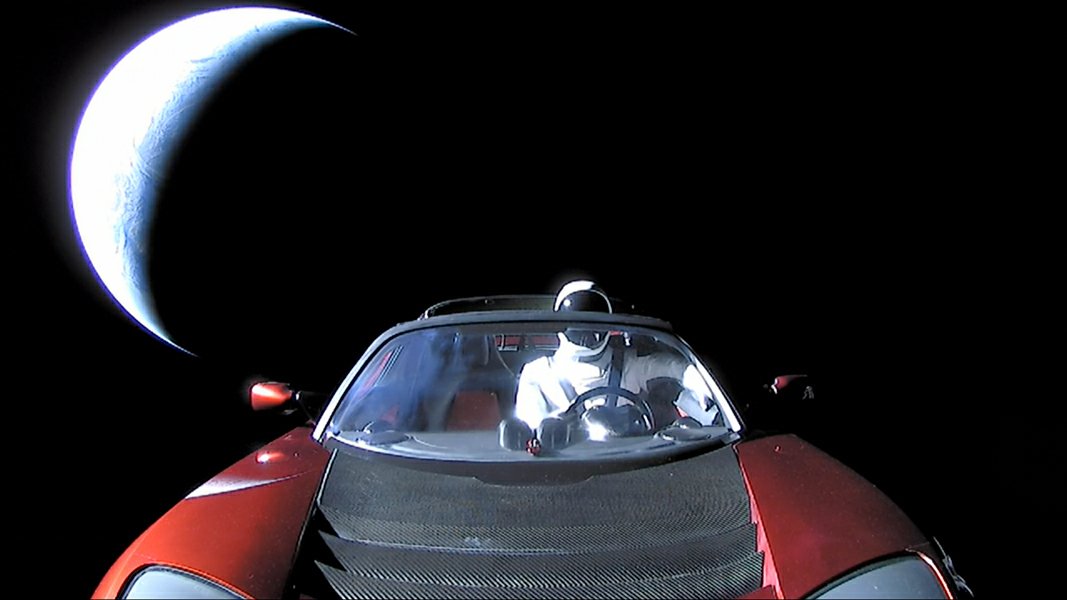
3) Roadster, Starman, Planet Earth

If there was any remaining doubt that Elon Musk is secretly trying to help an extraterrestrial get home, APOD posted this awesome photo last Saturday:

I have got to find a way to fit Elon’s roadster into Gunslinger to the Galaxy.

4) Barnes & Noble Layoffs

In publishing news, Barnes & Noble is laying off a bunch of full-time employees in an effort to save on benefits and health insurance. Passive Guy covered it twice, once for the Publishers Weekly article, and again with comments by the employees on The Layoff. There’s also a lively discussion on Mad Genius Club on the subject.

Felix J. Torres, who often has great nuggets of wisdom, shared his insights in a comment on The Passive Voice:

– Those experienced “leads” is where a company’s corporate memory really resides. The people who’ve been through the wars and seen it all, who know where the scripts and handbooks end and common sense crisis management and experience takes over. They are lobotomizing operations.

– If the difference between “lead” pay and entry level is the only thing between them and bankruptcy… Well, they might as well file right now. $40M in “savings”? That’s less than $80,000 per store. For that they disrupt people’s lives and cripple their operations? Smacks of desperation. Chapter 11 must be closer than even the harshest critics expects.

Looks like choppy waters and a major shakeup for the book industry in the coming months and years.

That does it for this week, but I’m sure I’ll have more in the weeks to come!