Trope Tuesday: New Year Has Come

Just like a story, every year has a beginning and an end.  For this reason, New Years has become a time to celebrate change, renewal, and the setting of impossible goals which we will all probably break by March.  Over time, this tradition has become so ingrained in our culture that it’s only natural for it to pop up in our fiction.

Most stories that feature a New Year subplot are episodic, such as cartoons, comics, anime/manga, and television shows.  They usually reflect real-world holiday traditions, such as the practice of setting New Year’s resolutions.  Because all stories need conflict (but also because fiction sometimes reflects reality), the characters in these stories are often just setting themselves up for failure in some hilarious way.

At first glance, this might seem depressing.  After all, if most of us will never reach our goals, why do we even bother setting them?  Why torture ourselves with guilt when, in all likelihood, we’re just setting ourselves up for failure?

In some ways, I think it comes down to this quote from David Gemmell:

May all your dreams come true save one; for what is life without a dream?

One of the things that makes us human is that we all need to have some impossible dream to strive for, some sense of hope for the future.  Through our New Year’s resolutions, we tap into that sense that anything is possible, and that we can change who we are and become better people.

For some of us, those resolutions are an effective tool to turn their lives around.  For those of us who lack that kind of will or self-discipline, the act of setting resolutions still helps us reflect on our lives and change in ways that perhaps we don’t immediately perceive.  After all, the truest measure of success isn’t whether you’ve accomplished all your goals, but how much you’ve changed through striving to meet them.

That’s my take on it, anyway.  In any case, a New Year’s story is a great way to give your characters some time for reflection, since it’s probably the most introspective holiday in our Western culture.  It’s a time for beginnings, endings, and chasing impossible dreams.

Happy New Year!
Trope Tuesday: Bittersweet Ending

WARNING! CONTAINS SPOILERS FOR AMERICAN GODS, LAGAAN, LORD OF THE RINGS, TREASURE ISLAND, AND CROUCHING TIGER HIDDEN DRAGON.

And he sang to them, now in the Elven-tongue, now in the speech of the West, until their hearts, wounded with sweet words, overflowed, and their joy was like swords, and they passed in thought out to regions where pain and delight flow together and tears are the very wine of blessedness.

Tolkien, J.R.R. The Return of the King.

I love bittersweet endings.  I love stories that warm my heart even as they make me cry.  There’s something about reading them that makes me feel alive, and something about writing them that makes me feel like I’ve truly told a story worth telling.

The tvtropes page claims that bittersweet endings fall more to the cynical side of the sliding scale of idealism vs cynicism, but I disagree.  Without tasting the bitter, how can we know the sweet?  Too many of our modern stories are like high fructose corn syrup, where everything gets tied up with a pretty bow and the characters remain essentially unchanged.  I firmly believe that it’s only through sacrifice that we can know true joy, and stories that follow this often end up being bittersweet on some level, even if they are idealistic.

The tvtropes page lists six types of bittersweet endings, which are:

  • Did Not Get the Girl: When the hero either loses the girl or has to give her up to win the day.  American Gods is a good example of this, I think: Shadow never actually gets back with Laura, even though he spends most of the book looking for a way to bring her back.
  • The Greatest Story Never Told: When the hero fades into obscurity after winning the day.  Lagaan, one of my favorite Bollywood movies, is an excellent example of this.  The last line of the movie is the narrator explaining how after the events of the story, the village faded into history until it was forgotten.
  • End of an Age: When the triumph over evil transforms the world so completely that there is no going back to the way things used to be.  Lord of the Rings is the best example of this: after the one ring is destroyed, all the other rings lose their power, and the elves must pass into the west.
  • Heroic Sacrifice: When victory comes only after the death of many or all of the main characters.  This is basically every David Gemmell book ever written, which is why I can’t get enough of him.
  • Only the Leads Get a Happy Ending: Where life is great for the main characters but everyone else ends up suffering.  I can’t think of any examples where this is done well; it’s probably just bad storytelling.
  • Karma Houdini: When the bad guy doesn’t get what’s coming to him.  The best example of this is probably Treasure Island, where Long John Silver gets away with the treasure in the end, leaving the good guys to say “I can almost find it in my heart to hope he makes it.”

It’s important to point out that this trope is not simply a tragic tale with a heart-wrenching twist.  Crouching Tiger Hidden Dragon, for example, is a straight up tragedy: even though Mu Bai confesses his love to Shu Lien, he promptly dies, and Jen commits suicide.  It’s an awesome ending to an awesome story, but there is no sweet in it.

When done poorly, a bittersweet ending can feel confusing or anti-climactic.  When done well, however, I think it adds a wealth of depth and feeling, as well as a degree of believability and realism.  After all, how many of our victories are complete?  How often do we have to give up something good for something greater?

So yeah, I love this trope.

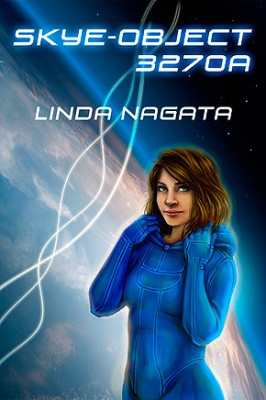
Skye Object 3270a by Linda Nagata

It’s not easy being a teenager in the orbital colony of Silk–especially when all the adults are functionally immortal and anyone under one hundred is considered an adolescent.  To make matters worse, Skye fell to the city in an escape pod when she was just a baby, with no idea who she is, where she’s from, or how long she was drifting in space.

Fortunately, she’s a tough girl with several close friends and a determined spirit.  One way or another, she’ll find out where she’s from–and whether there are any of her people still out there.  

I thoroughly enjoyed this book.  It combined the best of both science fiction and young adult: likeable teenage characters struggling to find their place in a high-tech alien world.  In particular, I found it fascinating how the widespread nanotech shaped both the society and the universe.

But the story isn’t about the technology, it’s about the characters, their adventures, and the friendships that form between them.  This was what really made the story come alive for me.  There’s a small amount of wish fulfillment, which may or may not be your thing, but overall I found the characters to be both believable and likeable.  It was a lot of fun to watch them grow and learn together.

At times, though, it felt as if the characters weren’t challenged enough.  The friendship and relationship issues were well done, but it wasn’t until the end that they started to have any significant try-fail (or try-almost fail) cycles in their adventures.  Also, while the ending was quite satisfying, it was also a little abrupt.

Those didn’t detract much from the rest of the story, though.  Overall, I thought it was a very satisfying read–the sort of book I wish I’d found when I was twelve or thirteen.  If I wasn’t already hooked on science fiction by that age, I have the feeling that this book would have turned me into a lifelong fan.

As a footnote, I’d like to add that this is EXACTLY the kind of book that indie publishing was made for.  It’s a great story, but the science-fictional setting is so unconventional that most publishers wouldn’t take a chance on it.  Even houses like Tor and Baen are focusing more on sub-genres like urban fantasy and military sf, which both have large, proven readerships.  For something that’s a little more niche or experimental, it’s good to see that there’s still a way to get it out to readers who would love it.

So yeah–if you like young adult books and you’re not turned off by space elevators, nanobots, or alien planets, you should totally try out this book.  I think it will surprise you just how much you enjoy it.

Sholpan 2.0 is finished!

Today I finished the second draft of the novella Sholpan, only two days after the deadline I set for myself.  Here are the stats:

ms pages: 173
words: 37,466
file size: 94 KB
parts: 5
start date: 1 Aug 2011
end date: 15 Aug 2011

I decided to divide it into parts because I read somewhere that novellas aren’t typically divided into chapters, and I felt that foregoing chapter divisions would give it more of a sense of unity.

Still, I divided it into five parts, which essentially function as very large chapters.  I did this because it seemed that the story needed it, to better develop conflict and theme, as well as the transitions and turning points.

Like I’ve said in the earlier posts, this is a “companion novella,” which means that it repeats one of the story lines from the novel with additional scenes that (hopefully) elaborate and flesh out that particular story line.  Ideally, this will entice readers of the novella to pick up the full-length novel, and give readers of the novel a satisfying experience by using the new scenes to cast everything else in a new light.

By my entirely non-scientific calculations, Sholpan contains about 80% repeated material from the novel (with a little touching up and fleshing out to get more inside of Stella’s head) and 20% entirely new material, most of it in the form of flashbacks to Stella’s life before she was captured and enslaved by the Hameji.  It ends about halfway through Stella’s story arc from Bringing Stella Home, and includes one of the major twists, but hopefully that won’t spoil too much.

In terms of story, I think there are some subtle deviations between Stella’s arc in the novel, and Stella’s arc in the novella.  Even though the novella ends just after one of the novel’s major shifts, the ending felt very satisfying–almost a little too much.  Still, it’s good for the story to be complete in itself, and there are enough loose ends that I think it will drive interest in the novel.

Anyhow, I’ve sent the project out to a couple of alpha readers, just to get a sense for whether or not I’m totally off base.  If all goes well there, I’ll send it out to my copy editor and get it up for sale sometime in mid-September.  I haven’t tried out the $.99 price point yet, so this will be a good test case to see how it works.

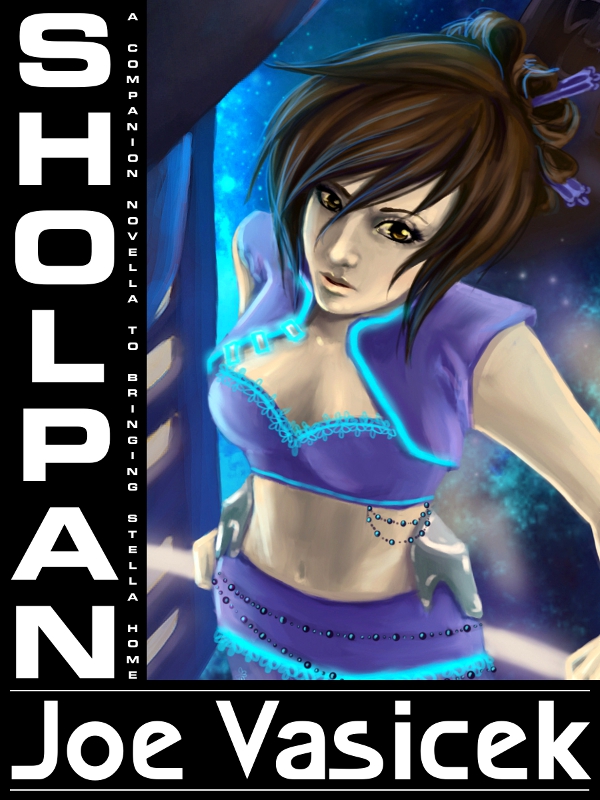
For those of you who are interested, here’s the cover:

And that’s about it.  I’m leaving the day after next for Worldcon, so I’ll do a post on that before I head out.  Probably won’t write much this week, but hopefully the con will help me make connections, pick up a few pointers, and get a good feel for the current zeitgeist in the science fiction and fantasy genres.  More on that to come.

Q2 roundup

For those of you who don’t know, I keep a spreadsheet with my daily writing word count and use that to help set personal deadlines for various projects.  In order to keep myself honest, I do a report every quarter on how I kept up with my writing goals in the past three months.

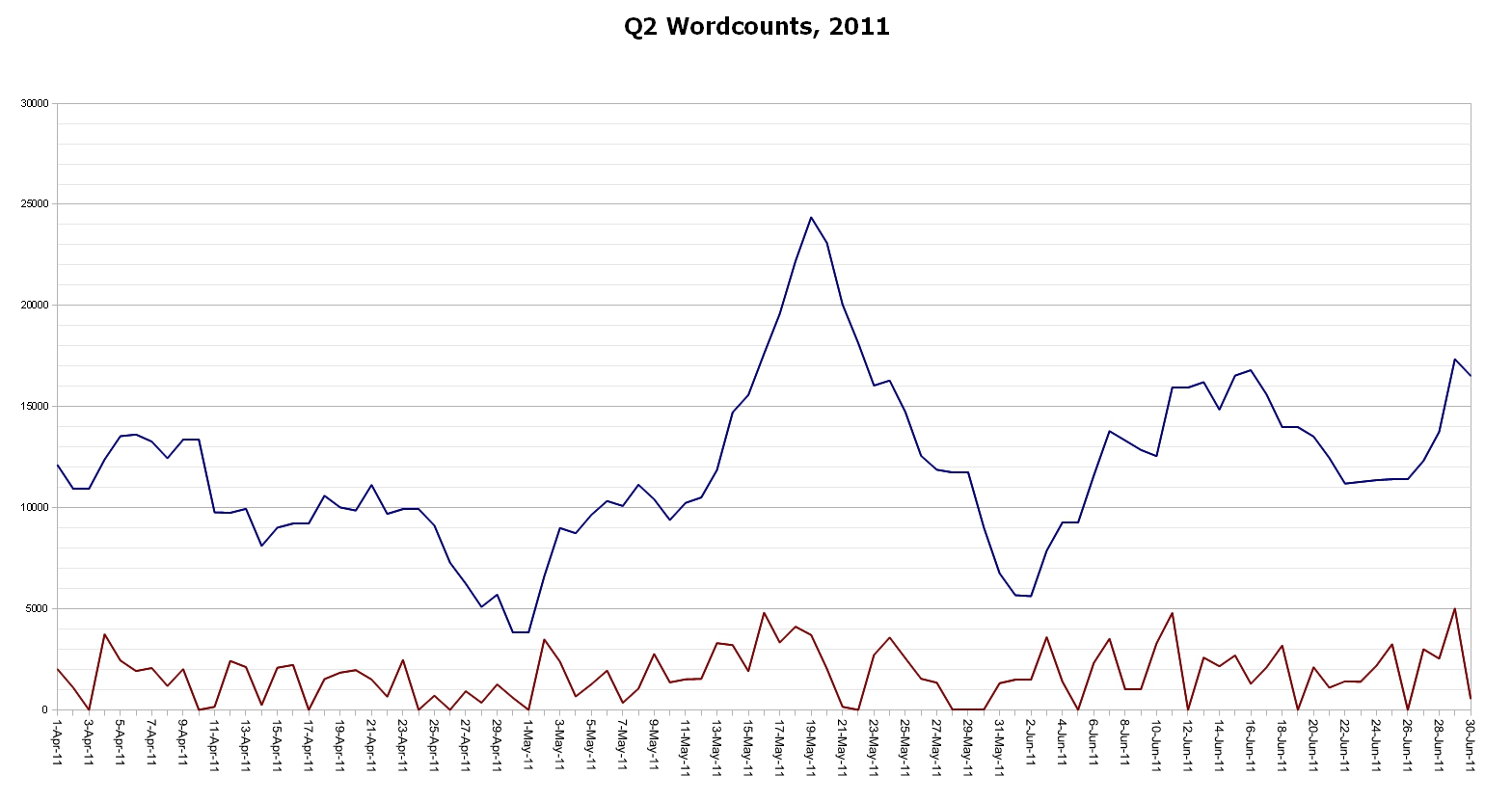
So, without further ado, here are last quarter’s numbers:

The red line represents daily word counts, the blue line is simply a running total of the past 7 days.  Because I’m a discovery writer who often does the heavy work of shaping the story in the revision process, I include revision notes and second / third / fourth drafts in these counts.  I do not include proofreading, though, or sentence / paragraph level revisions for basic errors.

In April, I was plugging through the middle of the first draft of Into the Nebulous Deep and working a temp job full-time doing data entry.  I had just indie published my first three short stories and was still trying to figure out how the system works.  Despite this, I was able to keep up a pretty consistent word count for most of the month, though 10k per week is lower than I would have liked.

Endings are probably the hardest thing for me to write, so at the end of the month things came to a head and my word count dropped significantly.  This was also the week before my youngest sister got married, so that threw a kink in the works.  The job also caught up to me, so in the last week of April my productivity took a real hit.

In May, however, I took time off from the job to “pursue a freelance project” (aka epublish Genesis Earth).  My boss had told me he’d like to have me back once the freelance project was finished, so I felt pretty good about taking the month off.

It took a while for my editor and cover artist to get back with the final product, though, so I spent most of May working on Desert Stars.  This was the third draft, so I was WAY stoked to work on it.  Outlined my revision notes for the first half in a matter of days, which led to the huge peak around the 19th, and launched right into the project full steam ahead.  It was glorious.

When my editor and cover artist got back to me at the end of the month, however, I put Desert Stars on the back burner for about a week to go over the copy edits for Genesis Earth and give it one final proofread.  That’s why things dropped off again toward the end of the month.

In June, I went back to the temp job to save up for Worldcon.  Fortunately, I was able to strike a pretty good balance between writing and work that lasted for the rest of the quarter.  If I didn’t have to juggle a full time job with my full time writing, I probably would have written more, but at 15k per week I was able to keep up pretty well with my personal deadlines.

So yeah, it was a pretty routine quarter.  Nothing too spectacular, though there were some ups and downs.  If you count Bringing Stella Home, I’m on track to complete two polished books this year once I finish Desert Stars.  The latest draft is pretty good, but I think it will need at least one more run through with first readers to make sure the changes to the story are good (and I’ve made a LOT of changes to the story).  Still, I’m averaging about two months per draft per book, so I’m optimistic about getting it out in time for Christmas.

My next project after Desert Stars will probably be the sequel to Into the Nebulous Deep.  I’ll work as hard on that until it stalls, then spend a couple of weeks to put together Sholpan, a novella with the events of Bringing Stella Home told entirely from Stella’s point of view.  I’ll probably put that one up for $.99 or so to generate interest in Bringing Stella Home.

So yeah, that’s what things look like for the immediate future.  Still working, still saving for Worldcon, but the writing is coming along and I should be publishing a few more ebooks in the near future.  So stay tuned!

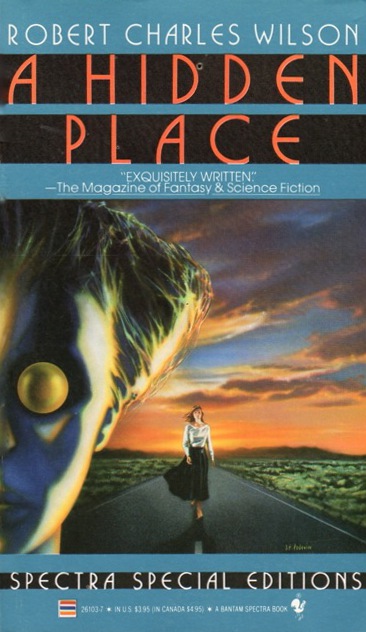
A Hidden Place by Robert Charles Wilson

Travis Fisher is an outsider in most places, but nowhere more than the small midwestern town of Haute Montagne.  But when his mother dies, leaving him parentless and jobless in the midst of the Great Depression, his stern aunt and uncle are the only ones who will take him in.

When Travis falls in love with Nancy Wilcox, the rebellious daughter of the Baptist Ladies Association president, things become worse.  With murderous transients roaming the countryside, Haute Montagne closes ranks, casting them out.

In this moment of distress, a mysterious yet hauntingly beautiful woman reaches out to them with a cry for help.  Stranded in the small midwestern town, she is a being from another world, and she is dying.  Only the two young lovers can help her, but to do so, they must find her dark, masculine half–and in so doing, confront the demons that threaten to tear them apart.

This is one of Robert Charles Wilson’s earlier novels, and I enjoyed it quite a bit.  It’s very short, yet well crafted and beautifully written.  Wilson’s prose is extremely evocative, and his descriptions of Haute Montagne brought back childhood memories from when I lived in the Midwest.  The story was also done well, and had a very satisfying ending.

While this is a good book, though, I wouldn’t say that it’s Wilson’s best.  His characters were interesting, but not nearly as compelling as those in Spin. The baptists were a little too villainous, though Travis’s aunt and uncle were individually more complex.

In spite of all this, however, the story was structured so well that the poignance of it largely overcame these flaws.  As a writer, that’s what I found most interesting about this book–how the masterful way the story was constructed made the whole greater than the sum of the parts.  Call it the monomyth, the hero’s journey, or whatever else, but something about this story made it reverberate in a powerful way.

I suppose that this is what all great stories do: echo some greater, universal story that is in all of us.  It’s the same echo that I felt when I read Spin, or Ender’s Game, or The Neverending Story, albeit a little softer.  It’s something that I hope my own stories evoke, this sense of clarity and wholeness, of returning to some great truth that we lost somewhere between birth and adulthood.

I don’t know if I’m making any sense, but those are my thoughts.  It’s a short read, and I enjoyed it quite a lot.  If you can find it, it’s a good one to pick up.

Character DTRs and other such stuff

Just a quick post before I go to bed.

The two main characters in WAFH just had a DTR (Define The Relationship discussion) and it was, well, kind of rough.  I don’t know what’s harder: having one in real life, or writing a fictional one that actually works.

I also don’t know which one I have more personal experience with, but that’s a subject I’d rather not get into right now.

Anyhow, even though that was an unexpected rough spot that had me down for the past few days, the end for WAFH 2.0 is definitely in sight.  I’ve got one more scene in this chapter, the big climactic end battle / rescue / whatever, and then a very short epilogue.  In all, that’s about seven scenes, two of which are already written and two others which I can probably glean from recycled material.

In unexpected news, I had a very interesting idea.  You know the Writers of the Future contest?  I always want to submit to them, but never can, because none of my stuff is short enough.  It’s acceptable to submit the first part of a novel–Dave Wolverton did that, with On My Way to Paradise–but only if the first part is a complete story in itself.

Well, as I was walking down the street, I wondered whether I could take one of my novels (like BSH) and eliminate all but one of the viewpoint characters’ scenes.  Specifically, I was thinking of doing that with Stella, who goes from prisoner to concubine to queen of a tribe of starfaring warrior nomads.  After cutting out all the other storylines and adding in a bit here or there to preserve continuity, it could make for an interesting novella.

Still, it’s going to be tough to get it down to the 17k word contest limit.  Stella is one of four major viewpoint characters, so her scenes probably take up at least 25k words in the book.  I might be able to cut out a couple of subplots, like the one with Gazan…but I dunno.  I’m open to suggestions from those of you who’ve read it.

In other news, I made the first cut for the 2011 Amazon Breakthrough Novel Award contest!  I submitted Genesis Earth in the YA category, and mine is one of 1,000 entrants that will go on to the next round of judging.  First place wins a $10k publishing contract with Penguin–yay!

I’m trying not to get my hopes up too much, but I’ll know whether I made the second cut by March 22nd.  A couple of friends from Quark also made it through the first round, so if any of us makes it to the second, that would be awesome.  Go Quarkies!

That’s about it for now; Brandon Sanderson did an interesting lecture in his 318 class on the new world of publishing, which was quite interesting.  I’ve got a LOT of new thoughts to share on indie publishing, but that will have to wait for another post.

Until then, keep being awesome…but not like this guy:

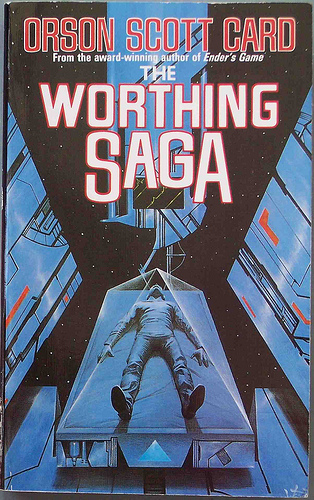
The Worthing Saga by Orson Scott Card

Somec: the miracle drug that allowed the rich and well connected to sleep through the centuries and postpone death almost indefinitely.  While the masses continued to live out their lives in normal time, the social elite watched over centuries as their investments multiplied, and their kingdoms grew into empires…

…and ultimately crumbled.

Thousands of years have passed.  Somec is unknown, except to the one man who saved humanity from its own corruption.  He has slept through the eons to find out if his last gambit brought about the peaceful and benevolent society that he hoped to leave behind.

But as he awakens from his slumber, he finds himself in a universe infinitely stranger than he could have imagined–among a people who revere him as their god.

I’ve heard that Orson Scott Card considers this book his best work, and I’d have to say, I agree with him.  Right up until the ending, it’s at least as good–if not better–than Ender’s Game, his most famous book.

The book unfolds magically from the first page, drawing you in to this beautiful, fantastical world.  The characters have depth and feeling, especially the ones from ages long past, whose stories are powerful and haunting.

I absolutely loved this book–right up to the end, which had a twist that caught me off guard, and not in a good way.

Story-wise, the ending was great.  It was a beautifully foreshadowed twist, right on the order of Ender’s Game and Speaker for the Dead.  Thematically, however, I had a hard time not feeling that it undermined everything that had come before.  I can’t get into details because I don’t want to give spoilers, but the last couple of pages jolted me out of the book and left me saying: “Huh?  How is that right?” I eventually warmed up to it, but it took a while.

Still, I’d definitely give the book five stars, or at least four and a half.  Everything about it is monumentally amazing.  The characters, the worldbuilding, the sense of wonder, the thought-provoking questions and issues it raises, and just the sheer joy of the experience of reading it.  This is a book that I can get lost in, and not just once.

As a side note, the book includes the short novel The Worthing Chronicles, as well as several short stories that take place in the same universe.  The short stories were all quite good, but personally I preferred the novel by itself.  Perhaps it’s because the epic scope came through so much better in the novel than in the stories, or because the stories didn’t allow me to spend much time with any of the characters.  Your mileage may vary, of course.

Interestingly, The Worthing Chronicles is a retelling of Hot Sleep, Orson Scott Card’s first novel.  As a writer, I find it interesting that Card revisited his first novel in this way–to basically rewrite it, keeping all the major events but telling it from the point of view of someone who meets the main character of the first (Worthing) much later in his life.  I haven’t read Hot Sleep, so I can’t compare the two, but The Worthing Chronicles turned out amazingly well.

Will I ever attempt something like this?  Not sure–but it’s interesting to think about.

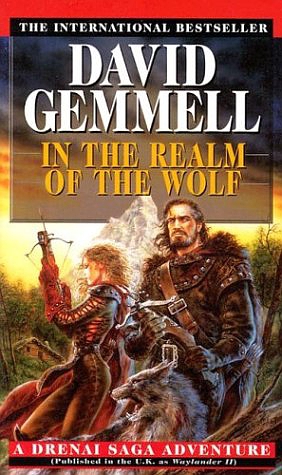
In the Realm of the Wolf by David Gemmell

Never leave home without a weapon, Dakyras taught his adopted daughter Miriel.  Though they live a quiet life alone in the mountains, death is never far from the man known as Waylander.

When the Assassin’s Guild puts out a high price on Waylander’s head, both Waylander and Miriel find themselves on the run.  With them come two ill-fated gladiators from Drenai: the loyal and steady Angel, and the arrogant and reckless Senta.  Both men vie for Miriel’s hand–and both are honor bound to kill each other.

But in the face of the evil hunting Waylander, Angel and Senta must lay aside their vendetta and take up arms against the Gothir army hunting the Wolf clan, tribe of the prophesied chieftain that will one day unite the Nadir.  For deep in the realm of the Wolf lies a castle more ancient than the three empires–a castle whose dark secrets threaten to upset the global order forever.

This book was awesome.  I loved every moment of it.  With each page, the story just got better and better, right up to the climactic finish.  If you’re looking for a rousing adventure, you can’t go wrong with David Gemmell.

One of the things I loved the most about this story was the love triangle between Miriel, Angel, and Senta.  At first, I thought I knew who was good, who was bad, and which one she’d end up with, but then things changed and I wasn’t too sure.  Even though I hated Senta at first, I spent most of the book vacillating with my feelings on him.  And the way things ended–I wasn’t disappointed.  Not one bit.

Even though the overall story conflict was much, much larger than life, Gemmell’s characters always felt very real.  Perhaps it has to do with the way their true nature always seems to come out in battle–and Gemmell gives them plenty of opportunity to show their true nature.

It also has to do with the things they’re fighting for, though–the stakes are always clear for each character, and when they’re confused what they’re fighting for, that’s made clear too.  Though the conflict itself is larger than life, the stakes for each individual character never are.

The ending really took the cake for me, though.  When I finished the book, I couldn’t help but smile.  Gemmell is a master at writing endings that make you want to stand up and cheer.

As awesome as this book was, though, the last book in the trilogy, Hero in the Shadows, is so much better.  The last scene of that book stands out so much more to me, now that I know everything about Waylander’s past.  So.  Freaking.  Epic.

But do yourself a favor: don’t read the last book first, like I did.  Start with Waylander, which is a good book–not great, but good–and read through the trilogy.  If you love stories about true heroes and epic adventures, you won’t be disappointed.

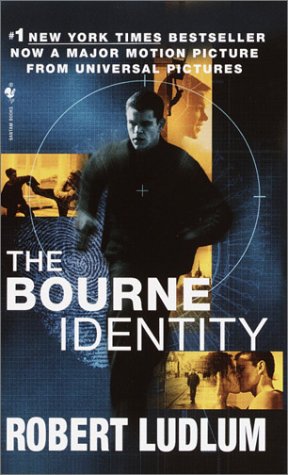
The Bourne Identity by Robert Ludlum

On a stormy night off the coast of Marseilles, a local fishing trawler recovers a man with a gunshot wound to the head.  The local doctor patches him up, but when he recovers, he has no knowledge of his past life.  Even his name is a mystery.

Fortunately, he has a clue to help him get started: a microfilm surgically implanted in his hip containing an account number for a bank in Switzerland.

When he arrives in Switzerland, he finds that the account contains millions of dollars, as well as a name: Treadstone 71.  Before leaving the bank, however, a squad of hitmen attack and nearly kill him, for no reason that he can possibly understand.

On the run from people he doesn’t know for things he doesn’t remember, Jason Bourne finds himself in a struggle, not only for his life, but to find his true identity.  But the answers, he fears, are much, much darker than he can possibly accept.

Okay, to start things off, let me say that this book is NOTHING like the movie.  NOT AT ALL.  The two are completely separate stories.  The beginnings of both are similar, with the whole amnesia thing and the bank account number implanted in his hip, but after Jason leaves Marseilles, everything gets different.  EVERYTHING.

For that reason, it’s difficult to say which is better, because they both try to do very different things.  The movie is more about the action and suspense; the book is more about the intrigue and character development.  Both succeed quite well at what they respectively set out to do.

That said, I enjoyed the book at least as much, if not more than the move.  Ludlum’s writing is quite good, and he paints an excellent picture of both the exotic European setting and the complex psychological portrait of his main character.  Unlike Crichton, whose characters often fall flat, Ludlum does an excellent job creating characters who stand up on their own right.

The suspense lagged somewhat in the middle for me, when the details about Cain and Medusa came to light (that’s one thing I’ve got to say about Crichton–he’s a master of suspense), but it wasn’t enough to keep me from finishing.  The ending, however, was atrocious–not in a clumsy way, but in a too-many-loose-ends kind of way that meant that the story wouldn’t truly be resolved until the sequel.  I hate stories that do that, but oh well, what can you do?

Overall, though, the book was quite good–better than I expected.  I can see why Ludlum was such a successful writer: he created interesting, capable characters and put them in exotic, foreign settings to fight ruthless, evil villains in a desperate zero-sum struggle for survival.

Interesting characters + exotic setting + high stakes conflict + good writing = win.  Oh, and Bourne is way more awesome than Bond. Just sayin’.