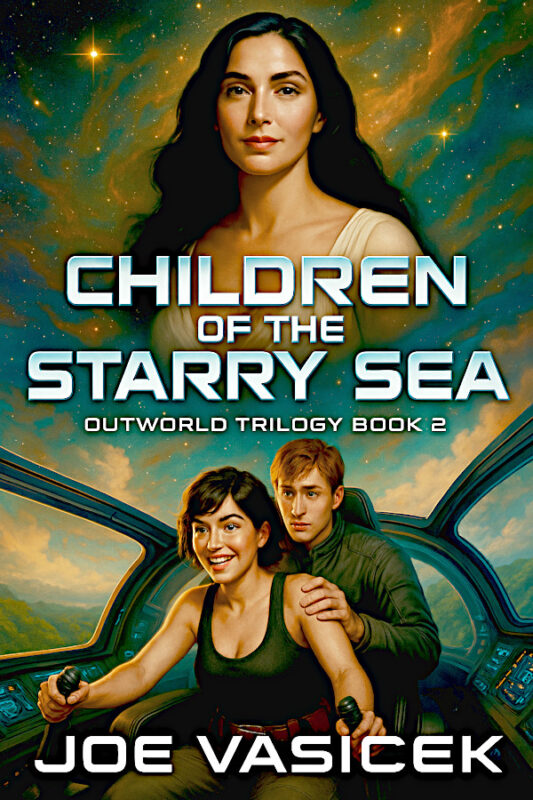
What does it cost to keep your family safe when your planet is under occupation and war has come to your doorstep? In this character-driven space opera about resistance, family loyalty, and moral responsibility, protection stops being a private instinct and becomes a dangerous, public act. Children of the Starry Sea is built around that question: not whether family is worth protecting—but how much you are willing to risk, lose, or become in order to do it.
Where the Idea Came From
I wanted to write a space opera that treated family not as background motivation, but as the central pressure point of the story. Instead of focusing only on fleets and empires, I asked: what does interstellar occupation feel like at the dinner table? In a child’s bedroom? In the split second when a parent has to decide whether to run, hide, resist—or trust? As the opening novel of The Outworld Trilogy, this book establishes the emotional and moral foundation for a larger interstellar conflict that unfolds across the series.
How The Cost of Protecting Your Family Shapes the Story
In Children of the Starry Sea, nearly every major decision flows from someone trying to shield the people they love.
Parents take risks they would never take for themselves. They lie, improvise, and step into danger because the alternative is unthinkable. Characters who might otherwise stay cautious find themselves hacking systems, negotiating with enemies, or joining fragile resistance networks—not because they crave heroism, but because someone smaller and more vulnerable depends on them.
But protection isn’t clean. It isn’t just bravery. It comes with tradeoffs. Seeking safety can draw unwanted attention to innocent communities. Rescuing one person may endanger another. Holding your family close may require you to let something else go—status, security, reputation, even pieces of your own identity. The story continually asks whether protecting your own can ever be separated from responsibility toward the wider human family.
That tension—between private love and public consequence—is what drives the emotional core of the novel. The political conflict matters. The empire matters. But what truly raises the stakes is that every strategic move has a face attached to it. A child. A spouse. A parent. The war is never abstract. It is always personal.
What The Cost of Protecting Your Family Says About Us
At its heart, this theme reflects something deeply human: love makes us brave—but it also makes us vulnerable. The people we cherish most are the very ones who can be used to control or break us. And yet, we keep loving anyway.
Stories about parents protecting children and families holding together under pressure resonate because they mirror our own fears and hopes. We all understand, instinctively, that safety is fragile. That stability can vanish. That sometimes the only thing we truly control is what we are willing to sacrifice for someone else. Children of the Starry Sea suggests that while protection has a cost, love is still worth paying it—because it is the one thing occupation, fear, and violence cannot fully erase. In an era when many readers are drawn to found family stories, resistance narratives, and emotionally grounded science fiction, this theme speaks directly to that hunger for stories where love—not power—is the true source of courage.
Why This Theme Matters to Me
When I wrote this book, I was thinking a great deal about responsibility—about what it means to be entrusted with other lives. In the author’s note, I talk about how real-life transitions and uncertainties shaped the emotional undercurrent of the story. I wasn’t interested in writing power fantasy. I wanted to write about burden. About the quiet, relentless weight of trying to do right by the people who depend on you.
For me, Children of the Starry Sea is ultimately about hope that survives fear—not because circumstances are easy, but because love makes endurance possible. It is a family-centered space opera that insists courage begins at home.
Where to Get the Book