Do you like your chapters named or numbered?

There’s an interesting article linked on The Passive Voice blog about the importance of a table of contents, especially in ebooks.  The article is geared mostly for non-fiction, which is a whole different beast from novels and novellas, but the discussion on TPV got me thinking: for ebooks, is it better to name chapters or to merely number them?

In the comments section on TPV, Jamie makes an interesting point:

With e-books in particular I think there needs to be more care taken with the TOC. I can easily find my place with a print book even without a book mark, but with an e-reader, it’s possible to lose your place very easily, and “loc 4950″ is not going to be committed to my memory banks. I know what happens in the chapter titled “His Grace of Avon Takes Command of the Game,” but I’m not sure if that was chapter 16 or 15 “loc 1730″ or what. I won’t remember the number.

For organizational purposes for my own use I title my chapters, and I believe that readers will appreciate that habit, too, and will be more forgiving if they use the Look Inside feature and see those headers vs. if they just see “1, 2, 3.”

I try to make sure the titles are enticing and pique the curiosity of anyone who would see them in a TOC. They’re not spoilers, because unless you’ve made it to the end of the previous chapter, you’ll likely have no idea what the next chapter’s title is referring to (and if it is obvious, it simply increases the suspense/curiosity). The titles Makes Sense in Context (TM).

When I first learned how to make an ebook, the concept of a table of contents for a novel seemed pretty weird.  I was used to reading print books, which you can flip through much easier and find what you’re looking for just from the feel of the pages.  But with ebooks, obviously that’s much different.  A table of contents is more than just a list of chapters, it’s an important navigational tool that can’t be overlooked.

But if chapter hyperlinks are perhaps the only way to flip through the middle of the book, does that mean that merely numbering the chapters is insufficient?  I have to admit, the concept of naming each chapter seems a bit old-fashioned, but the technology has changed and as writers, we need to change with it.

In the context of a hyperlinked table of contents, numbers are practically meaningless.  They can even be quite ugly, if there’s a huge list of them that sprawls beyond the screen.  Chapter titles can sprawl even more, but they at least provide some idea of what lies on the other side of the link.

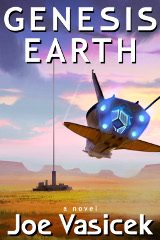
I’ve done it both ways.  For example, the table of contents for Genesis Earth looks like this:

Table of Contents

Copyright Page
Table of Contents

The Wormhole | The Mission | Terra | Cryothaw | The Ghost Ship | Trust and Deception | Betrayal and Discovery | Arrival | First Contact | Call and Answer | Earth | Rescue | Emotion and Reason | Planetfall | The Natives | Origin and Destiny | A New Genesis | Epilogue

Author’s Note | Acknowledgments

Most of the chapter titles are pretty mysterious, but I was kind of going for that.  And in any case, is it possible to make them completely unambiguous without spoiling key parts of the story?  It seems like the art of naming chapters is much subtler and more complex than you’d think at a first glance.

In contrast, the table of contents for Desert Stars looks like this:

Table of Contents

Copyright Page
Table of Contents

Prologue
Book I: Dome and Desert
1 | 2 | 3 | 4 | 5 | 6 | 7 | 8 | 9 | 10
Book II: Sand and Stars

11 | 12 | 13 | 14 | 15 | 16 | 17 | 18 | 19 | 20 | 21 | 22

Author’s Note | Acknowledgments

I kept the numbers for the chapters, but divided the novel into two sections or “books” and listed the numbered chapters as minimally as possible, to save space.  I suppose it looks all right, but as a guide to navigating the book, I’m not sure how useful it is–not to mention how hard it can be to click on a hyperlink that’s only one character long, especially on a touchscreen.

For Journey to Jordan, there were so many entries that I didn’t bother listing them all in the table of contents.  Instead, I divided each part into sections based on location, then listed the locations in the table of contents and the posts/chapters at the head of each section, complete with hyperlinks.

As a side note, it’s actually pretty amazing how internal hyperlinks can change the experience of the book.  For one thing, it opens up all sorts of possibilities for alternate endings and “Choose Your Own Adventure” type stories.  Is it possible to list a chapter in the <manifest> without including it in the <spine>?  I don’t think it is (at least, not in a well-formatted ebook), but if you could find a way to do that, you could add all sorts of hidden content and Easter eggs …

In any case, for my shorter Star Wanderers novellas, I think I actually prefer numbered chapters.  The stories are short enough that the numbered subdivisions still have meaning, and the chapter lists aren’t long enough to look too cluttered.  Besides, I’ve already started the series in this particular format so I think it will be better to keep it this way.

But for future books and future series … I don’t know.  What do you think?  Are ebook chapters better off named or numbered?

Thoughts on ebook parts and a sneak peek of STAR WANDERERS: DREAMWEAVER (aka Star Home)

There’s been some discussion on forums and the blogosphere recently about the different parts that should make up an ebook, and what order they should be in.  J.A. Konrath just did an interesting blog post on the subject, in which he picks his own books apart and gives some advice.  At the moment, here is how I’ve structured mine:

  1. Cover image (600×800).  Usually the same as the high res one I upload separately to publish, but may be different.
  2. Copyright page.  Very brief.
  3. Table of Contents, with hyperlinks to each chapter.
  4. The book blurb, which also appears in the book description on most retail sites.
  5. The book itself.  When you open up the ebook for the first time, this is where it automatically starts.
  6. A brief author’s note, in which I tell the story behind the story–how I came up with the idea, what the writing process was like, and any other relevant influences worth mentioning.
  7. The acknowledgment page, in which I list my first readers and anyone else who helped out with the book production.
  8. A couple of sample chapters for other books.  I only put these into the novels, though–for the novellas, they would take up more than 10% of the total ebook content.  That’s pushing it.
  9. A page promoting the Writer2ePub plugin which I use to build my ebooks.  It’s a really awesome plugin, and I figure the developer deserves some acknowledgment for his work.

I don’t totally agree with all of Konrath’s advice.  For example, I think the copyright page is small enough that it can go in the front without inflating the sample too much.  Then again, I keep the copyright page pretty brief–none of these ridiculous “unauthorized reproduction of this content is piracy and piracy is evil blah blah blah.” Not that I want to be pirated, but I figure my readers are smart enough to know all that stuff already.

In general, though, I think Konrath’s advice is mostly right, especially the part about not padding the end of the book with sample chapters.  I’ve seen a lot of readers complain about getting to the 90% mark of an ebook, only to find that the story is over and the rest of the content is filler.  As a reader, I’ve experienced that disappointment myself.

However, I do think it’s important to include at least some sort of mention of other available books in the back matter.  Until now, that’s meant sample chapters, as long as they take up less than 5% or so of the total content.  Since my Star Wanderers novellas are so short, I haven’t added any sample chapters to them–just a brief plug to sign up for the email list.  And for my novels, I only add a prologue or first chapter, so as not to take up too much space.

Recently, though, I’ve started to rethink this strategy.  When I finish a book, I’m not usually in the mood to read a sample chapter of the next one unless it’s a direct sequel that picks up right where the end of the book leaves off.  I will eagerly browse through book blurbs, though, especially if they’re in the same series or genre.  A good book blurb is much more likely to influence my decision on what to read next than a sample chapter, which I usually just skip over.

For that reason, I’ve decided to take out the sample chapters in my novels over the next few weeks, and replace them with a much shorter page containing a thumbnail cover image and book description for the next book.  I’ll still keep the author’s notes, since I enjoy writing them and I think they’re a good way to engage my readers.  It’s one of those things that makes it a Vasicek book.  But yeah, the sample chapters are gonna go.

This also opens up the possibility of trading book blurbs with other writers.  For example, my friend Kindal Debenham writes space opera stories in the same vein as my Gaia Nova series.  He shows up in my Also Boughts every now and again, so I know there’s a bit of a crossover in our readership.  I haven’t approached him with this idea yet, but if we both included short book blurbs for each other in the back matter of each of our books, we could cross-pollinate our fan base and point readers out to some books they’d be likely to enjoy.

That’s just a thought.  It will be interesting to run with it.

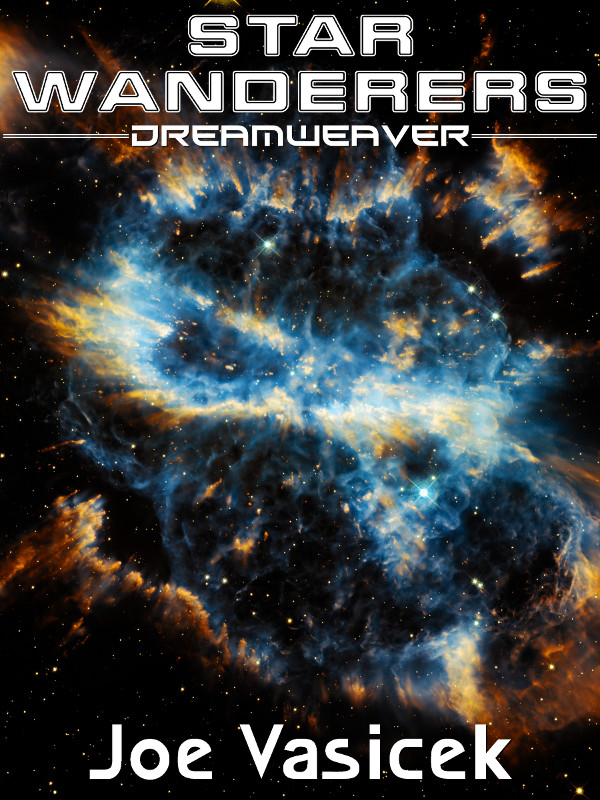
As for the sneak peek I promised in the title of this post, I’ve been playing around in Gimp the last couple of days, working on the cover art for the next Star Wanderers novella while waiting for my editor and illustrator to get back to me on Stars of Blood and Glory.  Here’s what I came up with:

SW-V Dreamweaver (cover)

What do you guys think?  That’s a pretty cool nebula, isn’t it? Hubble is so friggin awesome. 🙂 I took this from a new image of NGC 5189 that was featured on APOD a few months back.  The moment I saw it, I knew I’d be using it in a Star Wanderers cover. 😀

Dreamweaver is a parallel novella to Outworlder, and covers the events of that story from Noemi’s point of view.  I wrote it back in the spring of 2012, and put it on the back burner while I focused on finishing the other ones in the series.  In the author’s note of Fidelity, I think I referred to it as “Star Home,” which was originally its working title.  I was going to do all the other parallel novellas from Noemi’s point of view, but I’ve since decided to branch out with the other characters.  Right now, I’m writing a novella from Jakob’s point of view, which is turning out to be quite interesting.

After Stars of Blood and Glory is published, I plan to put up Star Wanderers: Dreamweaver, hopefully within a month or two.  After that, I’d like to bundle parts I-IV into an omnibus and put that up as The Jeremiah Chronicles, in ebook as well as print-on-demand.  A lot of that depends on cash flow, though, since I plan to hire an illustrator and go all out.  If any of you have any suggestions for a good artist / cover designer, please let me know!  The Star Wanderers books take place in the same universe as the Gaia Nova series, but they have their own distinctive feel and I’d like to find someone whose art reflects that.

That’s just about all for now.  It’s getting late, and I plan to wake up early to write.  President’s day is kind of a useless holiday–in fact, most one-day holidays are kind of useless when you’re a freelancer.  So yeah.  Later!

New blurbs and an interview

First of all, I recently did an interview with Elizabeth Baxter on her blog, Small Blonde Hippy. In it, I discuss Star Wanderers, Stars of Blood and Glory, and a bit about my path to becoming an indie author.  You can find it here–go check it out!

Second, in preparation for the new ebook versions of my novels which I plan to release soon, I’ve been going over some of the old blurbs and updating them.  It’s harder than you might expect!  I think the new ones are getting better, but I’d appreciate some feedback before I post them.  What do you think?

For Genesis Earth:

A BOY AND A GIRL ON A VOYAGE TO AN ALIEN STAR.

Michael Anderson never thought he would set foot on a world like Earth. He only studied planetology to satisfy his parents, two of humanity’s most brilliant scientists. But when they open a wormhole to an alien planet—one emitting a signal that can only be a sign of intelligent life—he soon becomes caught up in the mission to explore it.

His sole mission partner, Terra, doesn’t care nearly as much about the science as he does, though. The child of a bitter divorce, she sees the mission as a chance to escape from the expectations of others.

Before they can work out their differences, a mysterious alien ship begins to hunt them down. Alone, twenty light-years from the nearest human being, they must learn to open up and trust each other—but how can they do that when they can’t even agree why they’re there?

As Michael struggles to keep the mission from falling apart, he is forced to reexamine his deepest, most unquestioned beliefs about the universe—and about what it means to be human.

For Bringing Stella Home:

HE’LL GO TO THE ENDS OF THE GALAXY TO SAVE HIS BROTHER AND SISTER.

The New Gaian Empire is crumbling. An undefeatable enemy from the outer reaches of space is sweeping across the frontier stars, slagging worlds and sowing chaos. No one dares to stand up to them—no one, that is, except James McCoy.

As the youngest son of a merchanter family, James never thought he would get caught up in the Imperial wars. But when his home world falls to the barbarian Hameji, his brother and sister, Ben and Stella, are taken away as prisoners and slaves. With the rest of the galaxy thrown into chaos, only James has the determination to rescue them—even if it means losing everything in the process.

For Sholpan:

SHE’D RATHER DIE THAN BE A SLAVE TO THE CONQUERORS OF HER HOME WORLD.

Stella McCoy never thought she’d fall prisoner to the barbarian Hameji. The oldest daughter of a working class family, all she wanted was to finish her apprenticeship and start a career an astrogator. But when the Hameji conquer her home world with their starfaring battle fleets, she is forced against her will to become a concubine to one of their highest ranking warlords.

Stella would rather die than spend the rest of her life as a concubine. Fortunately, as she looks for a chance to escape, she starts to make friends in high places. But in the dangerous world of harem politics, with new friends come new enemies—ones that have the power to destroy her.

One of the changes I plan to make is to insert the blurb immediately before the first chapter.  I’ve heard that a lot of ebook readers are downloading so many free books and samples that it often takes months before they get around to reading them. This parallels my own experience, so I figure it’s a good idea to have something in the beginning to remind readers what the book is and why they picked it up.

Other than that, no big changes except fixing typos and formatting errors.  I’m not the kind of writer who makes sweeping changes to a published story based on reviews, one-star or otherwise.

In other news, I’m almost finished with the second draft of Stars of Blood and Glory.  This has been a surprisingly fast revision, but then again, that might be because I haven’t sent it out yet to my first readers.  Based on their feedback, I’ll probably do another draft before putting it in the publishing queue.

Star Wanderers is going to be my main focus until the end of the year, though.  I’ve gotten a lot of excellent feedback on Part II, and should start the revisions in the next couple of days.  With luck, I’ll have it published by mid-July.  Part III is going to take a little more time, but I’m pretty confident I’ll have it up by October at the latest.

For that to happen, though, I need to get back to writing.  So long!

Adventures in ebook formatting

Under the hood of my latest ebook release, Star Wanderers: Part I.

So a couple of days ago, I set out on a quest to figure out a better way to build an ebook.  In the process, I ended up learning WAY more about ebooks than I’d bargained for, in the most awesome of possible ways.  Seriously, I don’t think I’ve ever felt so empowered as an indie author as I do right now.

My old process was extremely convoluted.  It basically involved saving my manuscript as HTML (introducing all kinds of excess code) and using four or five programs to cobble together a Frankenstein-like creation, with bolts sticking out of its forehead and extra arms and fingers sticking out of weird places.  The tools I was using were like blunt instruments, and I was operating them blindfolded.

So what changed?  Well, three things:

  1. I added the Writer2ePub plugin for Open Office / Libre Office,
  2. I downloaded an open-source epub editor called Sigil, and
  3. I watched this video:

So what did I learn?

<geek>

First of all, that ebooks are WAY simpler than I thought they were.  An epub is basically a zipped folder containing HTML files for the text, jpgs/gifs for the cover and any interior illustrations, a CSS stylesheet, maybe some extra fonts (if you want to get fancy), and two additional additional files ending in .opf and .ncx that look a lot like HTML files.

So why is this so exciting?  Because it means that if you know HTML/CSS, you can build a fully functional epub file using only notepad, windows explorer, and the command prompt.  THAT’S IT!  And if you want to learn HTML, you can do so for free at w3schools.com.

Basically, an epub is structured just like a website, except that an ebook reader reads it instead of an internet browser.  If you can build a website, you can build an epub with very little trouble.  Even if you can only tweak a website, you can build an epub with very little trouble.

</geek>

In other words, the barriers to entry for ebook publishing are ridiculously low.  If you’re patient and a good learner (or hell, just a good learner), there is not a single reason why you need to spend any money to format your ebooks, upload them directly to retailers, or do anything else.  Using tools that are 100% available for free, you can create a product that looks every bit as professional as anything coming out of New York–in many cases, even more professional.

So what’s my new process?

1) Format the master file in Open Office.

This includes adding the copyright page and table of contents, adding anchors (in OO they’re called “bookmarks”) and hyperlinks, adding the author’s note and acknowledgments, any teasers, etc.  I save the file in open document format, add “Smashwords Edition” on the copyright page and save it as a .doc file for Smashwords.

At some point, I’m going to upgrade to Libre Office, but I haven’t gotten around to it yet.  When I do, it’ll basically be the same thing.

2) Export as .epub using the Writer2ePub plugin.

I cannot tell you how happy I am with this Open Office / Libre Office plugin.  It pulls out all of the unnecessary formatting and breaks up every chapter into a separate, cleanly coded HTML file, all bundled together into a fairly simple epub.  SO MUCH BETTER THAN SAVING AS HTML.  Or Mark Coker’s “nuclear option,” for that matter.

I don’t add the cover at this point, though.  Writer2ePub adds some weird stuff if you do it that way, and I find it easier just to code it manually in the next step.

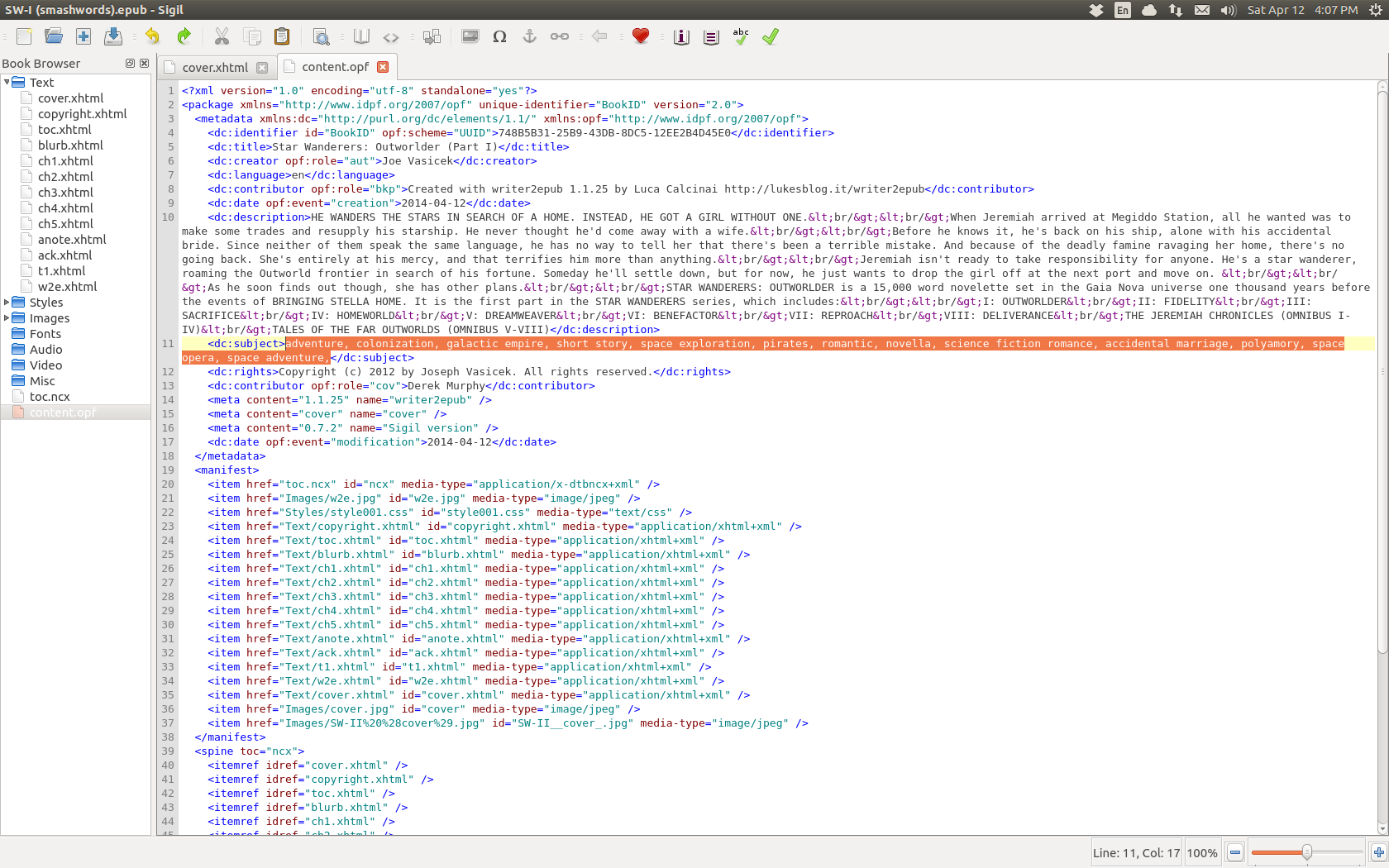
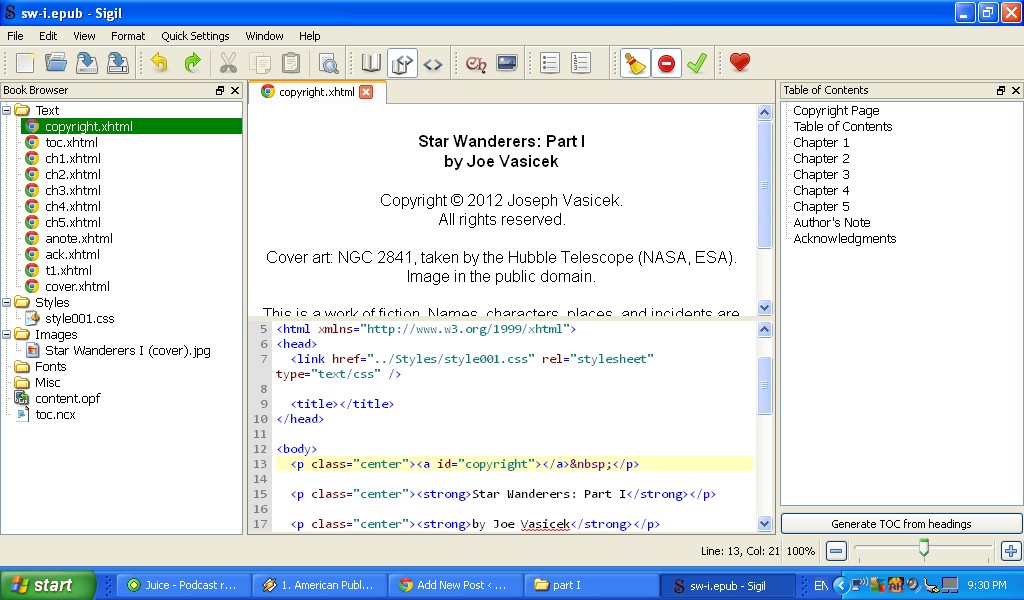
3) Finalize the .epub in Sigil.

Sigil is basically just an HTML editor with some extra functionality that allows it to build an epub from those HTML files.  It’s easy to learn, simple to use, and tells you exactly what’s wrong when something breaks.  Unlike Calibre and Mobipocket Creator, you can always see what’s going on underneath the hood.  Simple, clean, and elegant.  I love it.

This is the phase that takes the most work.  I add the cover, fill in the relevant metadata, tweak the CSS stylesheet for margins and indents, add the book guides, build the table of contents, etc.  If you want to know exactly how I do this, let me know and I’ll write up a post on it later.  It’s a little technical, but not too difficult.  Like I said, if you know even a modicum of HTML, you can figure it out.

Once this step is finished, I have the final epub version of my book.  I upload that to Pubit! and Kobo Writing Life, and just about anywhere else outside of Amazon where I sell my book.  Someday soon, Smashwords will hopefully allow you to directly upload an epub, at which point I’ll do that here as well.

4) Convert to .mobi with KindleGen.

Amazon uses its own proprietary format for ebooks, unlike everywhere else, which takes the open source epub format.  This is probably because of all the weird and funky stuff that Amazon likes to track for data collection purposes, although honestly, who knows?  A mobi file is about twice as large as an epub, and I suspect that that’s the reason.

KindleGen is a free program that Amazon has made available to developers in order to facilitate conversion of epubs and other ebook formats into mobi.  It’s a command line tool, which means that you have to get a little retro to use it.  But hey, I grew up in the 90s with DOS, so it’s actually kind of nostalgic.

Once you’ve got KindleGen installed to c:\kindlegen, all you basically need to do is go to the file folder where your ebook is saved and enter the following command:

c:\kindlegen\kindlegen mybook.epub -c1 -verbose

“mybook.epub” is whatever you named your epub file, “-c1” stands for standard DOC compression, and “-verbose” stands for verbose output (whatever that means).  There are other options you can enter, but I’m not sure what they do yet.  All I know is that if you want to convert from epub to mobi, this will give you a clean result.

There are a few small things that get lost in the conversion, so you need to add them as redundancies in the epub.  The biggest one I’ve noticed so far is the paragraph indents: if you go into the CSS stylesheet using Sigil and add p { … text-indent: 2em; … } that should fix it.

And that’s it!  Once this step is finished, I’ve got the final mobi version and can upload that directly to Amazon and my kindle.  Once that’s done, my book is available from every major ebook retailer in every country in the world.  Total time = maybe an hour (plus however long it takes for the retailers to publish the files to their stores).

I know it’s 2012 and this is old news by now, but do you have any idea how cool this is?  With one hour of work and two or three programs, all of which are available for free, I can produce a clean, professionally formatted ebook, and sell it around the world instantaneously with a marginal cost of zero.

And now, because I took the time to learn how to use the tools, I can be confident that there aren’t any bits of rogue or useless code in it either.  The only “black box” is really the mobi format, but I could probably crack that and figure it out if I wanted to.

So yeah, needless to say, I am extremely happy to be an indie writer. 🙂

Yay for Kobo Writing Life!

So after a month of waiting, Kobo’s publishing platform, Writing Life, is finally up!  I just finished uploading all of my titles (except my short stories–I’ll just continue to distribute through Smashwords for now). Genesis Earth is already available, and the others should be up soon.

For those of you who are readers, this means that you’ll be able to find my books on Kobo almost as soon as they go up on Amazon.  The formatting will (hopefully) be cleaner, since I’ll have direct control.  Prices will generally be the same as on other platforms, but when I change the price on Amazon, I’ll change it simultaneously on Kobo, too–no waiting for weeks on end for the price to drop.

For those of you who are writers, I’ll be sure to keep you updated with thoughts on my experience.  So far, it looks pretty good: the royalty rates are better than Amazon (70% for titles priced $1.99 – $12.99, 45% for all other titles), the publishing process is faster, and the upload formats (.epub, .doc, .docx, .mobi, and .odt) are generally more flexible.  Downsides include a higher minimum threshold for direct deposit ($100 or every 6 months), fewer category choices, and what appears to be a forced 2:3 aspect ratio for cover art.

Besides that–oh, look, Bringing Stella Home and Journey to Jordan just went up too!  Man, that’s fast!  And it looks like the aspect ratios went back to 3:4, so I won’t have to redo the covers.  That’s a relief!  So yeah, I’ll be sure to keep you updated.

Also, in preparing my books for upload to Kobo, I discovered some pretty egregious formatting errors for the Barnes & Noble copies of Bringing Stella Home and Sholpan.  I’m not sure what happened–probably it had something to do with an older version of Calibre or Open Office, since I was overseas at the time and only had access to my netbook.  So yeah, if you downloaded one of the broken copies, just shoot me an email and I’ll send you the updated epub version, no questions asked.

In general, I need to revamp my publishing process.  Currently, it resembles jumping through a ring of fire while juggling half a dozen angry poodles.  Open Office, Mobipocket, Notepad, Calibre, KindleGen, DOS prompts, and Kindle for PC–yeah, I’d better get on that.  If you have any suggestions for free/open source software that does .mobi and .epub, please let me know.

In other news, I finished my first pass through Stars of Blood and Glory, and should be finished with draft 2.0 by the end of the week.  After that, it’s back to Star Home and Star Wanderers.

Journey to Jordan is now published!

My travel journals from the 2008 BYU Jordan Study Abroad are now available as an indie published ebook from Smashwords!

Originally published as a blog, I always wanted to make it available as a book someday.  I spent the last couple of months running through it, putting together all the old posts as well as a few private ones.

I’ve edited them to bring the quality of my writing up to date, but did my best to retain the original sense of enthusiasm and discovery.  I’ve also added a foreword and afterword to give it a little more context, especially in light of the past few years.

This is the unillustrated version; I’m not exactly sure how to format ebooks with pictures, so the illustrated version with the photographs will have to wait.  I can’t promise I’ll get it up before I head out to Georgia (I’m just waiting to get the call–I could be leaving as soon as next week), but I’ll do what I can.

This version will be exactly the same as the other except for the photos, however, so if that’s not important to you, the unillustrated version is cheaper and much less unwieldy (only 895 KB).  Also, until Smashwords allows for direct epub uploads in a little less than a year, the only version available from Smashwords will be this version.

It was a lot of fun putting this one together, and I’m excited to see it up!  As with all my books, thanks for taking the time to read it, and I hope you enjoy!

How to make an ebook

Since I plan on publishing a number of books this next year, I decided to write down the step-by-step instructions for how I make my ebooks.

There’s 50 steps altogether and the process can get a little complicated, but if you follow the instructions it should all be very straightforward.  It takes me about two hours now to run through all the steps, and when I’m finished I have a .mobi file for Amazon, an .epub file for Barnes & Noble, a .doc file for Smashwords, and a couple .jpg files for cover art and thumbnails.

The best part is that all the programs are free, so once you know what you’re doing, it costs nothing but a couple hours of your time to actually make the ebook files.  Other than maybe another hour (if that) to upload the files to Amazon, B&N, and Smashwords, that’s all it takes to publish.

Since publishing isn’t a zero-sum business and all of us benefit when writers have options, I’m making this short manual available as a free PDF.  It may or may not work for you the way it works for me, but if it helps you to climb the steep learning curve that all of us face when we first start out, then I’ve done my job.

Vasicek epublication manual

Also, if any of you are more knowledgeable about formatting than I am, please let me know if you have any suggestions.  I’m always looking out for ways to make my books better, so none of this is set in stone (or print, for that matter 🙂 ).

New upload and thoughts on ebooks

Yesterday, I reformatted Genesis Earth and uploaded the new version to Amazon, Barnes & Noble, and Smashwords.  Basically, I took everything I’ve learned about ebook formatting in the last few months and brought it up to date.

Here’s the complete list of changes:

  • Revised author’s note to include Facebook and Goodreads links, mention of newsletter, etc.
  • Added teasers for BSH and Desert Stars.
  • Credited my editor on copyright page.
  • Put table of contents on one screen.
  • Added nav points using KindleGen.

If you’ve got the old version, the book itself is pretty much the same; basically, I just uploaded a cleaner version, with links to my other works.  Genesis Earth continues to sell better than Bringing Stella Home and Sholpan, so I figured it would be good to update it.

As for how sales of my ebooks have been going, to be honest they’ve dropped off quite a bit.  At Amazon, my free short stories have more or less equalized at 20-80 downloads per week, and they’re starting to get some traction on the new Amazon FR store, but the paid stuff has slowed down quite a lot.

What this tells me is that I haven’t yet built up enough of a reader base to be self sustaining.  It’s not enough just to upload your work to Amazon and the other ebook retailers (though that’s certainly important);  you’ve got to find ways to reach new readers and get your name out there.

I’m not too worried; I figure the most important thing right now is to build my list.  After all, if you want to get discovered, the most important thing is to have something that people can discover.

Beyond that, though, I’m going to try a variety of strategies, including submitting work to more traditional markets (especially short stories).  The biggest breakthrough would probably come from Writers of the Future, so I plan to put a lot more effort into that contest.

I’ll also focus a lot on the email newsletter, since that’s the best direct connection I have with my readers.  For those of you who have already signed up, expect to see a lot more free and exclusive content.  And for those of you who haven’t–what are you waiting for??  Check out the sidebar and sign up!

In the meantime, I’m going to keep writing novels and indie publishing them.  It’s definitely worth it, even if sales are initially slow.  Like Howard Tayler says, the first step to making grizzly bear soup is killing the grizzly bear–everything after that is just making soup.

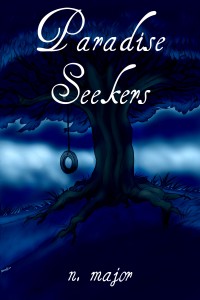
Paradise Seekers by Nathan Major

Haven–a land where no one knows who they are, where they’re from, or how they got there.  A place where everyone has a different recurring dream every night, which gradually grows in intensity until it drives them to madness.  A place where everyone has only a short amount of time to find Paradise, before they perish.

When Sam first comes to Haven, he thinks he’s found an idyllic utopia.  However, as he slowly uncovers the gruesome secrets of the place, he realizes he’s in a race against time to make Atonement and escape.

But how can he do that, when he can’t even remember who he is?  And how can he save the girl he loves, when she has only days before her dreams drive her into madness?

A few weeks ago, I said I’d start reviewing indie books on this blog.  This is my first one.  As a disclaimer, Nathan Major is a fellow Utah writer and a friend of mine, and I received a copy of the book for free, with the agreement that I would review it.

I genuinely enjoyed this book.  It’s a very compelling story, with a mysterious dystopian world and an intriguing premise.  Nathan is very good at building suspense and keeping the reader hooked, and the ending fully lived up to its potential.

As far as editing goes, I noticed only minimal spelling and grammatical errors.  However, the copy I read had some major formatting issues, such as wacky indents and an auto-generated table of contents that missed a few chapters.  Nathan assures me he’s fixed those issues, but I can’t vouch for the most recent copy.

As for the story, while I enjoyed it, it did feel as if it had been published too early.  More than once, I wanted to scream at the characters for doing something stupid, and the romance was occasionally over-the-top sappy.  The level of melodrama was on par with most anime, which is great if you can stand it.  Still, the story kept me hooked, and while I occasionally had to put the story down just to cool off, I always came back to it, right up to the very satisfying end.

If you like dystopian YA, I think you’ll like this book.  It reminded me a little of The Giver, with the urgency and sense of danger of a thriller.  Like I said, it also had a bit of an anime flair to it, so if you’re a fan of anime and manga, the issues I had with it probably won’t be as bad for you.

Overall, I rate Paradise Seekers at 3.5 stars.  If the formatting issues were fixed, I would rate it at 4.  Nathan has a natural talent at good storytelling, and I expect we’ll see many good things from him in the future.

Paradise Seekers is available for .99c from Amazon and free on Smashwords.