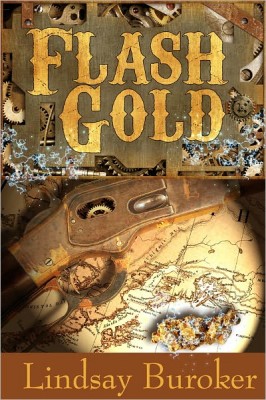
Flash Gold by Lindsay Buroker

All Kali McAlister wants is to leave Moose Hollow far, far behind–and with her dogless sled, the $1,000 prize for the sled race is just her ticket.  But with pirates, gangsters, and thugs in the Yukon after her late father’s alchemical secrets, she’ll be lucky to make it to the finish line alive.  And then there’s that striking man by the mysterious name of Cedar–why is he helping her?
This was a fun steampunk adventure story.  It was fast-paced, well-written, and quite enjoyable; Buroker knows how to hook a reader with interesting characters and conflicts.  I’m looking forward to reading more books set in this universe.

That said, I did have a few issues with this book.  At some parts, the dialog came across as wooden because the characters’ words and reactions didn’t match the intensity of the scene.  For example, Kali and Cedar got caught up in a couple of friendly discussions during gunfights, one about her automatic reloading rifle (which was somewhat excusable) and one about the status of their relationship (which felt a little contrived).  Also, the climax of the story revolves around a late third act info dump, which is a pet peeve of mine.  It didn’t bring the story to a screeching halt, but it did feel a little clumsy.

None of those kept me from enjoying the story, but they were definitely things I noticed.  My biggest issue was probably a lack of real dept or thoughtfulness; what I like to call a “stuff happens, the end” kind of story.  The main character had good internal motivations, but no real internal conflict.  For example, she had this whole history with a previous lover betraying her trust, but she didn’t really struggle much with learning to trust again; all that old baggage was just a part of her background.

Overall, though, this was a fun action-adventure romp.  The steampunk setting was great, one that I’d like to come back and revisit.  And in spite of my critiques, I didn’t feel cheated by this story at all; it really was an enjoyable read.  For $.99, what do you have to lose?

You can find Flash Gold at the author’s site here, or at Smashwords and Barnes & Noble (for some reason, the Amazon link appears to be broken).

Worlds of our own choosing

Note: All material in this post is under full copyright.  Do not use without permission.

About a month ago, I was walking out of the plasma center when inspiration smacked me square in the face.  Two character voices, both of which I’d never heard before, started having the most fascinating argument.

Knowing that I would immediately forget everything if I didn’t stop and record it RIGHT THAT MOMENT, I pulled out my story notebook, sat down next to my bike, and started writing.  This is more or less what I jotted down:

1st voice: All of us live in the world of our own choosing.

2nd voice: What are you talking about?

1st: I mean that all of us choose the world we live in.  All of us live in a world of our own construction.

2nd: That’s crazy.

1st: Yes, but it’s true.

2nd: It can’t be.  How can it be?

1st: Because that’s who we are.  It’s what we do.  We create worlds–if we didn’t, we wouldn’t be human.

2nd: Now you’re just being crazy.

1st: In the world you choose to live in, yes, I’m crazy.

2nd: Look, that can’t be true.  We all live in the same world.  We see the same things, not different things.  I can’t just choose to look out the window and see a red sky, can I?

1st: No, but you can choose whether or not the day is beautiful to you.

2nd: Yeah, okay, but the sky is the same color for all of us, isn’t it?  It’s still the same sky.  I can’t live in a world without a sky, can I?

1st: Actually, most people never look up to see it.  They live in a world where the sky over their heads is irrelevant–as if it didn’t exist.

2nd: Yeah, but look, if we were to take the same exact thing–say, a rock–and look at it under a microscope, we’d see the same elements, wouldn’t we?  The molecules and atoms are all the same, right?

1st: Of course.

2nd: Right!  So that means we live in the same world, not different worlds.  Everything is the same.

1st: My friend, you don’t understand.  A world is so much more than the sum of its atoms.  Those are just the building blocks–the true essence lies in how they’re put together.  It lies in the story we tell ourselves to explain it all.  You see a rock and think, “huh, just another rock.” It doesn’t fit into your story–into your world–except as another set piece.   A boy, however, would see the perfect, skipping stone; a geologist would see a remnant from the age of the dinosaur.  A pilgrim to Mecca would see the rock with which he will smite Shaitan.  Different worlds, my friend–their worlds are all very different from yours.

2nd: Okay, maybe that’s true.  We attach different meaning to things–I can accept that–but that doesn’t mean that we live in separate worlds.

1st: On the contrary, my friend.  You’re presuming that cold, objective reality is more important to us than subjective truth, and that’s obviously false, because none of us–absolutely none of us–can absorb objective reality without fitting it into some kind of story.  We cannot observe anything objectively, for in the very act of observation, we attach meaning to what we see, just to make sense of it.

2nd: Yes, but–

1st: This is what it means to be human.  We take pieces of the reality we observe and make up stories to explain it.  We all tell ourselves thousands of stories every day, simply through the act of living.  It comes so natural that most of the time, we barely notice it.

2nd: Whatever.

1st: The tragedy, my friend, is that most of us don’t realize that we choose the world we live in.  We make critical choices every day and aren’t even aware of most of them.  We each have the capability to change our world by changing the way we see it, yet most of us never realize it.  We go on living in a world that makes us miserable, looking for some outside force to change it, when really, change is no further than our mind.

2nd: That makes no sense.

1st: Only because you refuse to open your eyes and see it.

2nd: Yeah–because what you’re saying is impossible.

1st: Exactly!  That’s exactly what I’m talking about!

2nd: What?

1st: I’m talking about the impossible–the things that, in your world, could never happen.  But what if they’re only impossible because you refuse to believe in them?  Because they have no place in the carefully ordered reality you’ve constructed for yourself?

2nd: I–

1st: My friend, if only you can let go of the comfortable delusion of certainty and take one step into the darkness, you’ll soon find entire worlds of possibilities opening up to your view.  All you need to do is open your mind and take that terrifying first step.

There you have it.  A little rough, certainly, but that’s not important–what matters are the ideas behind it all.  And to me at least, the ideas are quite fascinating.

I tried to use some of these ideas in Worlds Away from Home, but I don’t think any of them came across very clearly.  I probably have to let the story stew a bit in my mind in order to figure out what it’s really about.  Maybe I’ll insert a slightly edited version of this dialog in there somewhere, but I won’t force it.

In the meantime, what do you think?  Did any of this resonate with you, or does it sound like so much philosophical hogwash?  Tell me–I want to know!

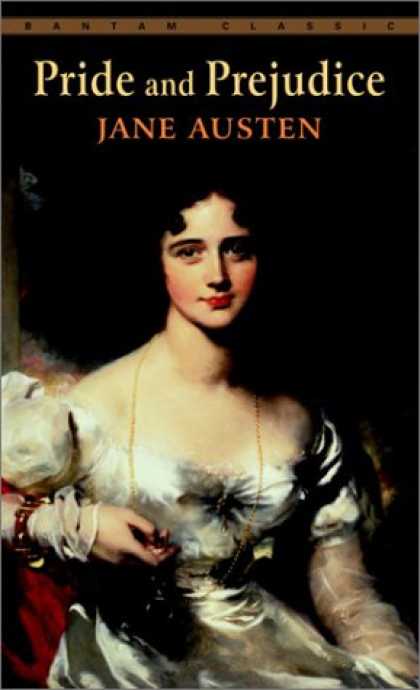
Pride and Prejudice by Jane Austen

I think the first line of this novel sums it up better than I ever could:

It is a truth universally acknowledged, that a single man in possession of a good fortune, must be in want of a wife.

I’ve been familiar with the story of Pride and Prejudice for a long time, but this was the first time I’d read the original.  Even though I don’t usually go for Regency romances, I have to say that I enjoyed this book very much!

Jane Austen has a genius for character.  She knows exactly what little mannerism to show or what description to give to make her characters come alive.  At several points in the book, I paused and said “holy cow, that’s just like so and so,” or “haha, I know exactly what this person is like.” At no point did I feel hit over the head or dragged through a long info dump explaining this or that character’s background.  Of all the possible details she could share, Austen always chooses the exact ones you need to get a clear, distinct picture–no more, no less.

Austen drives her story with some snappy, entertaining dialogue.  Far from being sappy or sentimental, her main character, Elizabeth, is snarky and spirited, and she clashes with a lot of people in ways that are much more interesting (and mature) than typical girl drama.  Be that as it may, I found it entertaining to compare Elizabeth’s dating/relationship experiences with my own.  As different as things were back then, in some very interesting ways they are still the same.

I did feel that the novel slowed down a bit in the middle, probably because that was when Elizabeth went on the tour of Derbyshire with her relatives and left behind most of the other characters that interested me.  Also (since I am a straight guy), Mr. Darcy didn’t really turn me on much, so Elizabeth’s gradual change of mind as she toured his house wasn’t as engaging to me.

One thing that confuses me, having read this book, is why women all over the place set up Mr. Darcy as the ideal male.  What exactly is his appeal?  He’s a little rough around the edges, has an independent streak, speaks his mind even when doing so would be rude, and is constantly aloof from everyone else.  Is this what women find so appealing about him?  I can see how the “Beauty and the Beast” syndrome can also be a turn-on–Elizabeth essentially wins him over by taming him–but that has less to do with who he is than how Elizabeth changes him.  Do women go for a guy who they have the power to change?  Is that what it is?  I’m still a bit confused.

One thing made me a little mad, and it had nothing to do with the book at all; it had to do with the blurb on the back.  It reads:

One of the most universally loved and admired English novels, Pride and Prejudice, was penned as a popular entertainment.  But the consummate artistry of Jane Austen (1775-1817) transformed this effervescent tale of rural romance into a witty, shrewdly observed satire of English country life that is now regarded as one of the principal treasures of English literature.

Austen’s “consummate artistry” transformed this novel from “popular entertainment” to “one of the principal treasures of English literature”?  Come on.  That statement is as pompous as it is illogical.  Once her book came out in print, Austen “transformed” nothing–the only thing that changed was the way people looked at it.  It started out as a popular genre novel, like anything by Rowling or Steele or Grisham or King, and when the literati decided to claim it, they rebranded it as something else.

What irks me is this idea that “popular entertainment” is somehow inherently devoid of literary worth.  Come on, people–virtually all the “great authors” before 1920 were well-read and well-loved in their day, among the masses as much as the literary elite.  It’s not a sin to make money writing books.

Overall, I enjoyed this book very much.  Just as Lord of the Rings is the quintessential fantasy novel, Pride and Prejudice is probably the lodestar of the romance genre.  I was pleased to find that it’s not a book that only women can enjoy!

…and they all lived evily ever after.

Today we had a quark writing group party, and it was lots of fun! We all went up to drek‘s new house, up in Draper, and read some of our really old, really bad first attempts at writing stories. Good times!

Drek, Nick, lexish, slipperyjim, jakeson, gamila, aneeka, and one of my friends from the FLSR writing group all came up. Jakeson and his crew got lost on the way, but we had a good time hanging out, chatting, eating the pita bread and hummous that I’d cooked (I figured everyone else would bring sugar-heavy treats, so I cooked something a little more on the healthy side–still delicious, as evidenced by how much everyone ate!), and talking about how we’d gotten started writing.

I think a lot of us had similar stories–while we all wrote for different reasons, we all tried to do something big in high school, something that marked a turning point of some sort. The other common thread that ran through our stories was…how laughably bad they were! There were gradations, of course (Nick’s story that started with the word “Gandalf” and only got worse was pretty ridiculously crazy), but all of our stuff was pretty bad.

It can be both fun and painful to look back on past stuff, especially the stuff you wrote back in high school. It’s like, all the painful awkwardness of high school is not limited to your social life, it seeps into your writing as well, especially if that’s when you first try out your hand at the craft. So many cliches, so much bad grammar, so many viewpoint errors and info dumps…ARGH!!!

Of course, that is precisely what made it so entertaining. The awkward, emo, immature teenage grasp of the universe, combined with dozens of stale cliches and atrocious grammar–brilliant! I’m glad we were all at a point where we could look back on this stuff and laugh. It can do you good to air out your closet and let go of some of the old stuff you are sure would destroy you if you ever let it saw the light of day.

My first writing attempt was a novel that has since been entirely lost. I printed up a hard copy, once a long time ago, but I’ve lost that one and really have no desire to try and dreg it up. Of course, all the digital copies haven’t survived. My second novel attempt, however, I have in both digital and hard copy. That’s the one that I dipped back into for this writing party.

I actually sent out a copy of this to my aunt in Washington DC, who is/was an editor for a magazine. She read about the first twenty or thirty pages and sent me this letter, which I will use to finish off this post. The only places I’ve used ellipses are when my aunt described problems specific to certain passages and quoted them.

October 14, 1999

Dear onelowerlight [name, obviously, has been changed 😛 ]

The manuscript your mom sent home with Evan has proven to be an interesting read in many ways. It is wonderful to see people take an interest in writing. This pastime has given me many hours of satisfaction. I find that the joy is in the journey and that the process is as important to me as the finished job. However, it is always satisfying to have a finished product that I feel good about.

What it looks like you have is a wonderful outline for a novel. Your language is colorful and descriptive. The battle scene held my interest and made me want to know what was going to happen next. My intent was to read the manuscript from beginning to end purely for the joy of reading it. The urge to edit, an urge that often gets in my way as I write a first draft, got in my way as I read. Hence I was not able to follow through. I have written on some of the pages. What follows are a few other observations.

A really good writer named John Gardner said that a piece of fiction opens up a dream to the reader. Anything that causes the reader to become aware of the author or that jolts him out of the fictive dream does not belong. It is always helpful to let a manuscript cool for several days and then begin to read it. This will help you be more objective. Sometimes the things that seem marvelous turn out to be less enchanting than one thought during the rapture of creation.

Titles are difficult. Would anyone have read Catch 22 by another name? Some people don’t think so. It has been postulated that the reason the story about The Man Who Went Up A Hill And Came Down A Mountain didn’t do better as a movie–and presumable a book–was because of the length of the title. For many authors the title is the last thing to be written.

Your first two or three pages contain a good deal of “throat clearing.” An opening needs to grab the reader so he will continue. There needs to be a problem, action and change. It should be action that is vital to the story. Someone is going on a trip. Someone is going into battle. someone is getting married. Someone is being born. Unless you want to write erotic literature it would be better not to start with conception. Work the background in later. In The Gospel of John the first few verses talk about the Word. Immediately the Word is identified with the Son of God and the story of his baptism. The problem of establishing himself as a teacher is presented. In episode IV of Star Wars the force is not explained to us at the beginning, rather we see what it can do. It isn’t until Solo talks about fools who believe in an ancient religion that we begin to have some idea th at the force is more than magic. The characters give all this information to us.

Point of view is the perspective that the story is told from. T he most difficult and therefore least used these days is the omniscient narrator. A good rule of thumb is to see the story through the eyes of the person with the problem. Many authors write in first person. One can also use second or third person. Third person is similar to first person except the pronoun I isn’t used as much. (Actually it is more complicated than that, but that will suffice for now.) Sometimes a narrator who doesn’t see into anyone’s mind tells a story. Most fiction that looks like omniscient narrator is actually being told from the point of view of one of the characters. The narrator can then see into the mind of one person and all the other action is viewed through his eyes. Sometimes a novel will contain oone person’s point of view in one chapter and that of another character in another. This seems to work. It is confusing when shifts occur without warning.

Psychic distance has to do with how close you want your reader to be to the story. Stephen King wants to inspire terror. He gets his readers as close as he can. You hear breathing, feel sweat, hearts race. Jane Austin keeps her readers at a great distance. You see the lights, you hear the conversation, it is all very proper–no sweat, no breathing, no racing hearts. Just as with the point of view, the important thing is that the narrative remains consistent. It must not switch in the middle of a sentence, paragraph, or chapter.

Write in active voice as much as possible. Your English teacher will tell you all about this. Be aware that verbs ending in “ing” do not help your story. (Running up the hill after Jill and tripping over a rock Jack stumbled.) This slows the action of the story down but when used sparingly can add emphasis. The following construction works better (Jack ran up the hill after Jill. He tripped over a rock and stumbled. “D___!” he grumbled. Jill took water from her bucket and soap from her pocket and washed his mouth out.)…

…You have many long sentences. Your writing will be tighter and stronger with shorter sentences and fewer prepositional phrases…

…There are lots of ways to deal with dialogue. You can put the dialogue first and description second…you can put the dialogue at the end…you can break it up the way you have in your manuscript or you can put description on either sie of it…Like every other element of your story, you don’t want it to call attention to itself.

I believe you changed fonts to show a change in viewpoint or in who is speaking. For me this is very distracting. There are other good ways that work. Also it is easier for me to read when it is double-spaced.

Two books that I have found most helpful are John Gardner’s The Art of Fiction. It is out in paperback. John Gardner also wrote a wonderful fantasy called Grendal. It is not very long. It is told from the point of view of the monster. The other book is The Elements of Style by Strunk and White.

Thank you for sharing your manuscript with me. It takes great courage to share one’s work. I admire you for starting out early. Remember free advice is worth what you pay for and don’t let anybody discourage you. You learn to write by writinig. You have a good start.

Your’s truly,

Aunt Yvonne