Spring Shorts Story #2: Prison of Dreams

It’s been a little crazy over here, which is probably why I’ve found it so difficult to write lately. It’s not a function of time so much as brainspace, and I really need to find ways to refill the creative well. But I did manage to finish another story this week, and I think it has real potential. Next step: writing group.

This is another Mythulu-inspired story, and I ended up using more cards for this one than any other story I’ve written. Here are the cards I used:

  • DREAM: A space where anything is possible but nothing lasts. Often inspires discovery and change elsewhere.
  • SCAVENGER: Symbolizes poverty of mind. Lives on the leftovers of greatness because they are unable to create something new.
  • DATA: The element you draw next is the primary means for carrying data. (Draw +1 Element)
    • MACHINE: The messy, awkward, expensive try-fail attempts of those who elevate a race to god-like status.
  • HIBERNATES: Enters a standby state with low power usage to survive extreme conditions. Most animals cannot heal during hibernation.
  • AWAKE: Pulled from sleep, animated, enlightened. A higher state of consciousness.
  • ARTIST: Passionately engaged in a profession that doesn’t pay. Artists are soul-healers and their work transcends political sides.
  • CASTE: Systemized, religiously justified discrimination.
  • LOVER: The other self. True lovers always fill a hole. Stronger together than the sum of the parts.
  • METALLOID: A non-metal element that behaves like metal. Conductive, fusible, and/or ductile. Trouble being categorized or fitting in is usually connected to extraordinary abilities.
  • RUST: Deterioration caused by extended contact with water, air, or acid. Threatens functionality. Difficult to restore.
  • STOCKHOLM SYNDROME: A captive who has developed sympathy for their tormentor.

I was worried at first that this short story would expand into something longer, but I managed to keep the first draft under 5,600 words. If I can get it under 5,000, so much the better. I really do feel like it could benefit from another set of eyes looking at it, so I’m going to hold off on sending it anywhere.

Dean Wesley Smith likes to boast how in the early days of his writing career, he would submit his stories to the editors before he workshopped them in his writing group, and often the things that his writing group criticized were things that the editors loved. But he also says that writers should never revise their work, and that anyone who reads critically needs to “go get help. And I mean real help, professional help, because you have lost all ability to see a story and are trapped by the little black marks on the paper.” In fact, some of the worst writing and publishing advice I have ever heard has come from Dean Wesley Smith, so at this point I feel no compulsion to follow anything he says that doesn’t make sense on its face. But hey, he’s the guy who always tells us to turn off our critical minds, so that’s really just following his advice.

(The crazy thing is that some of the best writing and publishing advice I’ve ever heard has also come from Dean, which makes his bad advice—and it is truly bad—all the more puzzling. How can someone who knows so much also be so wrong? I’ve come to my own conclusions about that, but this is a public blog, so I’ll refrain from posting my thoughts on the subject here.)

In any case, I’ve been really happy with the feedback from my current writing group, so from now on I think I’m going to workshop all of my short stories through there before publishing or submitting them. And I look forward to getting their feedback on this one, because even though I think it turned out pretty good, it needs an extra something and I’m not sure what.

As for the next story, I will try to use just as many cards as I did with this one, since my goal for this writing challenge is to use all of the cards in the deck. But there are a lot of cards, so it’s entirely possible that I won’t end up doing that. Should be fun, though.
Are short stories worth publishing?

Every couple of years, I get the short story bug and write maybe half a dozen short stories in the span of just a few months. Then, I get really excited about putting them up on submission, and for the next couple of years I systematically send them out to all the professional markets… and then the semi-professional markets… and then, when only a couple of them actually sell, I self-publish them. My enthusiasm gradually dies down, until I catch the short story bug again, and the cycle repeats.

When I caught the short story bug last year, though, it was immediately after NaNoWriMo, where I wrote 50k words of short stories instead of 50k words of a novel. That was so much fun that I think I’m going to do it every year. In fact, I may try out Camp NaNoWriMo too, just for the fun of it.

But this post isn’t about whether short stories are worth writing. That’s an artistic question, and the answer for most writers is probably some version of “yes, but…” The big question on my mind, however, is whether short stories are worth publishing—that is, are short stories worth it from a career/business perspective?

Several years ago (during one of those times when I’d caught the short story bug again), I wrote a blog post about whether it’s possible to make a living as a short story writer. I speculated that if you spent a year writing two short stories a week, that would give you a hundred stories by the end of the year. Keep it up, and after a few years you would have so many stories that by sheer numbers alone, you could do it.

Dean Wesley Smith came to a similar conclusion back in 2016, and again in 2018. The basic idea is to write like a madman out of hell, keep each one on submission for a couple of years, and self-publish them on a shoestring budget so that even if each one only brings in a few extra dollars, by sheer numbers alone, you make a decent living.

There’s just one problem.

There’s a site called The Submission Grinder that crowdsources writers’ rejection letters and acceptances to produce a lot of useful data on all of the various short story markets. After crunching this data, I discovered there are between 30-50 science fiction and fantasy markets that pay better than 5¢ per word. Most of them are temporarily closed at any given time, and very few of them accept multiple or simultaneous submissions. Furthermore, they all average about 25-30 days to respond to submissions.

What this means is that if you write faster than one short story a month, after only about a dozen stories or so, you will start to run out of available markets. Unless you write under multiple pen names or across multiple genres, you will very quickly develop a backlog of stories that won’t get submitted, simply because there aren’t enough places to submit to. So instead of taking one or two years for each story to work their way through the markets, it will take several more years or perhaps even decades, during which time those stories aren’t making any money for you at all.

As for self-publishing, I am currently experimenting with a lot of different ways to publish short stories, but what I’ve generally found is that short stories can be useful to do just about every other thing except make money selling them directly. If you price the singles at $2.99, you might sell as many as one or two per year, making less than $5. If you price them at 99¢, you may sell as many as a dozen per year, if you’re lucky—again, making less than $5. I didn’t have much luck getting bundles of 3-5 to sell, but larger collections of 10 to 12 stories do occasionally sell, and at a decent enough rate that I’m earning more on those stories than I would if I’d sold them individually as singles. But short story collections don’t sell anywhere near as well as novels.

So if you’re going to publish short stories, the best way to maximize earnings is to submit them to all the professional markets first, and to work your way through those markets as quickly and efficiently as possible. But that requires throttling your output, otherwise you’ll soon end up with a massive backlog of stories waiting for a place to send them. And self-publishing them all isn’t a panacea, because it’s very difficult to make money selling short stories directly. They can be useful for other things, like building your email list, converting readers to fans, and marketing your author brand, but all of this requires making those stories free—at least the singles, if not the collections.

But when you think about it, that makes sense, because most short stories are published for free anyways. When you sell a story to a professional or semi-pro market, it usually ends up on a podcast feed or a website somewhere, available for free in some form. These days, an avid short story reader doesn’t need to spend a dime to find high quality stories produced very well. If they do spend money, it’s usually because they’ve made a conscious choice to support an author, or a magazine, or an anthology that they love.

So is it worth publishing short stories? If you can break into the professional markets, probably yes, otherwise I’m not so sure. And while the best career writing advice is “be prolific,” I do think there’s a point at which the marginal cost vs. marginal benefit of writing another short story really doesn’t make any sense. I suspect that threshold lies somewhere around the point where the submissions backlog starts to build.

I’ll still keep writing short stories, because I do want to crack into those professional markets, and I do think the ancillary benefits of self-publishing short stories makes it worthwhile. But at best, it’s going to be a sideshow compared to everything else I do. Most likely I’ll reserve short stories to NaNoWriMo or Camp NaNoWriMo, and not even bother writing them for the rest of the year.

#GiveThanks Day Four

(45) I’m grateful for Jordan Peterson and his courage to speak the truth as he sees it, even in the face of incredible opposition.

(46) I’m grateful for the “intellectual dark web” and how they show that there are still intelligent people who can discuss important issues with those with whom they disagree.

(47) I’m grateful for the voices in the alternative media that push back against the gaslighting of the mainstream media.

(48) On a less political note, I’m grateful for Mike Duncan and his History of Rome podcast, which taught me far more about the Romans and their impact on our world than my college education ever did.

(49) I’m also grateful for Mike Duncan’s Revolutions podcast, which has done the same thing for the history of our modern era.

(50) I’m grateful for Dan Carlin and his numerous podcasts, especially Hardcore History.

(51) I’m grateful for the Writing Excuses podcast, which was very influential in how I developed my writing craft back when I was just getting started.

(52) I’m grateful for the Six Figure Authors podcast and the Science Fiction and Fantasy Marketing podcast, and the excellent marketing and publishing ideas that they give me.

(53) I’m grateful for the Sell More Books Show and how it helps me to stay up to date with what’s happening in indie publishing.

(54) I’m grateful for the Mythulu cards that my wife got me for my birthday, and how they’ve helped me this nanowrimo to come up with some great story ideas.

(55) I’m grateful for Kris Rusch and Dean Wesley Smith, and the influence they were in helping me to decide to self publish back in 2011.

(56) I’m grateful for Life, the Universe, and Everything, and how that conference was and continues to be critical in shaping my writing career.

(57) I’m grateful for the writing group that I was fortunate enough to marry into, and the good advice and feedback that I receive from it.

(58) I’m grateful for Quark, BYU’s Science Fiction and Fantasy Club, and for how it provided me with a community of like-minded geeks and aspiring writers in college.

(59) I’m grateful for Leading Edge and the opportunity that I had to read for their slushpile, back when I was still learning my craft.

(60) I’m grateful for all of the other science fiction conventions I’ve been able to attend over the years, including Worldcon, World Fantasy, FanX, CONduit, and others.

2020-01-23 Newsletter Author’s Note

This author’s note originally appeared in the January 23rd edition of my email newsletter. To sign up for my newsletter, click here.

Every week, when I sit down to write the author’s note for this newsletter, I try to come up with something that you’ll find genuinely interesting or insightful. I don’t want to talk about myself too much, since that tends to get boring rather quickly, and I also don’t want to talk too much about writing, since for non-writers that also tends to get boring. Most of my fans probably aren’t professional writers, and those of my colleagues who do subscribe to this newsletter probably just want to keep tabs on what I’m doing and aren’t themselves fans (except for you, J.R. Handley).

Then again, since you’re someone who 1. actually opens the newsletter, and 2. bothers to actually read it, you probably do have some interest in both me and my writing. So I hope you’ll indulge me, because the thing that’s on my mind this week has to do with a couple of blog posts I read by Kristine Katherine Rusch and Dean Wesley Smith.

I have tremendous respect for Kris and Dean. Their opinions on writing and publishing had a huge impact on my decision to jump into indie publishing nearly nine years ago. That said, their advice has been a mixed bag: some of it ranks among the best writing and publishing advice I’ve heard, but some of it has sent me down the wrong path, sometimes for years.

On Wednesday, Dean wrote a blog post where he explained his big secret:

It actually boils down to one simple thing… I don’t care what anyone thinks of me. Or of my writing, or methods of writing.

I just flat don’t care.

In other words, the grand key to understanding all of Dean’s writing and publishing advice is this: don’t give a damn about anything else except having fun.

All of a sudden, everything began to fall into place; both his good advice (don’t let agents scam you, trust your own voice, don’t let writing groups boss you around, don’t devalue your work) and his bad advice (never revise anything, never read reviews, do all of your own covers, write everything quickly, don’t outline anything, don’t actively promote your books). It all comes down to his core philosophy of not giving a damn.

But is that really the best approach?

Dean’s advice is very good for writing a certain kind of book. But the kind of books that I want to write are the ones that I like to read: books that really stick with you, either because they get you to think deeply about something, or feel deeply about something in a way you’ve never felt before. And I may be wrong, but Deans approach of not giving a damn seems like a terrible way to write those books.

Another thing that Dean always talks about is “critical voice.” Basically, all writers have two voices in their head: one that understands story and makes you want to write, and the “critical voice” that tells you what’s wrong with everything and makes you want to give up writing forever. Maybe he’s right about that. But does it necessarily follow that the only way to write anything is to get your critical voice to shut up?

For the last few years, I’ve been developing a new method for outlining my books. I used to think that outlining is terrible because it takes all the fun out of writing—in other words, exactly what Dean says. Instead, outlining helps me to keep my “critical voice” in check, because when something is broken the outline helps me to see where the problem is, and how to fix it. It also helps me to eat the proverbial elephant one small bite at a time.

Is there a useful place for “critical voice” in the writing process? Can giving a damn actually be the key to writing a better book, or making writing fun again?

This past week, I was writing a new scene in Star Wanderers from Noemi’s point of view. It takes place during the events of Fidelity and Benefactor, when Mariya’s father loses his job and the family doesn’t know what they’re going to do. It felt like a slog until I realized that the conversation between these two characters, Mariya and Noemi, offered a really interesting chance to explore questions of faith, doubt, and the problem of evil. Suddenly, the scene really came alive for me, and the key was asking myself “what can I offer my readers here? What will they take away from this?” In other words, giving a damn actually made the writing more fun, not less.

A few weeks ago, Kris wrote a really interesting blog post where among other things she said:

If a writer isn’t afraid of what she’s writing, then she’s doing it wrong because she’s not stretching herself. You should always reach just a bit, go a place you haven’t gone before.

I like that. And if I didn’t actually care about what you or others thought—if it was all about myself and “having fun”—I don’t think I’d ever really stretch myself as a writer. Or perhaps I would, but not in the right way. I’d be like one of those bodybuilders, with massive pecks and teeny tiny legs.

All of which is to say that I think I finally understand now why Dean Wesley Smith’s writing and publishing advice is so hit-or-miss. And also, that I understand a little better how to write the kind of books that made me want to write in the first place.

Early October Update

Holy crap, so much to discuss. Where should I begin?

First, the writing is coming along well. I’m doing a quick revision of Patriots in Retreat to get it ready for publication in January. It’s actually much better than I remember. Hopefully the same can be said of A Queen in Hiding, because I’m finishing that one next.

My goal is to have A Queen in Hiding up for preorder by the time Patriots in Retreat goes live. To do that, I need to have them both published by the beginning of January. It doesn’t get any easier, either, because An Empire in Disarray needs to be up for preorder before A Queen in Hiding goes live in March, and I haven’t even started that one yet!

It’s a pretty demanding schedule, but that’s good, because I need more practice at keeping deadlines and schedules. And if all goes well, the Sons of the Starfarers series will be complete by summer 2018.

On the publishing end of things, I’m making some changes to my pricing strategy after reading an interesting post by Dean Wesley Smith. Will probably do a longer blog post on that topic. It’s all an experiment, so it will be interesting to see how it turns out.

So much other stuff happening on the publishing / marketing ends of things. I’m getting ready to put out print versions of everything I’ve published. That’s going to take a while. Also, I want to start experimenting with audiobooks. Lots of fantastic new opportunities have opened up there, and I need to figure out how best to take advantage of them.

On a more personal note, Friday was my last day at the day job. Good company and good people, but the work schedule was too inflexible, and it’s more important right now to pursue my writing career. With the money I’ve managed to save, I plan to move back to Utah and spend a few months working exclusively on the writing and publishing. Expect to see big things from me in the not so distant future!

Rethinking free

I recently read an interesting blog post on Dean Wesley Smith’s blog, about how, how not, and whether to make your books free. The conclusion he comes to is this:

Free is short time, limited supply, and never on the major bookstore shelves.

In other words, no permafree, no free pulsing, and no publishing free online content on sites like InstaFreebie unless it’s for a limited time.

Three or four years ago, I probably would have pushed back pretty hard against this advice. There are still points of it that I disagree with, such as the idea that giving anything away for free devalues all your other work. Perhaps that’s true for physical product, but for digital content I think there’s a solid argument to be made that the rules have changed.

That said, a lot has happened in the last three or four years. Permafree worked really great until about the middle of 2014, at which point I noticed that it was a lot harder to generate any kind of interest in my free books. I switched to a free pulsing strategy in 2015, which was a lot more effective at giving away free books, but that didn’t always translate into more sales.

In fact, there’s a passage from Dean’s blog that sums it up real well:

A customer walks through your door and you have a wall of twenty pies in glass cases, all the smaller short story pies in a case in the center, and some specials near the cash register.

And there on your wall are three pies that say, “Free.”

And a bunch of short stories that are “Free.”

The customer can take an entire pie for free or buy one. As a customer, what would you do? Duh. You take the free pie and leave.

And pretty soon your customers start to change. The only people who come through the door are people who only want the free stuff. They would never buy something under any circumstances, but you are giving your pies away for free, so they take one.

Pretty soon there would be lines out the door to get your free pies and you would make nothing. The free takers would crowd out and devalue the pies you are trying to sell.

Now, I don’t entirely agree with Dean here. My 90-day sales chart on Amazon shows a predictable uptick in sales every time I set a book free and send out an email to my list. Most of my subscribers signed up through InstaFreebie, which means they’re probably not quite fans yet (and probably signed up for a bunch of authors’ lists).

But my long-term data tends to agree with Dean. Back in 2012 and 2013, there was a very clear correlation between free downloads and royalties / paid sales. Then, in 2014, that correlation started to become fuzzy. Over the next several months, it got progressively fuzzier (even though I was giving away more books), until today there’s really no correlation at all.

Obviously, YMMV and I can only speak for my own books. But there have been a lot of major shifts in the ebook market over the last five years. Kindle Unlimited has had a huge impact on the effectiveness of permafree, or any kind of free book strategy for that matter.

Point is, it may be personally useful to rethink my free strategy. I’m not going to stop doing the free book thing altogether, since I do think there’s still value to it (if for no other reason than that little sales bump, plus the handful of “thank you!” responses I get from my email subscribers each month). But instead of free pulsing two books each month, usually including a first-in-series novel, it may be better to do a 99¢ novel and a free short story.

The two biggest mistakes I’ve made so far in my writing career have been 1. underpricing my books, and 2. unpublishing books that were still selling. (I still can’t believe how stupid I was) Holding onto a free books strategy that isn’t working could easily become a close third. I’m not going to throw the bus into reverse while it’s barrelling down the highway at 70 mph, but some experimentation and a course correction may be in order.

Writing is not a business

I recently read Rich Dad, Poor Dad by Robert Kiyosaki. It’s a fantastic book, not only because it gives you a basic education on financial literacy, but because it gives you a solid foundation for making money in general. It’s one of those books that really deserves its bestseller status.

About midway through reading it, I realized that I’ve been thinking all wrong about my writing. Everyone always says that if you want to write professionally, you should treat your writing as a business. But that’s not entirely correct.

Writing is not a business, it is an investment. Publishing is a business.

The basic argument of Rich Dad, Poor Dad goes like this: if you want to be wealthy, don’t work for money—make your money work for you. How? By owning more assets than liabilities. An asset is something that puts money in your pocket. A liability is something that takes it away.

When you write a book, you are creating an asset. A book is an intellectual property that generates money. Dean Wesley Smith compares it to a piece of pie in a magical bakery, where you can cut infinite pieces for your customers. With online publishing through ebooks and print-on-demand, that’s not a bad analogy.

If I were to cease all of my publishing activities right now, including all marketing and promotion whatsoever, my books would still generate income. It probably wouldn’t be a lot, but it would still be something. Even starting from zero, with a single book on Amazon under a totally unknown name, over time it will generate a small trickle of income.

A book is an asset. Writing is how you create that asset. Publishing is how you service that asset to make it more profitable.

As an indie writer, I am my own publisher. The business that I own is a publishing business, not a writing business. It’s a subtle but important distinction. I could still create books if I weren’t my own publisher, but at that point I’d be a contractor, not a small business owner.

Writers are not paid by the hour. As an indie, I’m still earning money on work I did ten years ago, and I fully expect to continue earning income on that work for the rest of my life. That’s because writing is an investment. Not a job. Not even a business. An investment.

Which is not to say that the publishing aspect—or in other words, the business aspect—is less important. Quite the contrary. A rental property is an asset, but it won’t make any money unless you find renters and take care of the upkeep. Similarly, a prime plot of farmland is an asset, but it won’t make any money unless you work it.

So how do you “work” your books? By publishing them, of course. Publishing is your business. This includes marketing, promotion, branding, and the like. Publishing is the business that makes your assets—your investments—profitable.


The implications of this are really interesting. For example, suppose you have a book that doesn’t sell very well, or that gets a bunch of negative reviews. Does that make you a failed writer? Does it spell doom for your career? It’s easy to think so if you think of writing as your business.

But when you think of writing as an investment, everyone changes. Got a book that tanked? That’s okay, it’s just that book. Every investor gets it wrong every once in a while. Learn from the mistake and pick a better investment next time.

If all your books are tanking, is that a sign that you’re just not cut out for this writing thing? Possibly… or it could just be that you need to work on your publishing. Even the richest farmland needs to be tilled, and fertilized, and watered properly. Perhaps you just need to learn how to market better, or brand your books better, or do a better job of finding and connecting with your readers.

On the flipside, suppose you have a book that used to do well, but now it isn’t selling as well as you would like. You’ve clearly done a good job of marketing it in the past, but what can you do now? Market it even harder? Or recognize that this is just a normal part of the investment cycle and go out to develop a new asset?

If writing is your business, then the success or failure of your books is a direct reflection of yourself as a writer. With that kind of mindset, it’s easy to fall into some traps. On the one extreme are those who believe that publishing well is secondary to writing a good book, and that therefore they should devote the bulk of their time and energy to writing. On the other extreme are those who seek validation so hard that they put all of their effort into the publishing aspect and neglect the writing. The truth is NOT somewhere in the middle, because both extremes grow out of a faulty premise: that writing is your business.

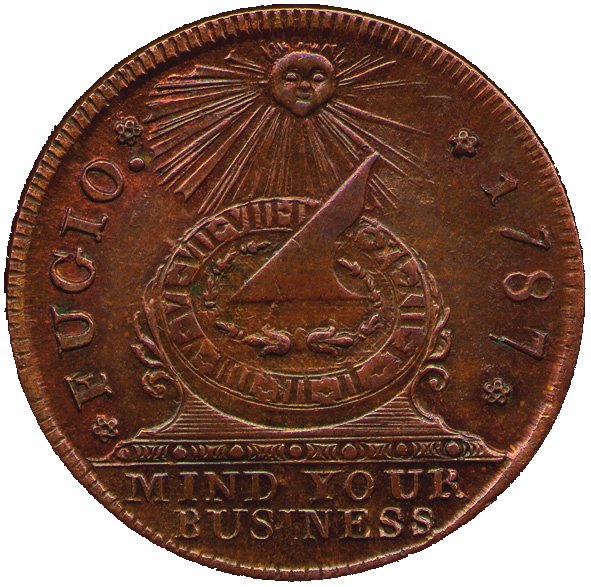
This is the Fugio cent. It was commissioned by the Continental Congress before the ratification of the Constitution, and designed by Benjamin Franklin. Fugio means “I fly,” referring to the sundial, which represents time. Taken with the inscription below, it is a reminder that we can all leave the world a better place by doing our best in whatever line of work we choose to pursue.

For many of us, writing is more than just a hobby, or a job, or even a career. It is a vocation. It is our calling. And yet, we live in a commercial world, where the price of a thing is often conflated with its value. How, then, can we best fulfill our calling as writers? By ignoring the demands of the market? By fancying that our books are simply unappreciated by those of inferior tastes? Or by losing sight of our calling for that lucre that will perish with us?

Benjamin Franklin’s message is that we can best fulfill our calling by pursuing excellence in every aspect of it. That includes the commercial aspect as well as the artistic, the practical as well as the spiritual. When we truly learn how to excel, we will see that there is no contradiction between the two sides.

Writing is our calling. Publishing is our business. Our books are investments, many of which may very well outlive us. By understanding this, I firmly believe that we can mind our business as well as Franklin admonished us, and truly fulfill our calling.

Some new writing resolutions

So I’ve been following Dean Wesley Smith’s blog pretty closely over the last few days, as he posts about his creative process for a novel he’s ghost writing.  It’s more than a little mind-boggling–he started literally with nothing, not even a working title, and yet he’s averaging between 5k-7k per day.  If he hasn’t already, he’ll probably finish it tonight.

I’m learning a lot from these posts, especially about the importance of switching off your internal critic and trusting your creative instincts.  Over the last couple of days, I’ve tried to do just that with the sword & planet novel I mentioned last week, and I can say that it really works!  By doing all I can to put words on the page and ignoring everything else, I’m averaging about a thousand words per day and the story is unfolding wonderfully.  It’s like a trust fall with my muse, where instead of failing miserably I’ve found she’s there to catch me.

All of this has made me think that I need to reorder my writing routine and make some resolutions in order to keep this momentum going.  If I can overcome some of my bad habits and replace them with good ones, I can be a lot more productive, and writing will be that much more fun.

So here’s what I’m going to do this week:

  • Start every day with writing.  Even if it’s only fifteen or twenty minutes, as soon as I get out of bed I’m going to sit down at the writing computer and pound out a few hundred words.
  • Write in lots of little chunks, rather than one or two large chunks.  In other words, don’t put off writing until the chores are done–put off the chores!
  • Shoot for 1000 words per hour or better.  If the pace starts to flag, switch projects if necessary, even if the other project is fanfic.
  • Go for at least one walk at some point in the day.  Walks do more to re-energize my creative energy than just about anything else.

Basically, I’m going to treat my work-in-progress as something fun, rather than work or a chore.  I’ll use a stopwatch to keep track of how many hours I write each day, but I won’t give myself a quota.

My writing process isn’t the same as Dean’s, and I’m not going to try to imitate his process, but I am going to pick out what I like about it and see what works.  Also, I’m going to focus a lot more on quantity than quality, with the understanding that treating everything as practice will likely improve both.

As for the A to Z blogging challenge, I’ve got two posts left, Y and Z.  I haven’t written them yet, but I’ve got a great idea for both of them.  Since writing takes precedence, though, I may not get to them until later in the day.  It also depends on whether the temp agency calls me up in the morning with a job–they’ve been doing that a lot recently.  Last week I was at a factory making toothbrushes for dogs (true story).  This week, I could be doing anything–or nothing, as the case may be.  I’d like a couple of days of nothing, just for a good chance to write.

Worldcon 2011: Thursday

Wow, the last couple days have been packed with awesome con-stuff, but I’ve got a short break so I thought I’d blog about it.

Thursday was great, attended a few panels but mostly just wandered around meeting people.  I’m a little surprised with how many people read this blog.  Got Brandon to sign my Kindle, and he was really supportive about my decision to epublish.  I seem to be one of the only Utah writers going full-steam with indie publishing, but a handful of others are considering it, though for now they’re in the minority (which surprises me).

Anyhow, Thursday had a couple of really notable panels.  The first was on faith and science fiction, and had both Eric James Stone and Moshe Feder on it, among others.  Excellent discussion, though a couple of the commenters tried to derail it.

I found it surprising that the panelists didn’t have a good answer to my question: how do you reconcile far future sf with millenialist religions?  That’s exactly what I’m trying to do with my Gaia Nova universe–create a far future epic that isn’t incompatible with the major western religions (Islam, Christianity, Judaism, etc).  From the after-panel discussion, I got a strong recommendation to read C.S. Lewis’s space trilogy, so I’ll definitely be checking that out soon.

The other notable Thursday panel I attended was on ebook art, and featured John Picacio and Lou Anders, among others.  John feels pretty strongly that indie writers are seriously devaluing cover illustration, and within the first ten minutes someone in the audience literally told him to f___ off!  Wow, talk about tension–but even though it almost fell apart, the panel turned out to be very enlightening.

Let me just take a moment to say that I’m very impressed with what Lou Anders is doing over at Pyr.  While the rest of the publishing world seems to have their heads in the sand when it comes to the ebook revolution, Lou is one of the few who sees it more as an opportunity than a threat.  I’m not currently looking for a publisher, mostly because I’m waiting to see how things shake out, but I would be very surprised if Pyr is one of the publishers that goes under.

The parties in the evening were pretty good–as always, the Tor party was literally packed.  Brandon saw a group of us clustering together, so he broke us up and sent us off to talk with editors and agents.  He tried to point me out to an agent, but…you know, I’m not really looking for one right now.  Brandon keeps telling me not to believe DWS when it comes to agents, and while I’m certainly not fundamentally opposed to them, I feel that I can better build my career by going in other directions.  At some point in the future, maybe, but for now…not so much.

Speaking of Dean, I spent the whole evening hunting for him, then gave up around midnight only to find out the next day that he showed up at the SFWA suite fifteen minutes after I left (nooo!). And now that it’s 9pm in Reno and the parties are just getting started, I think I’ll cut this blog post here and recap Friday sometime later.

See you around!

“…and I am doing my best to leave traditional publishing behind.” –Tracy Hickman

Those were Tracy Hickman’s exact words today at CONduit.

He said it as part of his introductory remarks at his first panel, “To Cliche Or Not To Cliche,” and reiterated it on all of the panels he was on for the rest of the day.

For those of you who don’t know, Tracy Hickman has built a career spanning over thirty years, and has 56 novels still in print.  He is an incredibly successful and prolific author.  What’s more, he is quite possibly the most humble and sincere person at the convention: extremely approachable, and very accommodating towards his fans.  He is an amazing man, and I hope to have a career like his someday.

He’s not the only big name author talking about epublishing either.  I heard this secondhand so it’s not admissible in court, but L.E. Modesitt apparently had a lot to say about Kristine Katherin Rusch‘s recent blog posts concerning the disturbing changes in traditional publishing.  Rusch is one of the voices at the epicenter of the indie publishing movement, along with her husband Dean Wesley Smith.

The initial shock wave of the ebook revolution has hit Utah, and people all over CONduit are talking about it.  In fact, I think I spent more time today in the hall talking about ebooks than I did attending panels.

You have no idea how invigorated this makes me feel.  I’ve been going around signing up bloggers for my Genesis Earth blog tour, and the sense of ownership I feel for my career is thrilling.  On my way back to Provo, I made a connection between two ideas for my current work-in-progress, and I literally screamed for two minutes straight.  I don’t know if I’ve ever been more excited to be a writer.

In his last panel of the day, Tracy Hickman closed with the following bold statement: if you master the art of story structure, have the dedication to work hard, and are willing to do what it takes to learn your craft, you will not only write a successful book, you will build a successful career in this world of new media.

That, my friends, is exactly where I want to be.