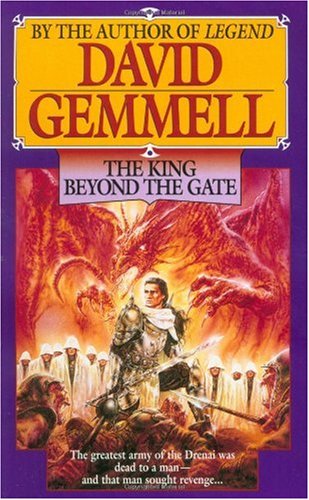
The King Beyond the Gate by David Gemmell

Tenaka Khan was a child of two nations and an outsider to both.  Half Nadir, half Drenai, the only home he ever knew was in the ranks of the Dragon, the elite fighting forces of the Drenai.  But now, a mad dictator rules the land, and the Dragon has been destroyed.

With all his friends dead at the hand of the evil Drenai emperor, Tenaka has only one desire: to steal into the palace and assassinate him.  Along the way, however, he makes a number of friends, all of whom seek the same thing, but all for different reasons.  As they join forces with the Skoda rebels, Tenaka realizes that he not only has something to die for–he has something to live for.

But in order to defeat the mad emperor, the rebels must fight the Joinings–terrible creatures made from man and beast, who slaughtered the Dragon years before.  Only the Nadir can save them–but the Nadir want nothing more than to ravage the Drenai.

If  you’ve read my review of David Gemmell’s Legend, you know why I love his books.  This one was no less incredible.  Parts of it were just as poignant as anything in Legend, and the ending, while bittersweet, was no less satisfying.

It’s really fascinating to me, because Gemmell’s books are not particularly flowery or well written.  His descriptions are sparse, his prose is unassuming, his characters, while distinguished from each other, sound more or less the same, and his viewpoint is often inconsistent.  But in terms of raw storytelling, his books are unequaled by anything else I’ve ever read.

He makes me fall in love with his characters: I cheer for them when they rise to the heroic deeds that circumstances demand of them, I cry when they fall short of what they could have been, and I weep when they give their lives in the service of something greater than themselves, which is almost invariably the case.

My favorite part of any David Gemmell book has got to be the order of warrior priests known as the Thirty.  They don’t show up in every book, but they show up in many of them, and they always share the same characteristics.  The warrior priests are dedicated to the Source (Gemmell’s equivalent of God in his Drenai universe), and have the supernatural abilities to speak telepathically, put thoughts into others’ minds, shield their comrades from the magic of the Chaos brethren, and leave their bodies to fly across the world and do battle in other dimensions beyond the grave.

The way the order is run is absolutely fascinating.  One person is the mouth, the other the ears, the other the heart, etc.  The most unlikely characters always fill the particular roles–but always for good reason.  They fight to defend the innocent and pure, but more than that, they always have some great destiny to perform–a destiny that invariably pits them against the forces of Chaos in some great, decisive battle.  In that battle, all of them invariably die, except for the weakest among them, who goes out to found the next order of the Thirty.

I don’t know about you, but this kind of stuff, just makes me want to jump up and down.  This is fantasy at its best–good versus evil, warriors facing death, and the most unlikely heroes rising to the level of greatness that war and honor demand of them.  Throw in a little magic, a brotherhood of evil sorcerers bent on crushing all that is good in the world, and terrible monsters the likes of which exist only in nightmares, and I am so there, man–I am so there.

In short, this book was nothing less than awesome.  If you love any book by David Gemmell, I think you’ll enjoy this one.  It’s got everything you could possibly expect from heroic fantasy, and more.
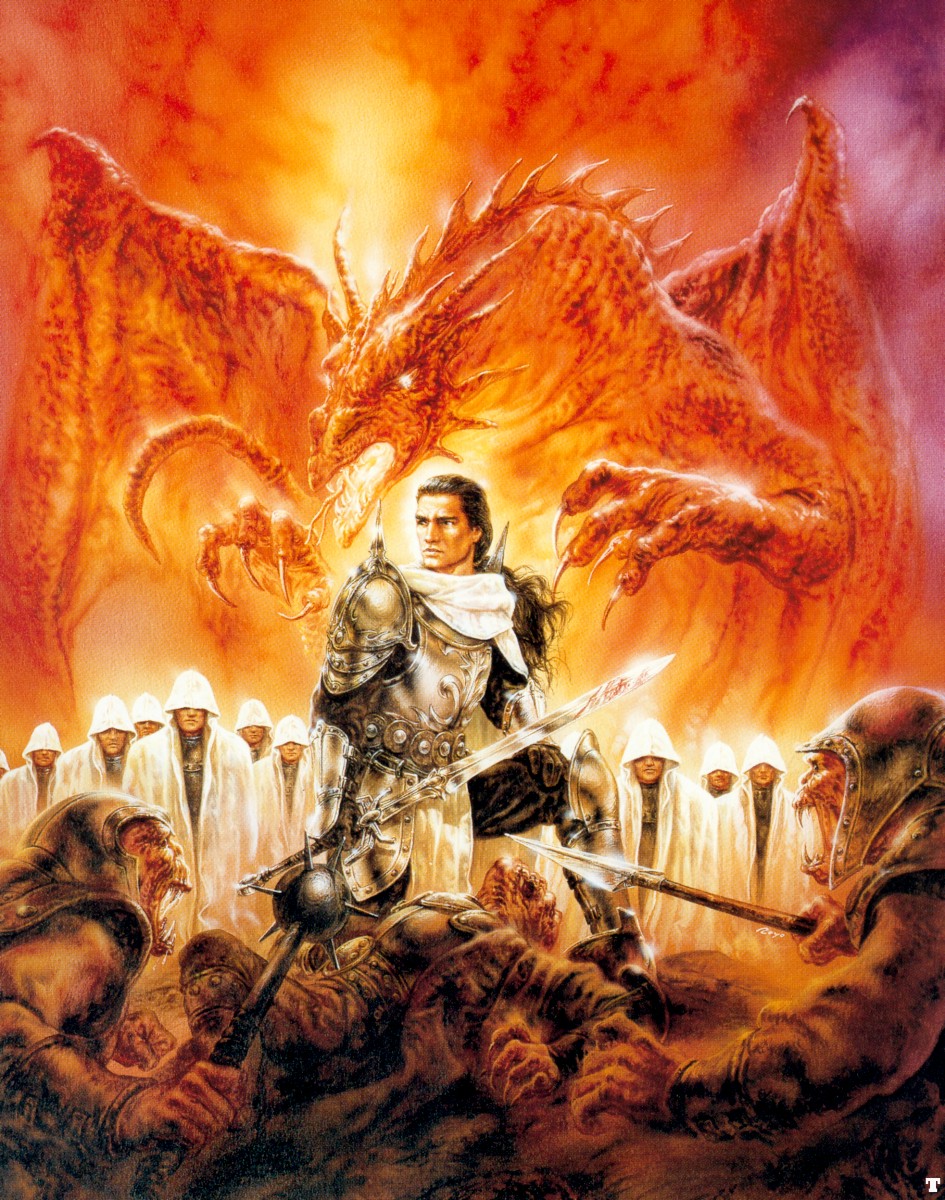
I’m so happy…

…because I checked out five of the Drenai books by David Gemmell from the library this week, and I’m going to read them all by the end of the month.  I’m already in the middle of The King Beyond the Gate, and it is awesome.

Holy crap, I love the Thirty!  If/when I ever write fantasy, I am definitely including an order of elite warrior priests like those guys!  And the way the Nadir sometimes end up fighting for the good guys, with the interesting twists in their culture that make them more than just the evil rampaging hordes–man, I love that.

I’m also happy because the Provo Library had a used book sale today, and I picked up a ton of new books!  Here’s the list:

The Wayfarer Redemption by Sara Douglass,
Starman by Sara Douglass,
The Princess Bride by William Goldman,
The Eye of the World by Robert Jordan,
A song for Arbonne by Guy Gavriel Kay,
Abhorsen by Garth Nix,
The Man with the Iron Heart by Harry Turtledove,
Terraforming Earth by Jack Williamson,
A Bridge of Years by Robert Charles Wilson,
Bios by Robert Charles Wilson,
Serpent Catch by Dave Wolverton (his second novel!),
Looking for the Mahdi by N. Lee Wood,
Warhorse by Timothy Zahn, and
Changeling by Roger Zelazny.

Oh, and a gift book for my mom.  All for $7. 🙂

So after I get off my Gemmell binge, which book(s) should I read next?

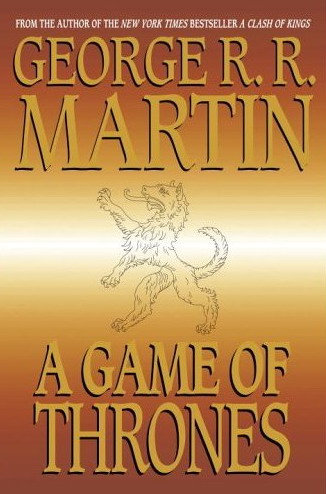
A Game of Thrones by George R. R. Martin

Almost twenty years have passed since the fall of the Targaryen dynasty–twenty years since the last of the dragons was seen in the Land of the Seven Kingdoms.  Now, the libertine Robert Baratheon sits on the Iron Throne, blind to the conspiracies and secret combinations that surround him.

In this dangerous time, Ser Jon Arryn, the King’s Hand, dies of mysterious causes.  Most of the realm accepts the official story that the death was natural, but when Arryn’s wife Lysa sends a letter to her sister, Catelyn and her husband Ser Eddard Stark immediately suspect that the death was orchestrated by the Lannisters.  Only one thing remains: to travel to King’s Landing and uncover the proof.  Soon, King Robert calls on Ser Eddard to become his new Hand, giving them the perfect opportunity to do this.

Little does Ser Eddard know, the intrigue goes much deeper than any of them realize.  For the Lannisters are gathering an army, and Queen Cersei and her brother, Ser Jaime, harbor a secret that would tear the realm apart.  Meanwhile, the last of the Targaryens bears a child prophesied to rule the world, while far to the North, an ancient evil bides its time, waiting to sweep the seven kingdoms with horror the likes of which has not been seen in a thousand years.

Winter is coming–and the people of the Seven Kingdoms are ill prepared to face it.

Everyone seems to be talking about George R. R. Martin’s Song of Ice and Fire series these days–next to The Wheel of Time, it’s probably the biggest epic fantasy line of the last ten or fifteen years.  Martin is well known for killing off his characters and writing in shades of gray, so I thought it would be good to give this series a try.

As soon as I picked up the book, I was hooked.  Martin knows how to craft a beautiful, engrossing fantasy world.  In order to leave no doubt on that point, observe:

Yeah, that pretty much sums up what Martin did with his Land of the Seven Kingdoms. It’s an awesome fantasy world, and I found myself lost in it from the first page.

I must admit, however, after hearing so much about the Song of Ice and Fire series, I was surprised at how few characters died in this book. That’s not to say everyone survived–in fact, Martin killed my favorite character, which made me feel HORRIBLE–but I was expecting there to be more. However, this is the first book in the series, so I assume that the really crazy stuff happens later.

While overall I loved A Game of Thrones, I admit I did have a few misgivings about the book. Martin really does write in shades of gray, and while that makes the story unpredictable and surprising, it also makes things very dark and austere. Martin seems to have no interest in redeeming his characters, and when any of them try to be noble, he cuts them down at every turn.

Personally, I don’t care for that. Flawed characters may be more relateable, but seriously flawed characters (or characters with no interest in overcoming their flaws) turn me off. In this way, Martin is practically the antithesis of David Gemmell; whereas Gemmell makes you love his characters despite their flaws, Martin keeps you reading in spite of the fact that you hate all his characters.

How does he do it? By creating a beautiful, wondrous world. By crafting a masterful story full of intricate twists and turns. By making you hate some of the characters so #%$^! much that you have to stick around and see how they die. It’s all entertaining and extremely engrossing, but at the end of it all, I didn’t come away with any real love for Martin’s characters–except perhaps for a couple of Eddard’s kids, who are still young enough to be somewhat innocent.

I suppose it’s all a part of this new non-conciliatory movement in fantasy. Don’t get me wrong; A Game of Thrones is an EXCELLENT book, but it’s very…non-conciliatory. If that’s your thing, more power to you, but I personally prefer stories about redemption, where romance still lives and even the most unlikely character can be a True Hero, if only for a few fleeting, glorious moments.

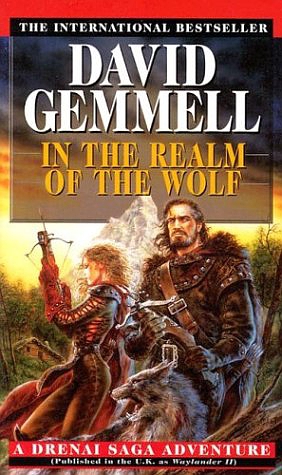
In the Realm of the Wolf by David Gemmell

Never leave home without a weapon, Dakyras taught his adopted daughter Miriel.  Though they live a quiet life alone in the mountains, death is never far from the man known as Waylander.

When the Assassin’s Guild puts out a high price on Waylander’s head, both Waylander and Miriel find themselves on the run.  With them come two ill-fated gladiators from Drenai: the loyal and steady Angel, and the arrogant and reckless Senta.  Both men vie for Miriel’s hand–and both are honor bound to kill each other.

But in the face of the evil hunting Waylander, Angel and Senta must lay aside their vendetta and take up arms against the Gothir army hunting the Wolf clan, tribe of the prophesied chieftain that will one day unite the Nadir.  For deep in the realm of the Wolf lies a castle more ancient than the three empires–a castle whose dark secrets threaten to upset the global order forever.

This book was awesome.  I loved every moment of it.  With each page, the story just got better and better, right up to the climactic finish.  If you’re looking for a rousing adventure, you can’t go wrong with David Gemmell.

One of the things I loved the most about this story was the love triangle between Miriel, Angel, and Senta.  At first, I thought I knew who was good, who was bad, and which one she’d end up with, but then things changed and I wasn’t too sure.  Even though I hated Senta at first, I spent most of the book vacillating with my feelings on him.  And the way things ended–I wasn’t disappointed.  Not one bit.

Even though the overall story conflict was much, much larger than life, Gemmell’s characters always felt very real.  Perhaps it has to do with the way their true nature always seems to come out in battle–and Gemmell gives them plenty of opportunity to show their true nature.

It also has to do with the things they’re fighting for, though–the stakes are always clear for each character, and when they’re confused what they’re fighting for, that’s made clear too.  Though the conflict itself is larger than life, the stakes for each individual character never are.

The ending really took the cake for me, though.  When I finished the book, I couldn’t help but smile.  Gemmell is a master at writing endings that make you want to stand up and cheer.

As awesome as this book was, though, the last book in the trilogy, Hero in the Shadows, is so much better.  The last scene of that book stands out so much more to me, now that I know everything about Waylander’s past.  So.  Freaking.  Epic.

But do yourself a favor: don’t read the last book first, like I did.  Start with Waylander, which is a good book–not great, but good–and read through the trilogy.  If you love stories about true heroes and epic adventures, you won’t be disappointed.

Thoughts after finishing In the Realm of the Wolf

Wow.  I just finished In the Realm of the Wolf by David Gemmell a couple hours ago, and it was AMAZING.  So amazing, in fact, that I want to write a post examining my reaction to it before I write the review.

You know that ecstatic, otherworldly feeling you get when you finish an amazingly good book?  Where you feel like you just came home from a long, epic journey and you can’t stop thinking about it?  Where your mind is racing with all sorts of new and beautiful ideas, as if you’ve opened your eyes for the first time?

That’s how I felt after finishing this book.

As a writer, I want more than anything for my readers to have the same experience when reading my books.  I don’t expect everyone will, but I want to be able to connect with a good chunk of my readers this way.  David Gemmell does this for me, and my main question is therefore: how does he do it?

Looking back, I’ve got to say that the book started good and steadily got better, right up until the awesome finish.  The first two chapters were good, but around the third chapter, my expectations started to be exceeded.  It wasn’t until the last half of the book that I realized just how much I was connecting with the characters, and when the climaxes hit, I found myself rooting for them more than I usually do.

So I guess escalation had something to do with it.  Gemmell starts with a pretty simple plot: Waylander has to evade a bunch of guild assassins out to kill him, but he doesn’t want to because his wife just died and he’s depressed.  Then more and more characters get involved, and the stakes steadily grew until the fate of global empires hung in the balance.

Yet throughout it all, the focus was always on the personal conflicts and the impact of the events on the individual characters.  The vast armies sweeping the land were more of a background setting element than anything else; the real story lay in the choices the characters made and why they made them. And when the characters started confronting their demons, I rooted for them as if they were my close, personal friends–or more than friends.

Yet Waylander himself is very much a larger-than-life character.  He’s a better hunter and tracker than the Sathuli tribesmen, a better swordsman than most of his opponents, by far the best crossbowman in the Drenai saga, and a cold, efficient killer with a body-count of hundreds.  Not only is he rich enough to support the bankrupt king of Drenai singlehandedly with his vast financial assets, but in each of the three books in his trilogy, he plays the most pivotal role of any character in the rise and fall of nations and empires.

And yet…I can still connect with him.  Why is that?

Maybe it’s because he’s far from perfect.  He vanquishes hundreds of soldiers, assassins, monsters, and demons, but he doesn’t escape uninjured.  In Realm of the Wolf, his less-than-perfect swordsmanship is a key element of the plot.

It’s the internal conflict, however, that really makes me connect with him.  Don’t get me wrong–I’m not a cold, unfeeling killer, nor have I lost my whole family to roving bandits–but I can understand his struggle to find happiness in the face of so much evil, both within him and without.

Or maybe it’s not so much that I understand him as that I’m fascinated by him, and I don’t know why.  It certainly helps that he has a soft side–that he’s not a complete monster.  In all the books, his quest is always to save lives, not just to take them, and every once and a while he does something to keep my sympathy.  The way he spared the Sathuli scout in Realm of the Wolf, for example.

Overall, though, I think it’s the characters and their conflicts that made this book come alive.  Waylander is basically an adventure tale with some interesting characters; In the Realm of the Wolf is also an adventure tale, but the personal stakes are much higher, and the focus is more on the characters than on the rise and fall of empires.

Anyways.  I still feel like there’s something elusive that I’m not quite getting, but those are my thoughts after finishing this book.  If you didn’t find it helpful, I hope you at least found it interesting.  And if you have the chance, read the trilogy!  It’s goood!

Travel writing + Gemmell + Sanderson signing = awesome

Today was an awesome day, which is weird considering everything that happened.  Woke up at 4:45 am to catch an early morning flight back to Utah, took public transport back to Provo, and ran around on errands until attending the midnight Way of Kings signing at the BYU Bookstore.
Yet it was awesome.  Why?

First, I got a lot of writing done on the plane.  Normally I can’t write much while traveling, yet today it was really flowing.  Maybe it’s because I love revising, maybe it’s because the chapter I was working on was already pretty decent to begin with.  Whatever the reason, writing was fun and productive.

Second, I started an AWESOME book by David Gemmell.  Holy crap, I love David Gemmell!  It is my life’s ambition to acquire a signed first edition hardback copy of his debut novel, Legend.  I just started In the Realm of the Wolf, and it’s even better than the first Waylander book.  It’s got all the standard awesomeness you’d expect from a Gemmell book, plus some very interesting plot turns at the beginning that widened the scope beyond what I was expecting.  Very awesome.

As a side note, I think these Gemmell books are influencing my writing style for the rewrite of Mercenary Savior.  I’m not sure if that’s a good thing, but I tend to think it is.  Gemmell’s style is very terse, very blunt, and cuts right to the action without much description.  I’ll probably have to watch that I don’t skimp out on descriptions too much, but the other elements seem to be helping.  I hope.

Third, I had lunch with my grandparents.  That was great.  I don’t see them all that often, even though they live up in Salt Lake City–maybe once every other month or so.  I need to visit them more.  Anyway, it was good to see them.

Fourth, even though it took about two and half hours to take the public transit to Provo, those two and a half hours were quite productive.  Read more Gemmell and made some satisfying edits to a pivotal scene.  I also discovered that I only need to charge my netbook for one hour to recover 50% of its battery capacity.  Sweetness.

Fifth, while running errands after I got back, I talked with my sister over the phone and solidified our vacation plans.  Looks like we’re going on a road trip!  Yay!  Also, while chatting with my new roommate, whom I barely know, I found out that he’s written a fantasy novel.  How awesome is that?

Sixth, the Way of Kings signing at the BYU Bookstore.  I’m currently too poor to buy it in hardcover (still need to find a steady job), but it was still a ton of fun to hang out and see friends.  Brandon did a Q&A before the signing, and there was this stunningly attractive and generally awesome fangirl…whom I chatted with…briefly…didn’t get her name or contact info…hope I see her again.

Besides heckling Brandon, which is always good fun, I chatted with another local writer going to World Fantasy 2010, and found out he’s got room in his hotel room if I want to split it. That’s great–I need to figure out my travel and accommodation plans for that convention, since it’s coming up quick.

So yeah, it was an all around awesome day. Now I need to take a shower and crash before the lack of sleep catches up to mmzzzzZZzzzZZZzz…

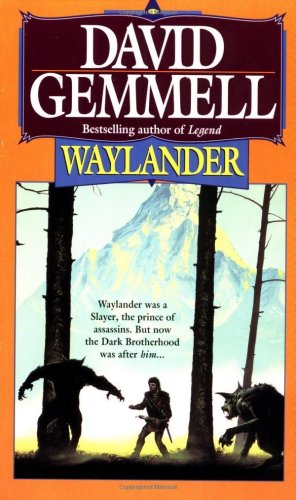
Waylander by David Gemmell

The Drenai lands have been overrun, and the Vagrian conquerors, led by Kaem and the Dark Brotherhood, are laying waste to all that lies before them.  Only the stronghold at Purdol withstands them, but unless the Drenai can rally a counterattack, all will be lost.

In these trying times, a strange old man visits the assassin Waylander and urges him to go to the sacred Nadir mountain of Raboas and retrieve the legendary Armor of Bronze.  With this armor, the Drenai commander Egel can rally the army that will save the kingdom.

But Waylander is a hunted man–a man of dark secrets and many enemies.  Kaem wants him dead for killing his son.  The Nadir want him dead for violating their lands.  And the Drenai want him dead for assassinating their king.

I love David Gemmell.  When you pick up one of his novels, you know exactly what you’re going to get: gritty, complex characters, bloody battles, ruthless villains, and difficult moral decisions that transform even the most depraved individuals into true heroes, if only for a few moments before they die.  Waylander is no exception.

Perhaps the most interesting part of the book is the story behind the founding of the Thirty.  When the young Source priest named Dardalion forsakes the pacifism in order to save the lives of his fellow countrymen, twenty nine fellow priests join him to form the band of legendary warrior monks.  This religious order goes on to play a pivotal role in some of Gemmell’s best works.

Waylander himself is also an interesting, memorable character.  During the events of Waylander, he’s basically hit rock bottom, but as he learns again what it means to love and fight for what he loves, he climbs out of that dark place.

I really enjoyed this book.  My only complaint is that the ending felt a little rushed.  All the plots and subplots get tied up, but some of them so abruptly that there’s little room to savor the emotional impact.  Still, the novel was quite satisfying overall.  I look forward to reading the next book in the Waylander saga.

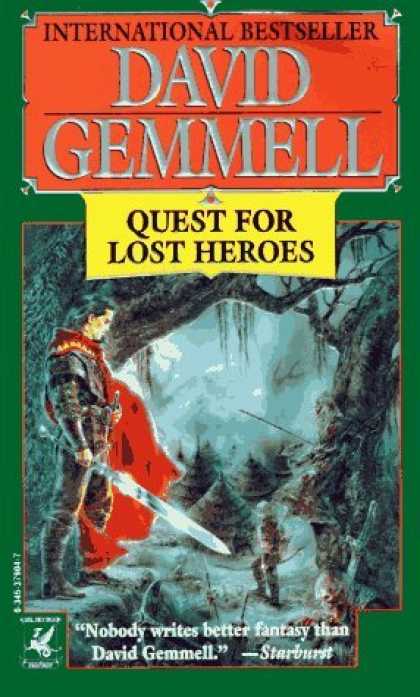
Quest for Lost Heroes by David Gemmell

It has been forever since I read this book.  Still, I really should review it.  Here goes.

At Bel-Azar, four friends held out against hopeless odds, only to be spared by the Nadir Khan.  Known by the Nadir as the “ghosts yet to be,” they enjoyed the fame of heroes for a time, but now live in obscurity in their own kingdom.

When a band of slavers raze a village and carry off the women, however, a young, reckless boy named Kiall calls upon the forgotten heroes to help him free his unrequited love.  And so the “ghosts yet to be” join together for one last quest, only to find that the stakes are much higher than any of them could have forseen…

David Gemmell writes awesome fantasy!  Some of the best I have ever read.  This one, while not quite as deep and meaningful as others like Legend, had its moments.  Let me just say, Gemmell knows how to kill off his characters.

The story started off very well, with some interesting introductions.  It felt a bit like a cowboy movie, where the heroes are all outcasts, unable to find their place in mainstream society.  I immediately took a liking to the main character, Chareos–Gemmell knows how to write heroic characters, even dark heroic characters.

The action began immediately, with blood and battle in every chapter.  As usual, Gemmell did an excellent job getting to the meaning (or lack thereof) of it all, but at times, it felt a little bit superficial.  Not very much, but sometimes, it seemed that he threw the action in just to keep the story interesting.  It didn’t pack quite the same punch as Legend, which was a much superior book.

It took me a few chapters to feel that the story was progressing–Gemmell isn’t always strong on plot–but once I did, it really took off.  I finished the last hundred or so pages at a sprint, and the ending, like all of Gemmell’s endings, did not disappoint.

Overall, I’d say this book is more fan action-adventure story than anything else–light reading, compared to Gemmell’s other work.  Still, it was definitely entertaining, and much deeper and well-written than your typical thriller.  If you like heroic adventure stories with lots of action, you’ll love this book.

Thoughts after finishing A Canticle for Leibowitz

Wow.  Wow.

This book is INCREDIBLE. I’ll review it later, but first I want to put down some of my initial thoughts.

With any great book, you come to a point where you realize, consciously or not, that it just can’t get any better.  The story, the characters, the world, the ideas and stakes, the overarching conflict–it combines so perfectly that you don’t think you could possibly ask for more.

And then, if it’s a true masterpiece, it crosses that threshold and gets even better.

A Canticle for Leibowitz did that.  Somewhere in the second half, after I was completely caught up in the story, it exceeded my expectations and went to a whole new level.  I remember the exact passage where it happened:

They shook hands gingerly, but Dom Paulo knew that it was no token of any truce but only of mutual respect between foes. Perhaps it would never be more.

But why must it all be acted again?

The answer was near at hand; there was still the serpent whispering: For God doth know that in what day soever you shall eat thereof, your eyes shall be opened: and you shall be as Gods. The old father of lies was clever at telling half-truths: How shall you “know” good and evil, until you shall have sampled a little? Taste and be as Gods. But neither infinite power nor infinite wisdom could bestow godhood upon men. For that there would have to be infinite love as well.

I love books like this: books that not only have a good, entertaining story, but that have a deeper, more thoughtful dimension. Stories that make me think and reflect on the real world, that open my eyes and help me to see things in a new way. It’s what I read for.

Yes, the story was somewhat didactic and preachy…but it worked. Even though it was trying to make an explicit point, so much of the symbolism and metaphor was open ended that the readers could draw their own conclusions–and see a number of things that perhaps went beyond the point the author was trying to make.

I guess there’s two ways to write didactic fiction: the open approach, and the closed approach. With the open approach, the author uses a lot of symbolism and allegory, but in a way that explores principles and themes rather than building up to a predetermined point. Good examples of this (in my opinion) include The Chronicles of Narnia and The Neverending Story. The closed approach involves consciously working everything around a conscious agenda: examples of this include His Dark Materials and Lord of the Flies.

I don’t care much for the closed approach–I can’t stand it even when I agree with the underlying ideology (as in Orson Scott Card’s Empire).  Those kinds of books don’t stimulate genuine thought or reflection.  The open kind, though–that I can appreciate.  Even though I disagree with many of Heinlein’s views, I can appreciate his books even when they’re preachy because they make me think.

Anyways, those were some of my thoughts after finishing A Canticle for Leibowitz. This book is epic–truly epic.  It wowed me just as much as David Gemmell’s Legend. This is a book I’m going to remember for a long, long time.

If you care at all about the role of faith in forming our society, or the complex interplay between religion and politics, or the ultimate end of humanity–you have got to read this book!

Thoughts after finishing Legend by David Gemmell

I just stayed up a bit late, finishing Legend by David Gemmell.  Wow.

According to his  wikipedia entry, Mr. Gemmell wrote Legend in two weeks while waiting to hear if his cancer diagnosis was terminal.  After reading this book, I can definitely see how that influenced the writing.

This book is incredible, one of the most authentic, thought-provoking things I’ve read.  It is…just incredible.  I’ll articulate my thoughts better when I write the review, but let me just say that reading this book made me a better man.

I want to quote the passage that impacted me the greatest, because it has to do with some of my more existential thoughts about being an aspiring writer–no, being a writer and aspiring to be an author.

“All things that live must die,” said Vintar. “Man alone, it seems, lives all his life in the knowledge of death.  And yet there is more to life than merely waiting for death.  For life to have meaning, there must be a purpose.  A man must pass something on–otherwise he is useless.

“For most men that purpose revolves around marriage and children who will carry on his seed.  For others it is an ideal–a dream, if you like.  Each of us here believes in the concept of honor: that it is man’s duty to do that which is right and just, that might alone is not enough.  We have all transgressed at some time.  We have stolen, lied, cheated–even killed–for our own ends.  But ultimately we return to our beliefs.  We do not allow the Nadir to pass unchallenged because we cannot.  We judge ourselves more harshly than others can judge us.  We know that death is preferable to betrayal of that which we hold dear.

I don’t want to write books just to entertain.  I don’t want to fill pages with words just so I can get paid and take care of my temporal needs.  Both of those are important, of course, but I don’t want to write “good reads” that people put down and completely forget about after a few months.

At the same time, I don’t want to write just to express myself either.  I don’t think I deserve any special treatment for being a writer, and I don’t suffer under the delusion that I’m somehow gracing the world with my genius (at least, I hope I don’t).  The world owes me nothing, and I’m certainly not the most qualified person to  be out doing this kind of thing, making the world a better place by telling stories.

What I do want to do, however, is write books like Legend, or Mistborn, or The Neverending Story, or Ender’s Game, or Spin, or any number of other books.  Books that you read and remember, because they changed or inspired or impacted you in some profound way.  Books where you read the last hundred pages in a breathless sprint, because you connect with the story in a deep and personally moving way.  Books that help people to understand the world better, to appreciate its beauty, to see the people in your life in a new light, and connect with them in new ways.

I can tell you exactly when I crossed the threshold from childhood to adolescence, down almost to the very day.  I crossed that threshold by reading a book: Absolutely Normal Chaos by Sharon Creech.  For what I was going through at that pivotal time in my life, that book had a profound, formative impact.  It helped me to see my family members in a new light, to understand a little bit better the changes I was experiencing in my own life, and to get through an emotional period that was particularly rocky.  When I read that book, I changed as a person.

That’s the kind of stuff I want to do as a writer: pass something on.  Something meaningful.  Something that will make this world a better place by connecting with someone, anyone, on a deeply personal and intimate level.  Something that will help peope to stand tall and live their lives more fully.

I don’t know if I’m getting this across effectively, but those are my thoughts at this time.  Legend is a damn good book.  It’s in good company, along with all the other books that have just made me go “wow.” Someday, I hope something I write will be up there on the same level for someone else.