Speaking Out Again

Hello there.

It’s been a very long time since I posted on this blog. I wonder if anyone is still following it. About a year ago, I pivoted from the blog to my newsletter, and while that’s going well, this blog has been mostly neglected.

And it would have continued that way, if not for recent events. I’m talking, of course, about the peaceful protests race riots Marxist insurrection domestic color revolution whatever the hell is happening in the United States right now. But the thing that really pushed me to action was Kris Rusch’s latest business post: Speaking Out.

Until that post, Kris was one of the people I admired most in the publishing industry. I’ve followed her business blog since 2010, and she was one of the most influential people in convincing me to take the plunge and self-publish. It’s been one of the best decisions of my life, not just from a career perspective, but from a personal perspective as well.

In her latest post, however, I feel that Kris went over the cliff with the rest of our fractured country. Here are the parts that got to me:

The letter [Jeff Bezos] posted on his Instagram page from some racist named “Dave” (last name redacted) told Bezos he would lose customers if he continued supporting Black Lives Matter. The letter is breathtaking in its racism…

…the people who bother me the most are the folks who, for economic or political reasons, can ignore the racism and hatred that spews daily from the White House…

I draw the line at hatred, racism, and bigotry in all its forms. I can’t respect a bigot. I don’t want to be near a racist…

If this post makes you feel the urge to write me a screed or tell me that I should tolerate the bigots for the sake of unity, please do me a favor and just leave.

What is a “racist”? What is a “bigot”? To the left-wing ideologues who control the cultural narrative right now, it’s anyone who dares to oppose their radical agenda. The mayor of Minneapolis is “racist” because he won’t abolish the police, in the midst of the most violent and destructive riots that city has ever seen. White people who refuse to literally kneel before people of color and denounce their white privilege in communist-style struggle sessions are now considered “bigots.” Anyone who dares to utter any sort of criticism or counter-argument to the narrative of Black Lives Matter is fired, canceled, humiliated, doxxed, and destroyed.

Does Kris not see this? When you are so ideologically possessed that a “bigot” is anyone who refuses to (literally) kowtow to your ideology, a tolerant and diverse society becomes impossible? When speech is violence and violence is speech, violence will be used to silence speech. Those who are kind to the cruel inevitably become cruel to the kind.

I tried to post a comment on her blog, explaining that some of these “bigots” who have unfollowed her or withdrawn their Patreon support aren’t doing it because they want to “silence” her, but because they feel she doesn’t recognize that they have legitimate reasons for disagreeing with her, and aren’t the bigots she thinks they are. Yes, Kris, it’s important to speak out, but it’s also important to listen.

What happened next was all too predictable. On a blog post about the importance of speaking up, Kris silenced me. The only comments that she has allowed are the ones that fawn over her and tell her she’s right. Typical.

I can endure a lot of bullshit, but two things I absolutely cannot abide: gaslighting and hypocrisy. So ultimately, it was this episode with Kris, a person I used to admire and respect, that spurred me into action.

This blog is going to become a lot more active in the coming weeks and months. The newsletter will still be my main vehicle for reaching out to readers and cultivating fans, but the blog will be a place to share my more controversial thoughts and opinions. That said, I intend to be very deliberate and conscientious about what I post here, and avoid shitposting, spewing outrage, or going off on political rants.

My working assumption is that the chaos engulfing our country will continue to escalate through the 20’s, and that things will get much, much worse before they get better. We may see an American holocaust. We may see American gulags. We are already experiencing the digital ghettoization of libertarian and conservative voices—or, more accurately, voices that refuse to conform to the cultural and ideological narrative of the progressive left.

That said, I am still optimistic about the future. I believe that after the chaos and violence plays itself out, we will return to the core values that make us Americans. The Republic will survive. Liberty will prevail. Enough of us will refuse to go over the cliff with everyone else that we will, when all of this is over, restore our country.

When that happens, the only people with any moral authority will be the ones who refused to bend the knee—the ones who had the courage to speak out at the risk of losing their careers, their livelihoods, and in some cases even their lives. People like Jordan Peterson, Tim Pool, Dave Rubin, Carl “Sargon of Akkad” Benjamin, and others who stand in the face of cancel culture to call out the lies—the gaslighting and hypocrisy—and serve the truth.

This is my mission statement for my writing career:

To serve the truth and empower my readers to be better people for reading my books.

I cannot remain silent and accomplish this mission. The forces that push us to bend the knee are the ones that compel us to speak out, because we must speak out if we refuse to go over the cliff with the rest of humanity.

I recognize that this is essentially the same argument that Kris was making. And on this point, I think she’s right. Where she goes off is in calling anyone a bigot who falls outside of her narrow echo chamber. I despise echo chambers and don’t intend to fall into any of them.

So I’m going to set some rules.

First, I’m going to assume that anyone who engages with this content is a reasonable person who has come in good faith, no matter their views. No matter how vociferously you disagree with me, I will always strive to see the best in you, and to be generous with the benefit of the doubt.

Second, I’m going to assume that most of my fans and readers are going to disagree, on some level, with the more controversial things that I post here. Some of them will agree and voice support, but others will roll their eyes and click away. I’m not going to fall into the trap of thinking that all good people see the world the way that I do, because that way lies madness.

Third, and most importantly, I’m going to bet that if I keep the first two assumptions on the forefront of my mind with everything that I post here, my readers and fans will stay with me even when I share an opinion with which they vociferously disagree. In today’s hyper-partisan atmosphere, that’s a very dangerous assumption to make, but I don’t think my readers are the kind of people who would jump off the cliff with the rest of humanity.

I think there’s still a majority in this country who see the insanity for what it is, but don’t know what to do about it. That’s the person I’m writing this blog for: the one who’s wondering if they’re the only sane one in a world gone mad. Until just a couple of years ago, that was who I was. But now, I believe that even with all the craziness right now, there are a lot more people like us than we realize.

So yeah, the blog is back, and it’s going to get spicy. I may lose a few readers because of it, though hopefully not too many as I keep to the three rules that I listed above.

And if you have any thoughts or reactions, I’m interested to hear from you! Like I said at the start of this post, I have no idea if anyone still follows this blog, but I guess we’ll find out soon enough. The newsletter will remain my main focus, but I’ll post to this blog as often as the spirit moves me, which may be sporadic but won’t be never. And I’ll try to keep it as timely and interesting as I can.

2020-02-06 Newsletter Author’s Note

This author’s note originally appeared in the February 6th edition of my email newsletter. To sign up for my newsletter, click here.

It has been an eventful week in American politics. Impeachment, State of the Union, Iowa Caucuses… don’t worry, I’m not going to go off on a rant about politics (much as I’m tempted to do so). I recognize that of the three main factions that exist in the United States—Team Red, Team Blue, and Team “I don’t want to talk about politics”—the vast majority of my readers belong to the latter. That probably includes you.

I wonder sometimes about the rest of the science fiction community, though. I read Locus Magazine each month, and while I think the editors generally do a good job of allowing all their contributors to offer their own views, you can hardly turn the page sometimes without an underhanded jab or a snide remark at the people on Team Red. Most of the time, they don’t seem to even realize that they’re doing it.

Does the science fiction genre rightly belong to the people who hold the “correct” political views? Should it? I don’t think so. If science fiction is truly the genre of ideas, then there needs to be a place in the genre for all ideas, even the really bad ones. Why? Because eventually, the people who decide which ideas are good or bad will be the absolute worst people to do so, if we give them that power.

That’s why I still read Locus Magazine, and why I’m still subscribed to all the SF&F short story podcasts (even if I don’t always listen to them). There was a real stinker of a story by N.K. Jemisin on Lightspeed last month: a barely disguised political screed arguing that tolerance is not enough, that free speech shouldn’t be a right, and that “some people are just fucking evil.” I didn’t finish that one. However, Lightspeed has put out some really tremendous stories in the past, and I’m sure they will again in the future.

Is this a frustration that you’ve had with some of the other authors you read? Do you ever feel that they, like many of our politicians, just aren’t listening to you? I think the main reason for all of the outrage in our politics these days is that everyone wants to talk and no one wants to listen. From what I can tell, that’s not just true in the United States, but in Europe, the United Kingdom, France, Hong Kong—pretty much everywhere else as well.

When I was in the Boy Scouts, I did a team-building ropes course during summer camp one year. One of the obstacles took us forever because everyone was screaming at everyone else, telling them what to do. For the next obstacle, our coach told us that the only people who could speak were the ones who had said nothing in the previous obstacle. I thought that we were going to fail. Instead, the quiet kids figured it out faster than any of the rest of us, and with their direction we were able to finish the course faster than I thought possible.

That experience taught me that it’s just as important to listen as it is to speak. Often, even more so. One of the reasons I deleted my social media was because I felt that I was becoming addicted to hearing myself speak, and consciously or not, surrounding myself with people who enabled that addiction.

If science fiction is truly the genre of ideas, then the best way to defeat the bad ideas isn’t to silence or cancel them, but to push them out with better ideas. As for the people who are “just fucking evil,” the best way to deal with that is to take a good, hard look in the mirror. That’s what I try to do. I just wish our politicians would do the same.

2019-08-08 Newsletter Author’s Note

This author’s note originally appeared in the August 8th edition of my email newsletter. To subscribe to my newsletter, click here.

A couple of days ago, Mrs. Vasicek and I had an old friend of hers over for dinner. This friend was visiting from out of state, and Mrs. Vasicek made it clear that politics was a subject which we would have to avoid, or at least tread very lightly. Among other things, I’d have to drop my tailgate to make sure it didn’t make a bad first impression.

(One of these days, I’ll have to share a photo of my tailgate. I despise political correctness in all of its forms, so my tailgate has become something of a monument to the first amendment. Frequently at stop lights, people will take out their phones to snap a picture.)

The dinner went really well, and we had good conversations well into the evening. Surprisingly enough, this wasn’t because we outright avoided politics, but because when the issues came up, we were able to find common ground in spite of our obvious differences. In this way, we were able to connect in a much more genuine way than if we had avoided those difficult subjects entirely.

One of the things we talked about was the destructive influence of social media outrage. Our friend told us how the relationship between her father and her sister has been destroyed, because Facebook is the only way that they can connect with each other. Those interactions have become so politically toxic that they’ve lost all of the love that they once had for each other.

That’s sad, but it’s becoming an all-too-common occurance here in the United States. Some people believe that we’re on the verge of a second civil war. I don’t know what the future holds, but if it’s anything like the first civil war, I know that there will be honorable people on both sides. That’s the tragedy. I have ancestors who fought on both sides of the American civil war, and when people ask which side I think was right, I answer “the American side.”

I’m fascinated by Robert E. Lee and his decision to fight for the Confederacy, when Lincoln himself offered him command of the Army of the Potomac. He opposed both slavery and secession, yet his conscience couldn’t allow him to stand at the head of an invading army. Neither could it allow him to stand by idly while his friends and family were slaughtered—not when he was in a position to make a difference.

Did he make the right choice? I don’t know. However, I do believe that he tried his best to do so. I try to keep that in mind when I talk with people across the political divide. No matter how much we may disagree, it’s refreshing to meet people who are sincerely striving to do what’s right as best as they know how.

In these troubled times, when the public discourse is rapidly deteriorating and outrage is the social currency of the day, it’s important to recognize the good in people, no matter which side they line up on.

Algorithms, social media addictions, and the endless churn of content

In the last 5-6 years, I’ve noticed a shift in most of the media content that I consume. Content has proliferated at an unprecedented rate, and the churn—or the rate at which new content pushes out old content—has become one of the driving factors for those of us trying to make our careers in this way.

We see it on YouTube, where three or four adpocalypses have massacred various channels, and where copystrikes have become part of the game. YouTubers who don’t put up content every day, like Tim Pool or Pewdiepie, quickly lose views and subscribers even when they do put up new content.

We see it in video games, where companies like Paradox are now making the bulk of their money on DLCs, some of which make the vanilla version almost unplayable. Back in the 90s, a game was a game was a game. You could get expansion packs for some of them, but that was just bonus content, not a core part of the gaming experience, or the business model.

It’s a huge issue in journalism, where the news cycle has accelerated so much that weeks feel like months, and months feel like years now. Remember the Kavanaugh hearings? That was less than a year ago. The Covington kids controversy happened this year. Everyone is in such a race to break the story that the quality of journalism has fallen considerably, but by the time the corrections come out, the news cycle has already moved on. Fake news indeed.

The churn has also become a major thing in the indie publishing scene. For the last few years, the established wisdom (if there is any) is that you need to publish a new book about every other month—preferably every other week—to keep your entire catalog from falling into obscurity. There’s a 30-day cliff and a 90-day cliff, at which points the Amazon algorithm stops favoring your books over new ones. And now, to complicate things, AMS ads are taking over from more organic book recommendation methods, like also-boughts. The treadmill is real, and it’s accelerating.

I’ve been thinking a lot about this, and I can think of a few things that may be driving it. I don’t have any statistics or firm arguments to back it up yet, just a couple of hunches, but it’s still worth bringing them up to spark a discussion.

First, social media has taken over our society, not only in public life, but in personal life as well. Now more than ever before, we use Facebook, Twitter, Instagram, Snapchat, and other social media to interact with each other. The problem is that these social media sites are incentivized to get us addicted to them, since we are the product they sell—our data, our time, and our eyeballs. Every like is another dopamine hit. Every outrageous headline is another injection of cortisol.

We have literally become a society of drug addicts. The drugs may be naturally produced by our bodies, but big tech has figured out how to manipulate it like never before. And as addicts, we are always looking for our next hit.

That’s not all, though. There’s a feedback loop between the end-users who consume content, and the algorithms that deliver content recommendations to the end-users. When something new gets hot on social media, the algorithms act as a force multiplier to drive it even further. But because of our addiction, and the fact that we’re constantly looking for the next hit, things can fall off just as quickly as they rise. Hence the churn.

It’s also a function of the massive rate at which content is proliferating across all forms of media. I’m not sure how many millions of English-language books are published any year now, but it’s much, much more than it was back when tradpub was the only real game in town. Same with videos, music, news blogs, etc. With so much new content coming out all the time, and so many people on social media ready to share it, the conditions for churn have never been stronger.

But there’s another, more sinister aspect to all of this, and it has to do with the biases of big tech and Silicon Valley. Yes, there is a feedback loop that governs the algorithm, but it goes both ways: the people who write the algorithm can, within constraints, use it to reprogram all of us, or even society itself.

I don’t think it’s a mistake that the churn is worse on sites that are run by big tech, or worse on content creators who depend on the platforms that big tech provides. The authors experiencing the worst burnout all seem to be exclusive with Amazon and Kindle Unlimited, and news sites that are getting hit the worst now (Vice, Buzzfeed, etc) all depended on clickbait tactics to ride the Facebook algorithm.

There are a few content creators who seem to have escaped the churn. As a general rule, they seem to be scaling back their social media usage and developing more traditional income streams, like subscriptions, sponsorships, and email lists. Steven Crowder, Tim Pool, and Pewdiepie are all examples. A few of them, like Alex Jones, Carl Benjamin, and Paul Joseph Watson, are learning how to swim by getting tossed in the deep end. Big tech has deplatformed them, but they’re learning—and showing to the rest of us—that it’s possible to make your own path, even when all the algorithms conspire against you.

I recently listened to a fascinating interview on the Jordan Peterson podcast, where he talked with Milo Yiannopoulos. Milo fell out of the public sphere when allegations of pedophilia emerged, getting him banned from CPAC in 2018. His career isn’t over, though, and his future prospects look quite bright, especially with the plan he’s been putting together. If he succeeds, big tech and the algorithms will never be able to touch him.

In my post a couple of days ago, I argued that one of the unique advantages of books over other forms of media is that they are timeless. As Kris Rusch puts it, books aren’t like produce—no matter how long they sit on the shelf, they don’t spoil. We are still reading books that were written centuries ago.

If that’s true, then there must be something about books that makes them resilient to churn. In fact, books may be the antidote to churn. That’s basically Jeff VanderMeer’s thesis in Booklife. It’s also worth rereading Program or Be Programmed by Douglas Rushkoff, where he offers some helpful rules to keep social media and the algorithms from completely taking over our lives.

So as indie writers, what’s the best way to deal with all of this? I’m not entirely sure. Back in 2011 when I first started indie publishing, slow-build and long-tail strategies seemed a lot more viable than they do now. But if there is something inherent in books that makes them the antidote to churn, then there has to be a way to take advantage of that.

I’ll let you know when I find it.

Defying Hitler by Sebastian Haffner

I picked this one up from Glenn Beck’s recommended reading list, and found it to be pretty good. The most disappointing part is that it was never finished, so what starts as a history of the Third Reich up to 1939 actually ends in 1933. It would be really fascinating to get Haffner’s account of events like the Night of the Long Knives or Kristallnacht, but unfortunately we never will.

That said, what we do have is a truly remarkable account of the fall of the German Empire, the chaos and collapse of the post-war order, and the transformation of German society as the Nazis rose to power. Most histories try to be objective, or at least try to limit their subjectivity. Not so with this book. As Haffner puts it:

Clearly, historical events have varying degrees of intensity. Some may almost fail to impinge on true reality, that is, on the central, most personal part of a person’s life. Others can wreak such havoc that there is nothing left standing… I believe history is misunderstood if this aspect is forgotten.

This book is not quite a history, and not quite a memoir. Rather, it falls somewhere between the two, combining the best of both forms to paint an extraordinarily vivid picture of one of the most terrifying times and places in modern history.

By far, the best part of this book is the depth and precision with which Haffner describes historical events and their effects on the German people. The only other author I know who is more precise with his language is Jordan Peterson. Because of this, it is very easy to imagine yourself in Haffner’s position, and to see the struggles of our time reflected in his story.

The parallels in Haffner’s account between Germany of the 1920s and 30s, and the United States today, are truly striking. It’s not a one-for-one comparison, of course, and the people today shouting “Nazi!” the loudest are obviously dead wrong. But the trends are headed in the same direction, and some of the more disturbing nuances are starting to rhyme.

My biggest takeaway from the book was this: when we reach a point where our neighbors are getting disappeared, it’s time to either take up arms or bug the hell out. In Germany, that happened well before the Nazis rose to power, which surprised me. But that wasn’t the only takeaway, by far. The book is full of them.

For anyone with an interest in the rise of Fascism and 20th century history, or anyone with an interest in politics and current events, I highly recommend this book.

Addicted to Outrage by Glenn Beck

I wasn’t always a fan of Glenn Beck. When I was in college back in the 00s, I thought he was a pompous blowhard—and I was probably right. We’ve both changed a lot since then. I started listening to his radio show podcast in 2017 at the urging of a friend, and to my utter shock I found him to be both reasonable and insightful. I’ve been listening ever since.

If you’re a regular listener to Glenn’s show, most of what you’ll find in this book is stuff you’ve already heard. That said, on the show you pick it up in bits and pieces, whereas here it’s all laid out in one place, without any filler or extraneous back and forth. Having done both, I would rather read this book and listen to his show only occasionally than listen to his show religiously and skip this book.

The thing I like most about Glenn is that he’s one of the few political pundits who have checked their pride in recent years. In Addicted to Outrage, he gives his story: how he went from being one of the most prominent and virulent right-wing commentators to acknowledging that he’s been wrong about some things and completely changing his approach. He lost a few of his old-time fans who preferred the screaming, ranting Beck, but gained an ability to understand and speak the language of those on the other side of the political divide.

The main thesis of this book is that outrage, especially social media outrage, has become an addiction very much like alcoholism, and that the steps for recovering for alcoholism apply equally as well for healing our modern outrage culture. Glenn brings up a lot of interesting points about how the outrage in our culture is increasing, how social media is designed specifically to foster a chemical addiction through repeated dopamine hits, and how it feeds into all of our worst impulses and does serious damage to our health, our relationships, and our ability to live together.

The most interesting part for me was where he talked about how our outrage culture and the news cycle is distracting us from the truly important stuff that’s going on right now, such as the development of AI, the rise of big tech monopolies, technological disruption and the looming unemployment crisis, and geopolitical challenges that threaten to drive our world into war. Again, this is all stuff that Glenn covers regularly in his radio show, but it’s useful to have it all in one place.

My biggest criticism of Glenn is that his obsession with all of the ways that things can go catastrophically wrong turns him into something of a doom pornographer at times. He generally keeps it classy, but classy doom porn is still doom porn. I don’t think we’re anywhere near a hostile artificial general intelligence sweeping the world with nanobots and turning us all into grey goo, for example. That said, his prediction track record is surprisingly good, so even with the doom and gloom it’s still worth listening to him. At least he doesn’t (usually) cross the line into fear mongering.

Glenn’s love of the Constitution definitely shines through this book. He spends a great deal of it going through the Declaration of Independence and the Bill of Rights, which I found to be insightful. In one of the more interesting chapters he talks about how we should neither whitewash our history nor condemn it, but acknowledge both the bad and the good and strive to live up to the aspirational deals set forth in our founding documents.

All in all, it was a good and insightful read. If you’ve never listened to Glenn, this book is actually a really good place to start.

Will A Song of Ice and Fire stand the test of time?

A while ago, I wrote a blog post titled Why I don’t like George R.R. Martin, in which I laid out some of the issues I had with the Song of Ice and Fire series, and why I decided not to read past the first book. That post has been getting a lot of traffic lately, probably because the last season of Game of Thrones is coming out and there’s a lot of hype right now about it.

At FanX a couple of weeks ago, I attended an interesting panel with Steve Grad from Pawn Stars on the do’s and don’ts of collecting. On that panel, he expressed some skepticism that Game of Thrones signatures and collectibles would hold their value over time. This made me wonder: will the books this TV series is based on stand the test of time?

Full disclosure: I have only read the first book, A Game of Thrones, and have not watched any episodes of the miniseries. I’ve watched a few of the more important scenes on YouTube and occasionally follow discussions about it on online forums. After reading the first book, I decided that this series was not the sort of thing I wanted to watch or read. See the blog post linked above.

People have been calling George R.R. Martin the American Tolkien for years now, but I’ve always been skeptical of that claim. Tolkien’s books are timeless because they are so archetypal, with the classic struggle of good vs. evil permeating every page. In contrast, Martin rejects the archtypes of good and evil for a nihilistic black-and-gray morality, where there are no heroes, only victimizers and victims.

Why, then, is A Song of Ice and Fire so popular? First of all, because the writing and storytelling really are top notch. For all my criticism of George R.R. Martin, I fully recognize that he is a master. But there are a lot of excellent, masterful books that never capture the public imagination quite like Game of Thrones and A Song of Ice and Fire. What, then, makes Martin’s work so different?

I believe it’s because George R.R. Martin has struck a nerve with the current zeitgeist, and scratches a uniquely contemporary itch in a way that none of the great works by the old masters can. What is that zeitgeist? It is spirit of a culture in the late stages of decadence, where wealth disparity, big government, endless wars, easy credit, runaway debt, moral decline, and corruption are the defining aspects of the age.

In a world where, in so many ways, we are shielded from the consequences of our own actions, morality becomes irrelevant and entertainment shifts to serve our basest, most carnal lusts. In such a world, we turn to nihilistic stories like Game of Thrones, which are saturated with sex and violence. They reinforce the view that good and evil don’t exist, that honor and integrity are for fools, and that wealth, power, and sexual indulgence are all ends in themselves. “Eat, drink, and be merry, for tomorrow we die, and it shall be well with us.”

At the same time, these stories satisfy a deep sense of self-loathing that arises out of the very nihilism that they celebrate. In those few moments when we are honest with ourselves, the decadence of our age profoundly disgusts us. As Haruki Murakami put it, “secretly everyone is waiting for the end of the world.” That is exactly what stories like Game of Thrones give us: gleeful destruction and total collapse, with blood, fire, ice, and steel. No one is safe. Anyone can die, even our most beloved characters. Winter is coming.

Every empire collapses, however, and every age of dedadence comes to an end. The very nihilistic elements that make stories like A Game of Thrones so appealing ultimately cause them to fall away and vanish, along with the culture itself. To stand the test of time, stories must be built upon archetypes that transcend the spirit of the age, rather than indulge it. Does George R.R. Martin do this? I don’t believe that he does.

A Song of Ice and Fire has an added disadvantage in that the TV series has overtaken the books. How many people will simply give up on the books after watching the season 8 finale? A Dance with Dragons averaged a 2.9-star rating on Amazon the year it came out, with thousands of reviews. It takes George R.R. Martin so long to write these books that it’s already become a meme, and his health isn’t all that great.

Personally, I think we’ve already reached peak George R.R. Martin. The season 8 finale will be an enormous affair, but after that the show’s popularity will steadily decline, and the books will not renew the public interest. I still think the books will do well compared to other books in the fantasy genre, but compared to previous installments, I think the Song of Ice and Fire series will go out with a loud and plaintive whimper.

A generation from now, when the current age of decadence is over and our children and grandchildren are rebuilding the world, I believe they will look at these books and scratch their heads—if they even bother to read them at all.

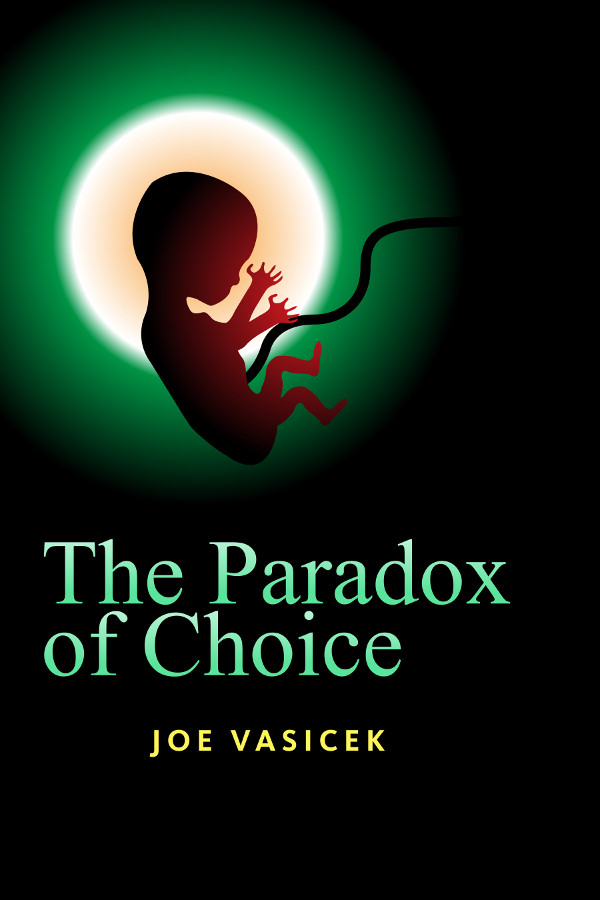
The Paradox of Choice: A chilling glimpse of an all-too possible future.

In cases where there may be severe deformities… I can tell you exactly what would happen. The infant would be delivered. The infant would be kept comfortable. The infant would be resuscitated if that’s what the mother and the family desired, and then a discussion would ensue between the physicians and the mother.


The Paradox of Choice

Enough small talk, Ruth. You didn’t come here to chat.

Is it really that obvious?

I’m afraid so. Who’s the father?

I don’t know, Jezebel. I can picture his face, but I can’t remember his name. I don’t even have his number. It was just one night—this was never supposed to happen.

Mmm hmm.

I’ve made a horrible mistake.

Don’t say that about yourself, dear. You’re a very strong woman. I’m sure we can find a way to fix this.

You are?

Absolutely. This is the current year, after all. Women have rights.

I know, but I think it may be too late. This is something I have to live with now.

Don’t be ridiculous, Ruth. It’s your choice.

Yes, but my baby is already three weeks old. I mean, look at him. He has my eyes.

You can’t seriously think of that as your baby.

Why not? He’s mine, isn’t he? I’ve already given birth to him.

Yes, you have. But the Supreme Court ruled that personhood does not extend to infants until they possess the ability to comprehend language. Until then, that thing is no different from a dog, or a cat.

But Jezebel, this is my child!

Not until its brain develops well enough that it can speak. Until then, there’s no legal difference between terminating him or putting down a dog.

How can you say that? Look at him, Jezebel! Look at how expressive his face is—how his eyes follow you—how he smiles.

Ruth, please. Don’t let your emotions cloud your judgment. Do you know how much other women have sacrificed to give you this choice?

No, but—

You are an empowered, modern woman. This is your choice. Don’t be ashamed of that. Be proud. Celebrate it.

But what if I don’t want to go through with it?

Come on, Ruth. Be reasonable. Are you really in a position to raise a child?

No, but I—

Then the most merciful thing you can do is terminate it, while you still can.

What?!

It’s true, and you know it. If you decided to keep it, you’d most likely find yourself trapped in the cycle of poverty, a single mother for the rest of your life. And is that any way to raise a family? Trust me, Ruth. Better to let it go.

But how is that worse than killing him?

The statistics don’t lie. A life trapped in poverty is not worth living.

How do you know that?

Are you seriously going to fight with me on this? You’ve led a privileged life, Ruth. We both have. It’s cruel and barbaric to bring a human life into the world under lesser circumstances than you’ve enjoyed.

But I already have.

No, you haven’t. Not according to the law.

But—but what if the law is wrong?

Ruth, dear. Please. You’re changing the subject. We aren’t talking about the law, we’re talking about you. About your life. About your freedom. About your choice.

I don’t know, Jezebel. It’s just… it doesn’t feel right to kill my child.

There you go again, calling it a “child.” Do we need to go over this again? It’s not a real child until it can speak.

But some babies can learn to make signs when they’re only a few months old. They can make gestures for food, for play, or for when they’re tired or hurt. Doesn’t that count?

Don’t get caught up in the minutiae of it, Ruth. The truth is, this is your choice, and anyone who tells you otherwise is just trying to shame you into silence. Don’t be ashamed. Don’t let them silence you.

I don’t know.

What do you mean, “I don’t know”? Do you doubt the science of brain development? Do you think you know better than the Supreme Court of the United States?

Okay, okay. I’m sorry.

Then what is holding you back?

Look at him, Jezebel. Isn’t he the cutest thing you’ve ever seen?

I know you feel attached to it, Ruth. And I know how hard this must be for you to hear. But I promise you, there is nothing wrong with letting it go.

Are you sure?

Yes. In fact, it would be a mercy.

But Jezebel—I can’t.

What do you mean?

I can’t put down my baby. It doesn’t seem right. Even if it is a mistake, it’s my mistake.

Then why should you have to carry it with you for the rest of your life? Why do you refuse to let it go? There’s still time for you to make this right. Be brave, Ruth.

How is it “brave” to kill my child?

We’ve been over this, Ruth. It’s not a “child.” Not yet.

Child or not, it’s still my own flesh and blood. I carried it to term and gave birth to it. I gave it life.

Yes, but it’s not a real person.

How can you say that? It laughs, it cries. It has feelings. If I don’t put it down, it will one day grow up to be a man. To be my son. His children will be my grandchildren. And who knows but what he’ll accomplish more in his life than I will in mine?

There you go, letting your emotions get the best of you again.

But where’s the line, Jezebel? When does he become a real human person? I’ve already brought him into this world.

Yes, you have. But until the law says he’s a person, he’s not one.

Is that what it all comes down to, then? The law?

I didn’t come here to argue with you about the law, but if that’s what it takes to convince you, then so be it. Yes, it all comes down to the law. If the law says you’re a person, you’re a person. If it doesn’t, then you’re not. Why make this more complicated than it needs to be?

Because… what if the law is wrong?

It isn’t wrong. This is your right. Your choice.

But isn’t murder a choice, too?

No, Ruth. Murder is a crime. It breaks the law.

But is that the only thing that makes it wrong?

Why should it matter?

Because putting down this child—I mean, terminating this life—it feels a lot like murder.

It’s not, Ruth. The law says so.

But what if the law said that I’m not a person? What if it said that you were within your rights to kill me? That would be murder now—would it still be murder then?

Ruth, I—

And who makes the law, anyway? How do we know that they’re right? I mean, yes, I know that without law, we can’t have a functioning society, but what if our laws are bad? What if following the law is wrong?

Don’t be ridiculous. Following the law isn’t wrong, because it’s the law. And the law says that you have a choice.

But—

Enough arguing, Ruth. Are you going to make your choice, or not?

What if I choose not to?

Ruth, Ruth, Ruth. How many times must we go over this?

But you said it was a choice. That means that I have options. I don’t have to kill—I mean, terminate it. If I did, it wouldn’t be a choice, would it?

That’s not the point.

Yes, it is. And it feels like you’re trying to make the choice for me.

Only because it’s the right one.

Why?

Because it’s empowering.

Then why does it feel like you’re trying to force it on me?

Don’t argue with me, Ruth. This is for your own good. One day, when you’re a happy, successful woman, you’ll look back on this conversation we had and thank me. Oh look, it’s beginning to snow.

It’s too warm outside to be snow.

My mistake. At least it’s good for the plants. Now, do you need me to come with you to the crematorium? I’m here to help you, Ruth. Every step of the way.

I don’t know. I just—

You just what?

Never mind.


Author’s Note

On January 22, 2019, New York enacted the Reproductive Health Act, which legalized abortion up to the moment of birth and repealed criminal charges for harming unborn children. A few weeks later, the Repeal Act was proposed in Virginia, which would have similarly repealed abortion restrictions in the state. In discussing this bill, Governor Ralph Northam said the following:

“In cases where there may be severe deformities… I can tell you exactly what would happen. The infant would be delivered. The infant would be kept comfortable. The infant would be resuscitated if that’s what the mother and the family desired, and then a discussion would ensue between the physicians and the mother.” (Julie, Cary, Ralph Northam, Ask the Governor with Va. Gov. Ralph Northam, WTOP-FM, 30 January 2019)

Governor Northam’s hypothetical case bears a striking resemblance to the 1939 case of baby Knauer, one of the first victims of child euthanasia in Nazi Germany. Baby Knauer was born with many severe deformities, including blindness, imbecility, and missing limbs. Hitler himself authorized the killing of the child. (Staatsarchiv Nürnberg, United States of America v. Karl Brandt et al., zitiert nach Ulf Schmidt: “Outbreak of War and Euthanasia. Results of Recent Research into the ‘Knauer Child’ in 1939.”) After baby Knauer, the Nazi eugenics program rapidly expanded to include forced euthanasia of the mentally ill and handicapped, and ultimately evolved into what we now know as the Holocaust.

In today’s political discourse, we have a tendency to use the Nazis as a proxy for the ultimate evil. Nazis don’t just exist on the spectrum of good and evil; Nazis are the scale. However, a compelling argument can be made that abortion in the United States exceeds the evil of the Nazis.

First, consider the numbers. Six million Jews were exterminated in the Nazi Holocaust, plus several hundred thousand Romani, Homosexuals, Jehovah’s Witnesses, and disabled. However, since Roe v. Wade, more than sixty million babies have been aborted in the United States alone. (Number of Abortions – Abortion Counters. http://numberofabortions.com/ accessed 9 March 2019) The number of babies aborted in the United States is an order of magnitude larger than the Holocaust.

Second, consider the historical context. In the 1920s and 30s, Germany was a shattered nation laboring under the burden of war reparations, hyperinflation, and starvation. In contrast, we are living in an unparalleled era of prosperity. The Germans turned to the Nazis out of fear and a sense of national crisis; we “shout” our abortions out of the apathy and selfishness of our own decadence.

Third, consider the victims. The German Jews were a distinct people with their own unique culture and religion. It wasn’t very difficult for the Nazis to “otherize” them, because they were already a peculiar people. In contrast, we are slaughtering our own flesh and blood, the fruit of our loins—our children.

The United States was founded on the principle of three unalienable rights: life, liberty, and the pursuit of happiness. And yet, when we look back at our own history, we find it difficult to comprehend how our fore-bearers could believe these things and still own slaves. I believe that future generations will look back on us in much the same way, and question how a people who claim to believe in the unalienable right of life could assent to the wholesale slaughter of the unborn.

Any woman who has carried a child to term will tell you that the baby inside of her has their own tastes and personality; that they sleep at certain times and wake at certain times, and get angry, happy, upset, or calm while still inside the womb. The science of biology tells us that from the moment of conception, a fetus possesses its own unique DNA, which determines hair color, eye color, sex, genetics, personality—everything that makes us human, short of actual lived experience. The point of viability is constantly being pushed back by developments in lifesaving technology, making it a poor moral standard. Is a child aborted at twelve weeks today any less of a human being than a child born in future decades, when we will have the technology to save that baby outside of the womb?

I don’t want to judge anyone who has had an abortion. I don’t know the details of every case or what lies in every human heart, and I cannot say with certainty that every abortion is wrong. However, I can say with certainty that every abortion ends a human life. When I look at what my nation has done, and the blood on our hands of the most innocent and powerless among us, I feel to echo Thomas Jefferson’s words: “I tremble for my country when I reflect that God is just, that his justice cannot sleep forever.”

This story was very difficult for me, and I wasn’t originally going to write it. The idea for it came to me several years ago, but it wasn’t until April 2017 that I felt impressed that this was something I needed to write. Even then, I only wrote it halfway. But the events of 2019 convinced me that I needed to dust off this old manuscript and bring it to completion.

Because I want this story to have the furthest reach, I am publishing it under a Creative Commons Attribition 4.0 International license (CC BY 4.0). Feel free to download it, upload it, meme it, rewrite it, and even resell it for your own profit. All I ask is that you copy this license and provide a link to the original.

I’ll end with this quote from Defying Hitler by Sebastian Haffner:

“We watched the earlier events unfold. They occupied and excited us… but they did not confront us with ultimate decisions of conscience. Our innermost beings remained untouched. We gained experience, acquired convictions, but remained basically the same people. However, no one who has, willingly or reluctantly, been caught up in the machine of the Third Reich can honestly say that of himself.”

I believe that we are living in a similar time. The assault on the sanctity of life deeply affects us all, both individually and as a society. In writing and publishing this story, I hope to have done some small part.

Thank you for reading.

Creative Commons License

The Paradox of Choice by Joe Vasicek is licensed under a Creative Commons Attribution 4.0 International License.

Why I deleted my Facebook account (again)

Please watch this video in its entirety (before YouTube takes it down). Whatever you think of James O’Keefe, this is serious stuff that he’s exposing, and it affects all of us.

The first time I deleted my Facebook, it was out of privacy concerns. I came back because there were social groups, such as my local church congregation, that organized all of their activities on Facebook and by being off the platform, I was cutting myself out of the loop. So I got back on, rationalizing that I could be careful about what I shared and it wouldn’t be an issue.

The second time I deleted my Facebook, it was because of the negative effect it was having on my life. I was disturbed about the way that social media was programming people, and I could feel it beginning to happen to me. It was around this time that I deleted my Twitter as well.

I came back because I worried that I was becoming too much of an “internet hermit.” There were also some social groups that it was more convenient to interact with over Facebook, but much less so than before. Mainly, I knew that there were people who wanted to reach out to me, and cutting out Facebook entirely seemed a little too extreme.

This time, however, it isn’t just about privacy issues, or even about social programming and the negative effects of social media in our lives. It’s about power, and conscience.

Facebook, Google, Amazon, and other big tech Silicon Valley companies have a massive political and cultural influence on our lives, and I don’t like what they’re doing with it. They’ve become too powerful, and now they’re abusing that power to shape our lives and our communities in ways that I don’t agree with. But the truth is, the only reason they have any power at all is because of us. We give them their power, and we can take it away.

I’m getting off of Facebook permanently this time because I don’t want to give that company any more power than they already have. I’m also deleting my Twitter. If I do come back to social media, it’s going to be through alternative platforms like Minds and Gab.

The next big step is to de-Google my life, and I’m not sure how I’m going to accomplish that. However, with the direction things are going, I believe it’s more important now than ever to do so. As for Amazon, it’s going to be much more difficult since such a large chunk of my income comes from them. What I will probably have to do is limit my dependence on these companies without cutting either of them out of my life completely.

Reworking The Paradox of Choice

The events in New York and Virginia of the past couple of weeks have been interesting, to say the least. The abortion debate has escalated dramatically, with talk of fourth-trimester abortions and keeping the infant “comfortable” while “a discussion would ensue between the physicians and the mother.”

Without getting too much into the politics of it, this discusion has put me in a very awkward position regarding one of my stories. It’s a very short piece, titled “The Paradox of Choice,” and it depicts two women having a conversation about whether or not to “abort” a baby who’s already been born. The narrative is entirely dialog, so it isn’t clear until the middle of the story that they’re talking about a living, breathing baby who happens to be sitting between them.

I wrote the story as a bit of a shock piece, to show that the line between infanticide and aborting an unborn child isn’t as clear as people think. When I wrote it, though, I thought that infanticide would still be considered abhorrent. I had no idea that the Overton window would shift as quickly as it has.

Hence the awkward position. Clearly, this story needs to be rewritten, but how? Expanded, perhaps? By adding more descriptions to actually show the baby? Or do I need to abandon the “shock piece” aspect and turn it into more of a reasoned discussion of evil?

I wasn’t originally going to write this piece, but a couple of years ago I felt a strong impression that I needed to. Even then, I only did about the minimum of what I needed to do to get it onto the page. This isn’t the sort of thing that I usually write. But now, I suppose I need to revisit it and put in the effort to make it properly shine.

Either way, it’s insane how quickly the debate is shifting.