The thing about Minneapolis that scares me

I learned four things by living through covid. They are:

  1. Whatever the mainstream narrative tells you to believe (or not to believe), you should probably believe the opposite.
  2. Whatever the government tells you to do (or not to do), you should probably do the opposite.
  3. Accusation is projection is confession.
  4. At any given time, the most important story is the one that no one is talking about.

As the situation in Minneapolis continues to escalate, it’s not just the action on the ground that has me worried, but the rhetoric itself. Specifically, the one that has me worried is the accusation that ICE is somehow Trump’s Gestapo.

Obviously, this is ludicrous on its face—a wildly false accusation meant to rile up the useful idiots, many of whom received a public school education and thus know almost nothing about the actual Nazi Gestapo. But because accusation is projection is confession, it’s actually much more than that.

If there’s one thing that’s consistent about the left, it’s that they always accuse their enemies of doing the things that they are actually doing, or that they want to do. So when they say that Trump has some sort of Gestapo, that’s a very strong signal about their future plans, if they ever get power again.

The key question is this: by accusing Trump of setting up his own secret police force, are they confessing to something they hope to do, or to something that they are actually setting up right now? In other words, are they projecting something that’s purely aspirational, or do they already have the databases and surveillance infrastructure set up so that they can have a secret police force up and running the moment they come back to power in Washington again?

Fantasy from A to Z: Z is for Zeitgeist

What is the future of fantasy literature? Where is the genre headed, based on current cultural trends?

For a long time, epic fantasy was basically Tolkien-light. There were exceptions, of course, but most readers wanted something that felt a lot like Lord of the Rings, and the most successful writers were the ones who gave it to them. There was a little bit of innovation, probably culminating in Robert Jordan’s Wheel of Time series, but if you picked up a random epic fantasy off the shelf, you could have a pretty good idea of what you were getting into.

Then, in the 90s and 00s, fantasy started to get dark and gritty, with writers like Joe Abercrombie and George R.R. Martin setting the tone. This new subgenre or flavor of fantasy, called grimdark, really came to dominate during this time, to the point where some were calling Martin an “American Tolkien” (though all that talk more or less died with the terrible finale of the show). Grimdark is still quite dominant, though an increasing number of readers are turning to “cozy” fantasy or slice-of-life in subgenres like litRPG. And of course, romantasy is taking off like crazy, though as we’ve already discussed, most romantasy is basically just porn.

So where are we going from here?

Our culture tends to pass through a cycle of seasonal turnings, where each season is the length of a generation, and the cycle itself is the length of a long human life. Reduced to its simplest form, the cycle follows a pattern like this:

Strong men create good times (first turning).

Good times create weak men (second turning).

Weak men create hard times (third turning).

Hard times create strong men (fourth turning).

We are currently living in a fourth turning, which is the period when all of the major wars and catastrophes tend to happen. In other words, the fourth turning is basically a grimdark world—or rather, when the full consequences of a grimdark world become manifest. But the grimdark subgenre really took off in the third turning, when dark and grim fantasy worlds resonated with the “hard times” that we all were starting to live through. This is also why dystopian YA became so popular in the 90s and 00s.

(As a side note, I have to say that I find it both perplexing and hilarious how so many zoomers think of the 90s as a simple and wholesome time, to the point where they think they experience nostalgia for it. Those of us who lived through the 90s remember it very differently, as an era of school shootings, political scandals, collapsing churches, teenage pregnancies, and ever-escalating culture wars. There’s a reason why Smells Like Teen Spirit was the decade’s anthem. Though in all fairness, I suppose that if someone from the middle ages were to visit our own time, they would find the nostalgic yearning on which the whole fantasy genre is based to be just as perplexing and hilarious.)

I believe we are on the cusp of a major cultural wave that is going to change everything, to the point of making our world almost unrecognizable to those who lived through the 90s and 00s. And just as the grimdark authors like Martin and Abercrombie rose to prominence by riding the wave in their part of the generational cycle, there are a lot of noblebright authors who stand to benefit from riding this next wave, which is only now beginning to break.

After all, there is another way to formulate the generational cycles. It looks something like this:

Complacent men create a spiritually dead culture (first turning).

A spiritually dead culture creates awakened men (second turning).

Awakened men create a spiritually vibrant culture (third turning).

A spiritually vibrant culture creates complacent men (fourth turning).

In the summer of 2024, I think we passed through a critical fork in the current timeline. If the generational cycle had followed its usual course, then our current crisis period would have ended with a period of unification under a new order, based upon the spiritual foundations that were laid during the 60s and 70s. In other words, the woke left would have won, and we’d be living under the sort of regime that would enforce woke values. Dissent would not be tolerated, because dissent is never tolerated in a first-turning world.

The second most likely outcome would have been a complete shattering of the generational cycles. In other words, we would have fallen into some sort of national divorce or hot civil war, with the United States splitting apart and the Western world completing its cultural suicide, which has been ongoing for several decades now. There has never been a time when such a major cultural rift has been accomplished by peaceful means. It is always accompanied by a terrible, bloody war.

But when President Trump survived the assassin’s bullet at the rally in Butler, Pennsylvania, that’s the point where I think our timeline diverged—and it followed the least likely path, which has only ever happened once in the history of modern generational cycles. We skipped from a fourth-turning straight into a second-turning, skipping straight from crisis to revival.

The last time this happened was with the US civil war. Usually, after a culture survives an existential crisis, you get a period of national unity, which often results in a brief golden age (or at least, an age that is remembered as such, often by those who did not live through it). But after the civil war, there was no national unity. Instead, we skipped right to the second turning, which is typically characterized by a major spiritual awakening.

Whatever your opinions of President Trump, the fact that he survived the assassination attempt in Pennsylvania and went on to win the 2024 election in a landslide means that we have (for the moment) avoided the first two scenarios. At this point, it’s difficult to imagine the woke left taking back the culture and leading us into a first-turning world in their own image. And though the US may yet fall into a hot civil war, from where I’m standing in flyover country that no longer seems quite so imminent.

Don’t get me wrong, though. We are not about to enter a period of national unity anytime soon. Certainly not a period of national unity whose foundations were laid by the previous spiritual awakening, which is what the generational cycle requires. At the same time, because President Trump survived the Butler assassination attempt (thank God), I think we avoided a hot civil war.

Because of all this, I think that we are about to experience a major cultural upheaval, the likes of which have never been seen in living memory. We will not get a period of unification. We will not experience a golden age period of material prosperity (though there may be a few years of plenty before the years of famine begin in earnest). But we will experience a cultural and spiritual revival that will burn through our culture until it has utterly demolished the woke worldview and values laid down during the 60s and 70s, and built something entirely new in its place.

What will that look like? And how will it affect the trajectory of fantasy literature?

Culturally, it will be a period of incredible dynamism. We will see an explosion of creative expression in every field, including in literature. Books and movies and games that are cultural mainstays now will be totally forgotten within a couple of decades, and everything that is popular now will feel dated and out of touch in the space of just a few years.

The authors and artists who will do the most to shape this new culture are today almost completely unknown, but they will become household names in surprisingly short order. Others will take decades to become known, but they will write their most important works in just the next few years.

The country will hold together. There will be no civil war, though there may be a global one. And there will almost certainly be an economic collapse, like the Great Depression, except much deeper and much longer. But all of this will only serve to fuel the spiritual revival, and the revival in turn will fuel the cultural dynamism, until the country and ultimately the world have been entirely transformed.

In more practical terms, I think we are going to see a lot of publishing houses fold, and a lot of popular authors fall out of favor. Many of them will keep their core group of fans, but they won’t be nearly as culturally relevant moving forward. New authors will rise from unexpected places to replace them, especially as the old institutions (publishers, conventions, magazines, review sites) collapse.

Romantasy will ultimately be recognized as the pornography that it is, though not until after it’s done great damage to the fantasy genre as a whole. The damage will be healed by a return to the genre’s spiritual roots. Grimdark will fade, and noblebright will rise, though it will ultimately take a different name and be recognized for other characteristics. It all depends on which of the thousand blooming flowers get picked.

LitRPG will mature into a long-term stable subgenre, and capture most of the innovation in the field. It may spin off into multiple long-term stable subgenres. Meanwhile, epic fantasy will return to its roots and grow as the spiritual revival takes hold. But instead of getting Tolkien clones, we’re going to see a lot of original and innovative work.

That’s the zeitgeist as I see it. The next few years are going to be a wild ride. Are you up for it? I hope that I am.
A clear pattern

A clear pattern is emerging in the ongoing violent unrest that is currently sweeping the United States.

It starts with a police shooting incident of a black or minority person. So far, it’s all been police, but I suppose it could also happen with a white-on-black shooting as well. Before the facts of the incident come out, a victim narrative gets pushed across all media channels. Within hours, rioters and looters descend on the community where the incident took place and begin to spread chaos and destruction.

If the municipal leaders are Democrats, the police are restrained from defending the community from the riots, and the rioters are released without charges or bail. If the state leaders are Democrats, they do everything they can to obstruct federal law enforcement and refuse to accept federal help in putting down the riots, even as their cities and communities burn.

The mainstream, blue checkmark-verified news sources downplay or ignore the violence. When forced to acknowledge it, they blame it on Trump, whose hands are tied by the governors. But if the members of the local community push back against the rioters, either in self-defense or otherwise in reaction to the violence, it gets covered as an act of “white supremacy” against “mostly peaceful protests.”

If the local community doesn’t push back, and Trump honors the governor’s orders not to send in the feds, then the violence steadily escalates, with Democrats and the news media continuing to run cover for the rioters until the “mostly peaceful protests” narrative can no longer be sustained. But before that happens, a new incident happens somewhere else in the country, the news cycle shifts, and the pattern begins all over again.

Whether or not the shooting incidents that spark these riots are spontaneous (I personally believe that they are), the pattern of events that follows each shooting appears to be coordinated, with the goal of provoking a violent backlash. Once the backlash happens, it will be spun as conclusive evidence that Trump is a fascist and that white supremacy in the United States is widespread, deep, and intractable. That’s exactly what happened with Charlottesville in 2017. It’s a false narrative, of course, but that doesn’t matter to the partisands who are coordinating this violence. The narrative has already been written: they just need to fabricate the evidence to support it.

Thus far, there hasn’t been enough of a backlash to give them anything substantial to point to. Which is remarkable, given that this violence has been happening almost nonstop since the shooting of George Floyd in May. But last night in Kenosha Wisconsin, there was a shooting that gave these people exactly what they’ve been looking for.

I expect that all of the blue checkmark-verified news outlets will give this shooting wall-to-wall coverage until the news cycle shifts, and that the Democrats will play it up the way they played up Charlottesville until the November elections. I also expect that the violence will escalate, and that the pattern of incident-riots-backlash will continue into November, and possibly beyond.

The scary thing is that this pattern could repeat itself almost anywhere in the country at this point. It’s more likely to happen in places where Democrats are in power on the state or local level, but it could also happen in Republican strongholds if the local Republicans are squishy enough. That’s probably what happened here in Provo, where a demonstration organized by Salt Lake City Antifa resulted in a shooting. Thankfully, there was no violent backlash, and the response from the local community was strong enough that the riots did not spread here.

If this pattern continues, I see one of three scenarios playing out in November:

If Biden is elected with a clear majority, the United States will descend into a hot civil war. The Left sees political violence as a dial to be turned up; the Right sees political violence as a switch to be turned on. The only reason that switch has not been flipped is because Trump is still in power. If he were replaced by a moderate or a centrist, things would probably be all right, but the Democrats have moved so far to the Left in recent years that I don’t see a compromise candidate emerging until the DNC goes the way of the Whigs and the Federalists, and is replaced by a third party. But that isn’t going to happen between now and November, so a Democrat victory will trigger the Right to flip that switch and throw the country into a civil war.

If Trump is elected with a clear majority, the Left will double down and the rioting and violence will escalate, at least in the short-term and in Democrat-run areas. With that said, Trump will also have the mandate he needs to go after his political enemies who are coordinating this cycle of violence. The DNC will either go defunct or become the minority party in this country for the next twenty years. Regardless, it will probably take most of Trump’s second term for the violence to abate.

If there is no clear winner in November, there will be absolute chaos in Washington. The Democrats will attempt to take power, Trump will refuse to give it up, and the violence sweeping the country will escalate until it is indistinguishable from a hot civil war. There may also be a secession crisis and a high profile political assassination or two.

Regardless of what happens in November, I don’t see any scenario where this pattern of violence de-escalates anytime soon.

2019-08-08 Newsletter Author’s Note

This author’s note originally appeared in the August 8th edition of my email newsletter. To subscribe to my newsletter, click here.

A couple of days ago, Mrs. Vasicek and I had an old friend of hers over for dinner. This friend was visiting from out of state, and Mrs. Vasicek made it clear that politics was a subject which we would have to avoid, or at least tread very lightly. Among other things, I’d have to drop my tailgate to make sure it didn’t make a bad first impression.

(One of these days, I’ll have to share a photo of my tailgate. I despise political correctness in all of its forms, so my tailgate has become something of a monument to the first amendment. Frequently at stop lights, people will take out their phones to snap a picture.)

The dinner went really well, and we had good conversations well into the evening. Surprisingly enough, this wasn’t because we outright avoided politics, but because when the issues came up, we were able to find common ground in spite of our obvious differences. In this way, we were able to connect in a much more genuine way than if we had avoided those difficult subjects entirely.

One of the things we talked about was the destructive influence of social media outrage. Our friend told us how the relationship between her father and her sister has been destroyed, because Facebook is the only way that they can connect with each other. Those interactions have become so politically toxic that they’ve lost all of the love that they once had for each other.

That’s sad, but it’s becoming an all-too-common occurance here in the United States. Some people believe that we’re on the verge of a second civil war. I don’t know what the future holds, but if it’s anything like the first civil war, I know that there will be honorable people on both sides. That’s the tragedy. I have ancestors who fought on both sides of the American civil war, and when people ask which side I think was right, I answer “the American side.”

I’m fascinated by Robert E. Lee and his decision to fight for the Confederacy, when Lincoln himself offered him command of the Army of the Potomac. He opposed both slavery and secession, yet his conscience couldn’t allow him to stand at the head of an invading army. Neither could it allow him to stand by idly while his friends and family were slaughtered—not when he was in a position to make a difference.

Did he make the right choice? I don’t know. However, I do believe that he tried his best to do so. I try to keep that in mind when I talk with people across the political divide. No matter how much we may disagree, it’s refreshing to meet people who are sincerely striving to do what’s right as best as they know how.

In these troubled times, when the public discourse is rapidly deteriorating and outrage is the social currency of the day, it’s important to recognize the good in people, no matter which side they line up on.

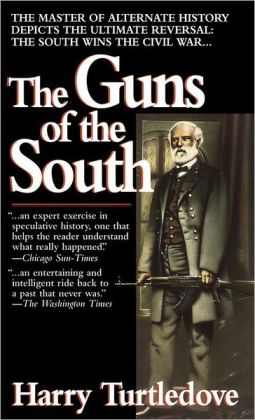
The Guns of the South by Harry Turtledove

As those of you who’ve read my short story “The Gettysburg Paradox” know, I’m a huge fan of both the US Civil War and time travel stories. Harry Turtledove’s The Guns of the South is, quite possibly, the best combination of the two.

The novel starts just a few weeks after Gettysburg. The Army of Northern Virginia is in disarray, and a defeated Robert E. Lee has been forced to face the truth that the Confederacy has no real hope of winning the war. Then a bunch of time travelers in strangely mottled uniforms show up out of nowhere and supply his army with strange new guns called AK-47s.

Immediately, the tides of war change. Lee soundly defeats Grant at the Battle of Wilderness and presses on to Washington DC, which falls overnight. Triumphant, the South immediately sets about the peace negotiations with their northern neighbor, and prepares for a presidential election which Lee is expected to win. But disagreements about the fate of the new American nation soon arise between Lee and his benefactors, sparking a conflict that is truly out of time.

There’s so much to love about this book. Turtledove’s attention to detail is meticulous, not just in the obvious major ones, but in the little ones that have a disproportionate impact. For example, Lee appreciates the killing power of the  AK-47s, but what impresses him even more are the MREs that the time travelers carry. When the gunmakers in Richmond pick apart the AK-47 in an effort to replicate it, it’s really fascinating to get their take on its functions. It really does read like a bunch of 19th century denizens puzzling over technology that they barely understand.

But what really got to me were the characters. Having read The Killer Angels and Jeff Shaara’s prequel and sequel to that great novel, Robert E. Lee felt like exactly the same character, just in a different book. His genteel sense of propriety, his calm but unshakeable sense of honor, his love of his men and respect for his enemy—it really was the same guy. And the decisions he makes after the war is over, while truly radical, are also eminently believable.

It’s not just Lee, either. Lincoln, Soward, Longstreet, Forrest—all of them feel very much like the people they really were, inhabiting an alternate reality. Turtledove’s research into their characters and personalities was meticulous. And it wasn’t just the big names, either, as all of the 19th century characters, including a prostitute who pretended to be a man in order to join the infantry, are based on real people who actually lived.

Fantastic book—a must-read for anyone with an interest in time travel or the US civil war. Whether those interests intersect for you or not, you’ll thoroughly enjoy this book.

Thoughts on the #Alexandria shooting

This attack was a warning.

It could have been much worse. There could be more than a dozen dead congressmen right now. We could be in a national crisis as severe as 9/11, or more.

This was a premeditated and carefully planned act of domestic terrorism. It is clear that the attacker was politically motivated. Millions of Americans share his extreme views. Thousands, perhaps even hundreds of thousands, believe that his actions were justified.

It is only by the grace of God that the attack was thwarted. As Congressman Loudermilk said, “God was there.”

I believe in a God who is intimately concerned with the details of our individual lives. I believe that His hand guides the events that shape us, and that He takes a particular interest in the course of the United States.

He has given us our individual agency, the freedom to choose between good and evil. That is a gift that He will never take away. No matter how violent we are toward one another, no matter how much anger and hatred fills our hearts, He will not violate our agency nor revoke that Liberty wherewith He has made us free, but will leave us to our devices until we return on our knees to Him.

This attack was a warning. We would do well to heed it.

Several months ago, I came to the conclusion that the United States is between three and fifteen years away from an existential crisis as great as the Civil War. Will this crisis turn into a second civil war? I believe there’s a significant chance that it will. Certainly we are on that path right now.

Wake up, America! You talk of wars in far off countries, but you know not the hearts of men in your own land. Even now, the voices of evil speak louder in your ears than that which will shake the Earth. Treasure up wisdom, and remember: if you are prepared, you shall not fear.

Thoughts after finishing The Last Full Measure by Jeff Shaara

WOW.

This was an amazing book. A highly memorable book. A book I will return to again and again in the future.

There comes a moment when reading a truly amazing book when you don’t think that it can possibly get any better. It’s a ten out of ten, easily five stars. And then … it gets even better.

The Last Full Measure by Jeff Shaara was one of those books. It’s the third book in a trilogy that technically starts with Gods and Generals, but really it started with the middle book, The Killer Angels, which was written by the author’s father, Michael Shaara.

The Killer Angels covers the events of the Battle of Gettysburg, and is definitely one of the best Civil War novels ever written. Years later, Jeff Shaara decided to write a prequel to his father’s book, showing all the events of the war leading up to Gettysburg. The Last Full Measure picks up immediately where The Killer Angels leaves off, and follows the war to its conclusion at Appomattox and the beginning of the Reconstruction.

This book is amazing. It really made me feel like I was there, from the bloody confusion at the Wilderness to the brutal hand-to-hand combat at Spotsylvania, from Grant’s terrible mistake at Cold Harbor to the long, hard siege of Petersburg. And then, at the very end, when Brigadier General Lawrence Chamberlain surveyed the monuments from Little Round Top just before the fiftieth reunion of Gettysburg, I realized that I actually have been there!

It was such a crazy moment, to read about something in a novel and then have it merge with my own memories of the place. It made the whole thing come alive in a way that was just fantastic.

There were a lot of other amazing moments in the book. When General Lee finally surrendered, it very nearly brought me to tears. And later, when Chamberlain accepted the arms of the Army of Northern Virginia and had his men salute the Confederate soldiers in a show of brotherhood and respect, it was amazingly touching.

Chamberlain’s storyline in general was fascinating throughout the whole trilogy. His father wanted him to be a soldier and his mother wanted him to be a priest, but he chose a career in academia instead at the insistence of his wife. But the academic lifestyle left something unfulfilled in him, and he didn’t realize it until the war broke out. He volunteered without telling anybody, not even his wife, and was soon swept up in some of the bloodiest battles in the war. At Fredericksburg, he spent the night on the bloody fields within sight of the enemy lines, shielded and kept warm by the bodies of his men.

Then, at Gettysburg, there was that was that glorious charge on Little Round Top that saved the Union flank, and quite possibly the entire battle. When he came home from that, he’d gained something that he’d never had before in his life: his father’s respect and approval. From Gettysburg, he rose to command a battalion, but at Petersburg the ineptitude of the Union command left him without support at a critical moment, and he was nearly killed. But he came back, taking command of a brigade upon his recovery, and turned the tide of battle at Five Forks and Appomattox.

By the time the war was over, not only had he won great honor and glory, he’d tested and proven himself, learned something about his inner character that he would always take with him, and that would always give him strength. The afterword starts with a quote from Lawrence Chamberlain that sums it all up amazingly well:

War is for the participants a test of character; it makes bad men worse and good men better.

I’m not going to lie: this book almost made me wish that I could go off to war like Chamberlain did. It’s not that Jeff Shaara glorified the Civil War war–just the opposite, in fact. The horrors and brutality and awful tragedy were all depicted in full measure, with the pain and death and suffering. It wasn’t glamorized at all. But there’s something deep, something primal about going through an experience like that–something that strips away all the luxuries, all the securities of modern life and forces you to find out who you really are, what you’re really made of. For all the horrors that those soldiers went through, I envy them for that part of their experience.

I feel like I’ve been channeling that recently in some of my short stories, like that orc story I wrote recently. I have an idea for another one that I’ll probably write while I’m out at Cape Cod. It’s also what drives me to heroic fantasy, to stuff like David Gemmell’s Drenai series. There’s something about taking up a sword, or an ax, or a musket and charging headlong into battle that rouses the spirit–that makes you feel truly alive.

I would love to write a book as good as this one; it’s one of those things that I dream of. I’m not sure if it’s possible to pull off a story as tremendous as this in short story or novella form, though. Maybe, but all of the stories that have had this powerful of an impact on me were all novels. The shortest one that I can remember was The High King by Lloyd Alexander, but that was the fifth book in a series (and it was still a novel). Short stories and novellas are great, but at some point I need to return to novels.

In any case, those are some of my thoughts after reading The Last Full Measure. There were a lot more, but this post is already starting to ramble so I’ll cut it short here. I’ll leave you with the opening credits from the movie Gods and Generals, a great piece that really captures what so many of the common soldiers were fighting for: home.

Take care and be well.

Why I couldn’t finish Gone with the Wind

For the past month or so, I’ve been on a Civil War kick. I watched the movie Gettysburg to celebrate July 4th, read Gods and Generals, wrote a short story about a time traveler at Gettysburg, and have been listening to a lot of Civil War music as I write. One of the books I decided to give a shot was Gone With the Wind, that classic American novel that’s tied so closely with the Civil War.

It’s definitely a good book. There were parts of it that I really enjoyed, such as the perspective of the people of Atlanta as Sherman’s troops got steadily closer. The poverty of the plantation owners after Sherman’s march to the sea provided a stark contrast to the pompous gaiety of society before the war. You definitely get a sense of what it means to be Southern while reading the book–it’s surprising how similar some things are to the way they were. And just in general, the sheer sense of immersion that the novel gives you is just incredible. It’s rare that I’m sucked into a world as thoroughly as I was sucked into the quiet charm of the antebellum South and the frenzied optimism of Confederate Georgia.

The real shock to me was that I could enjoy the book even as I hated the main characters. Scarlett is a bitchy, stuck-up brat–an entitled rich white girl who cannot comprehend that the world does not revolve around her. Rhett Butler isn’t nearly as stuck-up as she is, but he is an arrogant jerk who sneers at other people, profits from their misfortune, and hides his cowardice with his biting cynicism.

The fact that I enjoyed reading about them even though I disliked them so much is a testament to the fact that not every character needs to be likable. Even thought Scarlett really peeved me off, I still found her fascinating because I felt like I really understood her. Margaret Mitchell does an excellent job of getting you into her characters’ heads and showing where they come from. In some ways, I felt that I understood Scarlett better than she understood herself.

But I have to be honest–from page one, I was only interested in Scarlett for the schadenfreude. I already knew how the story ends, with those classic lines “frankly my dear, I don’t give a damn,” and “tomorrow is another day.” If I’d been waiting instead for Scarlett to experience a growth arc (and she really does start in an excellent place for one), I probably would have thrown the book across the room much sooner.

The part that made me stop reading–and yes, this will spoil the book–was the part where Scarlett steals Frank Kennedy, her sister’s fiance, in order to get the money to save Tara. She’s so singly focused on saving the plantation (Tara) that she’s willing to backstab her own family, who ought to matter a lot more to her than a house and a spot of land. Yes, I understand that it was entirely in her character to do that, but when she actually betrayed her sister like that, I just couldn’t stand it anymore. I skipped to the last chapter, had my juicy moment of schadenfreude, and returned the book to the library.

I had a lot more sympathy for everyone who locked horns with Scarlett (except for Rhett) than I ever did for Scarlett herself. The O’Hara overseer who gets fired in the first or second chapter for making the poor Slattery girl pregnant–I didn’t think it was noble for him to try and steal Tara through his postwar connections, but I could see why he’d do it. He probably didn’t feel like he could marry the Slattery girl because the O’Hara’s weren’t paying him enough. Even if they were, the fact that he married her showed that at least he was trying to set things right. And though I didn’t admire the way he went about trying to get his revenge, a part of me wanted him to succeed.

My favorite character was probably Melanie. As soon as she showed up on the page, I liked her, and as the story progressed, I came to actively admire her. Ashley, too, was a very interesting character to me–his thoughts on the war and on the passing of the old way of life were fascinating. But I could never really respect him, because it was always so easy for Scarlett to manipulate him.

And even though Rhett wasn’t so prone to Scarlett’s machinations, I still couldn’t respect him because he was always such an ass to everyone. It’s not that he wasn’t a gentleman–there were plenty of gentlemen in the book who were jerks, and plenty of men who weren’t gentlemen who were still good people. The thing was, Rhett was just never a good person to anyone except Melanie, and throughout the book, that never changed.

I guess the takeaway here is that it’s almost impossible to have any sympathy for a character who treats their friends and family like garbage. For me, at least, if a character constantly betrays the people who are closest to them, I really want nothing to do with them. But I guess that’s just me–judging from the success of Gone With the Wind, I guess I can’t generalize that at all.

I don’t know. What do you guys think?

Short Blitz #5: The Gettysburg Paradox

Title: The Gettysburg Paradox
Genre: Science Fiction
Word Count: 3,650
Writing Time: about 1 week

Ever since I read The Killer Angels, I’ve been something of a Civil War geek. For July 4th this year, I rewatched Gettysburg and read Gods and Generals. I’m also reading Gone with the Wind right now, and plan to read The Last Full Measure after that. Needless to say, the Civil War has been on my mind.

The basic premise of this story is that a time tourist at the Battle of Gettysburg discovers that most of the combatants are time travelers–that the battle is actually a clash of competing timelines and futures. Appalled, he runs out onto the field in the midst of Pickett’s Charge shouting “We’re all time travelers!” but no one pays him any heed. They don’t find it disturbing at all that the battle–indeed, the entire war–may be a fabrication from time travelers desperate to change their future.

This was a fun one. The idea came to me a few months ago, though I didn’t associate it with Gettysburg until just a few weeks ago. Originally, I thought I’d have someone from the far future come back to a battle in the near future, since that would be easier to write. But I’m glad I decided to go with a real historical battle, because that makes it a lot more interesting.

Here’s a passage that I’m particularly proud of:

It was madness–sheer madness. Soldiers from the future fighting a battle in the past. And did Gettysburg even belong to the nineteenth century anymore? Had it ever? States’ rights and the Union, secession and the constitution, slavery and equality, freedom and independence, the clash of American civilizations and the baptism by fire of democracy and the modern world. Never before and perhaps never since would so much of the future hang on so brief a moment in history. And so, here they were, men of the twenty-second and twenty-third centuries disguised as natives of the nineteenth to give their lives for the future they had never had. How much of it was even real anymore? How much of it was meddling from so many broken timelines? And what if the war itself was merely a fabrication to bring about this great and terrible day?

I wrote this story in three days over the course of about a week. At first, it seemed daunting, considering all the historical details that I wanted to get right. Fortunate, Gettysburg is right up my alley, and I had a lot less trouble with it than I’d thought I would. The rough draft came in at about 4,000 words, so I gave it a quick revision and cut 10% to make it closer to 3,600.

It feels good to write a short story for a change. I’m particularly satisfied with this one and would love to see it in a magazine. The plan for now is to keep it on submission until it finds a home. Then, when it does, I’ll self-publish.

On to the next one!