Where do you keep your books?

Now that we’ve moved back into our old house, unpacking all of our stuff and finding places for it, I just have to wonder… where in the heck do bookish normal people keep all of their books?

My in-laws have a dedicated library in their house, and while we were house-sitting for them, they were gracious enough to clear out several shelves for us so that we could put all of our books (more or less) within easy reach. But our house is a fairly small single family home, with a main floor and a basement. It’s about 2,300 square feet, with four bedrooms and three bathrooms—which is plenty of room for our small family—but there isn’t much space for bookshelves.

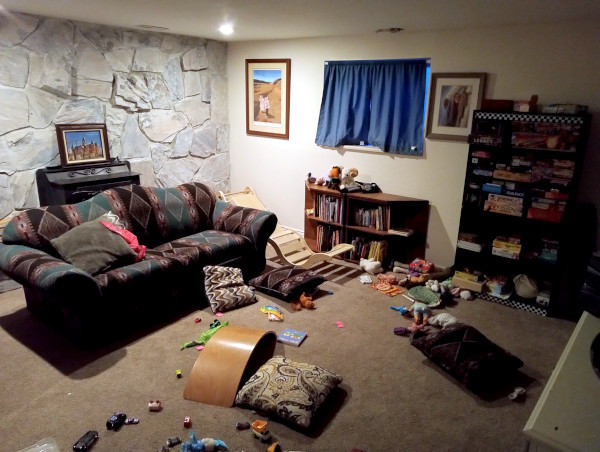
This is our main family room (please excuse the mess—small children and all). It has a little bit of shelf space by the stairs, which we could use for maybe a few dozen books, but we have a lot more than that. Boxes and boxes more. Behind the camera is the kitchen/dining area, so there isn’t much space for books there. And everything else on this floor is already taken, with bedrooms for the kids and a master suite for my wife and me—and my wife doesn’t want to cram all our books in our bedroom. With another small child on the way, I can’t blame her.

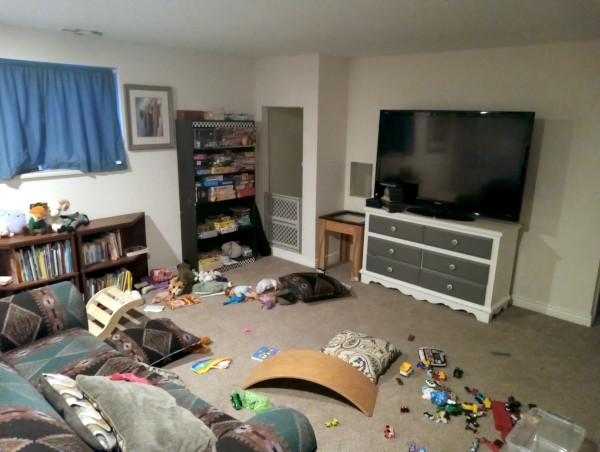
This is the downstairs main room. Again, please excuse the mess—we’re currently using this area as the kids’ play room. The bookshelves either have games or kids’ books, so those are taken. Behind the camera is a kitchenette area that we’re currently using to hold our food storage (and we have a lot of it, so that’s probably not going to change). Besides the main room here, there are two bedrooms, one of which is currently for storage, and the other is an office for my wife and me. Again, there’s not much space for shelves in either of those… and besides, we’d rather have our books out where people can see them (or at least where our kids can easily browse them).

What I suppose we could do is get rid of the massive TV (my wife won it from her work during a holiday raffle, and we don’t use it much, so it wouldn’t be a big deal to downsize) and move the dresser into another room, so that we could use that whole wall for shelves. That might fit all of our books, if the shelves stretched from floor to ceiling. It would be a big project, since we would have to use all of that space—and would probably also have to move the light switch—but it could be done.

Another idea I’ve had is to install shelves in the family room up above the main window. We could probably wrap it around most of the room, even into the dining room area if we had to. Have any of you done something like that? I’m a little bit worried it would make the room feel cramped, but it is a place where we could put a shelf.

Other than that, I’m kind of at a loss. I could try to get rid of most of my books, but I have no idea how successful that would be, since I tend to acquire new ones as quickly as I lose the old ones. It’s a blessing… and a curse. I’m sure that most of you can relate.

In any case, what do you do with all of your books? Where do you keep them? What would you do if you lived in our house?

Print vs. Ebook vs. Audiobook: When To Own

In last week’s post, I tried to make a comprehensive list of all the pros and cons associated with the various book formats. The purpose of that exercise was to figure out when to acquire a book in print, in audio, in ebook form, or some combination of all three. It’s long been my goal to build a magnificent personal library, and with the upsides (and downsides) of each format in mind, I think I’ve developed some personal guidance toward that end.

For the purpose of this exercise, I think it’s best to consider first what the platonic ideal would be, if money or availability were no object. So assuming that every book is available in every format, at a price that I can afford, this is what I would do.

If a book is worth owning, it’s worth owning in print.

For all the advantages of digital format, print is still better in enough ways that if I’m going to own a book, I want to own it in print. This really comes down to the rule of thumb that if you don’t hold it, you don’t own it. Also, the fact that print books are immutable, more private, and so much easier to share.

However, my calculation would be different if I hadn’t married and settled down. Back when I was a global nomad, ebooks were so much better than print, and even when I was a student my print books were more of a liability than anything. I moved so much in my college years that for most of the time, my books just sat in cardboard boxes under my bed. When I left on my internship, I ended up giving most of them away.

But now that I’ve settled down, print books are definitely the way to go. As for hardbacks vs. trade paperbacks vs. mass-market paperbacks, or used vs. new, I still have to figure that out. Personally, I prefer MMP to the other print formats, but that’s mainly because it’s what I grew up with and because I don’t really care if it gets banged up. For the purpose of building a personal library, the calculus is probably quite different.

If a book is worth rereading, it’s best to have a digital copy too.

There are a lot of reasons to own a book even if you’re probably not going to reread it—for example, if you want to share it with your friends, or display it prominently on your shelf. But if money were no object, I would want to own at least one digital format of every book I plan to reread. That way, if something happens to the print copy, I have another one to fall back on.

More than that, though, I think it would be interesting to change up the reading experience by rereading it in another format. Does a book hold up in audio as much as it does in print? How about ebook? Maybe it would be fun to see which passages other people have highlighted and shared the most.

Also, if I’m planning to reread a book at the same time as my wife or my friends are reading it, it would be great to have a digital copy so that they can borrow the print one. Or maybe they get the digital copy, and I keep the print one.

For all these reasons, multiple formats seems like the way to go, provided that money is no object. But then, the question becomes whether to get the ebook, the audiobook or both? To figure that out, here are the questions I need to ask:

Do I want to find and share my favorite passages?

One of the biggest advantages of ebooks that make that format unique is that the text of an ebook is searchable. That is no small thing for the kind of books that I want to go back through and pick out certain passages. Print books are better for flipping through, but they aren’t text-searchable in the way that ebooks are.

Another unique advantage of ebooks is that you can share passages that stick out to you, or see what passages other people have highlighted and shared. So if it’s the kind of book that I want to go back and think about, or reread certain passages in greater depth, the best digital format for that is probably ebook.

Do I want to read it quickly, without too much depth?

The biggest advantage of audiobooks is that your eyeballs can be elsewhere while you read. So with audiobooks, you can fit more reading time into the interstitial parts of your day, like commuting or doing chores, but it comes at a tradeoff because you’re not going to be concentrating all that much.

However, that probably won’t be as much of a problem on a reread, since you’re already familiar with the story. But it will be a different reading experience, one where your attention is not as concentrated. For that reason, I lean more toward owning a book in audiobook if it’s the kind of think I want to reread for enjoyment, not for depth.

But I can’t buy it all!

Okay, so all of this is great if money is no object, but few if any of us live in that world. I certainly don’t, and some of these formats—especially the audiobooks—can get to be quite expensive. So, what’s the best thing to do?

Since I tend to be more of a spreadsheet guy, my solution is to make a list of all the books I want to own, in each format. Some of these books will end up on various wishlists, and will probably come my way as gifts. For others, I just need to keep an eye out for good deals—it’s surprising how many excellent books come through the local thrift stores, some of them in rare or signed copies.

But the key here is patience. If you’re time-rich and money-poor, learn how to wait and keep an eye out for good deals. Books tend to come and go, just like so many other things in life.

So that’s how I plan to acquire books going forward. What about you? What’s your personal guidance on when to own a book?

Algorithms, social media addictions, and the endless churn of content

In the last 5-6 years, I’ve noticed a shift in most of the media content that I consume. Content has proliferated at an unprecedented rate, and the churn—or the rate at which new content pushes out old content—has become one of the driving factors for those of us trying to make our careers in this way.

We see it on YouTube, where three or four adpocalypses have massacred various channels, and where copystrikes have become part of the game. YouTubers who don’t put up content every day, like Tim Pool or Pewdiepie, quickly lose views and subscribers even when they do put up new content.

We see it in video games, where companies like Paradox are now making the bulk of their money on DLCs, some of which make the vanilla version almost unplayable. Back in the 90s, a game was a game was a game. You could get expansion packs for some of them, but that was just bonus content, not a core part of the gaming experience, or the business model.

It’s a huge issue in journalism, where the news cycle has accelerated so much that weeks feel like months, and months feel like years now. Remember the Kavanaugh hearings? That was less than a year ago. The Covington kids controversy happened this year. Everyone is in such a race to break the story that the quality of journalism has fallen considerably, but by the time the corrections come out, the news cycle has already moved on. Fake news indeed.

The churn has also become a major thing in the indie publishing scene. For the last few years, the established wisdom (if there is any) is that you need to publish a new book about every other month—preferably every other week—to keep your entire catalog from falling into obscurity. There’s a 30-day cliff and a 90-day cliff, at which points the Amazon algorithm stops favoring your books over new ones. And now, to complicate things, AMS ads are taking over from more organic book recommendation methods, like also-boughts. The treadmill is real, and it’s accelerating.

I’ve been thinking a lot about this, and I can think of a few things that may be driving it. I don’t have any statistics or firm arguments to back it up yet, just a couple of hunches, but it’s still worth bringing them up to spark a discussion.

First, social media has taken over our society, not only in public life, but in personal life as well. Now more than ever before, we use Facebook, Twitter, Instagram, Snapchat, and other social media to interact with each other. The problem is that these social media sites are incentivized to get us addicted to them, since we are the product they sell—our data, our time, and our eyeballs. Every like is another dopamine hit. Every outrageous headline is another injection of cortisol.

We have literally become a society of drug addicts. The drugs may be naturally produced by our bodies, but big tech has figured out how to manipulate it like never before. And as addicts, we are always looking for our next hit.

That’s not all, though. There’s a feedback loop between the end-users who consume content, and the algorithms that deliver content recommendations to the end-users. When something new gets hot on social media, the algorithms act as a force multiplier to drive it even further. But because of our addiction, and the fact that we’re constantly looking for the next hit, things can fall off just as quickly as they rise. Hence the churn.

It’s also a function of the massive rate at which content is proliferating across all forms of media. I’m not sure how many millions of English-language books are published any year now, but it’s much, much more than it was back when tradpub was the only real game in town. Same with videos, music, news blogs, etc. With so much new content coming out all the time, and so many people on social media ready to share it, the conditions for churn have never been stronger.

But there’s another, more sinister aspect to all of this, and it has to do with the biases of big tech and Silicon Valley. Yes, there is a feedback loop that governs the algorithm, but it goes both ways: the people who write the algorithm can, within constraints, use it to reprogram all of us, or even society itself.

I don’t think it’s a mistake that the churn is worse on sites that are run by big tech, or worse on content creators who depend on the platforms that big tech provides. The authors experiencing the worst burnout all seem to be exclusive with Amazon and Kindle Unlimited, and news sites that are getting hit the worst now (Vice, Buzzfeed, etc) all depended on clickbait tactics to ride the Facebook algorithm.

There are a few content creators who seem to have escaped the churn. As a general rule, they seem to be scaling back their social media usage and developing more traditional income streams, like subscriptions, sponsorships, and email lists. Steven Crowder, Tim Pool, and Pewdiepie are all examples. A few of them, like Alex Jones, Carl Benjamin, and Paul Joseph Watson, are learning how to swim by getting tossed in the deep end. Big tech has deplatformed them, but they’re learning—and showing to the rest of us—that it’s possible to make your own path, even when all the algorithms conspire against you.

I recently listened to a fascinating interview on the Jordan Peterson podcast, where he talked with Milo Yiannopoulos. Milo fell out of the public sphere when allegations of pedophilia emerged, getting him banned from CPAC in 2018. His career isn’t over, though, and his future prospects look quite bright, especially with the plan he’s been putting together. If he succeeds, big tech and the algorithms will never be able to touch him.

In my post a couple of days ago, I argued that one of the unique advantages of books over other forms of media is that they are timeless. As Kris Rusch puts it, books aren’t like produce—no matter how long they sit on the shelf, they don’t spoil. We are still reading books that were written centuries ago.

If that’s true, then there must be something about books that makes them resilient to churn. In fact, books may be the antidote to churn. That’s basically Jeff VanderMeer’s thesis in Booklife. It’s also worth rereading Program or Be Programmed by Douglas Rushkoff, where he offers some helpful rules to keep social media and the algorithms from completely taking over our lives.

So as indie writers, what’s the best way to deal with all of this? I’m not entirely sure. Back in 2011 when I first started indie publishing, slow-build and long-tail strategies seemed a lot more viable than they do now. But if there is something inherent in books that makes them the antidote to churn, then there has to be a way to take advantage of that.

I’ll let you know when I find it.

Plans for My Personal Home Library

If everyone has a weird or quirky super power, mine is the ability to acquire books. Even when I was living out of a suitcase in a remote Caucasian village, or traipsing across the Middle East, I was constantly acquiring books.

With my marriage to Future Mrs. Vasicek coming up, I’ve decided to put this super power to use. Instead of acquiring books randomly, I’m approaching the task of building a personal library with goals and a plan. Part of that plan is to inventory all of the books that I own, with lists of books / ebooks / audiobooks that I want to acquire. Part of it is to find a place in my home where I can shelve them all, instead of keeping them in boxes or the closet. And another part is categorizing all of the books, with goals for each category.

Requirements

After putting some thought into it, here are my basic requirements:

  • The entire library must fit in a single room / device / server.
  • The only books that I’ll keep are ones that:
    • I want to read again,
    • I want to talk about with others, or
    • I want to share with my family.
  • Ebooks and audiobooks must be DRM-free and device agnostic.

A while ago, I did a blog post on the pros and cons between print books, ebooks, and audiobooks. That seems to be a pretty good set of criteria for determining which formats to collect my books in, or whether to collect a particular book in multiple formats.

Ideally, I want to set up my personal library in a shared space in my home, where I can host guests. Future Mrs. Vasicek and I are going to get a set of scriptures, kind of like the tradition of a family bible, and I want this to be the centerpiece of my personal library. Eventually, I also want to get a dedicated ereader (or set of ereaders) that lives in the library, as well as a portable hard drive for all of the audiobooks. I don’t want any of it to depend on the cloud.

Categories

So far, I’ve got eight categories, though I’m sure this will expand. They are:

  1. Science fiction & fantasy
  2. Other fiction
  3. LDS non-fiction
  4. Self-improvement
  5. Writing & publishing
  6. Arabic language
  7. History & current events
  8. Other non-fiction

I have a lot more fiction books than non-fiction (go figure). For now, I’m using Goodreads as a library inventory system, though I may want to find something better in the future. If you check out my Goodreads profile, you can probably see all of them.

I’m working to come up with goals and plans for each category. Here’s what I have so far:

Science Fiction & Fantasy

My main goal here is to collect the complete works of David Gemmell. He is my favorite fantasy writer of all time, and I’ve read all of the Drenai series and most of the Stones of Power and the Rigante series as well. I’m holding off on the Troy books, mostly because I want to savor them. He’s also got a few standalones and duologies, most of which I’ve read.

Other series that I want to collect in print are:

  • Louis McMaster Bujold’s Vorkosigan series
  • All of Heinlein’s juveniles
  • The Barsoom series by Edgar Rice Burroughs (Princess of Mars, etc)
  • Ursula K. Le Guin’s Hainish cycle
  • All of the books by my writer friends

There are also a bazillion trilogies that I either own or want to collect, but it’s not worth listing them all here. I’m sure this is going to be a very dynamic part of my personal library.

Other Fiction

My main goal for this section right now is to collect all of the Sackett books by Louis L’Amour. There are only two left, both of which I’ve requested on Paperback Swap. Now I get to read them all, without any interruption!

I also plan to focus on collecting Jeff Shaara, especially the Civil War books. I currently have The Killer Angels by his father, as well as Gods and Generals and The Last Full Measure. But before that, I need to read Rise to Rebellion and The Glorious Cause, which I also own (those ones cover the Revolutionary War). Depending on how much I enjoy those, I’ll decide whether to collect Shaara’s complete works.

LDS Non-fiction

There are a tone of authors that I want to collect in this section: Nibley, Givens, Gileadi, Groberg, and more. There are also a few key books that I need to acquire and read, mostly biographies and church histories.

One series that I’m really looking forward to is the four book SAINTS series published by the church. The first book was fantastic; I listened to the whole thing on the train, and it was really cool to pick out the people from my own family history and learn how they contributed to the rise of the church. The next book is going to cover the westward migration, and I have a bunch of ancestors who participated in that, including a few in the Willie handcart company. Really looking forward to it!

Here in Utah, it isn’t difficult to collect LDS non-fiction books. You can find most of the older titles in thrift stores, and there are lots of LDS bookstores to choose from. That said, I don’t have any concrete goals for this section yet. The biggest challenge will probably be in refining this section so that I only keep the best books (ha), since it would be very easy to let this section get cluttered with good but mediocre books. That seems to be the general trend.

Self-Improvement

The biggest thing I need to do in this section is reread How to Win Friends and Influence People, preferably once a year. Fantastic book.

I should also probably focus on marriage and relationship books, since y’know, I’m getting married. Personal finance is also huge: I’ve got Rich Dad, Poor Dad, and should probably collect all of Kiyosaki’s books. Stephen Covey is another huge one.

Beyond that, my cowriter Scott Bascom is really into self-improvement, so my plan for now is to build out this section based on his recommendations.

Writing & Publishing

There are a few classics that I need to re-acquire, such as Character and Viewpoint and On Writing. One classic that I will probably skip is Strunk & White’s Elements of Style (can’t stand that pretentious book). Other than that, the biggest thing is to stay current and focus on indie publishing. For that reason, I suspect that I’ll collect mostly ebooks in this section.

Arabic Language

My main goal here is to read The Book of Mormon (كتاب مورمون) in Arabic. I also have plans to study the Qur’an, though that’s not a priority at the moment.

Most of these books are ones that I acquired while studying Arabic in Jordan. I don’t think I’ll acquire many more anytime soon, though if an opportunity arises, I probably won’t turn it down. The big question in my mind is whether to expand this section to Arabic language & culture, since I do have a bunch of English books on the Middle East.

History & Current Events

My biggest goal for this section is to build a collection of monetary & financial books that together make a complete history of the United States. This subject is my current pet interest, much to Future Mrs. Vasicek’s chagrin. I also have plans for a coin collection / history that I’m currently writing, though that’s on the back burner for now.

Other than that, I plan to focus on book recommendations by Ben Shapiro and Glenn Beck.

Other non-fiction

No real goals yet for this section. At some point, I will probably spin off family histories as a separate category, since there are a lot of them in my family.

General Goals

The biggest thing I need to do is read every book that I own. I may be really good at acquiring books, but I’m not as good at actually reading them. Currently, I’ve read only about 20% of them.

When will I have them all read by? Ideally, the end of the year, but I doubt that’s going to happen. Then again, if I can keep my goal to read for an hour or two each night, a year might just be enough.

Since the library is constantly growing, though, I suspect this will be more of an aspirational goal, or a moving target. Even when I manage to hit it, it probably won’t take long before I acquire more books and have more reading to do again.

The next big goal is to find a place for all these books, which probably won’t happen until after Future Mrs. Vasicek and I are married. At which point, all of these plans may change, since she has a bunch of books too—but probably not too much. We’ve talked about it, and it shouldn’t be too hard to merge our books into one family library, if that is what we decide to do.

Aside from that, I’d like to get as many books signed and personalized as I can. Shouldn’t be too hard: just look up the guest list of any convention I’m attending, and bring the books along.


That’s basically the plan as it stands right now. With my quirky super power for acquiring books, it shouldn’t take long to build an epic personal/family library.
Pros and Cons: Print Books vs. Ebooks vs. Audiobooks

One of the long-term things I want to do is build a home library. Last weekend, I started cataloging my books and putting together plans for how to do that. I’m sure I’ll be posting more about that in the future, but the big question at the start of it was this:

What are the advantages and disadvantages of each book format?

So I spent some time thinking about it, as well as browsing the internet to get other people’s thoughts and perspectives. There are three major formats for books now: print, ebook, and audio. Here, as best as I can tell, are the major pros and cons with each:

Print Books

Pros:

  • Ownership. If it’s physically in your possession, then you are the undisputed owner of that book.
  • No screens, batteries, or power requirements. Does not require a device to use.
  • Easy to share with others (though there is a risk that they won’t return it! See ownership above).
  • High visibility. Because of this, print books can be symbols of status or social reputation. They also are much harder to ignore once you put them in a TBR pile.

Cons:

  • Space intensive. You have to find a place for them.
  • Heavy, especially when boxed in large numbers.
  • Prone to damage, such as water damage, parasites, etc.
  • Requires shelving to properly store and display.

Ebooks

Pros:

  • Portability. Fits onto your everyday carry (EDC) device, such as a phone or tablet, as well as a dedicated ereader.
  • Requires very little storage space, both physically (on a device) and digitally (small file sizes).
  • Cheap, at least for indie published books.
  • Can read more easily at night, depending on the device.
  • Privacy. It’s easier to hide an ebook from people than it is to hide a print book, or even an audiobook.

Cons:

  • Ownership is ambiguous at best. Do you own your ebook files outright, or do you own a license to use the files? Can Amazon (or whatever site you bought the ebooks from) remove the books from your device at their discretion? It’s been done before!
  • Requires a screen or device to use.
  • Difficult (though not impossible) to share. There is a kindle lending library, but I’ve never used it, and in the handful of instances where I’ve tried, I eventually gave up trying to figure it out. Copying and sideloading is possible, but tricky. Much easier to pull a print book off the shelf and hand it to somebody.

Audiobooks

Pros:

  • Can listen while doing other things, especially driving or mindless chores.
  • Can also fit into the little gaps in your schedule, turning time that would otherwise be wasted into reading time.
  • Listening is a more passive exercise than reading. This can be a con as well as a pro.
  • Fits easily onto a phone or other EDC device, giving it many of the same portability advantages of ebooks.

Cons:

  • Takes longer to read. You can speed up the narration, but it’s not as easy or efficient as skimming a book.
  • More expensive than the other formats. An exception might be for rare or out-of-print books that aren’t available in digital.
  • Larger files, which take up more storage space. You can easily keep a large library of ebooks on one device, but you’d need a server or a dedicated hard drive to do the same with a large library of audiobooks.
  • Ownership is ambiguous. See above.

What are your thoughts? Let me know!