What Falls from the Sky by Esther Emery

This kind of book isn’t my usual fare, but I discovered this author through some YouTube videos on homesteading, and when I read in the description about how she went for a year without the internet, I thought I’d give it a try. I was not disappointed.

Esther Emery has had an interesting life. With one foot in the California theater scene, another foot in the evangelical Christian scene, and… a third, foot, I guess? …in Idaho and the intermountain west, she’s got a very interesting perspective. Her experiences give her a lot of interesting insights, too. When she decided to go for a year without the internet, her life and marriage were falling apart. Going offline turned that all around.

It really surprised me how much she opens up. The writing did feel a bit pretentious at first, but that’s more a function of style than of sincerity. This books is very honest, sometimes brutally. In a world where so many people keep carefully crafted social media accounts, signal their own virtue to their peers, or choose to spend most of their time in echo chambers that serve to reinforce their views, a book like this one really stands out.

Because quitting the internet wasn’t just a stunt for Esther, thought it might have started out that way. It was a genuinely transformative event. As someone who could not function without the internet (mostly just because that’s how I make my living), I found her story to be both fascinating and refreshing. The insights that Esther shares from her experience are quite powerful.

So yeah. Good book. Not science fiction at all, but I enjoyed it. Maybe you will, too.
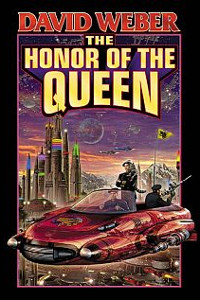
The Honor of the Queen by David Weber

I really enjoyed On Basilisk Station, the first book in the Honor Harrington series, and the second book did not disappoint. It had all of the stuff that made the first book so amazingly awesome, plus tons more action and political intrigue.

The dynamics in The Honor of the Queen were a bit different, in that Honor has definitely proved herself by now and is no longer the underdog freshman starship commander in the armpit of the galaxy. This time, she’s been given a small fleet, and assigned to an important diplomatic people with a critical potential ally of the Star Kingdom of Manticore.

But she still has a lot of proving to do, this time to the misogynistic people of Grayson who do not believe that women are capable of military command. If that sets off red flags, don’t worry: David Weber is no SJW, and this book was written long before “protect wamen” was a thing. The misogyny on Grayson has nothing to do with mansplaining, manspreading, or toxic masculinity: rather, it’s a culture that treats women literally as property, with none of the rights that women currently enjoy in the West.

One of the things that makes the Honor Harrington books so fantastic is the meticulous attention to detail. The history of Grayson is complex and nuanced, and presents a consistent and believable explanation for why the culture developed the way it did. Weber’s attention to detail extends beyond the world building to just about every aspect of the story: the characters, tactics, politics, and everything else. There’s a bit of handwaving when it comes to the technology—this is science fiction, after all—but not very much. Certainly, there’s no handwaving when it comes to human nature.

The part of the story that I found most interesting was the political intrigue between the Star Kingdom of Manticore and the People’s Republic of Haven. Honor’s enemy counterpart in the Havenite fleet is no pushover—in many ways, he’s just as sharp and capable as she is. Even though the People’s Republic of Haven are clearly the bad guys, I came away from this book thinking that Weber could easily write a book with the Havenite commander as the protagonist, and it would have been just as good. There are definitely bad guys and good guys, but they’re all still people, with reasons for believing the things that they do, right or wrong as they may be.

My only criticism of this book is that the ending felt a bit Mary Sue-ish with all of the accolades and promotions that Honor Harrington received. I still really enjoyed it, but if I didn’t already love the character, there were a couple of things that would have made me roll my eyes. Then again, truth is stranger than fiction, and I’m sure there are people who have received just as many honors and accolades as Honor Harrington did at the end of this one.

All in all, an excellent continuation to the series that builds on the first book and leaves plenty of room for more, especially in the rivalry between Manticore and Haven. Since that’s one of my favorite things about this series so far, I’m very interested to see what happens in the next book!

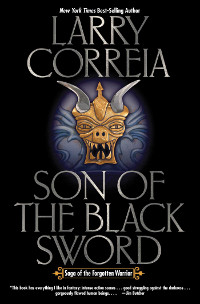
Son of the Black Sword by Larry Correia

This was a damn good book. One of the best epic fantasy books I’ve read. I started listening to it on the Baen Free Radio Hour, where it’s currently being serialized, and decided to pick up a copy. It did not disappoint.

This book reminds me of Brandon Sanderson’s Mistborn, in the sense that it takes place in a dystopian fantasy world where things didn’t turn out all that well after the hero of prophecy saved the world. It’s not difficult to imagine that after hearing Brandon pitch his book, Larry turned to the guy next to him and said “hold my beer.”

That said, Son of the Black Sword is very different from Mistborn. For one, it’s brutal and violent in a way that Mistborn never was. I wouldn’t exactly call it grimdark, since there is still an underlying sense of honor, and even a fair bit of optimism if you dig deeply enough.

However, you really can tell that Larry gets the kind of person who does terrible, violent things for a living. He knows how those people think, he knows how they see the world, and he knows how they interact with each other. He also knows what world dominated by those people looks like, which is definitely the world of Son of the Black Sword.

More than that, Larry understands and respects the relationship that exists between a warrior and his weapon. My favorite character was the sword Angruvadal, and I didn’t even realize it until the end. Angruvadal is a magic sword with a mind of its own, but it never really speaks or has any independent thought, other than whether its bearer is worthy and how best to serve its bearer if he is.

For me, the thing that makes or breaks a good fantasy book is whether the story is meaningful. I don’t really care for books that preach, but I don’t like books that are nihilistic and cynical either, which is why I never really got into George R.R. Martin’s A Song of Ice and Fire. Son of the Black Sword scratches that same itch for dark and gritty fantasy, but there’s still a sense of meaning beneath it all. Good doesn’t always triumph over evil, but the author still acknowledges that good and evil exist within the hearts of the characters.

I am so freaking excited to read the next book!

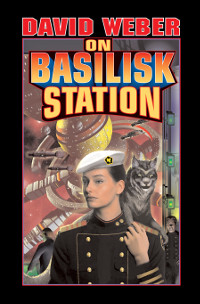
On Basilisk Station by David Weber

The Honorverse is what Star Trek wants to be when it grows up.

That’s the best way I can put it. On Basilisk Station is the first book in the series known as the “Honorverse,” which taken as a whole is David Weber’s best known work. Like Star Trek, the Honorverse is a far-future sprawling space opera epic full of exotic planets, interstellar empires, big starships, and big space battles. Unlike Star Trek, though, the Star Kingdom of Manticore has a military that actually functions like a competent, professional military (most of the time), and doesn’t have stupid rules like the Prime Directive that exist solely for the characters to break them. Also, the technobabble isn’t just babble, and the practical implications of the science fiction technology are fully explored.

The thing I liked most about this book was the political intrigue, though the characters come in as a close second. In fact, the two are intricately connected, as the intrigue grows out directly from the interactions between the characters. Like Ender’s Game, it all comes down to leadership, and like Orson Scott Card, David Weber has a keen grasp on human nature and what it takes to be an effective leader—and an effective follower, for that matter.

But unlike Card, Weber also has a keen grasp on how governments and bureaucracies operate, for better or (more likely) for worse. None of the characters in On Basilisk Station operate in a vacuum; they are all constrained by their loyalties, duties, and responsibilities, and their place in the chain of command. They are also constrained by the organizations and nations to which they belong, which in turn have their own positons and agendas, some of which run contrary to the personal beliefs and convictions of the people within them.

Weber is a master not only at pitting smart, competent characters against each other, but at pitting bureaucracies, parties, and governments against each other in ways that make you root for the little guys caught in the middle of it all. And above all else, Honor Harrington is a character worth rooting for. In a fight between Honor and any Star Trek captain (with the possible exception of Kirk), my money would be on Honor.

On Basilisk Station was an excellent start to what promises to be a highly entertaining series. I look forward to reading more!

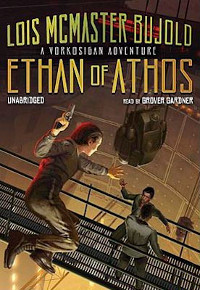
Ethan of Athos by Lois McMaster Bujold

I love the Vorkosigan books. Miles isn’t in this one, but a bunch of other characters are. It’s the same universe, with the same fascinating history, just with a bunch of new and interesting complications.

Ethan is from a world where women do not exist. The uterine replicator has rendered them obsolete, and a colony of fundamentalist MGTOWs has established a functional society where everyone is male and no one has ever seen or interacted with a dreaded female. But make no mistake, Ethan is not a MGTOW. He’s Athos’s best doctor: professional, responsible, and conscientious to a fault. And that’s why the council of elders has sent him on a mission to acquire female reproductive cultures before the ones on Athos all die out.

Along the way, he gets caught up with the Dendarii mercenaries, specifically one Commander Elli Quinn, and is soon caught up in the machinations of the Cetegandans and House Bharaputra, who are involved in some less-than-ethical bioengineering schemes that have brought the galaxy to the verge of war. If Ethan fails his mission, Athos itself might be nuked back to the stone age. But that is nothing compared to his most difficult task: learning how to work with a woman.

This book was a lot of fun! I have yet to read a bad book by Lois McMaster Bujold, and this one certainly didn’t disappoint. Lots of action and adventure, with dashing, resourceful heroes and frighteninginly comptetent villains. The all-male society of Athos was both fascinating and eminently believable, given the technology, and the interstellar espionage was loads of fun.

This isn’t the best place to start if you’ve never read any Bujold, but if you’ve already read The Warrior’s Apprentice and a couple of other Miles Vorkosigan adventures, you’ll really appreciate this book. Definitely one of the highlights of the series.

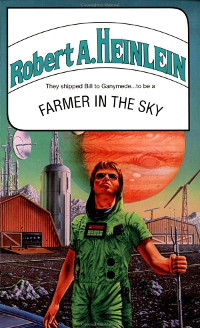
Farmer in the Sky by Robert A. Heinlein

As a general rule, Heinlein novels are either really controversial (The Moon is a Harsh Mistress), really meta (The Number of the Beast), really fun (Citizen of the Galaxy), or some combination of all three (Starship Troopers). Farmer in the Sky is one of the really fun ones.

This novel was written before the Apollo 11 moon landing, but it read like something from an alternate reality long after that pioneering era, where the space program never slowed down. For that reason alone, it was a fascinating book. You can really see how it inspired people back in the 50s and 60s to reach for the stars.

More than that, it was really fascinating to get into the knitty gritty of colonizing a world like Ganymede. This is one of Heinlein’s juveniles, so he doesn’t get too technical, but you can definitely tell that he did the research and built a plausible near future world. More than that, it’s the kind of world I’d actually love to live in. Ganymede is the new frontier, and the colonists who settle it are pioneers in every sense of the word. Not everyone makes it, of course, but those who do are rugged, resourceful, and remarkable.

This was a really quick read. There was a lot of little stuff that dates it to the 50s, like gender relations and the prevalence of the Boy Scouts, who are sadly no longer a cultural force in today’s society. None of it bothered me or threw me out of the story. If anything, it added to the novel’s charm.

Heinlein knows his stuff. This was a really fun book. If you’ve never read any Heinlein, Farmer in the Sky is a good place to start.

The Guns of the South by Harry Turtledove

As those of you who’ve read my short story “The Gettysburg Paradox” know, I’m a huge fan of both the US Civil War and time travel stories. Harry Turtledove’s The Guns of the South is, quite possibly, the best combination of the two.

The novel starts just a few weeks after Gettysburg. The Army of Northern Virginia is in disarray, and a defeated Robert E. Lee has been forced to face the truth that the Confederacy has no real hope of winning the war. Then a bunch of time travelers in strangely mottled uniforms show up out of nowhere and supply his army with strange new guns called AK-47s.

Immediately, the tides of war change. Lee soundly defeats Grant at the Battle of Wilderness and presses on to Washington DC, which falls overnight. Triumphant, the South immediately sets about the peace negotiations with their northern neighbor, and prepares for a presidential election which Lee is expected to win. But disagreements about the fate of the new American nation soon arise between Lee and his benefactors, sparking a conflict that is truly out of time.

There’s so much to love about this book. Turtledove’s attention to detail is meticulous, not just in the obvious major ones, but in the little ones that have a disproportionate impact. For example, Lee appreciates the killing power of the  AK-47s, but what impresses him even more are the MREs that the time travelers carry. When the gunmakers in Richmond pick apart the AK-47 in an effort to replicate it, it’s really fascinating to get their take on its functions. It really does read like a bunch of 19th century denizens puzzling over technology that they barely understand.

But what really got to me were the characters. Having read The Killer Angels and Jeff Shaara’s prequel and sequel to that great novel, Robert E. Lee felt like exactly the same character, just in a different book. His genteel sense of propriety, his calm but unshakeable sense of honor, his love of his men and respect for his enemy—it really was the same guy. And the decisions he makes after the war is over, while truly radical, are also eminently believable.

It’s not just Lee, either. Lincoln, Soward, Longstreet, Forrest—all of them feel very much like the people they really were, inhabiting an alternate reality. Turtledove’s research into their characters and personalities was meticulous. And it wasn’t just the big names, either, as all of the 19th century characters, including a prostitute who pretended to be a man in order to join the infantry, are based on real people who actually lived.

Fantastic book—a must-read for anyone with an interest in time travel or the US civil war. Whether those interests intersect for you or not, you’ll thoroughly enjoy this book.

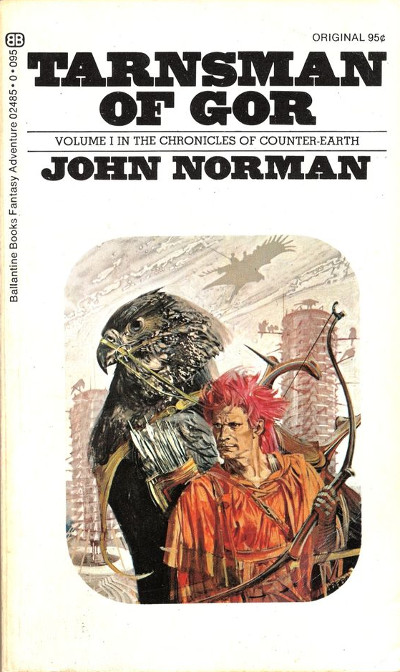
Tarnsman of Gor by John Norman

I’ve been meaning to read this book for a while, since I heard that it’s a classic of the Sword and Planet subgenre and I’ve really liked the other Sword and Planet books that I’ve read. (Princess of Mars, The Dying Earth, etc. Come to think of it, I haven’t done a review of Princess of Mars yet, so that’s as good a reason as any to reread it!)

Besides the association with Sword and Planet, the Gor books have also spawned a subculture of BDSM, and for good reason. On Gor, slavery is not only normalized, it’s romanticized. A typical marriage ceremony consists of the groom binding up his bride, carrying her off on a giant bird, and throwing off her clothes to “show her people what had been the fate of [such and such girl].”

I don’t swing that way, but I thought I’d give the first book a try. I’d heard that the bondage fetishism doesn’t take over until the fifth or sixth book, and while it’s definitely there in Tarnsman of Gor, it wasn’t enough to make me put the book down.

As a swashbuckling action-adventure tale, I thought this book was pretty good. There definitely was no shortage of action, and while the plot twists were fairly predictable, they were also enjoyable and interesting. It’s a fun, if brutal book.

There were a lot of lengthy info-dumps, though, which wouldn’t have been so bad except that I had problems with the world. In general, it felt like the author had come up with a really cool world but not sufficiently thought it through. For example, if humans aren’t the apex predator on Gor, how are there so many human cities? If the caste system is maintained by deliberately sharing false information with the lower castes, how is that system long-term stable if the caste isn’t something you’re born into?

The general impression I got was that this world is a brutal, savage place where everyone is broken in some way, a lot like Mad Max. The thing is, I’m not sure that that’s what the author was going for.

That may just be an artifact of the time this book was written, though. A lot of older books that invented the tropes now seem stiff and wooden—not because they weren’t innovative for their time, but because we’ve seen those tropes so many times that we already know what to expect. Tarnsman of Gor was written back in the sixties, before role playing games and chihuahua-killing fantasy tomes had made world-building so important. Back then, it probably was enough to say “here’s a really cool world” without first thinking about all the ways to break it.

Again, that wouldn’t be so bad if all this book attempted to be was a swashbuckling adventure on another world. But at several key points, the narrator steps back from the story to explain some aspect of the world that was only tangentially related to the plot.

All in all, I give this book three stars. It’s worth reading if it interests you, but it’s not a must-read.

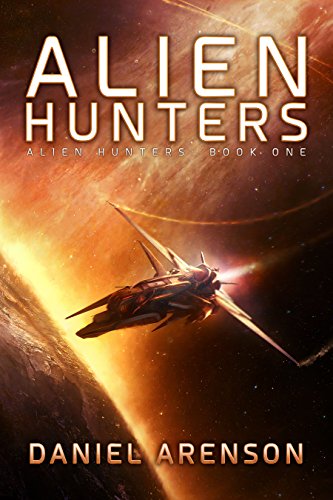
Alien Hunters by Daniel Arenson

I picked up this book from an Instafreebie giveaway, though it is free on Amazon and other venues (I assume). Even though it’s the first book in the series, it stands well on its own, which is always a plus.
I enjoyed this book. That said, it’s pretty wacky. Be prepared to suspend your disbelief for basically the entire book. Case in point: the good guys fly a spaceship that’s basically a giant dragon, with an AI interface that is literally an android Geisha. Also, there’s an otaku ADHD demon (literally a demon) who wears pajamas, lives in the spaceship’s attic, and likes to drink their fuel. Also, the main character’s brother is a literal knight in shining armor, and his girlfriend is an alien space babe gladiator (gladiatress?).

Like I said, it’s a pretty wacky book. But it’s also a really fun story. The whole thing was over the top, but in an entertaining way. I laughed out loud at several points and finished the book in a couple of days. Good, clean, fun, fast story.

Some of the other reviews complain that this is basically a fantasy story set in a science fictional universe. I actually think that’s a strength. It’s very science fantasy, but it hits the tropes in the right ways. And as wacky as the story is, the characters are well rounded and fun to read about (especially the pajama-wearing demon).

Will I read the next book? Probably, though it’s not super high on my TBR pile at the moment. But that’s only because there’s a bunch of stuff that I’ve been meaning to get to for months, or even years, that are now suddenly very urgent. For a light escapist diversion that I can read in a couple of sittings, something like this is perfect.

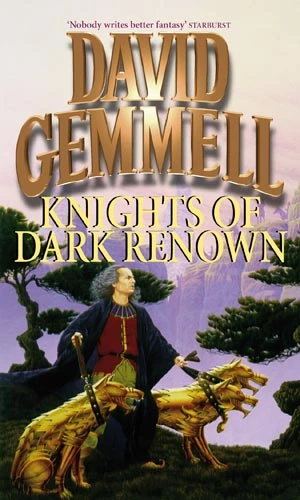
Knights of Dark Renown by David Gemmell

If you’ve been following this blog for any time at all, you know I’m a huge fan of David Gemmell. He’s not only my favorite fantasy writer, he’s my favorite writer, period. His first book, Legend, is still one of my favorite books of all time.

The Knights of Dark Renown is a true standalone, something rare in David Gemmell’s sizeable bibliography. And yet, page for page, it stands up to the best of his work. A brutally violent world populated with unlikely heroes and redeemed villains. An ancient order of magical knights fighting back against an even more ancient evil. Characters who leap right off the page and grab you by the heartstrings, making you weep when they die and stand up and cheer when they triumph—sometimes with the very same breath.

Honestly, if I’d written this review right after I read the book, it would be nothing but “squee!” repeated over and over. It’s been a few months, so my excitement has definitely been tempered with the passage of time, and yet looking back I can definitely say that this was an excellent book.

It’s probably the best vampire novel I’ve ever read, which isn’t what I was expecting. There are a million different kinds of vampires out there, most of which I have no interest in, but these vampires strike much closer to the original: charming, blue-blooded monsters who look perfectly normal on the outside, but beneath the facade are as cruel and terrifying as the most competent and accomplished serial killers—which they very often are. But the really awesome part is how the vampires tempt those they deem worthy to join them, which is how they begin the conquest of the world of men. Without ruining the book, I’ll just say that I was impressed.

Gemmell is often accused of writing the same book over and over again. While that isn’t completely fair, I do see how he gets that reputation. Thing is, that book he supposedly keeps rewriting is a damn good one. He’s a lot like Louis L’Amour in that way.

However, Knights of Dark Renown is something of a departure from that vein. The magic system is different from his other books, as is the lore. The usual character archetypes are there, though he combines them in different ways. The bard, for example, follows a very different path from the Drenai books, and is cut from a different cloth. But none of it is a particularly great departure from Gemmell’s usual fare.

With all that said, I really enjoyed this book. It easily earned the five stars I gave it. Highly recommended.