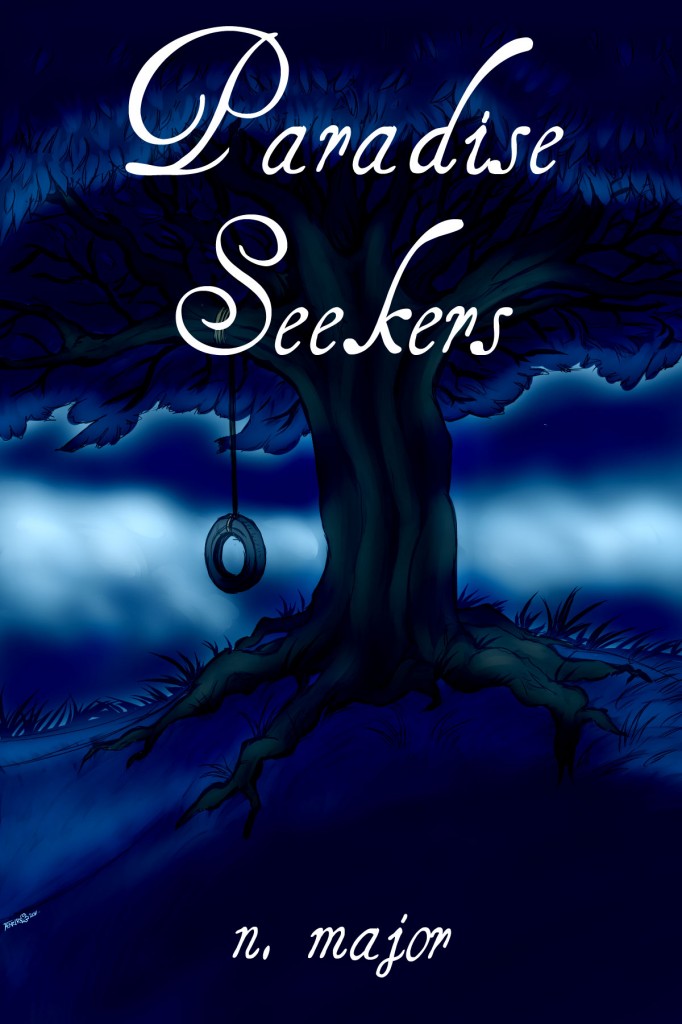
Nathan Major is a friend and fellow writing who, like me, has taken the epublishing route for his first novel, Paradise Seekers. I met him through our mutual friend Charlie at Brandon Sanderson’s English 318 class. His book is pretty good; I’m only partway through it right now, but he’s playing with some interesting fantasy concepts and I’m definitely looking forward to seeing how he pulls it off.
I recently appeared on his blog with a guest post on how I develop my characters; for his appearance here, I decided to throw the question back at him. Like a true fantasy author, he answered it with a multi-part epic that is probably only the first installment of a trilogy. He makes some good points, though, and it’s definitely worth reading (and not just for the snarkiness, heh).
On a tangentially related note, I also appeared recently on Charlie’s blog with a post on ebook formatting and book DIY. When you’re finished here, be sure to check it out!
And now, I give you Nathan Major…
================================================
 When you think of fantasy, what is the first thing that comes to your mind? Mystical worlds populated with elves, dwarfs, and other magical races? Kingdoms and castles, dark lords and noble heroes? Perhaps you entertain a world that is more supernatural and more interesting than our own, one that would allow you to escape to its enchanted forests and sweeping vistas.
The fantasy genre differs from other forms of fiction (except perhaps science fiction) in that the worlds they take place in tend to be the stars of the stories. Middle-earth and Prydain. Oz and Earthsea. And within these worlds, a classic clash of good vs evil is expected. The characters and story can often take a backseat, with many authors spending years of their lives crafting the perfect magic system, most precise system of fantastical government, and the means to make their elves the best damn elves you’ve ever seen.
This drives me crazy.
I’ve been reading fantasy my entire life, but it wasn’t until a few years ago that I got fed up with the whole thing. I loved The Hobbit and The Lord of the Rings, but as I dug deeper and picked up more modern fantasy, it all seemed to start blending together. Here is our noble hero, beating the odds to fight against a nameless, oft-hidden dark lord. Here is his spunky princess sidekick slash love interest, his old mentor who dies in act two, and the hardened warrior with a dark secret. While not all books contained these tropes, the main issue still persisted: I wasn’t seeing any new characters.
That was actually what drove me to writing. After reading through a particularly popular fantasy book that was also atrociously generic, I remember tossing the book on the couch and thinking, “I could do better than this!” So I set out to try my damnedest to write a fantasy novel that, yes, was in a fantastic worlds that we wish we could live in, but was populated by people just as interesting and well-developed as the world.
Since I’m severely ADHD, I’m going to break this up into a few key ideas that (hopefully) will get my point across. These aren’t just applicable to fantasy, but it’ll be my main focus.
1) Plan your characters first, before you plan the world.
Simple enough, right? When speaking with most other fantasy authors on the subject of brainstorming, the first things they say are, “Oh, I got the coolest idea for a magic system!” or “This world is going to be amazing…it’s made entirely out of White Chedder Cheese-its!” To which I say, “Ok, but what’s the story? And who are the people influenced by the story?” This is usually met with a, “I don’t know, I’ll figure it out later!” Then I defriend them on Facebook and pretend they never existed.
Ok, so the last part was an exaggeration. But the point still stands: you may have the greatest world ever devised, but so do map-makers, and theirs looks better. What is actually in the book is the plot and the characters, and the world is just what it takes place in. You might have the greatest appendix ever at the end explaining how the Haku-Bula Wolf Tribe’s language is actually a combination of grunts and Swedish, but that doesn’t matter to the average reader. Figure that stuff out after you’ve got a story, because it’s less important.
2) Don’t fall into cliches.
This is a hard one, as discovered by me when writing my third book, Where Gods and Mortals Dance. If you’ll excuse a moment of self-indulgence, when writing this book I had a female princess as the main character. She was a strong character, but due to circumstances beyond her control she was thrust into a situation that was almost impossible for her to fix. I remember trying to design her as strong but still fragile, as parts of her past haunted her and made her ability to rule difficult.
Then I took her to writing group, where the group was divided. Half said she was the, “generic, strong, masculine princess who takes charge,” and the other half felt she was the “weak, needy, spoiled princess” who has everything done for her.
It frustrated me, but also proved a point.
I was relying on two cliches and stereotypes to design my character. I drew from both in an attempt to be original, but that didn’t work. This happens all the time in fantasy. We have the old warrior, somehow inferior to our spunky young farmhand who picked up a weapon for the first time yesterday. We have a dark lord who never actually does any fighting or has any coherent plans, he just sort of sits on his throne of skulls and knives (which is probably black and on fire) and waits for farmhands to come and kill him.
Even in the most original novels, these cliches can become evident. They might not be as blatant as the ones said above, but keep them in mind when writing. Your book doesn’t have to star a teenager. It could star a forty-year-old man who wants to save the world. There doesn’t have to be a Dark Lord at all; the enemy could be something completely different. Stay the hell away from elves, dwarfs, or anything that Tolkien used. And taking Orcs, changing them slightly, and calling them “Orks” doesn’t count as being original, it counts as being a cop-out. Fight the cliché. Make your characters deep and unique.
3) Remember: Everyone is a hero in their own story
Sympathetic villains are a rarity in fantasy. Most of the time we have a group that is distinctly bad, and a group that is distinctly good. You can usually tell by how they live. If they live in trees, clouds, or anything that communes with nature: good. If they live in filth, a swamp, or basically anywhere that looks like it’s under the constant duress of a smoke-machine: evil. Usually bad-guy motives are just “they are bad and hate the good guys,” which is a freaking awful excuse. Oh, and don’t get me started on the “he’s insane, that’s why he wants to destroy the world!” villains. That’s the biggest cop-out of them all and if you use it I want to punch you in the face right now. You are cheapening your characters and your story to make things easier for you. Here’s a revelation: good books aren’t easy. It took Tolkien how long to craft the novel that essentially invented modern fantasy? I’m not saying you should take two decades to make your book, but you should at least have to take more than one sentence to describe your villain’s motives.
The best part about the above expression (which is probably my motto when it comes to developing characters) is that it changes the way you look at your book. Life isn’t black and white: it’s a whole lot of gray. You might see something in black and white, but if you were given a chance to enter someone else’s head, perhaps your view would switch entirely. Nothing is scarier than a completely sane, totally competent villain whose goals just so happen to be the exact opposite of our hero’s. In fact, it makes the reader uncomfortable, because many of them will no longer know who to root for. If you are doing it right, your villain’s motives and values should be just as convincing as the hero’s, which means the reader should be second-guessing their loyalties throughout the book. It makes for a hell of an engaging read, let me tell you.
But this little ditty isn’t just for main characters. Side characters also need to be their own heroes. Sam didn’t just tag along with Frodo because it was a fun thing to do. He knew what had to be done (probably even better than Frodo) and fulfilled that personal quest. Your side characters need to have their own motives and motivations, depth and personality. Don’t’ drag them to Mt. Doom with the only reason being “because the hero was heading that direction anyway.” They should be just as deep (or at least close to the level of depth) as your hero. Make them interesting, and your reader will love them even more.
4) For your characters to be successful, you must know them better than they know themselves
Wow, that’s a long one, and it is sort of off the theme of “broad, overgeneralizing statements” that these bullet points have been so far. At any rate, I’ll try and be brief with this one because it seems self-explanatory.
I have a friend author who, upon designing a character, takes an online “100 questions personality test.” While I’m not saying this is the “go-to” answer for everybody, it can be an extremely helpful tool in understanding a character better. What do they like to eat? What is their taste in women (or men)? If they magically appeared in our world and wanted to hang out, what would you do? These are questions that’ll maybe never be addressed in the story, but you should know these answers. If a character has a name and is in the book for more than a single chapter, you should know everything about them.
This can be hard work, especially if you like having a billion characters. But even if you just have one or two, you really need to be in their heads. Know them. Be them. Imagine them in other situations besides in your novel. And once you really understand what makes your spunky farmhand tick, then you’ll be able to write him in both a convincing and believable way.
5) Write characters you’d like to read about
Figured I’d end this on a simple one. It’s very easy when writing to get the rose-tinted glasses put on, and all of a sudden everything in your book seems perfect. Your characters are a little cliched, but whose aren’t? Your dark lord doesn’t really have a idiom, but he does have a badass axe carved from the ashen bones of the long-lost race of dragons. Who wouldn’t like this book?
Take a step back and think. And if you can’t think of yourself, think of me. A cynical, jaded red-head who writes fantasy only because most of the fantasy currently out there pisses him off. I am your audience. I am biased, blatant, and unbelievably good looking. What would I say?
If you know your characters (see #4!), and you know them well enough then this step shouldn’t be an issue. You’ll like them regardless, because any author gets attached to a character they know every aspect of. In my current novel, Effulgent Corruption, one of the viewpoint characters is complete scum. My initial development of him was a murderous, rampaging madman whose only reason for existence was to kill and destroy. However, as I dug deeper and began to understand the character, he became sympathetic. I realized the man’s goals, what emotional pains he’s been through, and what hurts him now. I knew who he relied on, and what parts of himself he hated.
He quickly became my favorite character.
This should happen with you. You should love your villains, and hope that, should this whole “world-saving hero” thing blow over, their goals will be accomplished. Your side characters should be entertaining and fun, people you’d want to hang out with, just like your hero does. You should know everybody and at least have a shred of sympathy for them. Then, you’ll have great characters.
This, of course, isn’t a complete guide to developing good fantasy characters. Hell, it isn’t really even a very specific one. But I’m almost 100% sure that, should you take these ideas to heart, you can beat the odds and write a fantasy novel that is as interesting in its ideas about elven politics as it is with its elaborate, three-dimensional characters. Fantasy as a genre deserves better, and you (yes, you!) can be the one to do it. So go forth, young author, and write the epic that will shake the Barnes and Nobles across the land!
Plus, it’ll increase your chances that I’ll actually read it, which is a perk in and of itself.
Copyright (c) 2011 by Nathan Major