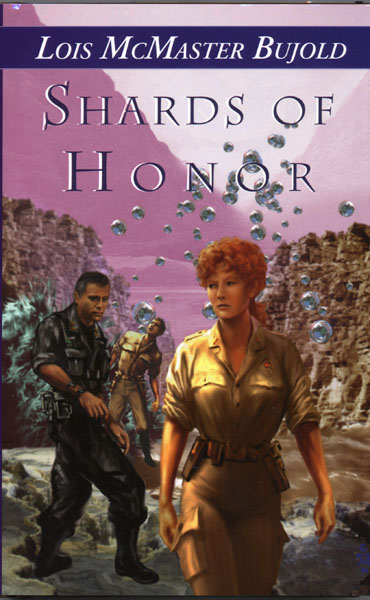
Shards of Honor by Lois McMaster Bujold

Cordelia Naismith never thought she would find the love of her life on a scientific survey to an unexplored border world, let alone that he would be a Barrayan, one of the enemy.  But Aral Vorkosigan is not just any other officer in the Barrayan Military.  He is courteous, fair-minded, thoughtful–and above all else, driven by an innate sense of honor.  To her surprise, Cordelia soon finds that she has more in common with the man than she thought possible.

But the rumors of war between Escobar, Beta Colony, and Barrayar soon conspire to drive them apart.  Though Cordelia sees Vorkosigan for the good man he is, the rest of the galaxy only knows him as the “Butcher of Komarr”–an unfortunate title which Vorkosigan does not entirely deserve.

As Barrayar goes to war and Cordelia finds herself rising through the ranks of the Betan Military, she is forced to choose between loyalty to her country and loyalty to the man she loves.  When the two are mutually exclusive, how does one preserve one’s honor while securing a degree of happiness?

I loved this book.  Unlike some romances, where the male protagonist is a complete douchbag, Aral Vorkosigan is the kind of guy I’d like to be like.  Bujold strikes an excellent balance between strong and sensitive that enhances, rather than taints, his manliness.  Besides that, Vorkosigan is extremely fascinating, with a complicated backstory and motivations that are both believable and interesting.

Though it’s technically a romance, the book reads very much like military science fiction, with deliciously tongue-in-cheek phrases like “the cadet was too young to believe in death after life” and rigorous attention to the details of military life, such as rank and chain of command.  The book definitely has enough explosions, space battles, and political intrigue to appeal to boys as well as the romance audience, but Bujold melds the space adventure elements seamlessly with the romantic elements, so that readers of either genre don’t feel left out or patronized.

There was only one thing that bothered me, and since it contains spoilers I’ll put it in black so that you don’t inadvertently see it.  To read it, highlight the text:

After Cordelia ran away from home and married Vorkosigan, why did she never think about her homeland again? You would think that as a career military officer who had dedicated her life to her country, she would at least have some lingering doubts that she’d done the right thing by running away–especially when her husband became the new Lord Regent of Barrayar! To me, this seems in-congruent with her character.

All things considered, though, this was an excellent, well-written science fiction adventure/romance. I thoroughly enjoyed it and will definitely be reading more of Lois McMaster Bujold’s work again.
Life in the Real World

So it’s been a week since I graduated, and life in the “real world” is very different from academia.  In some ways, it’s scary, but in other ways, it’s actually kind of fun.

Freedom from schoolwork is HUGE.  Seriously, I had no idea how much day-to-day stress came from school until now.  Without this or that assignment hanging over my head, I feel incredibly liberated.  I can go wherever I want, or do whatever I feel like doing, and the only restrictions on my time are the ones I set for myself.

Of course, life isn’t stress free–far from it.  Employment is definitely a problem.  I need to find a job and start making some kind of an income.  That’s the main stressor right now–how am I going to sustain myself?

In some ways, it’s kind of a game.  I’ve got my budget lined up, with projected monthly expenses, and that tells me how much money I need to make to break even.  The object of the game is to find creative ways to make that money.

This is what I spend most of my day doing.  Some interesting  prospects include:

  1. Freelance editing.  A roommate of a friend of mine has actually contracted with me to do this for a company he recently started.  It isn’t steady work, but $40-$60 per job for basically reworking a piece of fantasy, it isn’t bad either.
  2. Freelance translation.  A friend of mine from the FLSR told me all about this.  Basically, I just need to set up a free account at proz.com, post my resume, set up paypal, and start taking jobs.  Again, it isn’t steady, but it’s promising.
  3. Temp work.  As luck would have it, there’s a temp agency across the street from my apartment, and a friend of mine already works there.  It’s just filler until I get a real job, but it seems to pay fairly well, though the labor is mostly grunt work.  Still, better grunt work than office work.
  4. Working for a teleresearch company down the street.  It isn’t the best kind of work, but it’s a job, it’s got flexible openings, and it’s local.
  5. Anything legit on craigslist.
  6. Anything from the Wilk boards (though it’s kind of skimpy right now).
  7. Donating plasma.  Hey, $65 a week is better than nothing.

So that’s what I’m thinking about doing to hold me over until I get a real job.  My goal for May is to make more money than I spend.

Really, though, I don’t need a job for the money–I’ve got enough cash saved up to last at least through the summer.  I need a job for the sense of security.  It’s hard to focus on writing when I don’t know how I’m going to support myself.

Another danger with unemployment is the lack of structure.  When you don’t have to get up and go to work, you find yourself getting up later and later.  If you don’t have to do anything, you generally don’t accomplish very much.  It’s hard to stay productive in the face of so much free time.

Still, I’m going to try.  I’m keeping up with my writing, doing about 3k-4k words per day on the revision of Mercenary Savior.  I’ve got a handful of submissions out on Genesis Earth, and I’m going to keep a steady number of submissions out at any time.  I’ve also been submitting my unpublished short stories, so we’ll see where that goes.

In the meantime, I’ll keep looking for a day job while I play the game of financial independence.  It’s an adventure.

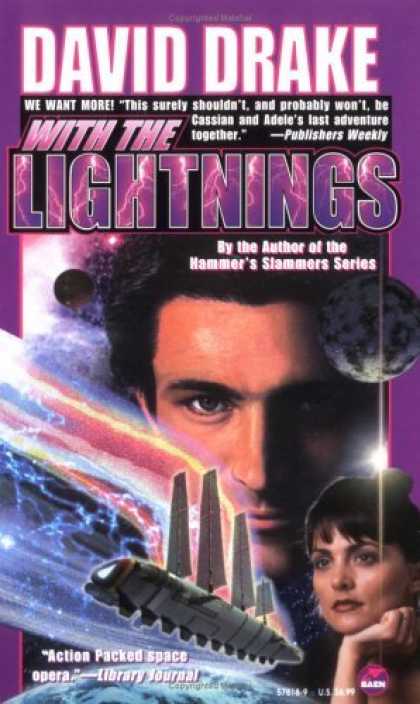
    With the Lightnings by David Drake

    Daniel Leary, Lieutenant in the Republic of Cinnabar Navy, dreams of commanding a military starship one day.  Unfortunately, as the estranged son of a corrupt senator, and with almost no money to his name, he has virtually no chance of ever seeing it happen.

    While serving in an assignment on Kostrama, a neutral trade world between Cinnabar and her mortal enemies, the Alliance, he meets Adele Mundy, chief librarian of the Kostraman capitol.  The title is virtual meaningless, however, as the uncultured Kostramans would give the position to anyone–even a political exile from Cinnibar such as Adele.  Her whole family was assassinated by Leary’s father, and she has sworn to take revenge.

    Little do they both know, the Alliance has other plans.

    Ever since I met David Drake at World Fantasy 2009 in San Jose, I’ve been meaning to read one of his books.  I must say, I picked a good one.  With the Lightnings is the first book in his RCN Series, which is basically David Drake’s take on Patrick O’Brian’s Aubrey-Maturin novels.  Think Napoleon-era naval battles and political intrigue…in space.

    Does it sound good already?  Yeah, I thought so.

    I was a little surprised at first, because the first chapter started with a bunch of info dumps.  It took until about the halfway mark for the action to really start, but when it did, it was awesome. A bunch of navy guys marooned on a hostile planet behind enemy lines, trying to survive a planetwide coup and blowing all kinds of stuff up along the way–yeah, it was cool.

    The thing I enjoyed most about this book, however, was the insight into the minds of the officers and the way the officers and soldiers interacted.  You can tell that David Drake has experience in the military–lots of experience.

    It was evident in the little things the main character noticed–the colors and patterns of soldiers’ uniforms, competency among his own men and incompetency in men not under his command, leadership style and how he dealt with crises–stuff like that.  The language was colorful, but when the soldiers swore, their language had a bite to it that went beyond the actual words.  The people felt gritty, but very real.

    At World Fantasy, I mentioned to David Drake that I’d read some of Joe Haldeman’s works, and knew they were both Vietnam vets.  He remarked that Haldeman’s works are very much different than his own: Haldeman’s characters are constantly stabbing each other in the back, whereas in Drake’s works, there is always a sense of teamwork and unity, even when the going gets messy.

    I could definitely see that in With the Lightnings–it’s one of the things that made the book so fun to read.  Yes, things get pretty tough and a lot of people die, but there’s always a sense of loyalty within the platoon (or whatever the unit is called).

    With the Lightnings is a great space opera action/adventure story.  After reading it, I really want to read more books in the RCN series.  If you want a good, fun military sf adventure story, this is a great one to pick up.

    Gah! It sucks

    I’m about a third of the way through To Search the Starry Sea, and my greatest fear at this point is that it isn’t as good as the last novel I wrote.  Because if it isn’t as good, that means that I’m getting worse, not better, and if I’m getting worse, that means I’m never going to make it as an author, because I’m not even published yet, and if I’m not going to make it as an author, that means I’m going to have to do what I’m doing NOW for the rest of my life, which means that I’m going to be miserable and life is going to suck…

    <pant> <pant> <pant>

    Seriously, though, sometimes I wonder if I’ve really made the right choice.  To Search the Starry Sea is much more of a happy adventure story, but sometimes I feel that it lacks depth and meaning.  I’m starting to get feedback from my alpha readers for Bringing Stella Home, and their reactions to it are surprisingly encouraging.  That story moved people–but this one?  I don’t know.

    Then again, Bringing Stella Home is dark, gritty, and very tragic.  I remember feeling depressed by the story even as I wrote it.  Is that the kind of story I want to be known for?  If I can write something deep and meaningful and have it be optimistic and adventuresome, that would be a lot better.

    I’m discovery writing it hardcore, which means that side characters often come to play a much more central role than I’d thought, and events that I thought I could cover in a chapter, I have to cover in two.  I have an idea where the story is going to end up, though, and it’s going to be awesome. How awesome?  Let me show you:

    Yeah, it’s going to be awesome.

    I think the key to keeping it meaningful is 1) to keep in mind the main character’s inner conflicts, framing them in a way that the readers can relate to their struggles, and 2) keeping the overall growth arc constantly in mind.  How does what’s happening affect how the character is changing?  That kind of stuff.

    I hope I can finish this in two months.  I’m mired in the middle of it right now, and the end is far from sight.

    In the meantime, I think I’ll get some sleep.

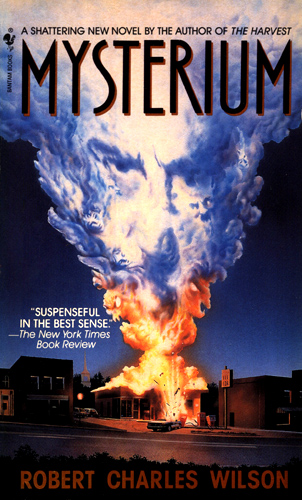
    Mysterium by Robert Charles Wilson

    Nobody knows why the government chose the small town of Two Rivers, Michigan, as the site for a top secret military project.  Even most of the people involved in the project don’t know what it’s really about.  That’s alright, because most of the denizens of this backwoods community are used to minding their own business.  But after a mysterious explosion bathes the entire city in light, that becomes impossible.

    On the outskirts of town, all the roads and power lines dead end in ancient virgin forest.  It’s as if a perfect circle has been drawn around the town on the map, and everything within the circle has been transported to a parallel world.

    A very unfriendly parallel world.

    Robert Charles Wilson’s writing is awesome.  I could eat up his prose all day.  It not only flows beautifully, it’s clear and transparent, to the point where I forget that I’m reading and feel as if I’m there.  He always uses the right expression, the right metaphor, and yet his prose never attracts so much attention to itself that it distracts from the story.

    I noticed several similarities between Mysterium and Wilson’s other novels that I’ve read.  All of them start in our modern world and move into a mysterious, unfamiliar milieu.  All of them involve strange religions and religious conflicts.  All of them involve male and female characters struggling to face personal relationship problems and eventually coming together.  In these ways, this story felt very much like Spin.

    At the same time, I can definitely tell that this is one of Wilson’s earlier works.  The story flows like a thriller, but lags in certain points.  After the town is transported into the parallel dimension, the story seems to meander without any clear direction.  For several chapters, I lost the sense of progress that usually accompanies a good plot.  The resolution receives very little foreshadowing–the “surprising yet inevitable” element was only “inevitable” three or four chapters from the end.  If it weren’t for Wilson’s beautiful writing, I would have put this book down in the middle.

    <spoiler alert>

    Unlike Spin, I found the milieu of this story somewhat depressing–not necessarily because of the setting itself (though it’s not the kind of alternate present that I’d want to live in), but because the people of Two Rivers never go back.

    According to Card, there are two basic types of milieu stories: stories where the protagonist returns profoundly changed, or stories where the protagonist “goes native” and becomes assimilated.  But…if the new world isn’t the kind of place you’d want to live in–in other words, if it’s dystopian (and Wilson’s alternate world in Mysterium is fairly dystopian)–then there’s this tension of “will the protagonist make it back?  Will they return?” And if they don’t return, the story is emotionally disappointing.  That was the case for me with Mysterium.

    </spoiler alert>

    From this review, it probably sounds like I hated this book.  That wasn’t the case–not at all!  This was a good story, and I enjoyed it.  I finished the last hundred pages at a sprint at 1:30 in the morning–it was definitely that kind of a book.  I couldn’t put it down.  And at the same time, it was thoughtful and profound (as you can tell from my previous post, “Why I love Robert Charles Wilson“).

    I’ve probably said enough.  If you like thrilling, parallel world adventure stories with a contemplative, thoughtful “what if?” element, read this book.  Even with all the misgivings I’ve mentioned here, it’s good SF.  Very good.