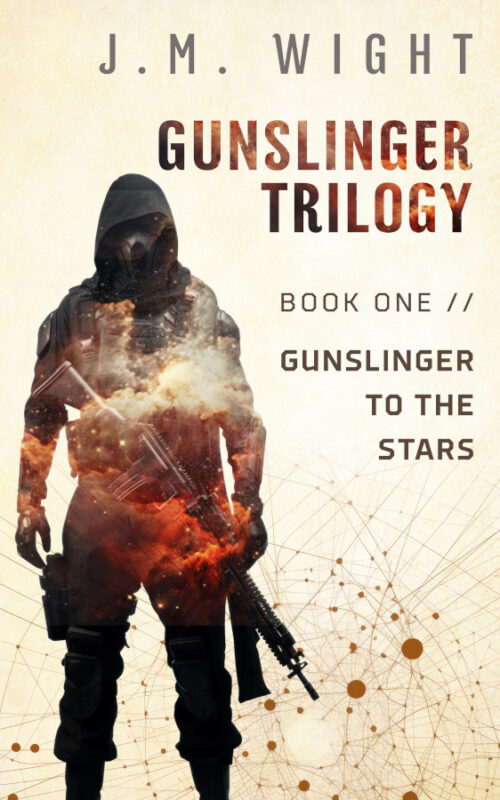
Is Gunslinger to the Stars for You?

Gunslinger to the Stars is a character-driven space opera novel that blends Western adventure, first-contact science fiction, and pulpy action. It’s fast-paced, voice-driven, and built around a loyal, reluctant hero navigating a dangerous galactic frontier. It’s told in the unmistakable voice of Sam Kletchka—half gunslinger, half star-hopping troubleshooter, and 100% fun.

What Kind of Reader Will Love This Book?

If you like…

  • Classic space adventure with modern voice and humor, where the hero solves problems with grit, guts, and an outrageous arsenal of lovingly described guns
  • Found-family dynamics between a rough-around-the-edges gunslinger, a principled xenolinguist, a telepathic outcast, and a trio of shapeshifting empaths
  • Galaxy-spanning mysteries, alien politics, and first-contact stakes that push characters to their limits
  • The feel of a Western gunslinger dropped straight into a richly imagined galactic frontier

…then Gunslinger to the Stars is absolutely your kind of story.

What You’ll Find Inside

Gunslinger to the Stars (Book 1 of the Gunslinger Trilogy) follows Sam Kletchka, a New Texas gunslinger stranded in the Gorinal Cluster just as the local jumpgate—the only way out—mysteriously goes dark. What starts as a simple job escalates into a battle for survival involving hidden alien races, shape-shifting empaths, worldships, and a rising threat the Immortals never wanted anyone to discover. The tone blends wry humor with escalating danger, and the style is fast-paced, voice-driven, and cinematic—equal parts action romp and big-idea sci-fi. The result is a story that feels both classic and fresh: a pulpy, heartfelt adventure that’s as much about loyalty and moral clarity as it is about space battles and exotic technology.

What Makes It Different

Fans of Firefly and Schlock Mercenary will recognize the snappy banter, the found-crew dynamic, and the blend of humor with high-stakes action. But Gunslinger to the Stars pushes those familiar ingredients in new directions: the gunslinger-as-space-ranger angle gives the book a distinctive American-frontier voice, while the empath culture, the Immortals’ centuries-deep manipulations, and the emergence of the Draxxians create a myth-arc that feels simultaneously expansive and personal. Where many space operas lean on military hierarchy or techno-fetishism, this one leans into character, moral philosophy, and the uneasy tensions between peacekeeping and necessary force—all told through Sam’s dry, self-aware perspective.

This story blends classic space western tropes — the reluctant hero, the ragtag crew, and the dangerous frontier — with a deeper mystery about ancient alien powers. If you enjoy space western stories with a strong first-contact throughline, you’re going to enjoy this book.

What You Won’t Find

If you’re looking for grimdark bleakness, heavy technobabble, or a cynical antihero who never grows, this isn’t that. And if you want romance-heavy sci-fi or endless political intrigue, this book doesn’t go down those roads either. But if you want hopeful, character-focused adventure with humor, heart, and a hero who takes responsibility for his choices—sometimes reluctantly—you’ll feel right at home.

Why I Think You Might Love It

I wrote this story at a time when I needed to shake things up creatively, by writing something fun, energetic, and different from what I had been writing at the time. I was also going through a time when my worldview was changing, and I was questioning a lot of my old assumptions. This book grew out of a number of things: from my conversations with close friends, my love of classic pulp sci-fi, and from the idea of a lone wanderer who tries—however imperfectly—to do the right thing. The result, I believe, was a book with a lot of heart that captures that spark of wonder that made me first fall in love with science fiction. If that’s what you’re looking for, I think you’re going to love it!

Where to Get the Book

Related Posts and Pages

Explore the series index for the Gunslinger Trilogy.

Visit the book page for Gunslinger to the Stars for more details.
Read about moral courage in Gunslinger to the Stars.

See all of my books in series order.

WIP excerpt: Gunslinger to the Stars

Here’s the first thousand words from my current WIP, Gunslinger to the Stars. It’s a departure from my usual stuff: a shoot-em-up adventure in the vein of Firefly and Guardians of the Galaxy. TONS of fun to write, and the ending is going to be absolutely spectacular. This may turn out to be the most entertaining book I’ve written to date.

But enough of me blabbering about it. Here it is!


Stranded in the Armpit of the Galaxy

The Gorinal Star Cluster is, in every meaningful sense, the armpit of the galaxy. It was just my luck to get stranded there right as shit hit the fan.

I didn’t know that at the time, of course. My ship, the Star Runner, was in pretty bad shape after a botched-up mission that I’d rather not talk about, and since the only trading commodity I had was the fuel in my tank, I was getting rather desperate for work. The Gorinal Cluster wasn’t my first choice of venue, but it was the closest place with plenty of job opportunities for a man of fortune like me.

The name’s Sam, by the way. Sam Kletchka. I was born on Gliese 832c, othewise known as New Texas, but didn’t spend much time there. Shipped off to Earthfleet Academy when I was nineteen standard years and dropped out after my first year to seek my fortune among the stars.

You see, back in those days, Earthfleet consisted mostly of 20th century submarines, lifted into orbit and repurposed for space. Only thirty-five years had passed since we’d made contact with the galactics, and we were in a mad scramble to put as many colonies on the starmap as possible. The Immortals had promised not to build a jumpgate within fifty light-years of Sol, and tech trading had given us fission-powered FTL and cheap ground-to-orbit. All of this meant that Earthfleet’s resources were tied up in the Gliese colonies—no boldly going where no one has gone before, at least not for members of Earthfleet.

Fortunately, we didn’t have to seek out new life and new civilizations—they were more than happy to come to us. So after dropping out of the Earthfleet Academy, I signed up on a Hyadean star freighter and never looked back.

The voyage out to the jumpgate at Aldebaran was long and boring. Like most ships built by the galactic junior races, Hyadean starships aren’t designed for long-range FTL. The reason for this became apparent when we arrived. Imagine an ancient ring almost five kilometers in diameter, built out of virtually indestructible material. When you look through the ring, you’re looking at a whole other starscape, light-years away. It very literally is a doorway to the stars, and it’s always open, with no gatekeepers to stop anyone from coming through. The Aldebaran gate has been open for hundreds of thousands of years—more than a hundred times older than the pyramids—and it’s one of the younger ones.

From there, it was a simple matter to travel between stars. The Immortals built the jumpgate network more than a hundred million years ago, and it runs almost the whole length of the galaxy. They don’t levy fees for it, either: the gates are as much a feature of the galactic landscape as planets, or black holes, or nebulae. Anyone can use them, and no one wants to live in a galaxy without them.

Which is why it freaked the hell out of everyone when the Gorinal Prime jumpgate went dark.

I had just flown the Star Runner through not fifteen minutes before. My ship only had about a half-tank of deuterium left, thanks to some evasive maneuvers I’d been forced to pull, and I’d also dumped most of my cargo, so I was pretty much flat broke. To add injury to insult, my right sublight engine was shot all to hell and the cabin was venting atmo. Like I said, I’d rather not talk about it.

In any case, I was navigating my approach to G-Prime V when the jumpgate shut down. Went dead. Turned off. There wasn’t a flash or anything, just a very brief flicker across the portal membrane, and then it was nothing more than a giant floating ring.

The comms went haywire almost immediately. A massive Nidrexian freighter has been passing through (one of those insanely long jumpgate hopping ships) and had effectively been chopped in half. Emergency first responders from the nearby monitoring station were scrambling to help out, and all the other ships queued to leave were filling the airwaves with all sorts of chatter. No one knew what to do, because nothing like this had ever happened before.

Yes, I’ve heard all the theories. No, none of them are true. How do I know? You’re jumping ahead. Trust me, it’s worth it to hear the full story.

So there I was, staring slack-jawed at a screen that showed the impossible: a jumpgate that had just shut down. Realizing that I was broke and stranded, I did what any sensible man would do: I headed to the nearest bar to get a drink.

The fifth planet in the Gorinal Prime system is the only one that’s habitable, for a given value of “habitable.” The world is essentially a giant desert, with oceans of sand instead of water. Fortunately, the spaceport that served as the main hub for the system was on the planet’s north pole. The weather was cool enough there to have clouds, rain, and even a couple of salty seas. Figuring it was the best I could do on a half-empty fuel tank, I decided to go down and try what was left of my rapidly deteriorating luck.

The first thing I learned after leaving Earth-space was that every jumpgate hub has a seedy cantina somewhere nearby. Sure enough, the place I was looking for was just a couple hundred yards outside the main spaceport entrance.

The second thing I learned was to get used to being the only human everywhere I went. Oh, it’s not so bad in the Orion Arm, where you can usually find a small expat community if you look hard enough. Xenopoligists, merchanters, vagabonds, and men of fortune like myself are all pretty common in that corner of the galaxy. But the Gorinal Cluster is in the Scutum-Crux Arm, on the far side of the galactic core. In that part of the galaxy, humans are as rare as ice on a neutron star.

So you can imagine my reaction when I saw a twenty-something blonde at the bar—one who was definitely not happy to see me.


Gunslinger to the Stars
Phase:3.0 Draft
100%

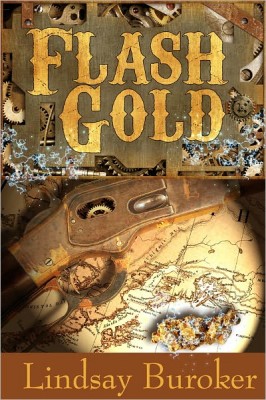
Flash Gold by Lindsay Buroker

All Kali McAlister wants is to leave Moose Hollow far, far behind–and with her dogless sled, the $1,000 prize for the sled race is just her ticket.  But with pirates, gangsters, and thugs in the Yukon after her late father’s alchemical secrets, she’ll be lucky to make it to the finish line alive.  And then there’s that striking man by the mysterious name of Cedar–why is he helping her?

This was a fun steampunk adventure story.  It was fast-paced, well-written, and quite enjoyable; Buroker knows how to hook a reader with interesting characters and conflicts.  I’m looking forward to reading more books set in this universe.

That said, I did have a few issues with this book.  At some parts, the dialog came across as wooden because the characters’ words and reactions didn’t match the intensity of the scene.  For example, Kali and Cedar got caught up in a couple of friendly discussions during gunfights, one about her automatic reloading rifle (which was somewhat excusable) and one about the status of their relationship (which felt a little contrived).  Also, the climax of the story revolves around a late third act info dump, which is a pet peeve of mine.  It didn’t bring the story to a screeching halt, but it did feel a little clumsy.

None of those kept me from enjoying the story, but they were definitely things I noticed.  My biggest issue was probably a lack of real dept or thoughtfulness; what I like to call a “stuff happens, the end” kind of story.  The main character had good internal motivations, but no real internal conflict.  For example, she had this whole history with a previous lover betraying her trust, but she didn’t really struggle much with learning to trust again; all that old baggage was just a part of her background.

Overall, though, this was a fun action-adventure romp.  The steampunk setting was great, one that I’d like to come back and revisit.  And in spite of my critiques, I didn’t feel cheated by this story at all; it really was an enjoyable read.  For $.99, what do you have to lose?

You can find Flash Gold at the author’s site here, or at Smashwords and Barnes & Noble (for some reason, the Amazon link appears to be broken).








