






Category: Uncategorized
The Gettysburg Paradox podcasted by Gallery of Curiosities!
Hey there, guys! Just a quick note that Gallery of Curiosities has podcasted my short story, The Gettysburg Paradox. Check it out!

My life is CRAZY right now
Oh my heck. How can I count the ways?
- My writing computer crashed yesterday. Upgraded to Ubuntu 16.04, and it crashed again this morning. I think I have a fix, but only time will tell.
- I started a new job on Monday. Carpentry crew. Nine to five. It’s exhausting, but the pay is good, and that’s what I need right now.
- The brakes on my truck need work. Pads for sure, and probably rotors too.
- I’m months overdue for a dentist appointment.
- I need to find a new place before the end of the month, or the first week of July at the very (very!) latest. Unfortunately, everything is overpriced.
When I make progress in one area, things seem to fall back in another. And of course, everything’s time sensitive. Still making writing progress, though—that is, when I have a machine to write on!
If this blog goes silent for a while, here are the reasons why. Don’t worry about me, though. I’ll figure it out.
In the meantime, here’s something I’ve been listening to:
Late June promotions




Why you should never leave your tools lying around a work site (especially in Jerusalem)
A Change in Direction
This is going to be a rather long post. I’ll preface it with some demographic trends among my generation, then tie that in with my situation and how I got here. From there, we’ll see where it goes.
I was born in the early 80s, which technically makes me a Millennial, though it doesn’t always feel that way. Millennials get maligned for a lot of things, which is pretty typical of all generations as they rise, from what I can tell. Civilization is constantly under attack by barbarians, most of whom we call “children,” which is really just another way of saying this:
Every generation reinvents the world.
— Joe Vasicek (@ldssfwriter) May 10, 2018
So how is my generation currently reinventing the world?
Thus far, not very well. The Great Recession hit us just as we were coming of age, and it shows. We were much more likely to move back in with our parents than previous generations. We’re putting off marriage and home ownership, some because we’re more focused on our careers, others because we just can’t seem to launch.
At the same time, not all of this is bad. In spite of the fact that most of us were never taught home economics or personal finance in high school (thanks, Baby Boomers, for all the participation trophies), we are rapidly learning more responsibility than our parents. Where six out of ten Americans would have to beg, borrow, or steal to cover a $500 emergency expense, nearly half of us Millennials have $15,000 or more in savings.
And yet, the problems we’ve inherited are truly daunting. Our national debt is $21 trillion and counting, and without facing a recession, war, or other emergency event, our deficit is still set to exceed $1 trillion per year for the forseeable future. Just this month, we learned that Medicare is set to run out of money in eight years, and Social Security is not far behind that. And don’t even get me started on the house of cards that is our national pension system.
Up until the 60s, previous generations saved and invested so that their children could be better off than they were. The Baby Boomers not only squandered this wealth, but they stole their children’s and grandchildren’s inheritance as well. History teaches us that there will be a terrible price to be paid for all of this. Our parents have proven themselves incapable of doing anything other than kicking the can down the road to oblivion.
That probably sounds more bitter than I intended it to be. Unfortunately, it’s the truth. Our parents just don’t understand the world that we’re living in. We’ve come of age in a world with far less opportunity than they did.
I had a conversation with my mother last year that demonstrates this. My mother likes to make cascarones for special events, like Easter or birthdays. To make them, however, you need a hollowed-out eggshell, which requires removing the yolk and whites in a very particular way. If you’re accumulating shells through normal consumption, it can get to be rather tedious.
One day, I came into the kitchen to find my mother blowing out eggshells and dumping the whites and yolks down the sink. She’d bought a whole bunch of them for 35¢ a dozen, and decided to just make the cascarones all at once instead of accumulating the shells over time. When I saw this, I was horrified.
“How could you waste all those eggs?” I asked.
“It’s not a waste,” she said. “They were 35¢ a dozen.”
“Yes, but we could have eaten them. That’s perfectly good food you’re dumping down the drain.”
She shrugged, as if it didn’t really matter. But I pressed her a bit further, until I came to a disturbing realization:
My mother has never been as poor as I am.
When I pointed this out to her, her answer was even more disturbing. With anger in her voice, she snapped “that’s because you choose to be poor.”
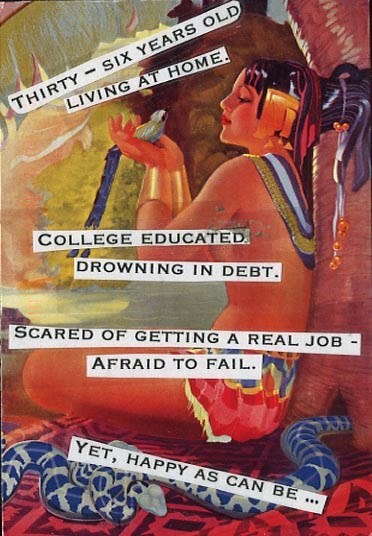
Is that true? Am I, a Millennial, poor because I choose to be poor? Perhaps. I’m not so irresponsible that I won’t own up to my life decisions, which have brought me to this place. But I think there’s this perception in the minds of our parents and grandparents that Millennials are generally like the person who wrote this postsecret above. Drowning in debt, living at home, so afraid to fail that we’ve utterly failed to launch, and yet blissfully oblivious to all of it. Perhaps that’s true for some of us, but not for those who will reinvent the world after our parents are gone.
To be clear, I love my mother and father. I don’t hold any of this against them personally, or anyone else of my parents’ generation (except the politicians who sold our Constitutional birthright, but that’s another rant altogether). Unfortunately, hard truths do not become softer because we choose to ignore them. And hard truth is this:
Hard men make good times.
Good times make soft men.
Soft men make bad times.
Bad times make hard men.
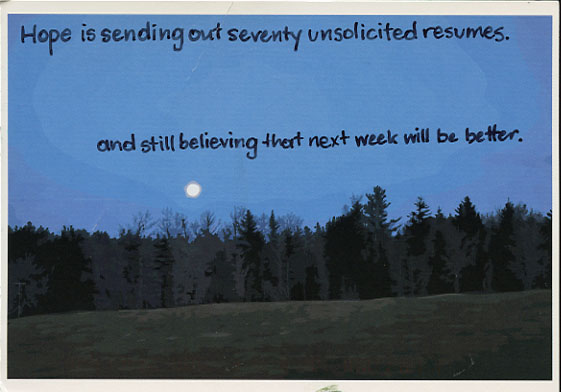
I graduated college in 2010. Through a combination of scholarship money, campus jobs, and (yes) generous parents, I was fortunate enough to graduate without any student debt. At the same time, it was the height of the Great Recession, and jobs were nearly impossible to come by. I can’t tell you how many of my writing friends put their dreams on hold, or abandoned them altogether. Almost all of them.
As a side note, I agree with Mike Rowe that “follow your passion” is bullshit advice. It ranks right up there with “be yourself,” and “you can be anything if you put your mind to it.” Don’t follow your passion. Follow opportunity, and take your passion with you.
But in 2010, I had an opportunity. Without any debt, and without any dependents or other obligations, I decided to pursue a writing career. And unbeknownst to me at the time, the industry was undergoing a revolution that would open the doors to make that possible.
I indie published my first short story, Memoirs of a Snowflake, in March 2011 and never looked back. Since then, I’ve published dozens of novels, novellas, short stories, and other works. It’s been an exhilarating journey. At the same time, it’s been the most difficult struggle of my life. And that is why I must now confront one of my most crippling fears.
Unlike the girl in the postsecret, I am not crippled by the fear of failure. If I were, I would never have published that first story, let alone all the others that followed. Instead, I have a fear of admitting failure, both publicly and to myself. It feels too much like an admission of defeat.
It’s an important distinction to make, though. The Romans admitted failure often and early—it’s how they learned from their defeats, ultimately going on to build one of the most powerful militaries in the ancient world. But they never admitted defeat. Even after Cannae, when Hannibal threatened the republic with utter extinction, the Romans refused to be defeated. And so, while Carthage fell into decline and decadence, the Romans endured until Scipio finally gave them victory at Zama, paving the way for the rise of Western Civilization.
I haven’t had a personal Cannae moment yet, but I do feel like I’ve been fighting a war of attrition. In 2014, the market shifted with the launch of Kindle Unlimited, and I failed to adapt. At that point, I was just on the cusp of going full-time with my writing, though looking back I can see that I didn’t yet have the foundation for a lasting career. Still, to have that dream snatched away when I was just on the verge of catching it, you can understand why I kept plugging along, believing that I was just a month or two from turning things around.
That’s basically what I’ve been doing for the last four years: writing full-time even though the writing doesn’t pay full-time wages. Maybe my mother is right. Maybe I have chosen to be poor.
And yet, while I now believe that I do have the foundation for a lasting career, I need to confront the fact that it may be ten years or more before I achieve it. Should I continue, like so many of my peers, to delay major life decisions until my career reaches that point? Is it worth it to put off marriage, family, and home ownership until my forties or fifties, if that’s what it takes? Or is it time to admit failure so that I can leave this dead end and find another way?
Back in 2010, I had no plan B. It was the Great Recession. I didn’t have a day job because I couldn’t find one—hardly anyone could. And from 2013 to 2014, writing paid well enough that I didn’t need one. Things were looking up, and I was just a couple months away from a sustainable long-term career.
Well, it’s time to admit that that line of thinking has turned out to be a trap. I’m approaching my mid-thirties and I’m still single and poor. I need some kind of long-term backup, because I can’t count on the writing career to take off like I need it to, at least not anytime soon.
So I’ve moved my writing onto a part-time footing. I’m limiting the number of words I write each day, leaving time for other pursuits. And I’m looking for a day job, preferably one that teaches me something useful and pays well enough to make ends meet.
I haven’t been defeated yet, though. Failure is not final until you decide to give up. I have not given up, and will continue to write, even if only on a part-time basis. And when I am making enough to go full-time, I have the foundations in place to do so.
In the meantime, though, I’m not going to put my life on hold for a dream.
WIP excerpt: Gunslinger to the Galaxy
Gunslinger to the Galaxy
I’m happily at work on Gunslinger to the Galaxy right now, just coming up on the halfway mark. With my new writing process, I make all the revisions as I go along, which means that the first chapter is more or less in a presentable state.
(As a side note, someday, I should do a blog post on my new writing process, because it’s radically different from the way I used to do it. Still got to work out some kinks, which I’m doing right now with Gunslinger to the Galaxy, but once I’ve got it down I should be able to produce publishable books on the first draft, in only a few weeks, as opposed to taking multiple drafts over the course of several years. Exciting stuff.)
In any case, here’s an excerpt from the first chapter. Enjoy!
In Which My Dear Husband and I Return to Earth
My name is Jane Kletchka, and I’m here to set the record straight.
By now, you’ve already heard my dear husband’s account of the Gorinal incident: how we were stranded in the armpit of the galaxy when the Gorinal jumpgate went down, how we both got caught up in an outcast Immortal’s million-year vendetta, and how together we thwarted it and stopped the galaxy from falling into a civilization-ending war. If only we’d known what we’d unleashed by doing so.
But I’m getting ahead of myself. As I’ve already said, my name is Jane Kletchka. I graduated summa cum laude from Earthfleet Academy with a double major in xenolinguistics and history. My parents urged me to pursue a graduate degree planetside, but I took the path less traveled and became a freelance xenologist. After gazing down on Earth from Luna for so long, it just didn’t make sense to clip my wings for another four years. I figured I’d spend a few years traveling the galaxy, do my part for intergalactic peace, then come back, find a nice Mormon boy, and settle down to raise a family.
Instead, I found my dear husband on the far side of the galaxy. If you’d told me only a year before that I’d marry a gunslinging mercenary, I would have laughed in your face. But so it was. Needless to say, settling down wasn’t in the cards anytime soon.
Still, as an old-fashioned Earth girl, I insisted on introducing him to my parents. So once our work at Gorinal Prime was complete, we set the Star Runner on a course for Sol.
* * * * *
“Sixteen days,” said Sam, shaking his head in disbelief. “Can you believe it? Sixteen f—”
“Ah ah,” I said, stopping him before he could swear. I love my dear husband, but he has a tongue as wild as the colony of New Texas where he was born.
“Sorry, honey,” he said, putting an arm around my waist. I tousled his dirty blond hair and glanced out the cockpit window at the starry warp-bubble that surrounded our ship.
“How long did it take when you first left Earth space?” I asked.
“Ten freaking months,” he said, catching himself. “Took a third-class berth on a Hyadian star crawler headed straight for Aldebaran, and by the end I was so bored I half-considered shooting myself for the diversion.”
“I’m glad you didn’t,” I said, stroking his back with my fingertips.
Down by my legs, a calico cat meowed. The Star Runner is a cozy little ship, designed for a crew of two with room for only one passenger. That was why Imutab had taken her cat form. A shapeshifter empath from the Silver Diadem, she’d signed on with us shortly after the Gorinal incident. As newlyweds, we didn’t mind her, so long as she was discreet.
“Uh, Jane,” said Tarak from the copilot’s chair. “Sam’s thinking about—”
“Thanks, but I’ve got a pretty good idea.”
Unfortunately, “discreet” does not accurately describe Sam’s copilot and first mate. Tarak is a Myadian, a race from the Scutum-Crux arm of the galaxy. They look a bit like hairless satyrs. Being telepaths, others tend to distrust them, so they mostly keep to their own kind. Tarak fell out with his clan, making him doubly the misfit. He’s a good person, though. It took a while for Sam to come around to him, but even he had to admit that it can be useful to have a telepath as your first mate, no matter how awkward or annoying he can be.
I leaned over and gave my dear husband a rather lengthy kiss. Imutab purred contentedly, while Tarak thankfully refrained from any more unwanted commentary. A cozy ship like the Star Runner makes everyone feel close.
“Let’s come out of warp before we’re inside Luna’s orbit,” I said. “I want to let my parents know we’re coming.”
“Sure thing, honey. We’re in no rush.”
“Also, I’m sure that Earthfleet will want to debrief us.”
“Debrief?” he said, frowning, “Honey, we’re private citizens.”
“Private citizens with a warship and a letter of marque and reprisal that goes straight to the top of Earthfleet itself. Or have you already forgotten all the upgrades we got from the EFS Auriga?”
“Don’t tell me you never dreamed about marrying a pirate.”
“Actually,” Tarak interjected, “Jane never—”
“That’s enough, Tarak,” I said, leaning over to give my dear husband another kiss. Imutab’s purring grew louder.
* * * * *
Returning to Sol was the easy part. Getting to Earth was much harder.
First, we had to get permission from Earthfleet to approach the planet itself. The Star Runner was originally a Setarni ship, which meant that the authorities didn’t recognize us as human at first. Even after we showed them the letter of marque and reprisal, they still insisted on an escort—for our “convenience.”
At least the debriefing was relatively painless. Since we fell in a category somewhere between mercenaries and pirates, they moved us along as quickly as possible. The same can’t be said of the authorities at Earth.
I won’t bore you with all the catch-22s of the bureaucratic nightmare we had to endure just to set foot on our beloved homeworld. Since since Sam had lost his passport and Earthfleet didn’t officially recognize us, we spent almost thirty-six hours waiting on a temproary ID from the colonial consulate. When the customs agents found out about Sam’s numerous firearms, they tried to force him to register them all, which threw him into a fit. I can’t remember how I managed to smooth that one out.
Eventually, we worked out an arrangement that left the Star Runner in high orbit, technically still in Earthfleet’s jurisdiction, and agreed to teleport onto the main spaceport for a shuttle to the surface.
“I don’t see why we need a shuttle when we’ve got line of sight to the surface,” Sam muttered as we made the final preparations for our departure.
“Because the only place we can register is on the spaceport,” I told him. “If the authorities pull us over when we’re planetside, and we haven’t—”
“I know, I know.”
I gave him a quick kiss, which seemed to help. Tarak keyed the teleporter, and the next we knew, we were surrounded in a conduit of shimmering blue light.
Teleporting is never a pleasant experience, but I take to it better than Sam does. As the light dissipated to reveal the spaceport concourse’s teleport pad, he made a face like he’d swallowed his own vomit. Thankfully, that was the worst of it.
The first thing about the spaceport that stood out to me was the sheer number of humans that filled the place. There were very few aliens in the crowd, and most of those were Hyadians. After spending so much time on the far side of the galaxy, it felt weird to be surrounded by people who look just like me. The second thing that stood out was just how crowded the spaceport was. Between the teleport receiving pads and the security checkpoint, people were packed almost shoulder to shoulder.
A haggard security officer with a permanent frown and bags under her eyes ushered us off of the platform. “This way down, this way down,” she said with practiced monotony. “The checkpoint is directly ahead, on the right.”
I’ve never seen Sam so tense outside of a combat situation. I took his hand.
We passed through the security scanners without incident. There was some confusion on the other side when the officer failed to locate his ID implants, but the documents from the consulate checked out and we proceeded to customs and registration.
Here, we were not so lucky. The customs officer refused to recognize Sam’s documents and called up his supervisor, who detained us for questioning. I rubbed my dear husband’s back and ignored his muttered cursing as we waited in the windowless interrogation room.
At length, the door swung open. “Greetings,” said a short man with brown skin and slanted eyes. His navy-blue uniform was wrinkled but clean.
Sam said nothing, so I smiled and offered my hand.
“Hi.”
He pointedly ignored my gesture and took a seat across from us.
“Your documents show that you are Sam and Jane Kletchka, from New Texas.”
“From Earth,” I corrected. “Sam is from New Texas, I’m from Earth.”
“Yes,” the officer muttered, checking his tablet. “Your ID checks out, miss Jane Elizabeth Carter. However, we have no record of marriage to a Mister Sam Kletchka.”
“Our marriage was performed at Gorinal Prime by Captain Isiatuk of the Silver Diadem,” Sam told him calmly.
The officer frowned. “Gorinal Prime? That doesn’t sound familiar.”
“It’s in the Scutum-Crux Arm,” I explained. When that failed to register a response, I added: “Of the galaxy.”
“Ah,” he said, raising an eyebrow. “I take it that isn’t in Earthspace?”
My dear husband frowned so deeply that his mouth disappeared into his beard. Things didn’t get any better from there.
I’ll spare you a blow-by-blow. Once again, the colonial consulate had to smooth things over, and we very nearly spent a night on those hard plastic seats in the interrogation room.
Eventually, though, we boarded a planetside ferry shuttle. Exhausted from the ordeal, we did so without a word, joining the mass of other zombie-like travelers who crowded the aging shuttlecraft like so many human sardines.
Motatseba, or how to bag a wife—literally (Blast from the Past: April 2012)
With the rise of #MeToo, I thought it would be interesting to revisit this old post from my time in the Republic of Georgia. Here in the US, we seem to be in the process of completely reworking the societal norms for how men and woman interact in the public sphere. On one extreme, we have serial predators getting ousted from power in industries that enabled their abuses for years. On the other extreme, we have the perpetually outraged calling for blood because someone greeted a woman in public with an unwanted hug. False and anonymous accusations abound, while clear and obvious abusers like the Clintons have gotten off scot-free. In short, it’s a mess.
Changes this drastic always produce unintended consequences. One of the unintended consequences of #MeToo may be the blurring of the lines of consent. After all, if a woman can call it rape because she decided afterward that she regretted it, is positive consent worth anything in the first place? In eastern Europe and central Asia, consent has also been blurred, which is part of the reason why bridenapping is still a thing. In Georgia, I came face to face with this reality.
Let me make it clear that I do not condone bridenapping in any form. Cultures are not equal, and some cultures (or some aspects of a culture) are better than others. A culture that condones the kidnapping and forced marriage of women is much worse than a culture that ennobles and empowers women to be agents of their own destiny.
With that in mind, here’s the updated post.
 მოტაცება (pronounced motatseba) is the Georgian word for bride kidnapping, as opposed to regular kidnapping, which takes a different word. It’s an ancient practice in the Caucasus region that still occasionally happens, especially in the rural areas. Today, most Georgians condemn it, but there’s still a whole slew of lingering cultural subtexts that can be very difficult for a Westerner like me to understand and navigate.
This is how it works: boy meets girl. Boy decides to marry girl. Boy gets his friends together and kidnaps the girl, with or without her consent, holding her captive overnight. The next morning, boy contacts girl’s parents to ask for girl’s hand in marriage.
Since the girl has been held overnight, the implication is that she’s been raped (which may or may not be true). Therefore, to avoid a scandal which could tarnish the family’s reputation, the parents will usually marry their daughter off as quickly as possible. However, if the girl can escape, or the girl’s brothers can rescue her before nightfall, the crisis can be averted.
Basically, it’s capture the flag with sex.
I first heard about motatseba from this post on Georgia On My Mind, back when I was looking into teaching English. It disturbed me, but not enough to dissuade me from coming to Georgia. A couple of weeks ago, however, I learned that that was how my host parents got married.
Here’s the thing, though: they both seem to remember it fondly. In fact, when my host mom saw a comedy skit on the subject, she couldn’t stop laughing. Her mom lives with them now, and from time to time they go out to visit his family in the village, so it looks like everyone’s on pretty good terms.
So what the heck happened?
Here’s the story, as best as I can piece it together. They were introduced by his sister, who was her coworker at the hospital. He liked her, but was too poor to afford a dowry, having just gotten out of the Red Army. After a month, he got together with some friends and tricked her into coming out to his family’s house out in the village. She was surprised and upset at first, of course, but her parents gave their consent, probably because she was starting to get into old maid territory (she was 29 at the time). They were married the next day by a magistrate. Now, they’ve got four kids—a huge family, by Georgian standards—and seem to be happy together.
As a Westerner, it blows my mind that a strong, healthy family can come out of something as violent as an act of kidnapping. Indeed, I have yet to be convinced that that’s a normal outcome. However, after asking around and doing some research, I’ve come to realize that motatseba isn’t a black and white issue: there are all sorts of cultural subtexts that make it much more complicated.
The key to understanding how all this works is the following proverb, which underscores Georgian concepts of gender roles and the differences between men and women:
If a woman says no, she means maybe. If she says maybe, she means yes. If she says yes, she is not a woman.
From this, two things follow:
Men should be more assertive
As a man in Georgia, I get this all the time. All three of my co-teachers are women, and all of them constantly defer to me, even though they have far more teaching experience than I do. When I had some pretty serious differences over teaching methodologies with one of them, she suggested that I take over the next lesson and teach it without her interference, so that she could get a better idea that way. This isn’t the case with the female volunteers. Many of them complain about how hard it is to get anyone to take their suggestions seriously.
A woman can never say no—or yes
If “no” is constantly interpreted as “maybe,” then it follows that no one is going to believe that a woman is even capable of saying “no.” On the other hand, if a real woman can never say “yes,” then the man ultimately has to take matters into his own hands. This turns the whole concept of rape into a nebulous gray area, which is why motatseba isn’t universally considered to be a horrible thing.
This is not to say that in Georgian culture, women are doormats or property (even though that’s what some TLGers claim). Women have a number of support networks, such as family, friends, and other women, and can use these networks to ward off unwanted attention. When I asked my host sister if she’s worried that she would ever be kidnapped, she said no, because if she was, her brothers would kick some serious ass.
On top of all this, Georgians have no real concept of casual dating. If a girl and a guy are seeing each other, they’re either married or about to be married. This shows up in the way they use Facebook and other social networks: instead of listing themselves as “in a relationship,” the girl will give her password to the guy she’s dating. And they don’t just do it because the guy demands it—when my host sister was seeing someone, he asked her if she wanted to give her password to him, as if that was the natural next step in their relationship. From the way she told me, she seemed to be worried that she’d made a mistake by telling him no.
Combine all of these together, and you should start to get a clearer picture of some of the subtext surrounding motatseba.
When I asked my first co-teacher about it, she said it was only an ancient practice and absolutely didn’t happen anymore. When I brought up rape and asked if that was also a part of it, she was horrified and didn’t want to talk about it. However, when I asked if it’s possible for a happy marriage to come of it, she kind of smiled a little and said that if the woman likes it, then why not?
My second co-teacher was much more straightforward with me. Yes, it happens occasionally, though it was a lot more “fashionable” about twenty or thirty years ago. No, it’s not romantic. Yes, a lot of the marriages aren’t very happy, which is why so many of them end in divorce. She told me that one of her friends from college was married through motatseba, and that she knows of at least one case in our school where an 8th grader was kidnapped and married. However, motatseba is now considered a serious crime, so it’s not as common as it used to be.
My third co-teacher’s answer was a lot sketchier. The first time I asked about it was in passing, as she walked in on the conversation I was having with my first co-teacher. When I asked her about rape, she laughed and said “well yes, of course it happens!” as if that wasn’t a big deal. Later, however, she sat me down and said quite seriously that motatseba is a horrible thing, that it’s a criminal act, that it doesn’t happen anymore, etc etc.
However—and this was perhaps the most illuminating thing—she said that sometimes, when a guy and a girl are in love, but she’s being wishy-washy and non-committal, he’ll sweep her off her feet and carry her off. In fact, that was what happened with her: her boyfriend wanted to marry her, but she kept putting it off, so one day he tricked her into getting in the car and told her “all right, enough is enough—we’re getting married this weekend.” And they did.
When I asked her if that was motatseba, she said no, but the subtext was clearly similar. A real man knows how to assert himself and take what he wants. Since a real woman will never say yes, sometimes you just have to man up and tell her how it’s going to be. And don’t worry if she says no—she just doesn’t know yet that she wants it. She’ll come around eventually. They always do.
It sounds pretty horrible, but that seems to be how it works. And really, there are gradations of it. Most Georgians will agree that it’s wrong for a guy to kidnap a girl he doesn’t know so that he can rape her. But if the guy and the girl know each other, and are already pretty serious, and he wants to speed things up—or, alternately, if she knows her parents would never say yes otherwise—that’s when everyone starts to wink and nod.
And really, can we say that our culture’s problems are any less abhorrent? What about teenage pregnancy? Secret abortions? Date rape? At least with motatseba, the guy is trying to marry the girl, not just sleep with her and walk away. If it’s just sex that the guy is after, there are plenty of other options for that.
Either way, learning about motatseba firsthand has certainly been an interesting anthropological experience.
Interstellar meets the Hudson River
Why money should not flow to the writer
Yog’s law states that money should flow to the writer. It’s an old aphorism in the publishing industry, from a time when self-publishing was synonymous with vanity publishing. According to this 2003 post by Theresa Nielsen-Hayden:
For years now, we’ve been dinning Yog’s Law into young writers’ heads: Money always flows toward the writer. Alternate version: The only place an author should sign a check is on the back, when they endorse it.
Scalzi, who is also one of the more outspoken proponents of Yog’s Law, added a corrolary in 2014 in response to the argument that the rise of indie publishing renders it invalid:
I disagree, however, that it means Yog’s Law no longer generally holds. I think it does, but with a corollary for self-publishers:
Yog’s Law: Money flows toward the writer.
Self-Pub Corollary to Yog’s Law: While in the process of self-publishing, money and rights are controlled by the writer.
…
So, Yog’s Law: Still not just a law, but a good idea. The self-publishing corollary to Yog’s Law: Also, I think, a good idea.
Here’s the thing, though: there’s a difference between money that flows to the writer like a meandering stream from the mountains to the ocean, and money that goes to the indie writer first and from there flows outward to the writer’s various publishing projects.
In the last couple of weeks, a massive scandal hit the publishing world when it was revealed that an accountant working at Donadio & Olson, a major New York literay agency, had embezzled millions of dollars over the course of decades from major bestselling authors, including Chuck Palahniuk, author of Fight Club. According to Kristine Katherine Rusch, this is not an anomaly:
Unfortunately, as I have been telling you all for years now, embezzlement and financial negligence is rampant at big name agencies. Almost none have systems set up to prevent it. Of the four agencies I worked with over the decades, two actively embezzled from me.
…
The last time I threatened one of those agencies with a forensic accountant they threw me out of the agency overnight. By the time I got up in the morning, they had severed my relationship with them and informed all of my publishers that the payments should go directly to me. Just the threat of an audit did that. This is one of the biggest agencies with some of the biggest names in the world. Ask yourself why they were afraid of a standard business practice. You know the answer.
…
Sorry, folks. I’m not crazy. I didn’t have a bad break-up. This type of financial mismanagement, the kind that led to the embezzlement, is common in these agencies. It’s becoming visible now, because traditional book sales have declined, and so it’s harder for an agency to pay one complaining client with another (non-complaining) client’s advance.
But here’s what I want you to see. I want you to look again at Palahniuk’s apology.
I apologize for cursing my publishers. And I apologize for any rants about piracy. My publishers had paid the royalties. Piracy, when it existed, was small scale.
Now, I want you to think about how many big-name writers you’ve seen railing against piracy and how it’s cutting into their book sales. I want you to think about how many big-name writers blame Amazon (!) for ruining the book business and causing book sales to decline.
I want you to think about how many big-name writers who have said there’s no money in writing, not like there used to be.
All of those writers have agents. All of them.
Money should not flow to the writer. It shouldn’t “flow” at all. It should go to the writer directly, passing through as few hands as practically possible. When it does have to pass through someone else’s hands, the writer should be able to track it at all times.
The problem with Yog’s Law is that it treats a writer’s cashflow like a bunch of tributary streams, meandering lazily from the mountains until they combine into a mighty river. Only after the river flows into the ocean does the writer see any of that money. How much of it was diverted along the way? Siphoned off by unscrupulous agents or publishers? Lost to things outside of the writer’s control?
Cashflow is the lifeblood of any business, and writing is a business. Writers should know exactly where their money is at all times. A system that allows money to “flow” in such a way that the writer cannot track all of it is a fundamentally broken system, even if it follows Yog’s Law.