Pushing Ice by Alastair Reynolds

Bella and Svetlana have both struggled hard to break into leadership positions in DeepShaft, an interstellar mining company that pushes comets to mining platforms back near Earth.  Bella is the second in command of the Rockhopper, and Sveta is one of the chief engineers.  Both women are the best of friends.

While conducting an operation on the edge of the solar system, however, Janus, one of the moons of Saturn, breaks out of its orbit and quickly accelerates out towards Spica, a distant star.  As the ice falls away from the small moon, observers realize that Janus is actually some kind of alien spacecraft.  Due to its unusually high rate of acceleration, nobody at Earth can scramble a mission fast enough to intercept the alien structure.  Only the Rockhopper stands a chance of intercepting the craft.

As if the dangers and unknowns of making first contact with an alien race were not enough, this surprise mission comes at a very difficult time for the crew.  The captain, Jim Christholm, has just been diagnosed with a terminal illness, and command falls to Bella.  A ruthless company auditor shadows Bella, seeking to undermine her authority and discredit her through playing dirty in company politics.  When Sveta discovers a corporate cover-up that may cost everyone their lives, Bella has to make some difficult leadership decisions that may threaten their friendship.  And when they do reach the alien structure, rifts arise among the crew, raising the chances of mutiny and even murder.

Pushing Ice is a recent novel, published in 2005.  I’ve heard a lot of good things about Alastair Reynolds, both from my roommates and from friends last year in English 318.  My roommate Colby said that one of Reynold’s books gave him nightmares when he was reading it out in a cabin in the woods.  After reading Pushing Ice, I can definitely say that Reynolds can put together some gripping, thrilling, page turning stories.

I enjoyed Pushing Ice quite a bit, but I think that the first half was considerably better than the second half.  It took me a while to figure out all the characters, but when I did, I was immediately drawn to them and their conflicts with each other. Like Crichton, Reynolds can write some truly dispicable corporate bad guys–the kind of people you just want to meet in real life and beat the crap out of them.  Slimeballs.

He also writes some very interesting, complex, and believable protagonists.  The thing that hooked me, that made me stay up late reading hundreds of pages at a time, was the conflict between the characters.  He created some people that I really came to care about, and a disastrous character conflict that I had to see resolved.

The first half of the book is set in a rich, complex, and highly believable near-future universe.  The Rockhopper was a fascinating spaceship, and the dynamics of the crew were also believable and interesting.  The political situation back on Earth, the company politics of DeepShaft, and everything else all rang true.  I could feel like I was actually there, and that really drew me in.

Around the middle of the second half, however, things started to break down a little.  Once the aliens made their appearance and the humans started coming into contact with alien technologies, I felt that the believability started to fall apart–not because I have to have an explanation for everything, but because it felt that Reynolds started doing some handwaving.  He’d throw in new alien cultures and technologies so quickly that I started to lose a handle on what was going on.  I found it harder to believe that I was actually there because the “there” was changing so much.

Also, I feel that towards the very end, he started to rely too much on cheap cliches.  Some of the alien cultures, especially in the last hundred pages, sounded like something out of Ascendency or Star Control II. What began as a compelling, believable story of human-alien contact became another cliche space opera where all the alien civilizations were too monolithic, too similar in terms of technological capabilities, too human-like in their underlying worldviews and interactions with each other, and too…stereotypically alien.  Too shallow, not enough depth.

I don’t think this is due to a lack of skill on Reynold’s part, however–probably more a lack of time.  I think he spent so much time on the first half of the book that he was rushed during the second half.  He’s definitely a very powerful, very capable writer of science fiction.  I would like to try out his other works–the ones that he’s better known for.  And, despite my misgivings about the book, I would still recommend it to friends of mine who love good science fiction.
I’m being responsible (for once)

I’ve got this history paper due on Thursday.  It’s the big research paper for the semester, and it counts for a large portion of the final grade.  Because the deadline is coming up, it’s really pressing on my mind right now.

Earlier in the semester, we had smaller assignments related to the paper–for example, we had to get our preliminary bibliography together, write a preliminary outline, etc.  I…pretty much did the bare minimum on all of those.  Yeah.  Didn’t do so well.

So for this final paper, I decided to finish it early, so that I could bring it in to the FHSS Writing Lab where I work and have one of my coworkers help me with it.   That means, of course, that I can’t wait until the night it’s due to write it (which is pretty much how I’ve done every other paper of my college career).  I need to be responsible and get it done early.

I woke up today thinking “crap, I’ve got a paper I’ve got to write.” I decided that I’d sit down and write the whole d*** thing today after dinner.  I had the urge to play Genghis Khan II, but I resisted it and went to the library.  I worked really hard–I only spent about 25% to 35% of my time there chatting with friends and engaging  in avoidance activity.  It was tough.

I started out hating the paper, but once I had a thesis and an outline, I started to really get into it.  History is kind of like storytelling, and I like storytelling.  When I figured out how to insert footnotes on Word 2007, I started to get the urge to just insert a ton of them everywhere because it’s so cool.  Gamila was chatting with me, and when she mentioned something from her Latin class, I said “hey, you could be the Franks and I could be the Saracens–after all, Saladin’s given name was Yusuf!” (my paper is on the crusades–can you tell?)

The coolest thing was that when I came back to the apartment, I just felt so FREEEEEEEE!  I mean, yeah, the paper is still due on Thursday, and yeah, there is still a ton of work that I have to do for it, but it’s half done, and the rest is easy!  I’m even starting to really enjoy this subject.  I can’t wait to tell the story of Reynauld de Chatillon and all the things he did to piss off Saladin!  That guy was so smug, sitting in his castle in Kerak.  He even defied the orders of the king in Jerusalem to break the truce between the Franks and the Saracens!  If it wasn’t for that, perhaps the Battle of Hattin would never have happened–perhaps the Kingdom of Jerusalem would have survived.  Who knows?

So, yeah, I was responsible tonight…and dangit!  It’s 1:45 am and I haven’t written at all for today!  I would crank out a couple hundred words before going to bed, but I’ve got to get up at freaking 7am…holy cow, it’s going to kill me.

But yeah, I’m just really happy to have that burden at least partially lifted from me.  Being responsible can have its perks–I should try it more often.

Destiny

A couple of weeks ago, we started learning about the Seljuk Turks in History 240 (History of the Middle East to 1800).  This band of rugged, horse-riding nomads went from mercenary warriors of some Persian dynasty to the de facto rulers of nearly half the Muslim world.  In an era when radical Shi’ism swept across North Africa and the Levant, and people thought the rise of the Fatimid Empire marked the end of the world, the Seljuks, self-appointed defenders of Sunnism headed the Fatimid conquest at Baghdad and pushed them back to Egypt.  Fascinating stuff!
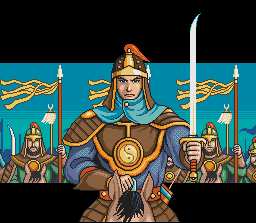
Then we learned about the Mongol invasion and the sack of Baghdad in 1258, when the world really DID end from the point of view of the Arabs, and I knew that Central Asia would never be boring to me again.

The Turks and the Mongols were both nomadic peoples who lived on the steppes of Central Asia–basically, an enormous stretch of grassland like the prairie in the American Midwest.  These guys lived in camps, with their cattle and horses, and looked down on the thought of settling down in cities and living a civilized, sedentary life.  To them, the nomadic life meant freedom–the people of the cities were voluntary slaves and beneath the hardy nomads.

Genghis Khan, born Temujin (“Genghis Khan” is a title that basically means “ruler of the world”), united the Mongol tribes and built the largest empire the world had ever seen.  Bigger than Alexander’s Hellenist Empire, bigger than the Roman Empire, bigger than the Babylonians, Assyrians, Sassanians, Umayyids, or Abassids.  The Mongol Empire was BIG–it stretched from Korea to the Black Sea!  If it weren’t for the Mameluks (one of the few Arab kingdoms that wasn’t mismanaging itself to death), the Mongols might have swept North Africa and the Mediterranean!

The coolest part of the story was the religious justification behind Genghis Khan’s ruthless, bloodthirsty conquest.  When Temujin was a young boy, the shaman of his tribe told him that the great sky god Tengri had given Temujin the world.  By conquering millions of people, massacring hundreds of cities, and building an empire of blood, death, and fire, Genghis Khan was only fulfilling his destiny!

For the last few weeks, I’ve been practically obsessed with all this history.  It’s fascinating!  Like reading a really good novel–except it’s real life!  Orson Scott Card often says that anyone interested in becoming a writer should study history instead of English in college, and I can see what he means.

All this stuff I’ve been learning about the Mongols has given me dozens of story ideas, many of which I plan on including in my current novel, Hero in Exile.  I’ll write a separate post to explain it all, but basically it involves the Mongol Empire in space.  Just like the Mongols considered themselves the only free people in the midst of sedentary urban dwellers, so the Hamejis in my novel (a spacefaring people who live entirely in their spaceships) consider themselves free in comparison with the billions of people living under continent sized domes across nearly a hundred settled planets.  Just as the sky god Tengri gave Temujin the world, so the god of the epistellar jovian in the Hameji home system has given them the universe.  It is their destiny to take and rule it by blood and fire.  Bwahahaha!

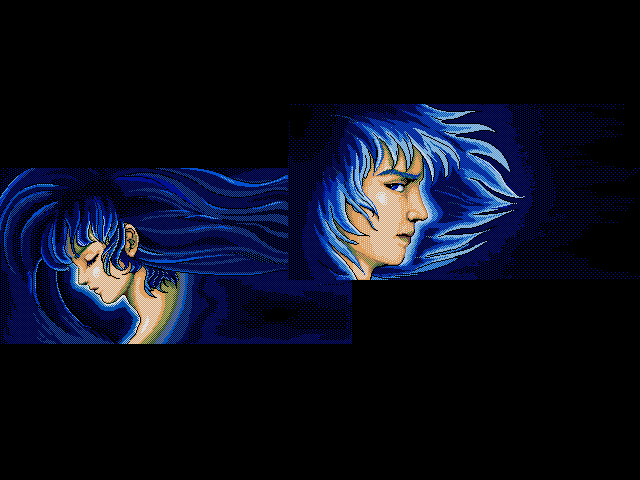
(photos taken from Genghis Khan II by Koei, a 90s DOS game)

A slow spot

This last week has been somewhat frustrating.  Started it off well, with good progress in my story, but early on in the week, all kinds of assignments started piling onto me–stuff that I should have seen coming, but have been putting off ’til the last minute (as usual).  It didn’t help that I just discovered Genghis Khan II, a really awesome old DOS game. :p

So, between juggling homework, struggling not to get addicted to this new game, and dealing with exhaustion in general, it’s been a pretty slow week.

The upside, though, is that I’ve had lots of time to think about the universe of Hero in Exile.  I’ve got some REALLY awesome ideas for the world, stuff that’s inspired by Heinlein’s Citizen of the Galaxy and the rise of the Mongol Empire.  History 240 is one of my favorite classes this semester–it gives me so many good story ideas!

As a result, I can hardly wait to get to the really good parts of my novel.  I just wish I didn’t have so much school to worry about.  Grr…

There is a lot that I want to blog about, but I need to get my sleep tonight.  Take home test due tomorrow for PLSC 201, and I want to get it finished before work at 10 am (yeah right…).

He remembered me!

Ok, so it’s 1:40 am right now and I have to be up at 7:00, so this is going to be short.

Yesterday was the release party for Brandon Sanderson’s newest book, Hero of Ages.  I had to go to work from three to four, but while walking through the bookstore on my way there, I saw a handful of cosplaying fans sitting merrily in a short line (maybe five or ten people) in front of the table covered in Brandon’s books.   I thought to myself, Ok, I don’t have to worry too much about the line being that long when I get off at 4:00.

Well, I arrived, and the line had already snaked its way around a couple of bookshelves.  That was ok, though.  I expected a wait.  Sat down in my spot and read a little from Tales from the Thousand and One Nights.

Fantasy fans can be really interesting, quirky people.  There was this girl in line just a few spaces ahead of me who talked the whole time about just about anything fantasy related.  It was really funny and entertaining.  The conversation in that part of the line was really interesting and engaging, even for those of us who were just listening in.  One of the people behind me mentioned later, “you can tell she’ll be a writer because of the way she talks.”

The guy behind me struck up a conversation by asking what I was reading (I had also pulled out the Qur’an to get some reading in for my history class), and I found out that he’d come all the way from his work in Salt Lake to get the book.  That was surprising, considering that he hadn’t even read Mistborn 1 yet.

Neither had the guy right in front of me.  He was an energetic freshman who pulled out his computer and wrote in his fantasy novel for a while.  I gave him the Quark writing group email (quarkwritinggroup@gmail.com, if you happen to be an interested BYU student) and we spent a good long time talking about various sci fi and fantasy books that we had read.

Brandon showed up, and the line started moving.  It was pretty slow, but that was ok because we’d all prettymuch broken the ice and were chatting it up the whole way there.  I saw a bunch of random people I knew, which was really fun. “Fantasy brings us together!”

So then, I got there at the desk where Brandon was signing the books.  He looked a little stressed up there, but he also seemed to be having a good time.  I wanted to know if he’d recognize me from his class last year–after all, he’s a busy man, especially now with Mistborn 3, Alcatraz 3, and the final Wheel of Time book.

But he did!  He saw my name on the sticky note and said “Joe!  How’s it going?” We chatted for a bit, and he asked how my novel was coming along!  I said it was coming along well, that it had been rejected once and he was like “yeah, of course that’s going to happen,” so I said I was working on it, as well as a new one, and that I was looking forward to his class in the winter.

He signed my book “For Joe–keep writing!” I was number 79.  Took a picture with him, and now it’s my Facebook profile picture.  It’ll be up there for a while!

Letter to the Daily Universe

My roommate Matt wrote this awesome letter to The Daily Universe last year (scroll down to the heading “Message for Sisters” to read his letter), and garnered some incredibly hilarious responses from the BYU community. He struck a tightly strung chord in this community, something that everyone here at BYU spends a lot of time thinking about: dating.

Well, I figured that I have something I’d like to say on this subject, so earlier this week I drafted a letter of my own. I haven’t actually looked at the submission guidelines for letters to the editor, so I’ll probably have to shorten this quite a bit, but I wanted to post the full version here in case anyone’s interested. Enjoy!

When girls complain that they don’t get asked out on dates, we are quick to find fault with the guys and slow find fault with the girls.I believe this is a mistake.While it is true that a lot of the stinging criticism leveled at the guys is true and valid, there are many things that the girls do to turn off potential admirers.With regards to that, here are five general principles for dating that I believe every girl at BYU should know and follow:

1.Everyone is worth a first date.

Of all of Elder Oak’s dating counsel, the point we ignore the most is that a first date is not a big deal.Relax.Have fun.Give it a chance.How do you know that it can’t work out?And even if it probably won’t, at least it’s a great learning opportunity.No one is too far beneath you for a first date.

2.If you turn down a first or second date, no matter the excuse, it says “I’m not interested in dating you.”

Ambiguity is more painful than rejection.Even if your excuse is legitimate, guys will assume the worst.They may ask you out again, after some time, but they will be much slower to do so.On the other hand, if you want to communicate disinterest, turning down a second date is the polite way to do it.

3.If a guy asks you on a date and the time does not work for you, the way to say no without communicating complete lack of interest is to suggest an alternative time and activity.

If you have an honest scheduling conflict but are interested in dating him, do this and you erase the painful ambiguity that makes him reluctant to ask you out again.Besides, it is polite and very classy.

4.Backing out of a date at the last minute not only says “don’t date me,” it is inconceivably rude and extremely unattractive.

Guys step up to the plate by taking the initiative; girls step up to the plate by following through.If you are guilty of backing out after saying yes, you have absolutely no right to complain that guys don’t ask you out enough.Quite frankly, you are getting what you asked for.

If something genuinely does come up and you must cancel at the last minute, remember principle three.Show by your actions that you are not flaking out just because you got cold feet.

5.If you rudely turn down one guy, others will hear about it.

Guys are not as aloof as you think.We have our social networks and we talk with our friends about our dating experiences just as much as you do.Keep that in mind when someone out of left field asks you out.The word gets around.

Please know that I don’t mean to blame the girls at BYU for not getting asked out.Too many guys at this university aren’t man enough to step up to the plate.At the same time, the girls are not beyond the need for repentance.I’ve found, in my experience, that these five principles work, and I sincerely believe that if every girl in this university followed them, not only would we all date more, but we would all have a lot more fun.

New job!

This past week I just started a new job at BYU.  I’m a writing advisor for the FHSS (Family of Home and Social Sciences) writing lab.  It’s GREAT!  I help students work on their papers and work on their writing skills, and I really love it.

How I got this job is an interesting story.  Honestly, it was really just a series of flukes that ended up working beautifully.  I was just in the right time at the right place and fell into it.

It began when I went to the BYU Bookstore to talk with my old boss in the stockroom and figure out all the paperwork for getting rehired.  I’d talked with him at the end of the winter semester, and he knew my schedule and had told me that everything was fine for me to work in the fall–we just had to fill out the paperwork and go through the formalities.

Well…long story short, when we finally got into the rehiring interview and I told him that I could only work MWF, his face dropped and he gave me a card with a number on it to call and check on my job application the next day.  He said that he wasn’t sure if they had a place for me because I couldn’t work TTh, but that he’d try.

It wasn’t hard to see, though, that I wasn’t going to get rehired.

Here’s a funny thing.  I tend to get really worked up and angry over little things, like slow drivers or computers that don’t work or paperwork that I didn’t know I had to fill out.  But when it comes to major things–like my old boss dropping the ball, leaving me without a job–I’m really mellow about it.  Even though I needed money and didn’t know what I’d do without a job, I figured that this had happened for a reason and that everything would work out in the end.

It did.  I was walking through the Wilk on my way home one day and decided to check the job boards.  I skipped over all the custodial and dining jobs (those are dead ends anyways) and looked at the academic ones.

Usually when I look at these jobs, I feel that I’m much too underqualified.  However, as I was skimming over them, my eye fell on the ad for being a writing advisor.  I love writing, so I decided to read a little more closely.  To my surprise, as I read over the qualifications, I found that I met almost all of them.

I picked up an application, selected some writing samples, and wrote a cover letter.  I was a little bit worried because I spent so much time talking about my experience as Quark writing VP, since that’s a non-academic setting, but that ended up being one of my most attractive selling points.  When they asked me what my greatest weakness was, I said “procrastination,” but then I was able to turn around and say “but I set a goal to write a novel last year and achieved it” through consistent, daily writing.  Even though the advisor position is for academic writing only, my experiences with creative writing made me look surprisingly attractive.

The thing that sealed me the job was my schedule.  They needed MWF and practically all my classes are TTh.  So not only were they excited because of my qualifications, they were excited because I was available when they needed it.  Getting the job wasn’t that hard from there.

So now I’m a writing advisor, and I LOVE it!  I sit around the lab, chatting and hanging out with all the other cool people who work there, and every once and a while an MFHD or Psychology major comes in with a paper and we look over it. Good people, low-stress work environment, work that I actually love doing, really good pay for an on-campus job, and best of all, it’s the kind of job that looks REALLY good on a resume.  This has got to be the best job I’ve landed since I came here at BYU.  I’m so happy and thankful that things worked out the way they did!

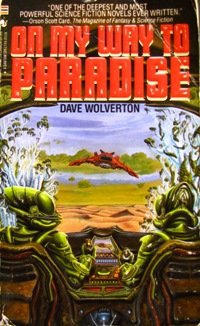
On My Way to Paradise by Dave Wolverton

n17823603_36079523_8117Senior Angelo Osic is a doctor in one of the refugee flooded neighborhoods of Panama.  The United Socialist States of South America has launched a new war in its efforts to reshape the human race into something purer, but all of that is far away from the life Angelo lives–until an emaciated woman with a bloody stump at the end of her arm shows up and demands him to grow her a new one.

Events rapidly spin out of his control, and Angelo flees on the first spaceship leaving earth–a mercenary transport taking hundreds of superhuman warriors to fight in a bloody planet-wide war among Japanese colonists.  As he tries desperately to evade socialist assassins, he makes friends among the mercenaries on the spaceship–as well as deadly enemies.  In the eerily realistic virtual reality world of the training simulators, Angelo dies a hundred times and slowly becomes desensitized to killing.

As the ship reaches its final destination–a world awash in a genocidal bloodbath–and Angelo’s enemies finally start to catch up with him, how will he maintain his humanity?  Will he ever be able to feel love and compassion again–or will he become the monster he fears the world is making him?

This book is violent.  It is violent and gritty. Rape, murder, assassination, brutal disfiguration and torture, graphic battle scenes and massive acts of genocide–it’s all in there. That said, the book is not about the violence–it’s about moral dilemmas, how we respond to injustice, and how we can maintain our humanity in the face of the most horrific evil this world can see.

Unlike a lot of cyberpunk, Angelo wants to be good–he desperately wants to be an upright, moral person–but time and again he finds himself in situations where he cannot avoid getting his hands bloody, sometimes up to his elbows.  How he responds to this evil, and how he endures it without becoming evil himself, is where the story has its meat.

On My Way to Paradise is a book that makes you think, and after you put it down, you can’t put it out of your mind.  It’s a book that has the power to change your life and how you see the world.

I found it by listening to it as a free audiobook on a podcast that podfaded shortly after, so I only caught the first seven chapters.  For the next year and a half, the story haunted me–I could not forget about it, or about the dilemmas and issues it raised.  I hunted all the bookstores for it, but sadly it’s been out of print for over a decade.  When I finally did find out that Pioneer Book had a copy in their warehouse, I ordered it and finished it a week or two later.  If I regret anything, it’s that I didn’t order it sooner.

This is honestly one of the best books I’ve read.  It is a masterpiece.  I’ve rarely read anything so real and down to earth, anything that resonates as truth so deeply.  It’s definitely not for everybody, but this book is incredible.  I’ve rarely read anythings so powerful–or so meaningful.

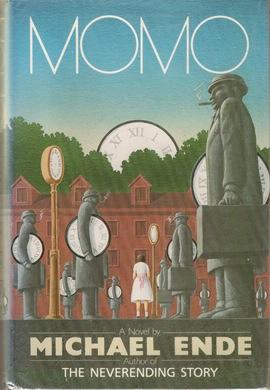
Momo by Michael Ende

[I originally wrote this book review in 2006.  However, Momo was such a good book that I wanted to include it here on this blog.]

I was browsing around at Pioneer Book in downtown Provo a few weeks ago when I saw this book. Michael Ende wrote The Neverending Story, which was my all-time favorite children’s book, and so I was really excited to see that he wrote this one. When I read it, I wasn’t disappointed.

Momo tells the story of a girl (named Momo) who has the uncanny ability to listen to people. People who have problems, don’t know what they should do, or are generally depressed come to talk with her. Because she’s such a great listener, she helps the people see things about themselves that they couldn’t see before, and helps them find out what they need to do with their lives. In this way, she becomes a friend to everyone and helps many people work out their problems.

Momo lives by herself in some ancient ruins (an awesome place to live, from a kid’s perspective! Kind of like having a tree house as a permanent residence), and she’s supported by her friends from the town, who frequently come to visit her.

The problems begin when these gray businessmen start going around town trying to get people to deposit their time in a timesaving bank. Don’t ask me how it works, that’s part of the fantasy. Basically, these men (who mysteriously know everything about just about everyone) convince people to work really hard so that they can save time, and by doing this, they will have a lot more time sometime in the future. However, the grey men are really these fantastical monsters who exist on stolen time, and their goal is to take all of the time from all of the people in the world. As they do this, the people become more and more miserable because they have less and less time for each other.

Momo recognizes the problem when she finds out that her friends aren’t coming by to visit her anymore. One of the grey men comes to Momo to steal her time, but she’s so good at listening that he ends up telling her who the grey people really are. Momo and her two best friends, as well as a whole bunch of abandoned children, try to find a way to stop the grey people, but it isn’t until Momo finds Never Lane and the source of time itself that she defeats the grey men and rescues all of the people.

I really loved the way this story was written. It was written like a really good children’s book–the kind that doesn’t condescend to children by assuming that they only have a very limited command of the English language. And as far as storytelling goes, this book was very well written. There were chapters that just really gave me this good feeling, like I had just experienced something really worth experiencing. I can see myself reading this book to my kids someday.

As far as the message is concerned, it’s fairly easy to tell that there are a lot of symbols and metaphors in the story. It’s not very preachy, though, which is good. I wish I’d read this story five or ten years ago, because I think I’d have understood the message better. Back then, I really loved reading stories that had deep meaning, and I was really good at picking the meaning out. Now, I guess I’m just older and too saturated with college studies for it to really sink in.

Which gets to the part about the grey men. If I were a character in this book, I wonder if I’d be one of the people who sells out to the grey men. But at the same time, I don’t regret being busy. I’m VERY busy all the time (especially this spring, with Poli Sci 200 giving me a major beating ). There are days where I wake up at 6:00 am and I don’t stop running from one place to the next until the evening. Sometimes, it’s true, I let the world around me just sweep me around and control my life. But I don’t think that things would be much better if I just cut out all the things that I’m doing.

I was home this time last year, not working or taking classes–I didn’t really have any responsibilities at all. And I was miserable. I felt like I wasn’t being productive enough, and I looked forward to coming out to BYU for the summer term because then I’d have something to do. Now that I’ve been really busy for a year, I’ve found that I really like it. It’s good to have a lot of challenging projects and responsibilities. I’m doing what I love and even though it can be difficult, I’m having a lot of fun. Work hard and play hard.

My sister Kate sometimes has problems with being overworked or underworked. When she’s busy, she’s so busy that it makes her anxious and she feels overstressed. We tend to fight a lot when that happens. So then, she takes time off to try and recharge, but she gets anxious because she feels that she’s unproductive. So then she fills up her schedule with things to do, until she’s overstressed again.

I think that the problem isn’t a matter of whether or not you’re always busy, so much as what you make time for. The people in the book got to the point where they figured that good things were something they’d only have time for sometime in the future, so they spent all their time doing menial things, and ignored their friends, families, and anything that was fun or enjoyable.

Life should be kind of like a car battery–once you’re up and doing something, it recharges itself. If I were only busy with things that drained me, I’d go crazy. It would just feel wrong, and I would make some major changes in my life. But if I actually enjoyed all of the things I was doing, and am doing, right now, I would know that things are working the way they should.

And ultimately, I think that that’s the message that Ende was trying to get out. Enjoy your life right now, where you are, and make time for the people around you.

So yeah, if you want to read a really awesome (and apparently very rare) book, check out Momo…if you can find it. Good luck! If you’re like me, and you like going places where you can be surrounded by large stacks of old, work, dusty books, maybe you’ll find a copy. Or maybe you’ll find something better. I’ll definitely be on the lookout.

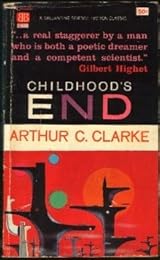
Childhood’s End by Arthur C. Clarke

They came completely unexpected. Hundreds of silver spaceships, hovering above all the capitols and major population centers of the Earth. For nearly a week, as thousands rioted in the streets below, they sat there, waiting. And then came the voice of Karellen, chief of the overlords, viceroy of Earth, heralding a new, planet-wide administration that was destined to end war, poverty, hunger, disease, ignorance, and fear. But as the generations pass and a new breed of humanity arises–one that has known no suffering, no danger, no religion but science, and no creative drive beyond sheer curiosity–mankind is about to discover that their welfare is not the overlords’ primary goal. Humanity’s time in the universe is about to come to an end–and a new, alien beginning.

I read this book in three days, but if I didn’t have any distractions or obligations, I could probably have read it in less than half a day. It’s very short–Clarke doesn’t take time to develop characters, describe the setting, give long info dumps, or show off his prosaic skills. He doesn’t even get into detailed explanations of how everything that happens happens. He waves his hand and gives us the broadest possible sweep of human civilization as mankind finally transcends human existence.

Partially because of the broad brush which Clarke uses to paint his picture, I found myself second guessing him at several turns. I was very skeptical of Clarke’s premises and conclusions, and found it very difficult to believe this story at several points. Believability of the aliens was not nearly so much an issue for me as was believability of humanity.

For example, when the overlords bring out a device that allows people to view any scene from any moment in the past, the world’s religious traditions are exposed and within a generation nobody in the world is religious. That’s not how religious experience works, though. Even if all of the religions in the world were hoaxes–which I’m perfectly willing to allow for the sake of a story–many, if not most of the adherents would continue to hold onto their beliefs, if only for no other reason than to hold onto something. There would be a lot more chaos and upheaval, and religion would stay with us in one form or another, if for no other reason than we as humans are religious creatures. It’s in our nature, whether or not any of the world’s religions are true. Clarke seems to demonstrate an ignorance of this as he paints the future with his broad brush.

A lot of other elements were missing in this book, such as character development, development of the setting, a strong buildup of tension, etc etc. However, as hard, classic sci fi, Childhood’s End doesn’t necessarily need those things to be an accomplished work within its genre. Hard sci fi–especially 50s and 60s sci fi–is all about grand, transcendent concepts, and here Childhood’s End succeeds, especially towards the end. When I finished the story and found out humanity’s final destiny, I was left with a sense of overwhelming awe at the grand cosmic scope of the story’s final message, much as I was with 2001: A Space Odyssey. You really feel, by the end, that you’re staring the incomprehensibly infinite right in the face. Good, hard sci fi will do that to you, and it’s wonderful.

I think this story did what Clarke set out for it to do, despite some of the conceptual spottiness that irked me in the beginning and the middle. The ending was solid, and did an excellent job showing what it means to transcend humanity. If you’re looking for a good story, this book probably will frustrate you, but if you’re interested in dreaming about man’s destiny among the stars, this book will give you that sense of awe and wonder that only classic science fiction can.