So it’s the beginning of June already, and it’s starting to feel like summer here in Iowa. Because it’s so flat, the sky stays light F O R E V E R, which is kind of neat. Lots more time to go on walks, which is where I work out plot points and other stuff.
In any case, Patriots in Retreat (my current WIP) is coming along well. It’s turning out to be shorter than I’d expected; there’s only three chapters left, and it’s not quite 20k words. Will probably come in between 3ok and 25k, making it one of the shorter Sons of the Starfarers books.
Middles are tough, even for short novels. I have no idea if this draft is going to turn out clean or not. But I am trying to cycle through as I write, to minimize the number of drafts I need to do. If I can master that technique, I can double or triple my production.
The Sword Keeper is just about finished, only a few more touch-ups before I send it out to my editor. Need to get back in touch with him. We’re definitely still on track for a release this fall, and I’m super excited because I think this is one of the best books I’ve written. Look out for a WIP excerpt later on this week.
There’s a couple of short stories I really want to write, but I’m so swamped with the other stuff that I don’t know when I’ll be able to get to it. I’m not behind (yet) on my current WIP, but I need to keep a steady pace of just under 3k words to meet my deadline, which is going to take some effort.
I haven’t started writing Gunslinger to the Galaxy yet (the sequel to Gunslinger to the Stars)… well, that’s not quite true, because I have written the first line:
My name is Jane Kletchka, and I’m here to set the record straight.
…but in any case, I’m starting to get a bunch of great ideas for that one. Will probably start working on it sometime this fall.
Publishing-wise, I’ve got a ton of stuff to work on but not enough time to juggle it. Most of the stuff falling by the wayside is marketing stuff, which isn’t good, but sales seem to have picked up in the last month so hopefully that isn’t too much of a problem. Still waiting for some reviews to roll in for Gunslinger.
Major items on my publishing to do list include:
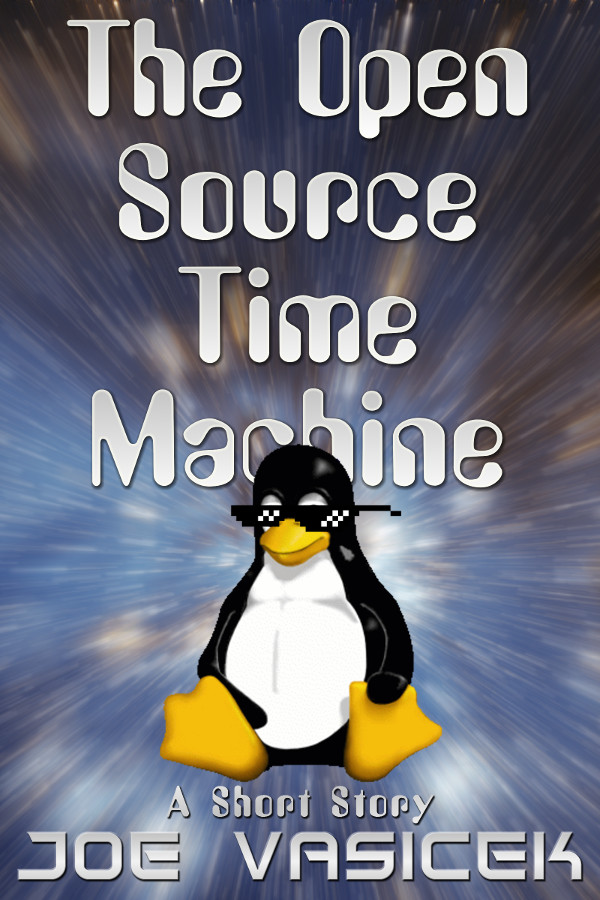
Write the author’s notes for “The Open Source Time Machine” single and short story bundle.
Compile the metadata for “The Open Source Time Machine” single and short story bundle.
Format and publish “The Open Source Time Machine” single and bundle.
Send The Sword Keeper to Josh Leavitt for editing.
Write the book description for The Sword Keeper.
Find a cover artist for The Sword Keeper.
Rewrite all short story descriptions.
Make a new cover for A Hill On Which To Die.
Upload all books to DriveThruFiction.
Not a small list—and that doesn’t include all the maintenance-type stuff!
So that’s the big challenge: making time for all of this while working the day job. It’s only 5-6 hours a day, but it adds up. I am saving money, though. My goal is to turn around at least $100 from my writing profits each month into investments. It would be really cool to start investing in space technologies, and the research for that could tie into my writing projects very well. Virtuous cycle and all that good stuff.
That’s what I’m up to these days. Peace, love, and penguins y’all. Thanks for reading!
Hey guys! Just a quick post today to let you know that I have a new short story out! It’s a fantasy short this time, set in the same universe as The Sword Keeper. With this latest one, I’m still on track to publish something new every month. Check it out!
Over the weekend, I read a really interesting post on The Passive Voice blog. It was an excerpt from a post by Dean Wesley Smith, looking at the tools and opportunities we have today and asking why we, as writers, still think that it’s difficult to write like the old pulp writers:
Yesterday, in the last chapter of the book I did about writing a novel in five days while traveling, I made a comment near the end that I found the exercise fun to be able to (just for a few days) feel like I belonged in the world of the pulp writers.
And I made a comment that I was born too late.
A reader wrote me privately with a good comment. Basically the reader reminded me that I should feel lucky to have the modern things we writers use such as computers, control of our own work instead of selling it to gatekeepers and so on.
The reader made a very good point. We do have it so easy, so much easier than the pulp writers did. I know that, I study the pulp writers and their lives.
Yet even with things being easier, it is unusual for a writer in 2017 to write a novel in five days.
…
So why do writers in this modern world not just write novels every week, week-after-week?
That even “Why?” question…
I knew the answer. Writer’s belief systems. Modern writers don’t believe they can.
That belief has been trained out.
Writers of the modern world have been taught to think that writing at pulp speed is different, unusual, a fantastic feat, massive work, and on and on and on…
I then realized I had done it too. And until tonight I hadn’t caught myself on it.
Look back at the last chapter I wrote. I called the entire idea of a novel in five days, “Crazy.”
Why? Writing a 40 thousand word novel should take me between 35 and 40 hours.
Sitting alone in a room and making stuff up for 40 hours in five days. What is so crazy about that????
And more importantly, what is so difficult about that?????
It’s a fair question. And it got me thinking: what are the false writing beliefs that are crippling me right now?
I can think of a few:
First drafts are never publishable.
Prewriting is not as important as butt in chair, hands on keyboard.
You can’t have more than one active WIP at the same time.
You can’t write short stories while working on a WIP.
Writing a short story per week is hard.
Well, it’s time to break free from these crippling beliefs, starting with the last one.
I’ve had a bunch of short story ideas recently, and I’m going to start running with them. I’ve neglected my short story writing for the past six months, so my active submissions have dried up somewhat (at least to the pro markets). But a lot of magazines have been giving me personalized rejections, which tells me that I’m not too far from a breakthrough. Trouble is, I just haven’t had anything to send them lately.
If I could write a novel per week, that would be absolutely fantastic. I’d probably write in a crazy obscure genre like Sword & Planet, except it’s not that obscure because Princess of Mars influenced everyone from Clarke, Bradbury, and Heinlein to George Lucas and the US Space Program.
But I’ll start with the short stories. And from there, who knows?
So you’ve written a short story, and you’re wondering what to do with it. You think it’s pretty good and you want to see it published, but you’re wondering what’s the best way to do that.
I can’t guarantee that this is the best way, but it is the way that I do it. Let’s start with the basics.
Indie vs. Traditional
Traditionally, short stories were published in magazines, anthologies, or collections. These were known as the “markets.” The editor was the one who chose which stories would go in and shepherded them to publication. Because of the periodical nature of the markets, there were a lot more short story slots than openings at the big publishing houses for novels, and many editors considered it a way for new writers to cut their teeth and prove their chops. It was also a great way for writers to get feedback, on the rare occasion that an editor wrote a personalized rejection.
In the 90s and 00s, the short story markets entered a period of decline, mostly due to the technological disruption of this newfangled thing called teh internets. Subscription rates for all the major sci-fi magazines went down, just like they did for newspapers. However, several new markets emerged to take advantage of the new ways to reach readers. The same innovations that spurred the indie publishing revolution also gave birth to new short story markets.
Today, when you write a short story, the first question you’ve got to answer is “do I want to self-publish this, or should I submit it to the markets first?” If you’re a happily self-published indie writer like me, the urge will be to self-publish first and ask questions later.
But Wait!
The awesome thing about short stories is that you can get the best of both worlds. How? Because unlike the major publishing houses, the traditional short story markets don’t impose prohibitive measures designed to gobble up your rights and lock down your publishing options. Publishing the same story in multiple markets is not only possible, it’s encouraged.
To maximize your returns, you have to be patient and impervious to rejection. You also have to learn some key terms. But first, as with any job, you have to select the right tools.
Get Thee to the Grinder!
To start out, you’re going to have to need some way to track all of your story submissions. By far, the Submission Grinder is the best free tool on the internet to do that. It’s a massive database for every English-speaking short story market, with stats compiled from user data. Not only does it tell you where you can submit, it gives you all sorts of useful statistics about each market. Create a free account, log your story, and use the Grinder’s search tools to find out where you can submit it.
Because I’m paranoid and believe in redundancy, I also keep a spreadsheet with all of my story submissions. At this point, though, it’s largely a backup. There’s no one right way to keep track of your submissions, but you absolutely need a system to keep track of them, and the best one out there is the Grinder.
Pro vs. Semi-Pro vs. Token
To decide whether a market is worth submitting to, you first have to determine how professional that market is. The best way to do that is by looking at the pay rates.
In the old days, when SFWA was more than just a snobbish in-crowd full of petty drama, you could tell that a market was professional if it was on the qualifying list for SFWA membership. Today, though, any market is considered professional if it pays at least 6¢ per word.
If a market pays between 1¢ and 6¢ per word, it is considered semi-pro.
If it pays less than 1¢ per word, it is considered a token-paying market.
Original vs. Reprint
Some markets want to be the first place where a story appears. If it’s already published elsewhere, they won’t touch it. Other markets don’t really care, though they may pay less for reprints.
The thing to look for here is “original fiction” or “first publication rights.” If a market’s submission guidelines specify either of those, then they won’t take your story if it’s self-published. Obviously, if you want your story to appear there, you can’t self-publish it first.
Most of the markets that accept reprints don’t mind if your story is already self-published. A couple of them do, which is super annoying, but whatever. As always, read the submission guidelines carefully before you submit.
In general, the more a market pays, the less it’s willing to accept reprints. Adjust your publishing strategy accordingly.
Multiple and Simultaneous Submissions
If the first thing you do after finishing a short story is submit it to every market that might possibly accept it, you’re liable to get yourself blacklisted and make a lot of editors angry. There is etiquette and protocol to the traditional publishing game, and if you want to succeed by going that route, you’re going to have to learn it.
A simultaneous submission is when you submit the same story to more than one market simultaneously.
A multiple submission is when you submit another story to the same market where you already have a story in consideration.
Most editors hate multiple and simultaneous submissions. If they like your story and want to buy it, the last thing they want is to find out that another editor beat them to the punch. Likewise, if they’re swamped with submissions (as they usually are), the last thing they want is more stories from someone who’s already submitted something to them.
For that reason, assume that a market does not accept multiple or simultaneous submissions, unless their guidelines say otherwise.
Of course, what’s bad for the editor isn’t necessarily bad for the writer. You can greatly speed up the submissions process by submitting to all the simultaneous-friendly markets at once, or by not having to wait for a response before submitting to a market again. The faster you can get through the submission process, the sooner it makes sense to self-publish.
With That Out of the Way…
Before you decide which publishing path to take, you first have to determine your publishing goals. Are you trying to make money, to build an audience, or both? Can you afford to be patient, or is time not on your side for whatever reason? Once you’ve determined what you personally want to accomplish, you’re able to make the important decisions that will take you there.
As a professional writer, it’s important for me to maximize profits. Also, I’ve found that I can do more to build an audience by self-publishing than by going through the traditional markets. That said, the prestige of publication in a pro market is still important in my field, so I find it worthwhile to submit original fiction to the pro markets before self-publishing.
Here are my criteria for submitting original fiction:
Will I make at least $100 from this story sale? ($20 for flash)
Is the average wait time for this market more than 60 days?
In a world where I can self-publish my stories and sell them directly, or give them away as freebies to build a readership for my other books, the traditional submission process costs both time and money. Also, if a market has eggregiously long wait times, that’s usually a red flag. Publish with them at your own risk.
However, for reprints I will submit my stories just about anywhere. They cost neither time nor money, because they don’t care if you self-publish first; all they want is non-exclusive publication rights. They don’t typically pay as well, but who cares? It’s free money, and the extra exposure isn’t going to cost you anything.
When making simultaneous submissions, I generally do it by tiers. If the story is at a pro market that accepts simultaneous submissions, I will only submit it to other pro markets. Likewise, if a story is at a semi-pro market, I will only simul-submit to other semi-pros. This is the best way to maximize your potential returns for original fiction.
In practice, though, since most simultaneus markets don’t pay more than $100, I usually end up submitting to them after I’ve already self-published. At that point, it doesn’t really matter where I submit, since a sale to a token market isn’t going to keep a semi-pro market from buying it too.
So in short, here’s my process:
Submit to all the markets that will pay at least $100 and respond in a reasonable manner (usually takes 1-2 years).
Self-publish.
Submit everywhere that accepts reprints and pays at least token rates.
A Word About Royalty-Share
In today’s rapidly changing publishing environment, a few markets are experimenting with non-traditional forms of payment. Royalty share is one of those. Instead of paying up front by the word, these markets pay you a share of the profits after the work is published.
In general, this is what I think of that:
Unless the royalty share arrangements are made against some sort of an advance, the publisher is basically asking you to take the risk for their venture. For original fiction, I’m generally not open to that, especially for markets with long exclusivity periods after publication. Tried that once, got burned, learned my lesson.
However, once I’ve self-published, the reprint rights are basically free money anyway, so I’m happy to give it a shot. Worst case scenario, I neither lose nor gain anything. And there are some places like Digital Fiction that are doing some really interesting things with non-traditional payment methods. I just signed a contract with them this week.
So yeah, that’s my process. The money in short fiction isn’t all that great, but if you’re systematic, organized, and prolific, you can make a decent profit at it. It’s one of the few areas of publishing where it still makes sense to go traditional, but you’ve got to know when to pull out and go indie. If you can afford to wait, it makes sense to run down all the pro and semi-pro markets with your original fiction. Otherwise, you have to figure out the cutoff point where it no longer makes sense to hold out.
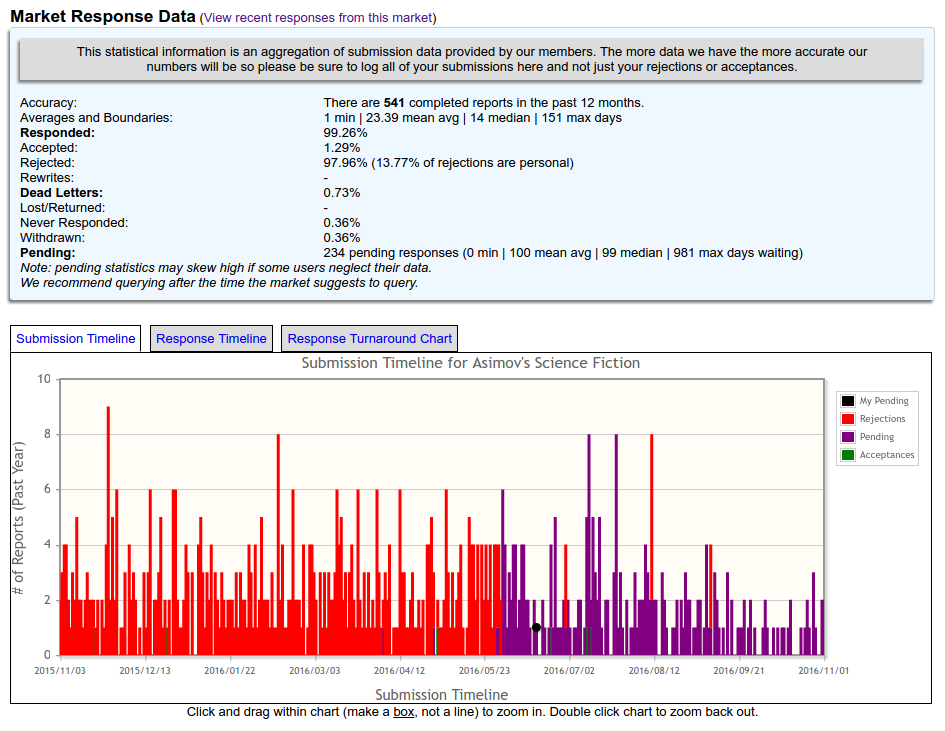
Way back in June, I submitted a short story to Asimov’s. Normally, it takes them four to six weeks to come back with a response. However, it’s been almost five months and I haven’t heard anything.
I’m not the only one, either. According to The Submission Grinder, their slushpile is backed up to the end of May. The average wait time for stories currently on submission is 100 days:
Clearly, something weird is going on. In the last 30 days, only seven responses are logged. Seven.
What’s going on?
I queried the editors six weeks ago, and they confirmed that my story was still under consideration. So it’s not like they’ve dropped off the face of the Earth completely. Still, that was six weeks ago, and there hasn’t been much movement since then.
Maybe there was a personal tragedy or family emergency? If so, that’s completely understandable. But I can’t find anything online to indicate that that’s the case, and my friends in the industry haven’t heard anything either.
I really hope this isn’t the new normal for Asimov’s. I stopped submitting to Analog because their average response time is more than 150 days. In an age where self-publishing is the new normal, it really doesn’t make sense to have a story sitting on an editor’s desk for that long.
This particular story takes place in the same universe as Gunslinger to the Stars, which I hope to publish in a few months. I would really like to get this story out sometime next year, either in one of the magazines or by publishing it myself.
If anyone knows anything about this, please let me know.
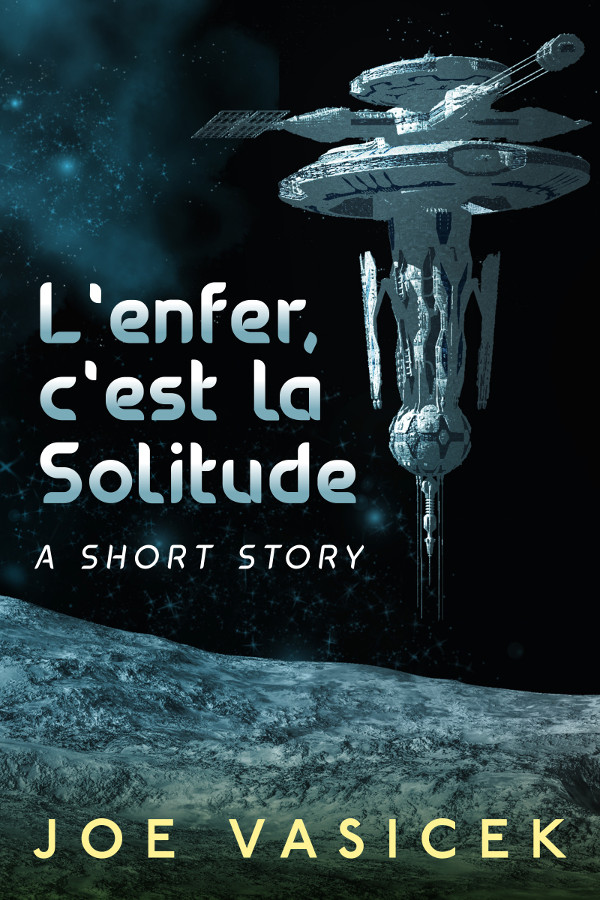
So for this next story, I decided to buy a premade cover over at GoOnWrite.com. I think it turned out pretty well!This story appeared in Perihelion about six months ago. It will be out as an individual short story by Monday.
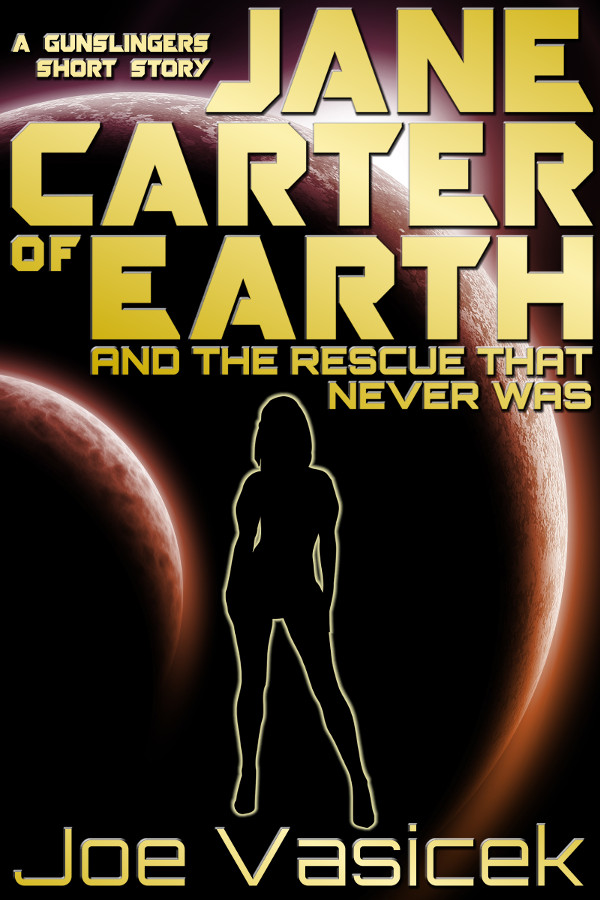
 Coming soon!