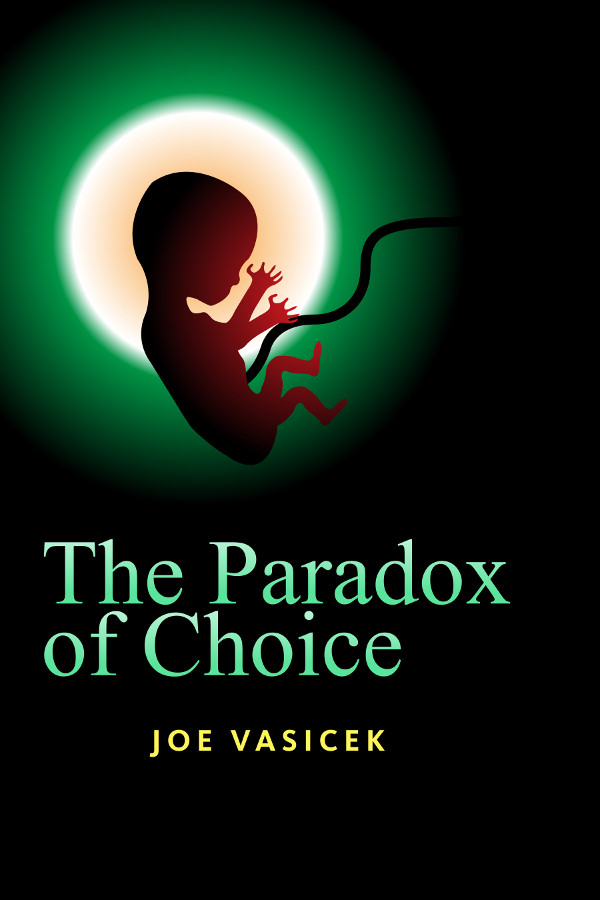
The Paradox of Choice: A chilling glimpse of an all-too possible future.

In cases where there may be severe deformities… I can tell you exactly what would happen. The infant would be delivered. The infant would be kept comfortable. The infant would be resuscitated if that’s what the mother and the family desired, and then a discussion would ensue between the physicians and the mother.


The Paradox of Choice

Enough small talk, Ruth. You didn’t come here to chat.

Is it really that obvious?

I’m afraid so. Who’s the father?

I don’t know, Jezebel. I can picture his face, but I can’t remember his name. I don’t even have his number. It was just one night—this was never supposed to happen.

Mmm hmm.

I’ve made a horrible mistake.

Don’t say that about yourself, dear. You’re a very strong woman. I’m sure we can find a way to fix this.

You are?

Absolutely. This is the current year, after all. Women have rights.

I know, but I think it may be too late. This is something I have to live with now.

Don’t be ridiculous, Ruth. It’s your choice.

Yes, but my baby is already three weeks old. I mean, look at him. He has my eyes.

You can’t seriously think of that as your baby.

Why not? He’s mine, isn’t he? I’ve already given birth to him.

Yes, you have. But the Supreme Court ruled that personhood does not extend to infants until they possess the ability to comprehend language. Until then, that thing is no different from a dog, or a cat.

But Jezebel, this is my child!

Not until its brain develops well enough that it can speak. Until then, there’s no legal difference between terminating him or putting down a dog.

How can you say that? Look at him, Jezebel! Look at how expressive his face is—how his eyes follow you—how he smiles.

Ruth, please. Don’t let your emotions cloud your judgment. Do you know how much other women have sacrificed to give you this choice?

No, but—

You are an empowered, modern woman. This is your choice. Don’t be ashamed of that. Be proud. Celebrate it.

But what if I don’t want to go through with it?

Come on, Ruth. Be reasonable. Are you really in a position to raise a child?

No, but I—

Then the most merciful thing you can do is terminate it, while you still can.

What?!

It’s true, and you know it. If you decided to keep it, you’d most likely find yourself trapped in the cycle of poverty, a single mother for the rest of your life. And is that any way to raise a family? Trust me, Ruth. Better to let it go.

But how is that worse than killing him?

The statistics don’t lie. A life trapped in poverty is not worth living.

How do you know that?

Are you seriously going to fight with me on this? You’ve led a privileged life, Ruth. We both have. It’s cruel and barbaric to bring a human life into the world under lesser circumstances than you’ve enjoyed.

But I already have.

No, you haven’t. Not according to the law.

But—but what if the law is wrong?

Ruth, dear. Please. You’re changing the subject. We aren’t talking about the law, we’re talking about you. About your life. About your freedom. About your choice.

I don’t know, Jezebel. It’s just… it doesn’t feel right to kill my child.

There you go again, calling it a “child.” Do we need to go over this again? It’s not a real child until it can speak.

But some babies can learn to make signs when they’re only a few months old. They can make gestures for food, for play, or for when they’re tired or hurt. Doesn’t that count?

Don’t get caught up in the minutiae of it, Ruth. The truth is, this is your choice, and anyone who tells you otherwise is just trying to shame you into silence. Don’t be ashamed. Don’t let them silence you.

I don’t know.

What do you mean, “I don’t know”? Do you doubt the science of brain development? Do you think you know better than the Supreme Court of the United States?

Okay, okay. I’m sorry.

Then what is holding you back?

Look at him, Jezebel. Isn’t he the cutest thing you’ve ever seen?

I know you feel attached to it, Ruth. And I know how hard this must be for you to hear. But I promise you, there is nothing wrong with letting it go.

Are you sure?

Yes. In fact, it would be a mercy.

But Jezebel—I can’t.

What do you mean?

I can’t put down my baby. It doesn’t seem right. Even if it is a mistake, it’s my mistake.

Then why should you have to carry it with you for the rest of your life? Why do you refuse to let it go? There’s still time for you to make this right. Be brave, Ruth.

How is it “brave” to kill my child?

We’ve been over this, Ruth. It’s not a “child.” Not yet.

Child or not, it’s still my own flesh and blood. I carried it to term and gave birth to it. I gave it life.

Yes, but it’s not a real person.

How can you say that? It laughs, it cries. It has feelings. If I don’t put it down, it will one day grow up to be a man. To be my son. His children will be my grandchildren. And who knows but what he’ll accomplish more in his life than I will in mine?

There you go, letting your emotions get the best of you again.

But where’s the line, Jezebel? When does he become a real human person? I’ve already brought him into this world.

Yes, you have. But until the law says he’s a person, he’s not one.

Is that what it all comes down to, then? The law?

I didn’t come here to argue with you about the law, but if that’s what it takes to convince you, then so be it. Yes, it all comes down to the law. If the law says you’re a person, you’re a person. If it doesn’t, then you’re not. Why make this more complicated than it needs to be?

Because… what if the law is wrong?

It isn’t wrong. This is your right. Your choice.

But isn’t murder a choice, too?

No, Ruth. Murder is a crime. It breaks the law.

But is that the only thing that makes it wrong?

Why should it matter?

Because putting down this child—I mean, terminating this life—it feels a lot like murder.

It’s not, Ruth. The law says so.

But what if the law said that I’m not a person? What if it said that you were within your rights to kill me? That would be murder now—would it still be murder then?

Ruth, I—

And who makes the law, anyway? How do we know that they’re right? I mean, yes, I know that without law, we can’t have a functioning society, but what if our laws are bad? What if following the law is wrong?

Don’t be ridiculous. Following the law isn’t wrong, because it’s the law. And the law says that you have a choice.

But—

Enough arguing, Ruth. Are you going to make your choice, or not?

What if I choose not to?

Ruth, Ruth, Ruth. How many times must we go over this?

But you said it was a choice. That means that I have options. I don’t have to kill—I mean, terminate it. If I did, it wouldn’t be a choice, would it?

That’s not the point.

Yes, it is. And it feels like you’re trying to make the choice for me.

Only because it’s the right one.

Why?

Because it’s empowering.

Then why does it feel like you’re trying to force it on me?

Don’t argue with me, Ruth. This is for your own good. One day, when you’re a happy, successful woman, you’ll look back on this conversation we had and thank me. Oh look, it’s beginning to snow.

It’s too warm outside to be snow.

My mistake. At least it’s good for the plants. Now, do you need me to come with you to the crematorium? I’m here to help you, Ruth. Every step of the way.

I don’t know. I just—

You just what?

Never mind.


Author’s Note

On January 22, 2019, New York enacted the Reproductive Health Act, which legalized abortion up to the moment of birth and repealed criminal charges for harming unborn children. A few weeks later, the Repeal Act was proposed in Virginia, which would have similarly repealed abortion restrictions in the state. In discussing this bill, Governor Ralph Northam said the following:

“In cases where there may be severe deformities… I can tell you exactly what would happen. The infant would be delivered. The infant would be kept comfortable. The infant would be resuscitated if that’s what the mother and the family desired, and then a discussion would ensue between the physicians and the mother.” (Julie, Cary, Ralph Northam, Ask the Governor with Va. Gov. Ralph Northam, WTOP-FM, 30 January 2019)

Governor Northam’s hypothetical case bears a striking resemblance to the 1939 case of baby Knauer, one of the first victims of child euthanasia in Nazi Germany. Baby Knauer was born with many severe deformities, including blindness, imbecility, and missing limbs. Hitler himself authorized the killing of the child. (Staatsarchiv Nürnberg, United States of America v. Karl Brandt et al., zitiert nach Ulf Schmidt: “Outbreak of War and Euthanasia. Results of Recent Research into the ‘Knauer Child’ in 1939.”) After baby Knauer, the Nazi eugenics program rapidly expanded to include forced euthanasia of the mentally ill and handicapped, and ultimately evolved into what we now know as the Holocaust.

In today’s political discourse, we have a tendency to use the Nazis as a proxy for the ultimate evil. Nazis don’t just exist on the spectrum of good and evil; Nazis are the scale. However, a compelling argument can be made that abortion in the United States exceeds the evil of the Nazis.

First, consider the numbers. Six million Jews were exterminated in the Nazi Holocaust, plus several hundred thousand Romani, Homosexuals, Jehovah’s Witnesses, and disabled. However, since Roe v. Wade, more than sixty million babies have been aborted in the United States alone. (Number of Abortions – Abortion Counters. http://numberofabortions.com/ accessed 9 March 2019) The number of babies aborted in the United States is an order of magnitude larger than the Holocaust.

Second, consider the historical context. In the 1920s and 30s, Germany was a shattered nation laboring under the burden of war reparations, hyperinflation, and starvation. In contrast, we are living in an unparalleled era of prosperity. The Germans turned to the Nazis out of fear and a sense of national crisis; we “shout” our abortions out of the apathy and selfishness of our own decadence.

Third, consider the victims. The German Jews were a distinct people with their own unique culture and religion. It wasn’t very difficult for the Nazis to “otherize” them, because they were already a peculiar people. In contrast, we are slaughtering our own flesh and blood, the fruit of our loins—our children.

The United States was founded on the principle of three unalienable rights: life, liberty, and the pursuit of happiness. And yet, when we look back at our own history, we find it difficult to comprehend how our fore-bearers could believe these things and still own slaves. I believe that future generations will look back on us in much the same way, and question how a people who claim to believe in the unalienable right of life could assent to the wholesale slaughter of the unborn.

Any woman who has carried a child to term will tell you that the baby inside of her has their own tastes and personality; that they sleep at certain times and wake at certain times, and get angry, happy, upset, or calm while still inside the womb. The science of biology tells us that from the moment of conception, a fetus possesses its own unique DNA, which determines hair color, eye color, sex, genetics, personality—everything that makes us human, short of actual lived experience. The point of viability is constantly being pushed back by developments in lifesaving technology, making it a poor moral standard. Is a child aborted at twelve weeks today any less of a human being than a child born in future decades, when we will have the technology to save that baby outside of the womb?

I don’t want to judge anyone who has had an abortion. I don’t know the details of every case or what lies in every human heart, and I cannot say with certainty that every abortion is wrong. However, I can say with certainty that every abortion ends a human life. When I look at what my nation has done, and the blood on our hands of the most innocent and powerless among us, I feel to echo Thomas Jefferson’s words: “I tremble for my country when I reflect that God is just, that his justice cannot sleep forever.”

This story was very difficult for me, and I wasn’t originally going to write it. The idea for it came to me several years ago, but it wasn’t until April 2017 that I felt impressed that this was something I needed to write. Even then, I only wrote it halfway. But the events of 2019 convinced me that I needed to dust off this old manuscript and bring it to completion.

Because I want this story to have the furthest reach, I am publishing it under a Creative Commons Attribition 4.0 International license (CC BY 4.0). Feel free to download it, upload it, meme it, rewrite it, and even resell it for your own profit. All I ask is that you copy this license and provide a link to the original.

I’ll end with this quote from Defying Hitler by Sebastian Haffner:

“We watched the earlier events unfold. They occupied and excited us… but they did not confront us with ultimate decisions of conscience. Our innermost beings remained untouched. We gained experience, acquired convictions, but remained basically the same people. However, no one who has, willingly or reluctantly, been caught up in the machine of the Third Reich can honestly say that of himself.”

I believe that we are living in a similar time. The assault on the sanctity of life deeply affects us all, both individually and as a society. In writing and publishing this story, I hope to have done some small part.

Thank you for reading.

Creative Commons License

The Paradox of Choice by Joe Vasicek is licensed under a Creative Commons Attribution 4.0 International License.

Reworking The Paradox of Choice

The events in New York and Virginia of the past couple of weeks have been interesting, to say the least. The abortion debate has escalated dramatically, with talk of fourth-trimester abortions and keeping the infant “comfortable” while “a discussion would ensue between the physicians and the mother.”

Without getting too much into the politics of it, this discusion has put me in a very awkward position regarding one of my stories. It’s a very short piece, titled “The Paradox of Choice,” and it depicts two women having a conversation about whether or not to “abort” a baby who’s already been born. The narrative is entirely dialog, so it isn’t clear until the middle of the story that they’re talking about a living, breathing baby who happens to be sitting between them.

I wrote the story as a bit of a shock piece, to show that the line between infanticide and aborting an unborn child isn’t as clear as people think. When I wrote it, though, I thought that infanticide would still be considered abhorrent. I had no idea that the Overton window would shift as quickly as it has.

Hence the awkward position. Clearly, this story needs to be rewritten, but how? Expanded, perhaps? By adding more descriptions to actually show the baby? Or do I need to abandon the “shock piece” aspect and turn it into more of a reasoned discussion of evil?

I wasn’t originally going to write this piece, but a couple of years ago I felt a strong impression that I needed to. Even then, I only did about the minimum of what I needed to do to get it onto the page. This isn’t the sort of thing that I usually write. But now, I suppose I need to revisit it and put in the effort to make it properly shine.

Either way, it’s insane how quickly the debate is shifting.

Politically incorrect thoughts on intersectional authorship

I’m subscribed to six or seven short story podcasts, and I’ve noticed a trend on them recently. Before they start the story, they introduce the author by first listing all of the intersectional minority identities that the author qualifies for, like “queer,” “transgender,” “immigrant,” “disabled,” “person of color,” etc.

Whenever story starts off like this, I immediately delete it form my podcast.

I’m a busy guy. I’m subscribed to far too many podcasts to listen to every episode. There’s just not enough time. If I have a reason to skip it, I will.

When the first thing you tell me about the author of a story is where he/she/ze/your majesty falls on the intersectional victimhood stack, that tells me a couple of things. First, it tells me that the editors subscribe to this bullshit idea that victimhood makes you virtuous. It doesn’t.

Second, it tells me that the editors didn’t think that the story could stand on its own. Instead of giving a typical author bio, with a few incidental facts and a cute aside about the author’s wife/kids/pets/plans for world domination, the editors decided to lead with the author’s victimhood status. Because that’s why I should listen to the story. Because victimhood is virtuous, and if you don’t listen to this story after learning just how much of a victim the author is, that makes you a racist sexist transphobic Nazi fascist.

Fuck that.

I’m sure this post will generate outrage among some circles. There was a time when I would try to respond genuinely to such outrage, apologizing for causing offense and vowing to try better to understand, sympathize, and accept the experiences of…

Fuck that.

If it offends you that I automatically delete these sorts of podcasts, go fuck yourself. Seriously. Call yourself an autosexual and see where that put you on the intersectional victimhood stack. I don’t give a shit about your outrage. I couldn’t care less about how triggered you are right now. If that makes me a fascist, so be it. To paraphrase Syndrome from the Incredibles, when everyone’s a fascist, no one’s a fascist. (Which is very convenient for actual fascists.)

By the way, I’m not actually opposed to stories written by immigrants, or lesbians, or transgenders, or people of color. I’ve listened to quite a few good ones. “And Then There Were N – 1” from Escape Pod was really fun. So was “Octo-Heist in Progress” from Clarkesworld a couple of months back. Neither of which were introduced by describing just how many oppressed victimhood classes the author qualified for.

If there’s one thing we’ve learned from the Trump era, it’s that when people call you a racist sexist transphobic Nazi fascist, they really just want to bully you into silence. But all bullies are cowards at heart. If they want to silence you, it’s because they know that they’re wrong.

Can we please return to the time when everyone acknowledged that stories should stand or fall on their own merits, not on the merits of the author? Mur Lafferty did quite a few ISBW epidodes on this, and she’s hardly a right-wing type. By all means, let’s bring all the queers and wierdos along. Science fiction wouldn’t be the same without them. But let’s not use a double standard when it comes to their stories.

After all, that would be racist.

“The Open Source Time Machine” now available on The New Accelerator!

The good folks over at The New Accelerator have picked up another one of my stories! This time, it’s The Open Source Time Machine. If you’re already a subscriber, be sure to check it out, and if you’re not a subscriber, it looks like they put out a new weekly story for the very reasonable fee of £1 per month. If they’ll publish me twice, you know they can’t be that bad. Be sure to check it out!

New short story goals

In the last few months, as I’ve reworked my business plan, I’ve put a lot of thought into what I want to do with short stories. I’ve written about two dozen of them so far, and while I don’t expect to be known as a short story writer, I do expect that short stories will play an important role in my career, especially with the way that the publishing world is changing.

Objectives

Short stories are a great way for readers to try out new authors, without all the cost in time or money of a novel. It’s also a great way to build a hybrid career, as the professional short story markets have few of the hangups of publishing a longer work with a traditional publisher. It’s not extremely lucrative, though there is money to be made. More than that, it’s a way to gain cache and build your brand, especially if your stories get picked up by a major magazine or anthology in your genre.

So that’s my main objective with short stories: to use them to build my author brand and grow my readership. Self-publishing plays a role in that, but not nearly as much as the professional markets.

Writing

To get picked up by the professional markets, I need to have stories to submit to them, which means that I need to be prolific. Consequently, my goal from here on out is to write a new short story each month. That’s a pace I can maintain that doesn’t interfere too much with my other writing. It can be refreshing to take a WIP break from time to time, and short stories only take a few days at the most.

I know that Dean Wesley Smith says that you should never revise anything, and I’ve been following that advice until now with my short fiction. However, I do feel that it can strengthen my writing significantly to cut the word count by 10%, especially for short fiction where the strongest writing tends to be economical. So I’ll most likely do that to all my stories from now on.

Submitting

In general when submitting, it’s best to start with the top-tier markets and work your way down. This is the order in which I prioritize my submissions:

  1. SFWA qualifying markets
  2. Professional paying markets (6¢ per word or higher)
  3. Semi-pro paying markets (between 1¢ and 5¢ per word)

I’m not sure if I’m going to bother with token paying markets (less than 1¢ per word). Probably not for anything other than reprints. They don’t really put me any closer to my goals. Also, I’m not sure if I actually want to join SFWA, but I do want to qualify for it through my short story sales. Never join a club that would have you as a member, etc etc.

As for non-paying markets, I’ve decided not to submit to them after all. It’s been pointed out to me that giving something away for free after you’ve charged other people money for it is a dick move. Also, there aren’t really any non-paying markets that would bring me closer to my goals. All of the markets with serious cache also pay professional rates, at least in science fiction.

Self-publishing

Until now, I’ve self-published my short stories either immediately after their first sale, or after I’ve submitted all of the professional markets. My guiding philosophy has been that unless there’s a significant opportunity elsewhere, it’s better to self-publish something than to keep it on your hard drive.

However, self-publishing short stories doesn’t help me get much closer to my objectives. Certainly keeping a bunch of singles up for sale doesn’t help much, and it might actually hurt by cluttering up my book pages. They’re good for the occasional newsletter giveaway, or for first-in-series and other stuff, but that’s about it.

Dean Wesley Smith says to charge $2.99 for individual short stories in order to get the higher royalty rate, but I’ve tried that for the last couple of years and haven’t seen much benefit from it. Unless you’re known as a short story writer, I just don’t think short stories are good for making money. Because of that, and also because I’m going to be using them for giveaways and promotions, I plan to sell all of my short fiction (under 10k words) for a token 99¢.

Considering how it’s rude to give something away for free immediately after selling it, I plan to refrain from self-publishing until both the first-publication and reprint markets have been exhausted. That’s because I plan to make my short stories free when I first self-publish them, at least for the initial few weeks. Again, better to put something out for free and raise the price than it is to charge for it at first and make it free later.

When enough short stories have accumulated to put into a bundle, then I’ll unpublish all but the one or two best-rated or most popular singles, and put a link to the bundle in the back of those. In that way, the short story singles will help to sell the bundles, which make more money anyway, since I plan to charge $4.99 for them. This also helps to clean up the book pages, by replacing singles with bundles over time.

So that’s the plan. Submit until all professional and semi-pro markets have been exhausted, then self-publish as singles until there’s enough to put in a bundle. And hopefully sell a bunch of stories to the major markets.

Should I submit to non-paying markets?

I’ve recently gotten back into writing and submitting short stories, and this is one of the questions on my mind.

Don’t get me wrong: I still believe in the top-down approach to short stories, where you start with the highest paying markets and work your way down. And I’m not going to write anything specifically for a non-paying market, unless it’s a charity anthology. That just doesn’t make any sense.

But what about a story that you’ve already sold somewhere, already self-published, and the non-paying market only wants non-exclusive reprint rights? I understand the pay-the-writer argument, and that’s certainly one approach, but there’s also the Jonathan Coulton, song-a-day, be prolific and fill the world with your work approach.

As far as I can tell, here are the pros and cons of publishing a short story with a non-paying market after it’s already been published:

Pros:

  • Improved chances of winning an award
  • Improved chances of appearing in a “best of” anthology
  • Networking opportunities with other publishing professionals
  • More readers will find you
  • More publishing credentials
  • Makes you part of a community

Cons:

  • Could damage author brand if publisher is non-reputable
  • Violates Kant’s categorical imperative
  • Costs too much in time and effort

What sayest thou?

Yes, I still exist

Wow, it’s been more than a month since the last time I posted on this blog? This needs to be rectified, and by more than a solitary post.

It’s been a bumpy few weeks. Not rocky, but not smooth either. Between working unpredictable odd jobs and unexpectedly finding myself in a romantic relationship, it’s been difficult to get into a productive writing and publishing routine—hence, the less frequent posting on this blog.

That said, I’ve seen a marked increase in book sales recently, which is encouraging. Getting a couple of Bookbub featured deals definitely helps. By my calculations, I have about six months of expenses in my business savings, which includes things like Bookbub deals and convention costs. The goal, though, is still to build my email list, and that’s proceeding a lot slower than I would like. I need to find new and better ways to get my books in front of the readers who will love them.

Writing-wise, things are proceeding at a slow but steady pace. I’ve put Queen of the Falconstar on the back burner for the time being, to work on Gunslinger to Earth. If all goes well, I should be finished with that WIP by mid-January, and release it in April. That will complete the Gunslingers trilogy!

I think it might be cool to release a few excerpts in audio as well as on this blog. What do you guys think? Record a few MP3s of my own narration, release them as downloads. Or maybe put them up on YouTube. It’s a bit ironic, because Gunslinger to Earth is a first-person book from Jane Carter’s perspective, but still, I think I can pull it off. It will also be good practice for audiobook narration, which I hope to do more of in the following year.

In other news, I’ve decided to hold off on self-publishing any more of my short stories until I’ve sold the first publication rights. Up until now, I’ve been fitting them into my publishing schedule for the months when I don’t have a novel release. But I think that holding off to publish them traditionally, even with a market that pays semi-pro rates, is better than self-publishing them just for the sake of having something to release.

Don’t get me wrong: I still want to self-publish my short stories, I just want to sell them to a magazine first. In the short term, this means that I won’t have as many things to fill out my publishing schedule. In the long-term, it means that I need to write more short stories now in order to have more content to submit to the magazines, and ultimately to fill out my publishing schedule later.

So my goal from now on is to write at least one short story a month, on top of my regular WIP schedule. Some of these will be in the same universe as my novels, much like Starchild or Jane Carter of Earth. I’ll probably self-publish those first, to promote my new releases. But the other stories will stay on submission until they sell, preferably at professional rates.

I really need to up my short game. Speaking of which, Larry Correia just released the cover art for his second short story collection, and it is hilariously badass, much like Larry himself. I love the fact that his wife is in it too.

Looking ahead, I hope to get back into a semi-regular blogging routine, with more book reviews. I’ve read quite a few books recently, and it would be good to share a few reading recommendations. And I’m still writing regularly. Just because I’ve neglected the blog doesn’t mean I’m neglecting everything else.

That just about does it for now. Take care, and thanks for reading!

Free and 99¢ books for February

Free:

Nothing Found

Brothers in Exile

Brothers in Exile

eBook: free!

Isaac and Aaron are nothing if not survivors. Their homeworld lost and their people scattered, all they have left is each other. Then, in the Far Outworlds, they find a dead colony with a beautiful young woman frozen in cryostasis. She is also a survivor—and she needs their help.

More info →


99¢

Strangers in Flight

Strangers in Flight

$9.99eBook: $2.99

When Reva went into cryosleep, she wasn't prepared to be the sole survivor of a people that history never remembered. Isaac wants to help her, but he carries a secret that may decide the outcome of the war. Little does he know, the Imperials aren't the only ones hunting him.

More info →

Comrades in Hope

Comrades in Hope

$9.99eBook: $0.99

Isaac and Aaron have joined the war effort, and not a moment too soon. The Imperials are poised to strike at the heart of the New Pleiades and obliterate the ragtag flotilla standing in their way. Aaron always wanted to prove himself, but he was never ready to make the ultimate sacrifice—until now.

More info →