Trying something new

I’m going to try something new and post to this blog every day for a while. I’ve heard that blogs do best if they have daily content, and while I personally find it difficult to keep up with those blogs (unless, like The Passive Voice, they’re more like a subject-specific newspaper), I’m willing to give it a shot.

I gave up social media about a year ago… or was it two? I still post stuff to Twitter occasionally, but only to procrastinate or waste time. For a variety of reasons, it’s not a platform I take very seriously.

But blogging, I actually enjoy. Mostly, I just like reading other people’s blogs, but I have been posting to this one for… what, ten years now? At times, it’s been more sporadic than others, but it’s something that’s definitely stuck. I’ll probably keep blogging for the rest of my life.

In any case, I’ll try this out for the next month or so, just to see how it works out. If you have any ideas or suggestions, or you’re a longtime follower who just wants to say hi, feel free!

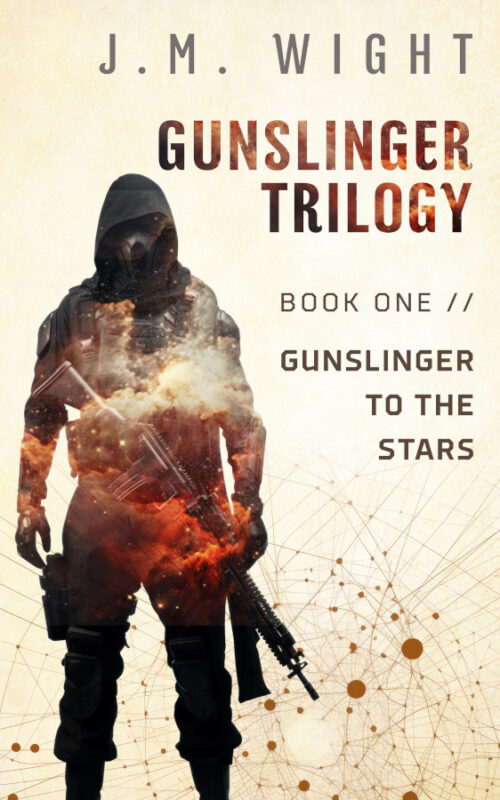
Out Now: Gunslinger to the Stars!

Great news guys! My latest novel, Gunslinger to the Stars, is now out!

I really believe that this is the most entertaining book I’ve written to date. Definitely the funnest one to write. In some ways, it’s quite a bit different from my previous fare, but I think my readers will enjoy it nonetheless.

If you do get a chance to read it, I would greatly appreciate if you’d take the time to post a review. Now is the most important time for reviews to be posted, in the days and weeks immediately after release. It will also help me to decide whether and how soon to turn this into a trilogy If you can’t, no worries, but a huge thanks if you can.

Other than that, thanks for reading and enjoy!

Gunslinger to the Stars

Gunslinger to the Stars

$15.99eBook: free sale!Audiobook: $2.99 sale!

Sam Kletchka here, freelance gunslinger and interstellar privateer. This, my friends, is how I went from being stranded in the armpit of the galaxy to becoming the luckiest human being in the universe.

More info →

The end of politics in America, part 1

I am convinced that the grand key to understanding United States history in the 20th century—and by extension, current events in the 21st—is a deep knowledge of monetary policy and the financial system.

In 1913, two things happened: Congress established the Federal Reserve, and the Constitution was amended to allow for an income tax. This established a new monetary system in direct opposition to the gold standard, which in turn had replaced the bi-metallic standard established by the Constitution. In time, the Federal Reserve system would replace the gold standard altogether, becoming our sole form of legal tender.

Before the Federal Reserve system, every dollar represented a fixed weight of gold—a real, physical asset. Today, what does a dollar represent?

Dollars are created when Washington runs a deficit. The government spends more money than it takes in through taxes, so it has to borrow the difference. It does this by issuing treasury bonds, which it sells to the banks. The Federal Reserve then buys them, but with money that it creates by issuing a check against an account with nothing in it. In other words, the Fed creates money out of nothing to buy our national debt.

These dollars, called “base money,” then trickle down into the banking system as government contractors deposit their money. Through fractional reserve banking, this base money multiplies by ten-fold, or even a hundred-fold or more.

In other words, every dollar in existence represents a dollar’s worth of debt. Some of it is our national debt, owed by current and future generations of taxpayers. The rest of it is owed by private citizens in the form of mortgages, car loans, student loans, credit cards, etc.

But if every dollar represents a debt, where do you get the money to pay the interest?

You borrow it, of course. The only way to create more money is to create more debt. This is why the US dollar has lost 97% of its value since the creation of the Federal Reserve. This is why inflation has been a fact of life for the past century. This is why income inequality has widened so dramatically. And this is why our politics have become so insane.

I titled this post “The end of politics in America” because I’ve come to realize that the greatest problem facing this country is not political, and that no political solution can fix it. The problem is economic. It’s financial.

Our country has bought into a massive Ponzi scheme that we like to call “money.” We measure our wealth in a debt-based currency that steals prosperity from future generations and transfers wealth and power to an elite class of unelected bankers and bureaucrats. As with every Ponzi scheme, it only works so long as new capital enters the system. This happens in three ways: growth, innovation, and serfdom.

Growth is obvious. So long as our economy is growing, debt isn’t a problem because we’re creating more wealth to pay it off with. This is where debt actually makes sense: when it goes towards building future prosperity. An example of this that people often point to are the infrastructure projects of the 1950s.

Unfortunately, when your debt level reaches a certain point, it goes from stimulating growth to inhibiting it. Our debt-to-GDP ratio is now 104.17%. That means that if we took the sum total of all the goods, services, investments, tax revenue, deficit spending, and net exports, and we spent it ALL on paying off the debt, we still couldn’t pay it all off.

Think about that. Your entire paycheck. Warren Buffett’s paycheck, and all the millions he made last year on his investments too. All of the money spent on Amazon. All of our grocery bills. All of the ticket sales for every blockbuster movie, and the production costs as well.

Even with a whole year of that, you still couldn’t pay off the national debt.

Ever since the Great Recession, our GDP has never seen more than 3% annual growth. This, in spite of deficit spending that from 2009 to 2012 was higher than the deficit we ran in World War II! We have gone even deeper into debt than we did to defeat the Nazis, and all we got was this crappy economy.

We’re not going to grow our way out of this debt burden. The debt is the reason the economy can’t grow.

Innovation is, in some ways, another form of growth. Instead of making more mousetraps, you’re building better ones. This is why computers are cheaper now than they were in the 1980s. This is why we have no idea how people survived before mobile phones.

Twenty-five years ago, data storage cost nearly $10,000 per gigabyte. Email was a novelty. Mobile phones were revolutionary. Only the military had GPS. Satellite imagery was top secret spy stuff. “Facebook” was a printed directory of addresses and phone numbers for your local college or high school.

And yet, with all of these incredible innovations in just the past few decades, does it feel that your life has gotten any easier? Is it any easier to make ends meet? Have we entered the leisure society yet?

The truth is that we’re caught in a tug-of-war between inflation and innovation. In some areas, innovation is winning. This is why computers and smart phones are getting cheaper. In other areas, inflation is winning. This is why cars and housing are so much more expensive.

Can we innovate our way out of our national debt burden? Not without fundamentally changing our monetary system first. Until then, we’re just putting patches on a broken operating system. We can delay the inevitable collapse for a while, but not forever.

Which brings us to the third way our Ponzi money stays afloat: serfdom.

I have a lot more to say, but this post has gone long enough and already sucked up way too much writing time. I’ll post part 2 sometime next week, taking the risk that events in Washington will make me regret the post title. But I don’t think that they will. Hopefully you’ll soon see why.

Gunslinger to the Stars — excerpt 8

“Oh my heck,” said Jane, still trembling.

I holstered Kindness and reached down to help her to her feet. Her face was pale and her arms were trembling, so I figured it was a good time for us both to leave.

“Barkeep,” I said, pulling out a credit chit. Behind the counter, Ivosh rose unsteadily to his feet.

“My apologies,” he said, cracking his neck. Though the rockadillo grunt had punched him hard enough to break some bones, he looked none the worse for wear.

“You okay?” I asked.

“I’m perfectly fine,” he said, walking around the counter.

“Are you sure? That blow you took—”

“For members of my species, the physical form is less of a liability than it is for yours. Emotional energy does much to revive us, as I’m certain you can tell.”

He gestured to Jane. Her cheeks were still pale, and she was gripping my arm as if to never let go. I had no idea what was running through her mind, but it was clear to us both that I had just saved her life. Apparently, her relief was enough to make Ivosh regenerate.

“Let’s get out of here,” I said. “Can you take us to your place?”

“Certainly,” said Ivosh. “Come, let’s go.”

I left the credit chit on the counter and followed him out, Jane by my side. The fact that no one else seemed fazed by the gunfight told me everything I needed to know about the Gorinal Cluster. This place was going to be tough.


Gunslinger to the Stars

Gunslinger to the Stars

$15.99eBook: free sale!Audiobook: $2.99 sale!

Sam Kletchka here, freelance gunslinger and interstellar privateer. This, my friends, is how I went from being stranded in the armpit of the galaxy to becoming the luckiest human being in the universe.

More info →

Further impressions of Iowa

This post could just as well been titled “Oh my heck, Toto, we’re not in Utah anymore.”

What is up with all of the tattoos everywhere? Call me old-fashioned, but unless it’s a part of your cultural heritage (Arab, Indian, Polynesian, etc), I don’t really find it interesting or attractive. It’s like someone vandalized your body.

Utah is pretty insulated in this regard. Sure, you can find people with tattoos, but only if you look for them. Here, every other person has a tattoo somewhere.

Is this part of a wider trend across the United States? If so, is it connected to the crappy economy? People with stability and security in their lives don’t typically get tattoos. Or maybe it’s all of my fellow Millennials who don’t know what they’re doing with their lives and are sort of just drifting.

I’ve probably got readers who are thinking right now: “dude, WTF? You’ve got a character in Sons of the Starfarers who has a full body tattoo, and doesn’t mind showing it off.” To which I would say: 1. it’s temporary (henna), 2. it’s part of her cultural heritage, and 3. it’s fiction.

The other big thing I’ve noticed (which again, is probably just going to show how insular Utah can be) is that no one has any concept of food storage. There’s a store out here called Mills Fleet Farm, which is kind of like a Home Depot swallowed a feed store and ate a Walmart for dessert. Asked three employees for foodsafe five-gallon buckets, and none of them had any idea what I was looking for.

In Utah, you can get foodsafe five-gallon and two-gallon buckets from any grocery store. At Macey’s and Winco, they sell the gamma lids. You can also buy 50 lb bags of oats or wheat, 25 lb bags of beans or rice, and twice a year they have case-lot sales where you can buy canned goods by the case upwards of 50% off. Freeze dried foods and can rotation systems are also a perennial.

Am I the weird one for thinking it’s a good idea to keep 90 days worth of non-perishable food in your pantry? Aside from all the prepper reasons for why that’s a good idea, it’s also a lot cheaper to buy in bulk. And it’s not like people don’t keep gardens around here. Though I do have to admit, there aren’t nearly as many home gardens as Utah.

But the people seem friendly enough, and aside from those two points, this place is actually a lot more culturally similar to Utah than other places in the country where I’ve lived. It’s more conservative than California, more churchgoing than New England, and a hell of a lot more honest than Washington DC. About the only other place I’ve been that comes close is Texas, but Texas is Texas. Nothing else compares.

I could see myself ending up in Texas someday, if I don’t move back to Utah first. Utah isn’t for everyone, but I love it there and wouldn’t mind putting down some permanent roots. California, on the other hand… you couldn’t pay me to live there. Same with Washington DC.

Iowa’s not a bad place, though. Time will tell how it rubs off on me.


Gunslinger to the Stars — excerpt 7

The .45 is an excellent caliber for dealing with unfamiliar races. Having never faced a rockadillo before, I wasn’t sure what to aim for, but the .45’s stopping power covers a multitude of sins. I aimed for the leader’s neck and fired twice. Kindness bucked in my hands, and the rockadillo leader stumbled backwards with dark, oily bodily fluid gushing from his wound. He squealed like a pig, and Grunt Number Two drew one of his blades. Unfortunately for him, Kindness was faster. I shot out his wrist, elbow, and shoulder joints in quick succession. The blade fell from his pudgy armored hand, and his arm went limp, dripping oily blood all over the floor.

With the rockadillos more or less neutralized, I risked a quick glance at Jane. She was huddled on the floor behind me, clutching my leg. I turned and stared the aliens down with Kindness pointed squarely at them, but the fight was over. Grunt Number One dragged the unmoving body of their leader away toward the door, while Grunt Number Two staggered after him.

“Ack mar alakzan!” he shouted in my direction just before leaving. My wrist console attempted to translate, but the rockadillo’s native tongue was not in the database. Still, the meaning was clear: I now had a price on my head.


Gunslinger to the Stars

Gunslinger to the Stars

$15.99eBook: free sale!Audiobook: $2.99 sale!

Sam Kletchka here, freelance gunslinger and interstellar privateer. This, my friends, is how I went from being stranded in the armpit of the galaxy to becoming the luckiest human being in the universe.

More info →

Heaven’s Library (Blast from the Past: June 2009)

All right, it’s time to get in the wayback machine and revisit a post from long ago. This one should be especially interesting to you aspiring writers out there, as well as the seasoned writers who need an extra gut-wrenching wake-up call from time to time. I know I certainly do.


Today was the first day of BYU’s writing conference, and it was great! The speaker in the last workshop, Dandi Mackall, was exceptional. I don’t have my notes with me and the BYU library closes in twenty minutes, so I’ll recap the best part of her presentation.

She said that once she had a dream where she died and went to heaven (thank goodness!). When she got there, the angel who greeted her offered to show her around, and asked what she wanted to see first. Her answer? The library, of course!

In heaven’s library, she found shelves stretching as far as she could see, full of the very best books. She picked out a few and recognized some of her favorites, the ones that had impacted and changed her life.

After a while, though, she started to get a little disappointed: all of the books in heaven’s library were books we already had down on Earth. Why was that? Didn’t heaven have anything new–anything we hadn’t already seen down below?

“But all these books were here first,” said the angel.

Still, she couldn’t accept that as an answer, so the angel took her down a long, winding, narrow corridor. The deeper she went, the narrower and dustier it became, until she started to feel uneasily. This part of the library was dark and dirty. It was clear that hardly anybody every came down here.

Finally, the angel led her to a door covered in cobwebs. He brushed them aside and opened the door. Here was a room many times larger than the first, with old, dusty bookshelves stretching out of sight.

She picked out a book and started reading through it. It was one she’d never heard of, but it grabbed her. She could tell that it was really good. She picked up another one, and realized that it was just the kind of book that one of her friends would have loved. She picked up another one, and realized that this one could have helped out another friend through a terrible crisis she’d recently been through.

“Why didn’t we have these books?” she angrily asked the angel. “They are just as good as the other ones. Why didn’t they make it down?”

“These are all the books that remain unwritten,” the angel answered. “Each one of these is a book that a writer, somewhere below, has in them but fails to write down.

“This one is by a writer who won’t let anyone give her the criticism she needs to improve her craft. This one is by a writer who doesn’t have the discipline to finish what he starts. This one is by a writer who doubts herself and doesn’t think she can ever get her story to work.”

Humbled, she followed the angel back to the main hall. Just before stepping through the doors, she saw one last book. The name on the cover was her own.

For some reason I don’t understand, fate, God, or genetics (or some malicious combination of the three) conspired to turn me into a writer. Sometimes, I wonder if I’m making a mistake trying to turn this passion into something that will feed myself and my future family. Looking at the millions of other writers like myself, it’s easy to feel anxious. Only a tiny fraction of us will ever make a professional career out of this. Do I even have a chance?

But then I hear a story like this one and I remember why it is that I write. Not for fame, fortune, publication, personal gratification, or even just because I can’t not do it. It’s because storytelling itself is important. It helps us connect with the world around us, to see its beauty and wonder. It helps us to appreciate ourselves and understand others. It stimulates our imaginations and lifts our eyes to see the divine potential that is all around us. It helps us to grow and to heal—to live and to love.

May you find your book in heaven’s library and bring it into the world!

Gunslinger to the Stars — excerpt 6

Our little pissing match had attracted some unwelcome attention, in particular three large and rather unfriendly looking aliens. Picture the love child of an armadillo and a rock, beaten half to death with the ugly stick. Their tentacle-like tongues flicked in and out of their narrow mouths as they formed a half-circle around us.

“You are hoo-man?” the largest one asked in the local trade language. My wrist console translated for me through my ear-jewel, though I understood well enough to get along without it.

“Yes,” Jane answered before I could say anything. “Though we are not official emissaries, we express our greetings in a spirit of friendship.”

She was a lot better at the trade language than I was, but she had still missed a few non-verbal cues. The two grunts stood with their centers of gravity low and their arm-like upper appendages ready for action, like linebackers just before a play. They all carried dagger-like blades on their belts, with a longer one sheathed on the backs of their knotted shells. It was clear that they weren’t here to establish friendly diplomatic relations.

My hand slipped down to Kindness, the .45 ACP 2011 holstered on my hip.

“You come with us,” the head rockadillo said, its tongue flitting rapidly. “No question. No resist.”

“I’m sorry, but there must be some mistake,” said Jane, frowning at their odd request.

“We no mistake. You hoo-man, you come now. No more talk!”

“Friends, please,” said Ivosh, stepping between them. “There is no need to—”

Without any warning, Grunt Number One lunged forward and threw a punch into Ivosh’s body with a sickening snap, and the empath tumbled over the countertop. Jane screamed, and I bolted into action.


Gunslinger to the Stars

Gunslinger to the Stars

$15.99eBook: free sale!Audiobook: $2.99 sale!

Sam Kletchka here, freelance gunslinger and interstellar privateer. This, my friends, is how I went from being stranded in the armpit of the galaxy to becoming the luckiest human being in the universe.

More info →

Gunslinger to the Stars — excerpt 5

“Yes,” said Jane, sighing. “Ivosh, allow me to introduce my friend Sam. Sam, Ivosh.”

“This man is your friend?”

“Yes, he is. We knew each other at Earthfleet Academy.”

Ivosh’s pursed lips quickly turned to a wan smile, and his hair went from red to brown in almost an instant. “Forgive me for the misunderstanding, my good sir. It is truly a pleasure to meet you.”

The David Bowie look must have been an attempt to intimidate me, because Ivosh dropped it almost immediately—or at least fast-forwarded a couple of decades. He offered his hand and probably would have kissed me on the cheek, if I weren’t so careful to keep my distance.

“Sam is something of a mercenary,” Jane explained. “You want someone dead, pay him well enough, and he’ll get the job done. Unless someone else pays him to turn on you.”

“I prefer ‘man of fortune.’ And contrary to what you might think, Jane, I never go back on my word.”

She rolled her eyes, probably because I didn’t deny being a mercenary. At the time, though, I thought it was my honesty she was questioning. That made me a little touchy.

“Name one time that I’ve lied to you, Jane. One time.”

“Are you forgetting that you stood by and let the slavers take me?”

“That’s different. I was working for someone else. He betrayed you, not me.”

“Oh, for the love of—”


Gunslinger to the Stars

Gunslinger to the Stars

$15.99eBook: free sale!Audiobook: $2.99 sale!

Sam Kletchka here, freelance gunslinger and interstellar privateer. This, my friends, is how I went from being stranded in the armpit of the galaxy to becoming the luckiest human being in the universe.

More info →

Gunslinger to the Stars — excerpt 4

“So, what happened after the slave auction?”

She sighed. “I was bought by a band of empath shapeshifters. They were kind enough to free me, so long as I signed an employment contract. I’m working for them now.”

“Empath shapeshifters?”

“It’s a race we haven’t catalogued yet. They feed on emotional energy, and can alter their physical form to match most alien races.”

“Sounds like an interesting bunch,” I said, accepting my cocktail from the barkeep. I drizzled some of my home brew into it and handed the flask to Jane. To my dismay, she refused it. Guess her trust only went so far.

“They’ve been treating me all right. Humans are new to them, so they’re eager to learn as much about us as they can. They run a sort of host club for alien races, catering to their emotional needs.”

“A host club?”

“Yeah. They do what they can to pleasure their clients, and feed off of the positive emotions that ensue.”

“So, a brothel, then.”

She stiffened. “I’d rather not call it that. Sex isn’t the only service they offer.”

To my credit, I kept my mouth shut.

“In any case,” she continued, “they offered me a secretarial position and free room and board, with the understanding that I would help them adapt their skills to humans.”

“Sounds like a cushy job,” I said, taking a drink.

“It’s not like that,” she said, her cheeks blushing red. “I swear, most of the time, I just—”

“Is this man bothering you, my dear?”

It’s strange enough to meet another human on the far side of the galaxy, but it’s even stranger to hear an alien speak English. Not that the empath shapeshifter didn’t do a good human impression. He looked a little like a young David Bowie, which is to say that he’d crawled out of the uncanny valley, if just barely. High cheekbones, pursed lips, and eyebrows that looked more than a little metro, with a wild red carrot top.

I looked from him to Jane and back again. “Empath shapeshifter, right?”


Gunslinger to the Stars

Gunslinger to the Stars

$15.99eBook: free sale!Audiobook: $2.99 sale!

Sam Kletchka here, freelance gunslinger and interstellar privateer. This, my friends, is how I went from being stranded in the armpit of the galaxy to becoming the luckiest human being in the universe.

More info →








