Hellish week (and I’m still crossing my fingers)

Holy cow, this week was insane.  INSANE. Two papers (13 pages and 8 pages respectively) in one week, hours and hours wrestling with Sambanis’s Civil War dataset and Excel (I wish I knew STATA–it’s so much more useful for analyzing ginormous datasets), 33 tests to grade (of which I’ve only graded about 11), peer reviewing two research proposals, about half a dozen dense poli sci articles…

I could continue the list, but I think it would bore you.  Suffice it to say that the Homework Alert Level has been on RED since Monday.  Not good–and damnably frustrating, since it eats up all my writing time.  Unsustainable.

However, by 3pm today, all the major hurdles were finished. Thank goodness!  And I not only got some writing in, I finished reading a book.  It was a pretty good one–I’ll review it sometime later.

But, in completely unrelated news, I just want to let you know…

The second round of honorable mentions for the Writers of the Future contest has come out.  I’m not on the list.

I also have not received a rejection letter…yet.

<crosses fingers> <crosses fingers> <crosses fingers>

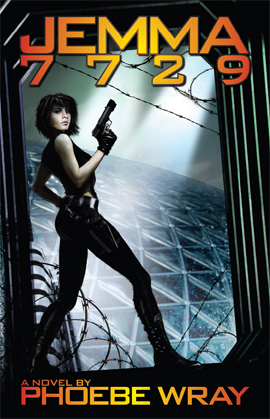
Jemma 7729 by Phoebe Wray

The following is a book review I wrote for The Leading Edge. It will be coming out in the November issue, along with my short story Decision LZ150207.  The editors gave me permission to post the review here.  Be sure to pick up a copy of the magazine when it comes out!
Jemma is a rebel, fighting against a system that teaches women to be obedient and submissive and “alters” those who refuse to assimilate.  After escaping the giant dome cities of a post-apocalyptic California, Jemma joins with a band of rebels known as the Movers in the free, uncultivated country.  But as her reputation grows and the people in the domes begin to take up arms, the government stops at nothing to hunt Jemma down and silence her for good.

With images reminiscent of Brave New World, 1984, and A Handmaid’s Tale, Jemma7729 is a dystopian, post-apocalyptic novel with a YA feel.  The first half of the book details Jemma’s childhood and her transformation from daughter of two mid-level government workers to a rebel fighting to overthrow the system.  I enjoyed the first part of this novel, with its intimate human drama and its resourceful, sympathetic viewpoint character.  The story was paced well and kept my interest.

The second half of the book, however, was somewhat disappointing.  Once Jemma escapes the domes and begins her campaign as a rebel terrorist, the story loses a lot of tension.  Even though she is barely a twelve year old girl, she still, without any outside assistance, manages to blow up almost a dozen government facilities without getting caught or killed.  The villains’ reasons for creating such an oppressive, anti-feminist regime are never adequately explained, and when Jemma starts to fight back, the government is too weak to put up a believable resistance.  The middle of the novel lags considerably, with very little real action or suspense.

When the pace finally does pick up again, about forty pages from the end, the action is so confusing and happens so quickly that I felt completely lost.  The main character’s voice gets lost in a blow-by-blow account of impossibly rapid events, as if the author was trying to compress two hundred pages of story into less than a quarter of that space.  I fount it disappointing and inconsistent with the tone of the rest of the book.  However, the twist at the end caught me by surprise and gave me some degree of satisfaction as I finished the book, though I would have been more satisfied if the last half of the book had been as good as the first half.

Review of JEMMA7729
Joe Vasicek
Jemma is a rebel, fighting against a system that teaches women to be obedient and submissive and “alters” those who refuse to assimilate.  After escaping the giant dome cities of a post-apocalyptic California, Jemma joins with a band of rebels known as the Movers in the free, uncultivated country.  But as her reputation grows and the people in the domes begin to take up arms, the government stops at nothing to hunt Jemma down and silence her for good.
With images reminiscent of Brave New World, 1984, and A Handmaid’s Tale, Jemma7729 is a dystopian, post-apocalyptic novel with a YA feel.  The first half of the book details Jemma’s childhood and her transformation from daughter of two mid-level government workers to a rebel fighting to overthrow the system.  I enjoyed the first part of this novel, with its intimate human drama and its resourceful, sympathetic viewpoint character.  The story was paced well and kept my interest.
The second half of the book, however, was somewhat disappointing.  Once Jemma escapes the domes and begins her campaign as a rebel terrorist, the story loses a lot of tension.  Even though she is barely a twelve year old girl, she still, without any outside assistance, manages to blow up almost a dozen government facilities without getting caught or killed.  The villains’ reasons for creating such an oppressive, anti-feminist regime are never adequately explained, and when Jemma starts to fight back, the government is too weak to put up a believable resistance.  The middle of the novel lags considerably, with very little real action or suspense.
When the pace finally does pick up again, about forty pages from the end, the action is so confusing and happens so quickly that I felt completely lost.  The main character’s voice gets lost in a blow-by-blow account of impossibly rapid events, as if the author was trying to compress two hundred pages of story into less than a quarter of that space.  I fount it disappointing and inconsistent with the tone of the rest of the book.  However, the twist at the end caught me by surprise and gave me some degree of satisfaction as I finished the book, though I would have been more satisfied if the last half of the book had been as good as the first half.

Polishing is harder than it looks

It is.  This is the final revision of Genesis Earth before I submit this novel everywhere, and it’s tough.  I’m changing a lot more than I thought I would, and it’s going a lot slower than any other process so far.

Plus, on my way to Murray for my mission reunion, the service light for my engine flipped on.  What the heck?  I just had the car serviced a month ago!

At least I know about it now, before I attempt to drive to San Jose for World Fantasy.

Long story short, showed up at 9pm to the reunion just in time to say hi to President and Sister Heywood as they were getting ready to leave.  So worth it, though.  They’re both getting older, and I don’t know when I’ll be seeing them again.  Listened to From Cumorah’s Hill on the way back, and it was awesome.  I mean that in a religious way.

I’ve got a research proposal due tomorrow, and I kid you not, I was working on that thing in my sleep last night.  All night, while I was dreaming, I was thinking “should I use this author in my paper?  How should I tie that in?  What controls do I need to use?  Will this dataset cover the same years as that dataset?” All. Night. Long.

And then I forgot it all when I woke up!

I did get some time to write, though.  Took the netbook up to the laundry room in the FLSR (I still go there–much cheaper than my current apartment) and worked on my novel while waiting for the laundry to finish.  Good times–some of my best writing has come out of that laundry room.  Award winning writing.

In tangentially related news, I still have not heard back from Writers of the Future.  I’m guessing that’s a good thing <crosses fingers>.

I want to see this movie

It looks really good. Dark, depressing, and very, very graphic, but good.

I mean, check out the animation:

Awesome.

I think my Middle East studies major has desensitized me to a lot of the violence in that part of the world. Probably not as much as if I were caught up in the conflict on the ground, but still, quite a bit.

Lots of material for stories, though. Lots of material.

September recap

So, September’s over now.  Where in the heck did all that time go?  In some ways, I can still remember the summer…but in other ways, it’s never been further away.

So, what did I do this past month?  Plenty.  I got a good start on school (14 credits this semester), I quit the writing advisor job and replaced it with two TA jobs, and I turned 25 years old.  Quarter century…and still in school.  I feel like some kind of relic. “An elegant weapon for a more civilized age…”

As far as writing goes, I wrote 41,649 words total, averaging 1,602 words per day (not counting Sundays–counting Sundays, I averaged 1,388).  I passed the 3/4ths mark on Bringing Stella Home 2.0 and started work on Genesis Earth 4.0.

Not bad!  I’m surprised I wrote so much; 41k is almost as much as nanowrimo.  However, I can’t help but wonder: how many of those words are good words?

It’s a much more subjective thing to measure, but I do feel that my craft has improved.  Now that I’ve started the rewrite on Genesis Earth, I’m catching a surprising number of sentences and paragraphs that could be much better phrased.  For today, I “wrote” 1,616 words, but only got about 1,000 words further into the story (I measure wordcount with compare documents, totaling all the deletions and additions).  After the last revision–just last July–I felt very satisfied with the draft as I’d written it.  The fact that I’m changing so much on this rewrite shows that I’ve set the bar a lot higher for quality of writing (at least, I hope that’s what it means).

School is still kicking my trash.  I’ve got papers up the wazoo this entire month–3 major ones, two minor ones, and at least one midterm, not to mention all the midterms and papers I’ll be grading.  Oh, and I’m reading about a dozen academic articles per week. Dense articles.  The kind that suck your life out through your eyes.

Because of all that, and because of World Fantasy at the end of the month, I’ve decided to  put Bringing Stella Home on temporary hold until I finish the revision of Genesis Earth. Got to put priorities first, and that’s how it falls.  If the revision takes longer than expected, I may have to change my personal deadline for Bringing Stella Home to Thanksgiving.

But come Thanksgiving, I am definitely starting something new!

Final polish

I mapped out all the major assignments for my capstone class for the next month on my calendar.  Turns out I’ve got a lot more work than I thought I did.  Because of that, I decided to start work on Genesis Earth 4.0 today.

This is the final polish before World Fantasy convention.  Of all the stuff I’ve written, Genesis Earth is the only ms that I feel is ready for me to send to editors/agents.  With this draft, I hope to smooth out the writing, make the text more readable–basically, make this book really shine.  We’ll see if it succeeds.

It’s kind of nerve-wracking, in some ways, doing this final edit (inasmuch as any edit is “final”).  Previously, whenever I did a revision, I knew that I had time to come back later and fix anything that I just couldn’t get to.  Now, this is where it counts.  The writing has to be perfect.

Imagine how horrible it was to find a grammatical mistake on page one.  I’d forgotten to capitalize the first word of a sentence in the third or fourth paragraph.  Thankfully, it was the only mistake I saw on that page, but it’s enough to make me nervous about those chapters I sent out to the editors from BYU’s Writers and Illustrators for Young Readers.  I know how to write–really, I do!  Please believe me!

So today, every hour of the day was jam packed with classes, work, homework, and obligatory social activities.  I only had two hours to write, and in that time, I only wrote about 500 words for Genesis Earth (though, to be fair, I’m measuring it by comparing documents and only counting the words that changed).  Ouch.  Not sustainable, if I want to finish Genesis Earth and Bringing Stella Home (I need to change that title) before World Fantasy.  I made up for it by writing for half an hour just now in Stella, but still…

And this is where I hope I don’t mess things up.  Every time I’ve tried to juggle two projects at once, I’ve found it very hard to do so.  It’s something I’ll probably have to learn, if I want to write professionally, but it’s still very hard.  I hope my writing quality doesn’t suffer because of it.

If worst comes to worst, I’ll focus on Genesis Earth until it’s done to my satisfaction.  Shouldn’t take more than a couple of weeks,  even with school.  But I’m still keeping my goal to finish Stella before World Fantasy.

In unrelated news, in my political philosophy class today, Professor Hancock mentioned Huntington and I said, under my breath, “that guy was so full of crap.” Well, it turns out that Professor Hancock is quite the admirer of Samuel Huntington and his clash of civilizations theory.  This is going to make class…interesting, to say the least.  After studying this stuff my entire college career, I really do believe that Huntington’s theories are utterly full of crap.

Oh, and I had a great idea for a comic: Plato’s Republic, as a cartoon!  Okay, maybe I’m just a geek, but seriously, if it were done well, it could  be really, REALLY cool.  Really cool.

School is kicking my trash

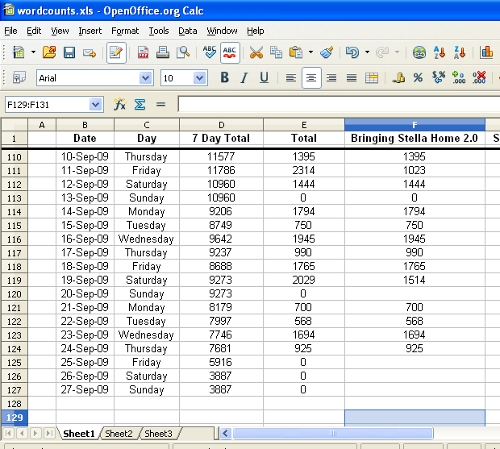
It’s true.  This is what my wordcount spreadsheet currently looks like:

wordcounts24sep09

Note that the seven day totals are dropping consistently.  If I want to finish this novel before World Fantasy, I’m going to have to keep that number above 7,800…not including the work on Genesis Earth 4.0.

Something tells me that’s going to be very hard.

This week was particularly busy.  I had a research proposal presentation for my capstone class–that was stressful–plus a writeup of the presentation.  Thankfully, the full written proposal isn’t due for a couple of weeks.

Besides that, I’ve been working my two TA jobs and doing a buttload of readings and summaries for my other classes.  Ugh.

The cool thing, though, is that when it’s my office hours and the students aren’t coming, I can get paid for reading Aeschylus, Plato, Sophocles, and all those other awesome Greek writers.  The Libation Bearers was surprisingly good.  I’d like to read The Furies, but I’ve got to read Plato’s Apology in order to keep up with the class.  Still, the Apology is good stuff, too.

Reminds me: today, I went kayaking on Utah lake with the wilderness writing class.  While I was there, I had this story idea: what if the Greek civilization had developed in Alaska instead of Aegea?  And then I realized that it already happened: the Norse.

With school and work consistently kicking my butt, the only time I have to write EVER is between 10pm and 12pm.  Every day this week (except for one time, when I drove a girl home), I’ve been in the Harold B Lee library until closing time, when the music starts to play.  Every day, I come home exhausted.  And then I get up the next day at 7am to get ready for class.  Something tells me this isn’t sustainable.

Still, I think the worst times in the semester are at the beginning and the end.  In the beginning, you’re still in the summer mentality, so the work beats you up until you get used to it.  In the last half, everything gets so insane with exams and term papers that you can barely keep your head above the water no matter what you do.  I’m adjusting slowly, but adjusting.

I’ll keep up with the writing as best I can, but Genesis Earth is going to be my top priority when I start that.  In the meantime, I’ll just try to finish Bringing Stella Home by plugging away and catching up on the weekends.

In the meantime, I’ve got some great ideas for my next big project.  Come November, I’m going to have a lot of fun.

🙂

I look forward to having a 9 to 5 job

I really do.

School is difficult, because you can never really separate yourself from your work at the end of the day.  You’ve always got homework to do for the next day, or some project to prepare, some reading to do.  There’s never a defined time where it “ends.”

This semester so far has been pretty crazy–not as crazy busy as some semesters, but it’s starting to approach it.  I’m taking my capstone class, and it’s fairly rigorous.  Today, I’m doing a research  proposal presentation, and I just discovered, after looking in the syllabus last night, that a 2 page mock grant proposal is due Wednesday.  On my birthday. <groan>.

I’m stressing out a bit about this presentation.  Professor Christensen is a real stickler for presentations.  Going over 6 minutes will dock your grade 10%+.  Looking at the audience for less than 90% of the time will dock your grade about 5% or so.  It doesn’t help that I’m going on the last possible day.

Now, I’m probably stressing out more than I need to.  I’m just unfamiliar with this format for presentations, and that’s getting to me.  The result is that when I sit down to write, I find it very hard to concentrate because my mind is on this other stuff.  And since I could be using any writing time to work on my presentation, I usually end up doing that.  Unfortunately, because I’m not very familiar with this kind of assignment, I don’t think a lot of that time is particularly productive.

It will be nice to have a job that ENDS at five o’clock and gives me the rest of the day to do what I want, without having to worry about the stuff that happens from nine to five.  In some ways, it will probably be more conducive to my writing, even if it does require more time than my classes.  It’s very hard to have the mental space for writing when you’re over your head in homework.

Revelation Space by Alastair Reynolds

Hundreds of thousands of years ago, an ancient race of sentient aliens known as the Amarantin went extinct just as their civilization experienced a golden age.  No one knows why, but archeologist Dan Sylveste is determined to find out.  Unlike the other colonists on the remote planet of Resurgam, he believes that the answer may be important.

He has no idea how right he is.

Just as he’s on the verge of a major breakthrough, a team of rebels takes over the administration of the colony.  Sylveste becomes a prisoner of war, and his research comes to a frustrating halt.

Meanwhile, on Yellowstone (the nearest human-inhabited planet to Resurgam), a mysterious entity known as The Mademoiselle hires assassin Ana Khouri for a special mission: kill Dan Sylveste.

The only ship headed in that direction, however, is an ancient warship commanded by a rouge crew of Ultras, genetically modified transhumans.  They seek Sylveste in order to heal their captain, who suffers from a plague that melds human biology with advanced technology.  The de facto leader, Illia Volyova,  hires Khouri to replace the ship’s gunner, who went mad and mysteriously died.

But neither Khouri nor Volyova realize that the thing that drove the gunner mad still resides deep in the ship’s systems.  It is neither human nor AI–and it knows what killed off the Amarantin nine hundred thousand years ago.

Revelation Space is a space opera unlike any other that I’ve read, with the possible exception of Dune. The far-future universe Alastair Reynolds created for this book is incredibly complex and expansive, almost completely unrecognizable from our own, with technology bordering on godlike, posthuman and transhuman races that are all but commonplace, and nothing but a blurry, indistinct line dividing the human and the machine.  On every page, I felt as if I had left the real world behind for something completely (and often disturbingly) alien.

Setting, by far, is the strongest point of this book.  In fact, as an aspiring writer, I found it  somewhat intimidating.  Reynold’s Revelation Space universe was completely alien, but in ways that made perfect sense for the far future in which it was set.  From this, I’ve learned that to make a far future setting believable, you have to make it…well, as alien and complex as Reynolds makes it.  It shouldn’t be an exact copy of Reynold’s mold, of course, but if it’s 500 years in the future and everyday life still feels exactly like our own–well, there had better be a reason for that.

As for character and plot, I did not feel that those were particular strong points of this book.  It’s not that they were done poorly,  it’s just that they weren’t done well enough, in my opinion.

The characters in Revelation Space did not particular engage me at first; I found that I had to force myself to keep reading, rather than read because I had to find out what happened to them.  Later on, as the story progressed, they grew on me, but I never felt that I intimately knew them.

As for plot, I felt that every fifty or one hundred pages, Reynolds would pause the story and throw something in from left field, simply because he had to foreshadow something coming up.  In this way, the book seemed a little choppy–like a debut novel (and, in Reynold’s defense, this is his debut novel).

Even with these issues, however, this was an incredible book, and it’s stuck with me even months after finishing it.  Reynolds pulled off an amazing ending–very satisfying, with a twist that I had not foreseen but that made good sense.  The final scene, and the last two sentences of the final scene in particular, were just awesome.  They made me want to clap my hands and say “bravo.”

If I could describe Revelation Space in terms of other works, I would say that it’s a cross between Neuromancer and Stargate the movie. While it’s solid space opera, it has a dark and gritty feel that borders on Cyberpunk / post-Cyberpunk.  It’s not exactly the kind of stuff I want to write, it comes pretty darn close.