Worlds Away from Home 1.2 is finished!

That’s right!  Here are the stats:

Worlds Away from Home 1.2

mss pages: 536
words: 116,219
file size: 259 KB
chapters: 24
start date: 9 June 2010
end date: 16 August 2010

And here’s the wordsplash:

Wordle: Worlds Away from Home 1.2

Also, I don’t know if this is of any significance to anyone, but this is the song that I had playing while I wrote the last scene. Thanks to Rafael for tipping me off to it.

And what are my thoughts, now that it’s finished?

1) Thank goodness it’s over.
2) Wait, it’s over?
3) Wow, the ending didn’t suck as bad as I thought it would.
4) …is it really over? Really? Like, I’m not going to wake up tomorrow and procrastinate writing all day, like I have for the past two months?
5) Huh.

Of course, it still needs a TON of work–plot holes to fill, character inconsistencies to mend, worldbuilding crap to throw in (or throw out), climaxes to resolve. I won’t send it out to any first readers until after I’ve done at least one major revision.

Still, there’s something satisfying about finishing a 120k word novel. Most of my misgivings about the story disappeared as I wrote the final chapters, and now I’m much more confident that I can make this thing publishable.

Eventually, that is. For now, it’s time to move on to the next big project.

The biggest scare of my life

I just had the biggest scare of my life.

Moments after finishing Worlds Away from Home, I opened the spreadsheet with my daily wordcounts and noticed that it was missing all the data from the last week.  All the data.  Not sure what to do, I saved Worlds Away, closed it, reopened it…and found that everything I’d written in the last week was lost.

I almost had a nervous breakdown.  I had just finished the last scene, written the last sentence, brought the story to an emotionally poignant ending–and it was all gone.

I freaked out.  Searched through all the temp folders, found the backup path for openoffice and searched that–it was all gone.

Not sure what to do, I plugged my flash drive into my other computer, brought up the document, and THANK GOD it was all there.  Everything down to the very last line that I’d written only moments ago.

Oh man, you have no idea what I was feeling right then.  I collapsed to my knees and promptly saved a two backups, one of the document, the other of everything on my flash drive.

Now I’m scared to plug my flash drive back into my desktop computer, though.  What happened?  Will I lose all my data again?

Maybe this will help: While I had my novel open, I plugged in another storage device to a jack next to the one my flash drive was plugged into.  You know the tone that windows makes when you unplug a USB device?  It made that noise twice, as if I’d just unplugged my flash drive.  Later, I unplugged the second device, I think it did the same thing, but I’m not sure.

Also, when I opened up the documents I’d been working on on my other computer, I noticed that while my novel (which I’d had open prior to plugging in the second device) had its most recent save, the other documents only had the data from my save on the previous night.  In other words, while everything I’d written in my novel tonight was saved, anything I’d written in anything opened after plugging in the second USB device was not saved.

Clearly, this must be a hardware problem of some sort.  Perhaps something on the motherboard isn’t fully plugged in?  Dang, I’ve got to fix it–I can’t afford to have another scare like this.

Sorry I haven’t posted much recently–I’ve been very busy with this novel.  Expect a post sometime tomorrow about finishing it.

Almost at four

I’ve got half a dozen things I could blog about, but it’s 2 am and cleaning checks are tomorrow, so I think I’m going to give a quick update and go to bed.

Worlds Away from Home is doing quite well–I’m only two chapters and five scenes from the end.  I’d push really hard to finish it tomorrow, but I’m still waiting on some of my alpha readers for Mercenary Savior and probably won’t start that project until after I go back to Massachusetts at the end of the month.

I’ve been thinking a lot about the seven point story structure Dan Wells talked about at LTUE 2010 (which I missed, but caught on youtube), and I’ve got a TON of ideas for Mercenary Savior now.  I’m practically chomping at the bit to start analyzing this story and working out all the complex plot and character elements.  That’s very good.

While chatting with one of my alpha readers for Mercenary Savior, I had an interesting idea for a direct sequel.  Basically, while James’s storyline has some closure (or should, after I finish this next revision), he’s still got a lot of growing and maturing to do.  My mind is already working it out…should I make that my fifth novel?  Or move on to something else first?  The thing about direct sequels is you can’t sell them without the first book, and if the first book doesn’t sell…

I’m applying for Redcliff Ascent; if all goes well, I’ll be participating in the November training (since September is full).  At first, I was hesitant about this (since I kind of need a job now), but looking at it now, that’s probably the best time to do it.  It’s after World Fantasy, which gives me time to finish Mercenary Savior, and late enough in the year that I can still finish that article for Mormon Artist.  Plus, I can easily get a schedule that allows me to attend LTUE 2011.  The only disadvantage is that I won’t be able to attend all of Brandon Sanderson’s English 318 classes, but that’s not such a big deal (seeing as I’ve taken the class twice already!).

Other than that, life is good.  I’m going home in a week to see my parents and get my teeth done (since my mom’s health insurance covers me until my birthday in September–why pay for a checkup when you could have it for free?), and I’m definitely looking forward to that.  And now that I’m almost finished with Worlds Away, I can see that it’s got potential, and that’s encouraging.  Not this draft, certainly, but once I fix all the holes, it could really go somewhere.

Either way, it’s going to be nice having four novels under my belt.

What’s for lunch?

So a few weeks ago, I decided I needed to make some changes in my life and start eating healthier.  I figured the best way to do this was to experiment with Middle Eastern cuisine, because:

1) it’s healthy,
2) it’s cheap, and
3) it’s fun!

First, I made a batch of pita bread, using this recipe (with 2 tbs sugar instead of 1).  Pita bread is way easy to make; just roll them out and toss in the oven for four or five minutes.  After letting the dough rise, it usually takes me about 45 minutes to an hour to make a batch.

Pita bread is both cheap and tasty.  A batch of pita bread roughly equals as much as a loaf of bread and costs considerably less (considering each ingredient by amount used).  One thing I’ve found, though, is that pita bread doesn’t keep very well–after only a week, it starts getting moldy.  This happens regardless of whether or not it’s refrigerated.

I’ve tried letting the dough sit in the refrigerator overnight to enrich the flavor, but I’ve found that doing that makes the final product drier and more crumbly.  Besides, I can barely taste the difference.  It takes a bit more time, but I prefer cooking it right after letting the dough rise, usually for 90 minutes to an hour.

Next, I made the hummus.  Store bought hummus is ridiculously expensive, especially considering that you can make it yourself from relatively cheap ingredients found in any American grocery store.  The one possible exception to that is the tahini, but you can still make a tasty batch of the stuff without it.

To make the hummus, I used:

  • one 2 lb bag of dried garbanzo beans (otherwise known as chick peas)
  • 6-10 cloves of garlic
  • 3-5 tbs lemon juice
  • 1-2 cups water
  • 2-3 tbs peanut butter
  • paprika, cumin, and salt to taste

I can’t say exactly how much of any ingredient I used because I eyeballed most of it.  That’s generally the way I cook everything.  Still, it turned out great!

I used dry beans instead of canned because I wanted to avoid the sodium.  Plus, dried beans are way cheaper.  I let them soak overnight (and found that they generally expand to 3 times their initial volume–plan on it!) and cooked them for about two hours–basically, until they were tender enough to mush apart between my fingers.

As an experiment, I substituted peanut butter for the tahini.  Tahini is basically sesame seed butter, and it tastes almost the same as regular peanut butter.  I found, though, that using too much peanut butter overpowers the flavor of the garbanzo beans and gives it a weird taste.  In the future, I’ll probably skip the peanut butter (or add sesame oil–I wonder if that would work?).

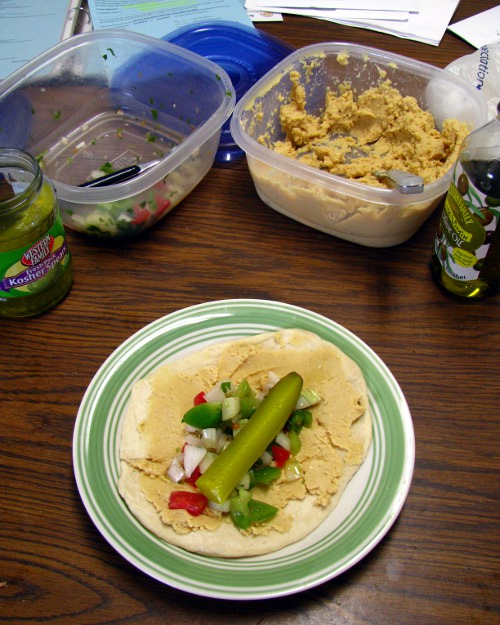
To make hummus, you really need to have a good quality blender.  I went to my brother-in-law’s parents and used theirs.  Of course, I left them a pie tin full of the stuff to say thank you!  With a two pound bag of dried garbanzo beans to start with, I had PLENTY left over, as you can see from the photo.

All told, if you know what you’re doing, you can make hummus in large quantities for extremely cheap.  I can make the equivalent of a $10 bucket of Costco hummus for about $2-$3 from scratch.  A pie tin of the stuff, with the whole beans, paprika, and olive oil sprinkled on top for presentation, would cost much less–yet in an American restaurant you’d probably pay $15 or more.

(By the way, pita bread with hummus and fresh cilantro tastes heavenly.)

For the vegetable part, I diced up some cucumber, onion, tomato, bell pepper, and cilantro, with a touch of lemon juice.  For flavor, I added a pickle (the restaurants in Jordan serve pickles with just about every meal) with a tiny bit of olive oil on top.

Let me tell you, the end result was a resounding success! I’ve been eating this stuff for lunch for the past week, and it is delicious! Not to mention that it’s nearly twice as cheap as what I was eating before, and at least ten times as healthy.  Yeah!

My next culinary experiment will either be with Egyptian koshari or something to do with the million cherry tomatoes I picked at the McQueen’s house over the weekend.  I’ve also got a bag of frozen chicken, and I wonder if I can make some tasty shawarma if I marinate it in the yogurt I got on sale.  By the way, yogurt on pita bread with whole olives makes another delicious Middle Eastern snack.

Anyways, that’s what I’ve been up to.  If you want to try this out or have any ideas or suggestions, let me know!  I’d love to hear about it.

End in sight

Things are winding down for my current work in progress, Worlds Away from Home–or should I say winding up, since I’m just a chapter or two from the major climax?  In any case, by the end of the week, inshallah, the rough draft will be finished. <crosses fingers>
It’s been tough, but I’m cautiously optimistic that I’ll be able to salvage it, probably sometime after World Fantasy 2010.  Drafting is not my strongest point; I’m much better at revision.  My goal is to have a fully polished draft before the end of 2011.

As far as the real world goes, things are starting to come together as well.  I’m going home at the end of the month to get my teeth checked before my Mom’s insurance no longer covers me, and when I get back this temp agency should have a warehouse job lined up for a while, if I can’t find anything else.  I’m cautiously optimistic that my sister will help me get a job at the residential treatment center where she works, which would be awesome, and of course there’s always the possibility that BYU will lift the hiring freeze (pretty soon, they’ll have to).

So here’s my plan for the next few months: quit my job at the call center and go home in two weeks, then either work through the temp agency through September/October or find something better.  The wilderness job I was looking at has their training in November, so I’ll start the application process now in order to have that option in case everything else falls through.  And if all else fails, I’ll go teach English in Asia for a year.

Meanwhile, I hope to stay in Utah until at least February, preferably until April.  There are a lot of good resources here for writers, and I hope to take advantage of them.  After I finish the rough draft of Worlds, I will throw everything behind Mercenary Savior and get it polished in time for World Fantasy 2010.

And then?  Who knows.  I’d kind of like to try my hand at a fantasy novel; I’ve got the start of an idea for a magic system, and enough knowledge of Middle Eastern history to throw in a sweet medieval Arab flavor in the mix.

In terms of the real world, my plan is to reteach myself Algebra, Geometry, and Calculus using some excellent resources my Dad is sending me, then go back to school in a hard science…probably.  Still not sure what I want to do school-wise, but hopefully I’ll figure that out in the next year or two and head back soon.

That is, if I don’t get published and launch my writing career by then.

So that’s what my life is looking like right now.  If you’re still reading and aren’t bored stiff (or if you just skipped to the end of the post, which is what I would have done), here’s an excellent song from one of my favorite Celtic bands, The Rogues:

Story Notebook #3 (part 2)

Alright, I said I’d finish running through my third story notebook, so here it is. After all, there’s no better time than now:

The song, btw, is from Summoning of Spirits, quite possibly the best fanmade video game soundtrack that ocremix has put out. Oh, and it’s completely free; did I mention that? If you want to download it, you can find it here.

Anyways, on to the story ideas:

First line: “The invisible pink unicorn in the room sneezed.”

Hahaha! Martha, this one’s for you!

Theory: all of us have a mechanism in our brains that helps us relate to other people, to see ourselves in them. But over time, we learn to shut it off, because so long as that mechanism is working, we can’t do anything to hurt other people. If we can’t relate, we can’t care and can’t feel the pain of the other.

Or maybe we learn to turn it off because it just hurts so much to feel others’ pain. We desensitize ourselves in order to survive this cruel world. But is a life disconnected from others’ pain and joy really worth living? Where is the balance?

A writer who uses himself as an alpha reader by going to an alternate universe in which he never became a writer –> told from the point of view of the alternate person, who wishes he’d become a writer but never did.

I’m pretty sure I got this idea from a short story that Mechmuse published before it went under. You can still find it here. Normally, I have a policy of not writing stories about writers (since it’s so overdone), but for this one, I might be willing to make an exception…that is, if no one beats me to it.

A democracy in which the president serves for ten years and is ceremoniously executed at the end of his/her term.

Hey, that’s what they used to do to the ancient kings in Europe: when the king got old and the time came for him to hand over his kingdom, the druid-priests would ceremoniously execute him in front of the rest of the tribe.

The question is this: would such a custom lead to a better system of government? It would certainly weed out all the greedy scumbags who are only looking for money and power (which constitutes the majority of politicians). But who would take their place? Would the new politicos be any better?

How would foresight, like Atium, change sports? Like fantasy steroids, except different.

Thoughts while reading Mistborn. True story.

What if the Dome of the Rock was a magical portal to another world?

Hey, it’s possible. The circle/square/octagon motif represents a connection between heaven and earth, and scholars have never really figured out what the religious function of the structure was supposed to be.

And that concludes story notebook #3. Have fun writing!

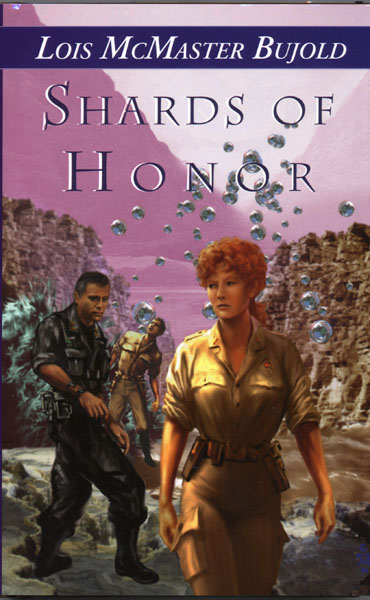
Shards of Honor by Lois McMaster Bujold

Cordelia Naismith never thought she would find the love of her life on a scientific survey to an unexplored border world, let alone that he would be a Barrayan, one of the enemy.  But Aral Vorkosigan is not just any other officer in the Barrayan Military.  He is courteous, fair-minded, thoughtful–and above all else, driven by an innate sense of honor.  To her surprise, Cordelia soon finds that she has more in common with the man than she thought possible.

But the rumors of war between Escobar, Beta Colony, and Barrayar soon conspire to drive them apart.  Though Cordelia sees Vorkosigan for the good man he is, the rest of the galaxy only knows him as the “Butcher of Komarr”–an unfortunate title which Vorkosigan does not entirely deserve.

As Barrayar goes to war and Cordelia finds herself rising through the ranks of the Betan Military, she is forced to choose between loyalty to her country and loyalty to the man she loves.  When the two are mutually exclusive, how does one preserve one’s honor while securing a degree of happiness?

I loved this book.  Unlike some romances, where the male protagonist is a complete douchbag, Aral Vorkosigan is the kind of guy I’d like to be like.  Bujold strikes an excellent balance between strong and sensitive that enhances, rather than taints, his manliness.  Besides that, Vorkosigan is extremely fascinating, with a complicated backstory and motivations that are both believable and interesting.

Though it’s technically a romance, the book reads very much like military science fiction, with deliciously tongue-in-cheek phrases like “the cadet was too young to believe in death after life” and rigorous attention to the details of military life, such as rank and chain of command.  The book definitely has enough explosions, space battles, and political intrigue to appeal to boys as well as the romance audience, but Bujold melds the space adventure elements seamlessly with the romantic elements, so that readers of either genre don’t feel left out or patronized.

There was only one thing that bothered me, and since it contains spoilers I’ll put it in black so that you don’t inadvertently see it.  To read it, highlight the text:

After Cordelia ran away from home and married Vorkosigan, why did she never think about her homeland again? You would think that as a career military officer who had dedicated her life to her country, she would at least have some lingering doubts that she’d done the right thing by running away–especially when her husband became the new Lord Regent of Barrayar! To me, this seems in-congruent with her character.

All things considered, though, this was an excellent, well-written science fiction adventure/romance. I thoroughly enjoyed it and will definitely be reading more of Lois McMaster Bujold’s work again.

If it kills me

I will finish this novel if it kills me. At the rate things are going, it just might.

Things are kind of tough for me right now.  I desperately need a new job–the one I’ve got is slowly sucking away my soul without even paying enough to get by–and job rejections are way worse than rejections from publishers (I’ve been getting a lot of both, by the way.  Not that I’m looking for pity, but yeah.).

As if that weren’t bad enough, my current novel, Worlds Away from Home, is turning out to be a train wreck.  There are all sorts of problems with character motivations, improper foreshadowing and plot set up, etc etc.  That makes it REALLY hard to get motivated to write each day.  Yesterday, I wrote only 245 words (youch).  Today, I did about 2.2k, but that’s still way less than I need to be doing.

The thing that worries me the most is the thought that the audience for this particular story may be slim to nonexistent.  It’s solid space opera, but with a romantic element that challenges a lot of the mores of our modern, sex-saturated society, as well as many of the conventions of romance within science fiction.

The main female protagonist is something of a pushover–but she has to be, in order for her growth arc to have any umph.  The main male protagonist is an orphan on a quest to discover his own origins, kind of like a cross between Mogli and Pip.  His quest, combined with her parents’ manipulative attempts to get them physically intimate too soon, are the main things keeping them apart.

But in a genre where physical intimacy usually marks the romantic climax, how do you make it out to be the obstacle against that climax?  Will science fiction readers go for that, or will they hurl my book across the room because of it?

Well, if they hurled my current draft, I wouldn’t blame them one single bit.  So many plot holes and awkwardly written scenes–ugh.  I’ve got to seriously rethink so much about this story.  But a later draft?  I don’t know–maybe it would work.  It would probably need other hooks to keep them engaged, such as cool world building elements, but I think I could make those work.

Anyway, I suppose it’s nothing unusual.  For every book I’ve written, I’ve come to a point in the rough draft where I thought the story was completely unworkable and should be scrapped.  It’s a tortuous, masochistic process, but I suppose it’s normal.  That’s some comfort, at least.

My goal is to finish this abomination by August 15th, then move on to polish Mercenary Savior and make it really shine.

Another goal is to get a decently paying job (at least $8/hr at +25 hours per week) in order to afford to go to DragonCon in September.  Another goal is to reteach myself algebra and calculus through the math books my dad (who is a geometry teacher) is letting me borrow.  Another goal is to actually get a social life.  BLARG.

Story Notebook #3 (part 1)

I’m not sure whether this notebook is #3 or #2. There’s a lot of notes from English 318, which would put it in the winter, but I don’t know if it’s from ’08 or ’09.

Not that that matters; ideas are ideas.  And here they are!

An empty parking garage with no exit.

Covered this already in a previous post. Strangely, it’s one of the most popular posts on this blog. I constantly get search engine traffic from people googling “empty parking garage” and other such stuff. Who googles “parking garage”? Weird.

Telepathy through instant messaging between microchips interfaced with the brain.

Also covered in the same post.

And they all lived evily ever after.

Bwahahah! I’ve got Jakeson to thank for this line–specifically, from a conversation at LTUE. Good times!

A TV show where the viewers vote between ads what should happen next.

I’m pretty sure I got this idea from an Escape Pod story–one of the Hugo short story nominations from ’06 or ’07, IIRC.

What if the human mind, which we think is so great, is ridiculously broken?

After all, isn’t it true that we only use a tiny fraction of our brain’s capacity during our lifetime? What if the true potential of the human mind far outstrips anything we could possibly imagine?

What if the human brain was manifested as some sort of library / processing building, with short term, easy access, and archival memory sections manifested as bookshelves and long rooms? And there were flies or insects or parasites of some sort that fed on the archives, causing forgetfulness? And you were trapped in there?

I’m pretty sure I was tripping out on the Brain Science podcast at this time, combined with an old Roger Allen McBride novel about time travel and terraforming. Good times.

What would it be like to be God’s intern?

FREAKING HARD.

If perfect, instantaneous communication is possible, doesn’t this blur the individual identities of those speaking, so that they become simply voices in one mind? If so, does this mean that our individuality is based on the ways we misunderstand each other?

At its core, this idea is a take on the whole perfection vs. personality debate: the question of whether our individual personalities disappear as we approach Godlike perfection. I’ve come to the conclusion that this is not the case, but that’s a discussion for my other blog (which I have not updated in a ridiculously long time, dangit).

A middle aged mom at a children’s book fair in Utah who has a tattoo partially showing from under her sleeve

I saw this in the Wilk one day, and started wondering about this woman. Who is she? Where did she get the tattoo? Why is she at a Utah Children’s Book Fair, which is about as far removed from tattoos and tattooed society as you can get?

A robot that was made to suffer, as part of an experiment.

It makes you wonder what ‘suffering’ actually is. Do inanimate objects suffer? Do the rocks and clouds and sky and stars suffer? Do they weep for us?

On that trippy note, I’ll cut this short and finish reviewing the notebook in a later post. Until then, stay awesome.

Wolverton interview and more

The interview with Dave Wolverton was a resounding success!  We had a fascinating conversation about science fiction and the gospel, his latest book In The Company of Angels, self-publishing, the English 318 class at BYU and the profound impact it’s had on the LDS writing community, and much, much more.
On that, I suppose I should disclose my full reasons for going down to St George and meeting with Dave.  I’m putting together an article for the December 2010 issue of Mormon Artist, where I hope to give a brief history of BYU’s “class that wouldn’t die” and explore the impact that it’s had on both the LDS writing community and on mainstream sf&f.

The “class that wouldn’t die” was the group of students who signed up for the first English 318R science fiction creative writing class at BYU, back in ’78 (I think it was ’78…gotta check that).  After the semester was over, the students banded together through forming a writing group, which they called “Xenobia.”

They didn’t stop there, however.  As Xenobia grew and matured, the students decided to form other organizations designed to help new writers (especially sf&f writers) improve their craft and build their writing careers.  Specifically, they founded Quark, BYU’s science fiction and fantasy club; Leading Edge, a student-run magazine that gives written feedback to every story submitted; and LTUE, an annual science fiction and fantasy symposium (like a convention, only no costumes).

These organizations, as well as the 318 class, led directly to the explosion of LDS writers in science fiction and fantasy.  Several bestselling LDS authors, including Stephanie Meyers, Brandon Sanderson, and Dan Wells (among many others) can trace the launch of their careers back to this class.  In turn, these authors are having a tremendous impact on mainstream sf&f literature.

The article is slated to come out in next December’s issue of Mormon Artist Magazine, just in time for LTUE 2011 (which I hope to attend).  Right now, I’m in the research phase, meeting with some really amazing people and gathering some fascinating stories.  This article is going to be awesome.

In parting, let me share one of the more interesting things Dave said in the interview.  As we talked about all these amazing resources available for sf&f writers in Utah valley, I asked him why this happened in this community and not elsewhere.

His answer was extremely insightful: for many writers, the mentality is that once you break in, you have to close the gate behind you.  It’s something of a zero-sub game, where people horde their ideas, compete with each other to break in, etc.

Not so in the LDS community.  As Latter-day Saints, we have a deep-set mentality of helping each other and building each other up.  That’s exactly what happened with the “class that wouldn’t die”–they did everything they could to foster other writers.  The proliferation of Latter-day Saints in mainstream sf&f is a direct result of this.

That’s Dave’s take on it, anyway.  It will be interesting to hear what others think.

Oh, and FYI, Mormon Artist is 100% volunteer run and free, so when the article and interview come out, you won’t have to pay anything to read them.  I’ll certainly provide links on this blog–stay tuned!

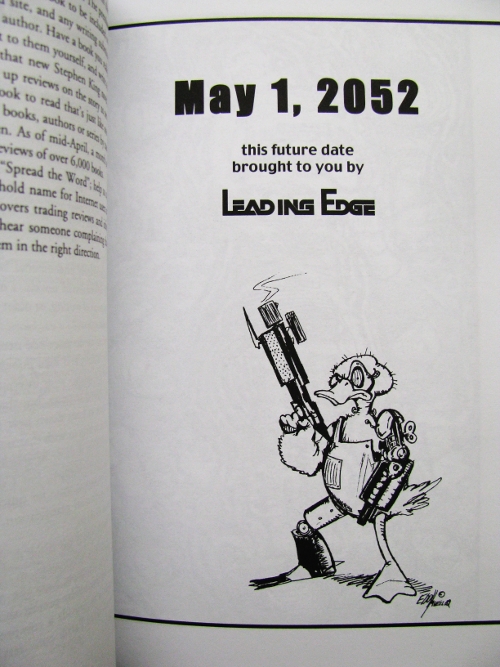
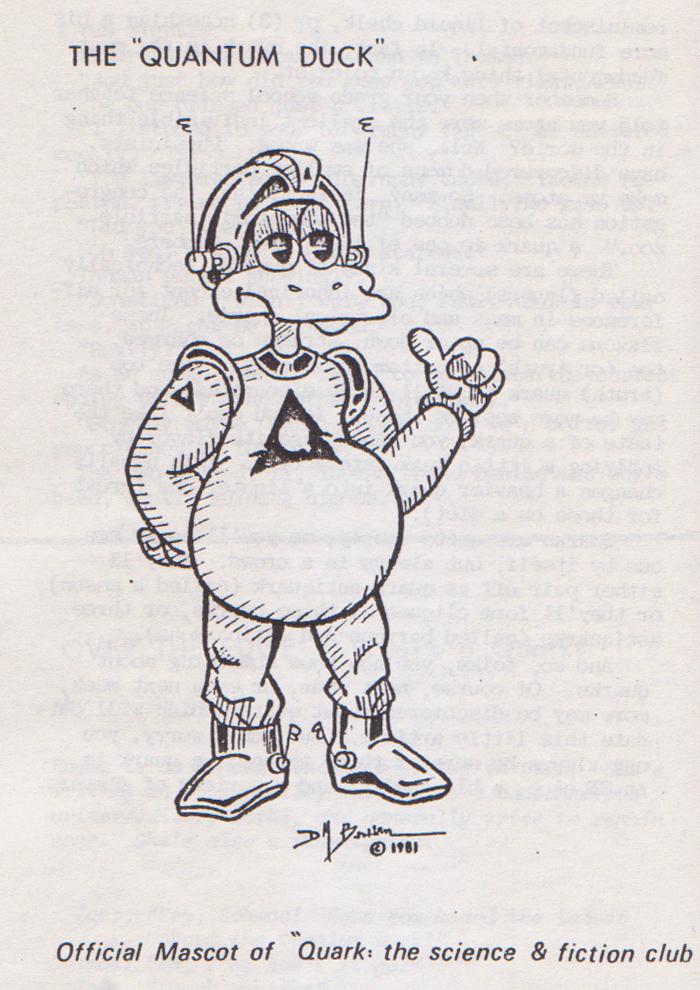
And as one final note, check out this piece of Xenobia history: the original Quantum Duck, as featured in the first issue of The Leading Edge.  Why a quantum duck, you ask?  Because that’s where the club’s name came from: a bumper sticker that said: BEWARE THE QUANTUM DUCK THAT GOES ‘QUARK,’ ‘QUARK’!