What This Series Is About
The Hameji Cycle is a connected set of character-driven military science fiction and space opera novels set in the wake of a catastrophic invasion. When the Hameji conquer the Karduna system, ordinary civilians, young officers, exiles, and mercenaries are forced into impossible choices—trying to protect the people they love while empires close in, institutions fracture, and “victory” stops being a meaningful word. The series follows the human-scale cost of interstellar conflict: families torn apart, refugees trapped between hostile powers, and leaders who must choose between moral cleanliness and survival.
Across the four books, the arc widens from a desperate personal rescue mission to larger questions of resistance, collaboration, legitimacy, and what it means to preserve a people when the old world is gone. You’ll find tight starship tension, ground-level grit, political pressure-cooker decisions, and moments of stubborn courage—where the only way forward is to take responsibility for outcomes no one can fully control.
Reading Order
Book 1: Bringing Stella Home
When the Karduna system falls and refugees flood the starlane stations, James McCoy hires a hard-bitten mercenary captain—Danica Nova—for a rescue mission that looks almost suicidal on paper: his brother and sister were taken by the Hameji, and he refuses to accept they’re gone. As the occupation tightens and every faction has its own agenda, James and Danica’s crew are forced to gamble everything on a plan that could get them all killed.

Bringing Stella Home
When a ruthless Hameji battle fleet kidnaps his sister, James McCoy—a young merchant starfarer untested by war—vows to bring her home. But to save her, he must give up everything he has and become something he never thought he could be.
More info →








Book 2: Desert Stars
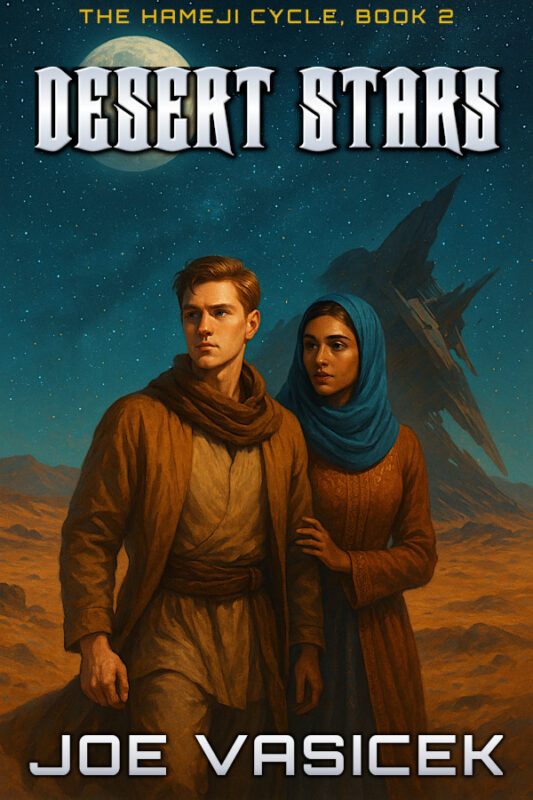
A desert-born boy leaves everything he knows behind to search for his lost family and a past he barely understands, even as the wider war grinds on. In a harsh, frontier-flavored corner of the universe, survival, belonging, and loyalty collide—until events escalate and escape becomes a ticking clock.
Desert Stars
He is sheikh’s sole heir, a young man raised by desert tribesmen after falling from the stars. She is the sheikh’s most beautiful daughter, promised his hand in marriage—but only if she can convince him to stay.
Together, they must travel to a land where glass covers the sky and men traverse the stars as easily as tribesmen cross the desert. At the ancient temple dedicated to the memory of Earth, they hope to find the answers that will lead them home.
But the call of the stars soon threatens to bring their budding romance to an end. And as the moment of decision draws near, the choices they must make will drive them toward a future that neither can foresee.
More info →Book 3: Stars of Blood and Glory
As the Hameji offensive surges toward key systems, Danica Nova’s mercenary crew takes a high-stakes contract that drags them into the path of much larger forces—while old wounds, divided loyalties, and the machinery of war close around them. The story expands the conflict’s scope through multiple viewpoints, balancing battlefield pressure with the political and personal costs of decisions made under fire.

Stars of Blood and Glory
As the undefeated Hameji Empire embarks to crush the last free stars, Danica and her band of mercenaries must rescue a runaway princess before the son of Sholpan takes her as a trophy of war.
More info →Book 4: Heart of the Nebula
With Karduna’s economy collapsing and the occupation tightening, a secret plan emerges: an exodus—not just of ships, but of an entire station—before starvation or annihilation becomes inevitable. As James becomes entangled with power, legitimacy, and the burden of saving people who may not forgive him for how he does it, the series turns hard toward the question: what does it take to keep a society alive after it’s been broken?

Heart of the Nebula
To save his people from the Hameji, James must lead them on a desperate exodus across the stars. But with each decision, the line between protector and tyrant grows thinner. And in a galaxy full of predators, freedom is the first dream to die.
More info →Core Themes
- Refugees, displacement, and the search for home after catastrophe
- Leadership as a moral burden: “serve and protect” vs. political reality
- The cost of war beyond the battlefield: scarcity, trauma, and compromised ideals
- Family bonds, separation, and the lengths people go to bring loved ones back
- Exile and identity: who you become when your old life is no longer possible
- Democracy vs. emergency power: legitimacy, consent, and “necessary” betrayal
- Ethical gray zones: collaboration, revenge, and choosing the least-worst option
- Found family and loyalty under pressure (crews, comrades, and unlikely allies)
- Hope as action—not speeches—when systems fail and people still have to endure
For Readers Who Love…
If you love character-driven military SF and space opera where the focus stays on people, consequences, and hard choices—the kind of stories that mix starship tension with ethical pressure, political fallout, and the lived experience of refugees and survivors—The Hameji Cycle should click. Think in the lane of writers known for blending action with moral weight and social systems under strain: readers who enjoy the leadership dilemmas and “tight crew under fire” energy often found in Lois McMaster Bujold, the wartime-perspective realism of David Drake, the political-and-personal interplay of C.J. Cherryh, or the large-scale conflict frameworks associated with David Weber will likely find familiar satisfactions here—especially if you want the aftermath to matter as much as the battles.