Operation SB #2: The Open Source Time Machine

Title: The Open Source Time Machine
Genre: Science Fiction
Word Count: 3,247
Time: About 10 days

I felt really good after finishing this short story. The last line in particular surprised me, which is always a good sign. I think this story is going to go places.

The idea for this one actually came about 4 months ago. I imagined an inventor trying to convince a bunch of investors to fund his time travel development project by calling on his future self to appear to them. He fails–his future self never shows up–but after the meeting has ended in failure, he goes home and finds his future self waiting for him there. Why wouldn’t he go back in time to help himself get the funding to develop his project? That was the core idea that became this story.

I wrote out a couple of pages of that one before getting frustrated and trunking it. Then, about ten days ago, I broke my operating system (Ubuntu) and had to upgrade/reinstall it three times before it would work again. For Linux users, that’s kind of like a rite of passage. It was frustrating, but also kind of awesome because of all the stuff I learned from it. Open source technology is really, really cool.

Around the same time, I read Program or Be Programmed: Ten Commands for a Digital Age by Douglas Rushkoff. Fascinating book, especially if you’ve got a job/lifestyle where you spend +50% of your waking life in front of a screen. Rushkoff is a technology theorist, and this book is about all the subtle ways in which computers, social media, the internet, and other modern technologies can be used to manipulate us if we aren’t careful. His ideas are brilliant and his perspective is fascinating, so his book definitely got me thinking about things.

With both of these things on my mind, I went for a long walk while taking a break from my writing. Short stories were also on the mind, since I was wondering what I should write about for the month of January. The old time travel idea popped up, and everything just sort of melded together until I had the story.

I wrote the first half of it the next day … and then sat on it for a little over a week. I’m not sure why I did that–maybe I was just nervous about screwing it up or something. By far, the hardest part about writing is getting out of your own damned way. Yesterday, I finally buckled down and forced myself to finish the thing, and it actually turned out pretty well. Took the whole day to finish it, but it’s finished and that’s what’s important.

So after touching it up this morning, running a spell check and tweaking a couple of relatively minor things, I put it out on submission. That’s two stories I have on submission now: “The Infiltrator” got rejected from Clarkesworld, but it’s out at Analog now so we’ll see how that goes.

I think my short form is getting better, though there’s still a lot of room for improvement. I’m going to start running these stories through Kindal’s writing group, even though I’ll put them out on submission as soon as they’re finished. The feedback will be useful in writing the next one.

No idea what the next short story is going to be about. Maybe I’ll go through some of my old story idea notebooks and see what comes together. Or maybe a story will just come to me, and I need to position myself so that I’m ready to capture it on paper when it comes.

We’ll see. In the meantime, I’m very pleased with this one.

Q is for Quark

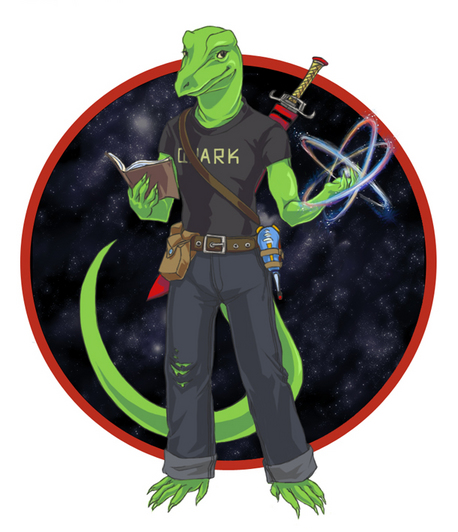
Quark_Mascot_by_OrphneIf it takes a village to raise a child, does it take a group of like-minded creative souls to raise a writer? I don’t know, but in my case, having a writing community around me really helped.  That community was Quark, BYU’s Science Fiction & Fantasy club.

I joined Quark my second semester of college.  I’d heard about the writing group, and on a whim I decided to check it out.  This was when Ben Hardin was the writing group leader, back before the current iteration of the club was really well-organized.  Aneeka Richins had basically built the writing group from scratch only a year or two before, and Kindal Debenham and Annaliese Lemmon had each spent a year as president shortly after that.  They were all still around, workshopping their stories and adding to the community.

We met on the second floor of the Harold B. Lee library, in one of the study rooms way in the back near what is now the classical music area (2520 was the room number, I think).  Looking back, it seemed like a weird place to meet, since we were always so LOUD.  However, back in those early days Quark didn’t get a lot of respect from the BYU student administration (BYUSA, known more familiarly as BYUSSR), so we kind of organized under the radar.

The spring semester of 2007 was a lot of fun!  I fit in very well with the group, and made a lot of friends.  It wasn’t until they made me the writing group president that I started attending regularly, though.  In retrospect, accepting that post was probably the best extracurricular decision I could have made.  I lead the writing group for two years, from fall of 2007 to spring of 2009, and that’s when I really became a writer.

When I first started back in 2007, I had a couple of hobby projects kicking around here and there, but the main thing I wanted to write was a Final Fantasy VI fanfic.  At the same time, I had a great idea for an original novel, but I’d never written a complete novel before, so I wasn’t sure what to do.  Aneeka convinced me to go with my own project, and that became The Lost Colony, also known as Ashes of the Starry Sea.

Around that time, I also started this blog, mostly so my writing friends could keep me honest.  I finished the first draft in 2008–a whopping 168k word manuscript that barely held together.  After coming back to the US from a study abroad program in the Middle East, I started revising it, but soon decided to trunk it in order to work on other projects.  Shortly thereafter, I finished the first draft of Genesis Earth, and the rest is history.

I later wrote up a detailed post on the origins of Quark, one that was published in a short-lived magazine called Mormon ArtistYou can find that article here.  Orson Scott Card himself commented on it, which really made my inner fanboy squee. 😀 For me, though, Quark was all about surrounding myself with like-minded friends who could foster my natural sense of creativity.  I probably would have become a writer anyway even without them, but it would have happened a lot later, and the road would have been much more rocky.

And now that we’ve all graduated and moved on, I’m happy to say we still keep in touch!  Kindal is a self-published indie writer much like me, with some excellent books out there.  He’s organized an online writing group that is mostly made up of us old-time Quarkies.  Aneeka’s got her webcomic, which seems to be fairly successful, and the others who chose to go a more traditional path are having success there as well.  But mostly, it’s just great to keep in touch.

After my time as president, Quark really exploded in popularity and became officially sanctioned by the BYUSA.  It’s really thriving right now, with a book club, a board/video gaming group, a film forum, and a bunch of other stuff.  Most of that was there when I was in the writing group, but it was floundering, and the writing group was much more autonomous.  But the guys who have carried on the torch seem to have done a great job making things even better, and that’s encouraging.

Why I’m not a fan of writing groups

I was listening to a recent episode of I Should Be Writing today, and it got me thinking about writing groups and how my philosophy on them has changed.  Long story short, I used to love them, but now I’m not such a huge fan.

I should probably start out by mentioning that I lead a college writing group for two years, and I don’t regret the experience at all.  The Quark writing group was extremely helpful, both in terms of my own growth as a writer, and the connections it gave me with other writerly people.  I still keep in touch with many of them.

But now…I just don’t think writing groups are all that great.  In fact, I think that they often do more harm than good, not just for experienced writers, but for the beginner who lacks the confidence to strike out on their own.  Here’s why:

The group dynamic gives inexperienced critiquers a false sense of authority.

Most writing groups consist of writers who are at roughly the same level of expertise.  For beginners, this means that the people critiquing your story might not know any better than you whether the story is broken.  However, because of the dynamics of the whole thing (captive audience, desire to impress peers, etc), these people are likely to act as if they have more authority than they really do.

To be fair, I’ve had plenty of critique partners who have managed to be modest and down-to-Earth when offering their critiques.  However, I’ve also seen plenty of others get puffed up and offer some really dumb advice.

Beginning writers often naively look for someone to show them the answers–some mentor or authority figure whose every word is true, who will light the path and show them the way.  Put a bunch of them into a writing group together, and more often than not you’ll end up with the blind leading the blind.

The weekly submission process does not simulate the reading experience.

Logistically, most writing groups have to set a limit on the size and number of submissions.  For the Quark writing group, our limit was three submissions of four thousand words each.  It worked out fine for short stories, but most of us were writing novels, which meant that we had to workshop our books in little four thousand word chunks.

The problem is that nobody reads novels at that rate.  Either they get hooked and finish the thing, or they get bored and stop reading.  Therefore, while the feedback you receive might be good for helping out with craft issues, by the time the next week rolls around either everyone has forgotten what happened already, or they remember it wrong, or they were expecting something different and are ticked off because they have to wait another week.

After I revised Bringing Stella Home a couple of times (after–see below!), I workshopped it through a writing group I’d put together after leaving the Quark writing group.  I can’t tell you how many times I heard “why are we in James’s point of view this week?  I hate James!  I want to get back to Stella!” I got this comment so often, for a while I thought the book was really flawed.  However, when I got the feedback from my first readers, no one had this problem at all.

The reason?  They read the book the way it was actually meant to be read.

Workshopping a work in progress is the surest way to kill a book.

Committees might be good at doing some things, but they’re absolutely horrible at producing anything innovative or original.  Make no mistake: if you’re workshopping something you haven’t already finished and you follow most or all of the feedback you receive, you’re writing your book by committee.

Most writers agree that when you write your first draft, you should not revise anything until it’s done.  This is because the act of revision makes you so critical of your own work that it’s very easy to get discouraged or “fix” something that was actually a good idea.

Workshopping a work in progress does exactly the same thing: it puts you in a critical frame of mind that will literally kill your book.  Even if you manage to finish it, it won’t be nearly as good as it could have been because you’ve probably nipped all your best ideas in the bud, before they had time to grow and develop.

A truly great book does not appeal to everyone.

There’s a word for something that appeals to everyone equally, that runs about middle of the road and doesn’t upset anyone.  That word is “average.”

No truly great work is loved by everyone.  This isn’t just true of controversial stuff–it’s true of everything.  For every one of your favorite books, there’s a one-star review of it on the internet somewhere.  So if everyone tells you your book is good, that might not actually be the case.  In fact, it’s a much better sign when some people hate it and others can’t stop raving about it.

The trouble with writing groups is that the group dynamic can lead to a herd mentality, where everyone goes along with the first opinion that gets expressed.  Ever played Werewolf?  The same thing happens there.  One person throws out an accusation, the vote gets called, everyone starts looking around to see who is raising their hand and before you know it, all the hands are in the air.

So unless one of the seven or eight people in your writing group loves your work enough to stand up and defend it, chances are the feedback will err on the side of being too negative.  This makes it very difficult to tell whether your story actually sucks, or whether it’s just above average.

Writing groups teach you to write to rules, not for readers.

One of the dynamics of writing groups is that they encourage people to find and latch on to certain writing rules, where people can say “this story is broken because of x” or “this writing is flawed because of y.” Over time, this becomes so ingrained that people stop reading to see whether the story actually works and instead read to see whether the story follows the rules.

The truth, however, is that there are no hard and fast rules when it comes to writing.  For example, you’ve heard of “show, don’t tell”?  Yeah, go and read Ender’s Game.  The entire book is one giant tell–and it’s brilliant.  It was the first sf novel to win both the Hugo and the Nebula awards in the same year, and has remained a perennial bestseller ever since.

Nothing hit this home for me more when the cryo scene excerpt from Genesis Earth won first place in the 2009 Mayhew contest at BYU.  Parts of the scene lapse from first person past tense to second person present tense, and the members of my writing group pointed that out as a major no-no.  However, even though it broke the rules, it worked well enough to win an award.

To be fair, there are some things that writing groups are very good for.  They can be a good way to learn the basics of craft (ie “the rules”), and they do give you a sense of community that can be very encouraging when you’re just starting out.  However, the drawbacks are so great that I don’t think I’ll ever go back.

Personally, I’ve moved from writing groups to a core group of first readers whose feedback I value and whose opinions I trust.  I finish my project, send them the entire manuscript with a deadline in which to read it, and thank them graciously for whatever feedback I receive.  Most of them aren’t even writers, in fact–but all of them are readers.  Most of them don’t know who the others are, and none of them ever see any of the feedback from the others.

Criticism is good; if you want to grow as a writer, you should welcome criticism and constantly solicit it.  But I do believe it’s possible to grow out of a writing group–or to succeed without ever being a part of one at all.
Quark has a new writing VP

That’s right; her board name is Jimmy and she’s basically doing it the same way I did it–by jumping in the deep end first.  Joined quark last semester, went to a few writing meetings, and pow!  Writing VP.

Anyways, we had some interesting conversations after the last writing group meeting of the semester.  Basically, I think I convinced her to set daily writing goals the same way Aneeka convinced me.  She also decided to start a writing blog, so if you get a chance, you should check it out!  It’s called Dragons, Dirt & Bones, after the quote by G. K. Chesterton:

Fairytales are more than true–not because they tell us that dragons exist, but because they tell us that dragons can be beaten.

The funny thing is that we met each other two years ago and both totally forgot about it.  She was a high school junior visiting BYU, and came to Brandon Sanderson’s English 318 class.  She remembers bookstore guy…and one of the writers whom the others in the writing group mercilessly ripped on.  Guess who that was?

In unrelated news, I am no longer homeless but am currently unemployed.  Dropped off a business card at Pioneer Book, though–told them I could help if they need extra work for the move.  Who knows, maybe that will lead to something.

I will probably end up getting a generic summer job, then upgrade to something more semi-permanent (and resume friendly) by August.  I’ll probably stay in Utah, using my writing and editing skills in some capacity.  I’d like to work as a grant writer for BYU, but they’re still under a hiring freeze.  Once that lifts, though, there are going to be a ton of job openings.

My primary plan is still to make my living as a published author, and I’m very optimistic about that working out.  Before the end of next week, I want to have Genesis Earth sent out to at least five new places.  My goal for Mercenary Savior is to finish draft 3.0 by CONduit at the end of May, but I will probably polish the first three chapters and start sending it out before then.

In the meantime, the real world awaits.  Scary, I know, but at least I’m graduating debt free, with a roof over my head, friends and family close by, and lots of exciting possibilities for the future.  I think things will turn out well.

Uh oh…more projects?

That’s right.  I recently formed a writing group with some friends, and decided to workshop Bringing Stella Home through it.  They went through the first chapter yesterday and tore it apart.  I appreciate the help a TON, but I’m going to have to start making revision to it now, so that subsequent submissions to the writing group won’t have the same issues.

So, that makes three major ongoing projects for me now: the Genesis Earth 3.0 revision draft, the Ashes of the Starry Sea 2.2 draft, and now, Bringing Stella Home 2.0.  It’s going to be very hard to juggle all three, and one of them will probably fall through  the cracks (probably Ashes, to be honest).  However, I’m going to do my best to give them all equal time.  We’ll see if I succeed.

In order to accomplish this, I’m probably going to have to make some changes to my daily routine.  Right now, I work out, eat breakfast, read the Book of Mormon, and arrive on campus ready to write…at about 11:00 am.  And that’s on a good day.  I write until about 2:00 or 3:00 pm, then go home for lunch, take a nap, check the internet, be lazy, etc.  At about 7:00 or 7:30 pm, I head back up to campus and write until about midnight.

So far, it’s been working.  I’ve been averaging 4k words per day pretty regularly these past couple of weeks.  However, if I’m going to work on these projects, I might have to focus and up that wordcount a bit.

Therefore, I’m going to try to cut back on IMing while I’m writing.  Usually, during the day, I’ve got gmail open on my browser and I check it from time to time.  I’ve got a couple of friends with whom I usually keep a running chat for the entire day, which can be maddening when you’re trying to concentrate.

I’ve been thinking about cutting back on the IMing for the last few weeks, but thus far it hasn’t been too much of an issue.  However, if I’m going to buckle down, something’s got to go.  Sorry.

(Of course, it remains to be seen if I keep this resolution.  Internet habits die hard.)

In unrelated news, I cooked the AWESOMEST chili today!  Best chili of my life, and what’s even better, I cooked it in MASSIVE amounts!  Here’s what I put in it:

corn
diced onions
ground beef
kidney beans
pinto beans
black beans
crushed tomatoes
diced jalapenos
plain yoghurt
spices

The secret ingredient was definitely the yoghurt.  Adds a creamy texture, like sour cream without the unhealth stuffy.  Also give it a rich and interesting flavor.

Good stuff!

The end of an era

Today was my last writing meeting as Quark writing vp. :'(

It’s been a good run, two years as leader of the Quark Writing Group at BYU. I remember how it was when I started–I was still just a hobby writer, with a nebulous interest in getting published someday but without any real goals or plans. I heard about the group from some friends, but didn’t really start going until winter of ’07, as Reigheena and Aneeka were graduating. One day, I showed up after the meeting was finished (but everyone was still hanging around chatting) and Reigheena was like “so, you want to be writing vp next year?”

I was kind of nervous but really excited that first semester, with lots of ideas to try out. We posted our fliers around all the freshman dorms the first couple days of class (most of the members were graduating and/or moving on), and we got quite a few new members, as well as curious English majors who came for a couple of times before moving on.

Those first days, meetings were two hours long, the submissions were up to 4,500 words, and we did four of them every meeting. We met in the basement of the BYU library, in one of the study rooms, and we crammed between ten and fifteen people down there each meeting. Pretty intense! Two hours was not enough time to comfortably cover everyone’s story, and we always felt rushed. We held meetings every other week (or, more accurately, every 1.5 weeks) on a weird schedule that only I really had figured out.

Well, after that first semester, we made a few changes. Reduced the submissions length to 2,500 words, the number of submissions to 3, and the length of the meetings to one hour instead of two. I think we also started meeting weekly, instead of the weird Tuesday–Saturday–Tuesday schedule. We also got a real room, over in the Talmadge building.

Things have definitely changed. This past year, we didn’t really do much to get new members, but we have started to bring in people from the other sections of Quark. A lot of other old timers have moved on–Drek moved up to Draper, so I doubt we’ll see much of him, and Jakeson and Gamila have been coming less and less as they move on to the next stage of their lives. Still, it’s been fun, holding our weekly writing meetings each Saturday.

While I always tried to encourage everyone to be frank and honest with their criticism, we’ve also done a good job diffusing that tension with humor. Here are some of my favorite quotes from my time as writing vp:

“He has two guns in the office and he wants to give Autumn a talking-too for having a knife in her boots?”
“She’s an intern.”

“Other than that, I thought it was just good ol’ fashioned fantasy violence.”

“I don’t remember anything about your characters right now, but I remember when I was reading your story that they were very distinct and I knew who they were.”

“I’m trying to think of something I can say that doesn’t sound like a critique.”
“Your writing is…legible”

“I have a friend that had a way to hide a knife in her hair.”
“I want a wife like that!”

“Some books don’t have chapters, they have acts.”
“We have a name for those. We call them… ‘plays’.”

“As always, your writing was legible.”
“No, wait, it wasn’t! It was courier!”

“If this was meant as a short story and not the beginning of a novel, “defenestration” will suddenly become a useful word in your vocabulary.”

“Maybe I should write a prologue about a writer who’s writing a prologue and realizes that nobody ever reads them.”

“It doesn’t have to be functional, it can just be like ‘hey, we make gears.'”

“The love in Twilight is all based on scent: he smells nice and she smells delicious.”

“The goatee gives me programming x2.”

“Missions…”
“The first six months…”
“The first two years…”

“I like getting to the exciting event within a page of the story.”
“Frodo, see this ring? Destroy it!”

“I loved how flat your characters were!”
“You’re so good at poor writing!”

“Maybe ‘MacBeth’ could be a title. Like, the leader is known as ‘The Macbeth.'”
“Yeah! And all the lower downs would be ‘the Duncans.'”

“Wait… I did write something good… at the very end!”
“Like, ‘Oh good, it ended!”
“You are putting words into my criticism!”

“Then I thought, what would my characters be like if they were alive? And then I was afraid.”

Ah, the good times. It’s so sad to log onto the Quark forums now and not have moderator privileges, to know that I won’t be sending out those weekly emails, moderating things, doing all that other stuff. It’s the end of an era for me. My duties as writing vp for Quark have been a major part of my college experience here at BYU, and I won’t forget it.