Breaking 40k

Broke 40k words today…again.  I looked back while compiling my submission for English 318 and realized that I could cut 1,000 words from the middle of one chapter without losing anything.  So I did it.  And now I’m back to about 40,500 words.

And…I’m delirious.  Stayed up late hanging up with Steve last night.  Combine that with LTUE and no homework, and you have a train wreck in the process of happening.  But that’s ok.  Life is good.

And now I’m going to bed.  But first, this saying I came up with while chatting online with friends between writing a few extra lines in my story:

“To be intoxicated is to be human.”

Night.

LTUE 2009

Wow. Life, the Universe, and Everything 2009 is over, and it’s hard to believe that only three days have passed. It feels as if this symposium has been going on for a week, and that’s a good thing. Friday and Saturday, I spent practically every waking moment in the Wilk, the student center where the symposium was held. By the end, I think some of the professionals there were starting to recognize me and strike up conversations with me instead of the other way around. Kind of interesting. Way fun. Loads and loads of helpful advice and information to process. I’ll be lucky if I can soak it all in before the end of the year.

I’m glad to say I was able to open up and talk with a lot of people these past few days–in fact, I got a chance to talk with just about everyone who was on a panel that I’d attended. It was fun to shake their hands, compliment them on what they said, and strike up a conversation around that. It was surprisingly non-threatening, to be honest. I definitely feel more prepared for World Fantasy 2009 now–definitely.

By far, my favorite part of the convention was Tracy Hickman’s main address. It was titled Creative Reading 201, and it was all about how the reader and the writer are both collaborators in the creative experience, something that’s fascinated me for a long time. The implications of this simple fact are tremendous. First of all, it means that a story does not come to life until it is read. Anyone can get published, especially with the technology today, but all of those words are empty symbols until someone takes the time to read it. Second, it means that the spirit speaks to us in the white spaces between the lines. Just as people with different needs take the unique message they need from the scriptures through the power of the holy spirit, so each work of fiction speaks differently to us. Finally, all of this means that stories change as we change, even as they inevitably change us. As we grow, the stories that touched us the most simultaneously grow with us even as they help us to become better people.

Tracy Hickman then shared an incredible story about a book signing he and collaborator Margaret Weis had recently at a veteran’s home. A man in a wheelchair came up to them with an extremely tattered copy of one of their earlier works, about a knight who sacrifices his life in battle to save the order, even though all of his fellow knights in the order look down on him as less than a true knight. This wounded soldier then told them that this tattered book had traveled with him in his pocket throughout his military career, through parajumps, underwater operations, and into war theaters like Afghanistan. While fighting in Afghanistan, this soldier was shot in the lower back. As he went down, his first thought was “what would the knight in Tracy’s book do?” He saw the Taliban forces setting up a mortar on the opposite ridge, and in spite of his wounds and the risk to his life, he took down the enemy and saved twelve of his fellow soldiers fighting in that battle. The soldier then presented his purple heart and bronze star to Margaret Weis and Tracy Hickman, for writing the story that inspired him to be a hero.

Sometimes, as I’m sludging away with my writing and wondering what I’m going to do in 2010 when I finally graduate, I wonder if I’m somehow being lazy. I worry that I’m somehow being irresponsible by not going into some other profession, some kind of respectable 9 to 5 job in an office, the kind of thing that everyone else goes into. I wonder if I’ll ultimately become some kind of a parasite on society, trying to make it big as a writer. In the worst moments, I worry that even if I make it big, I’ll still be some kind of parasite, not really producing anything respectable or useful. After all, fiction is entertainment, especially in genre fiction–don’t we have enough of that already?

Then I remember the impact that one good book can have on people–the way it changes us, the way it opens our eyes and helps us to become better people than we were before we picked up the book. Then I realize: what could possibly be more respectable than telling good, honest, life-changing stories? And then, as I think about it a little more, I realize that that 9 to 5 office job isn’t what I think it is. I realize that I’m not slacking off by trying to be something more than a cog in the corporate machine, producing widgets.

If I strive to tell the truth as a storyteller, and to write the kinds of stories that truly inspire people to do marvelous things and become better people, what greater career is there than that? Teaching, I suppose, comes close to having a similar impact, as well as some kinds of therapy work. Certainly there are other careers that have tremendous opportunities to sacrifice and have a meaningful impact on one’s fellow men. However, my talent is in writing and telling in stories–and it’s a talent that I cannot suppress, from which I cannot escape. So long as I live, I will always tell stories–it’s just hardwired into who I am. Certainly I can use this talent to serve my fellow men in a way that is both respectable and meaningful. And really, for me personally, what else could be better?

It doesn’t mean that it isn’t scary. However, thanks to LTUE this year, I feel that I’ve learned a lot that can help me break in and make it. Whether it was something said in one of the panels or just the experience of attending, it was a truly awesome experience for an aspiring writer like myself.

As far as the files, I’ll post links to the audio files from the conference after I get them uploaded. I should be able to do that sometime within the next 24 to 48 hours, so look out for that.

It’s been a while

Man, it’s been a while since I wrote on this blog.  I guess I’m caught in the semester tailspin or something.

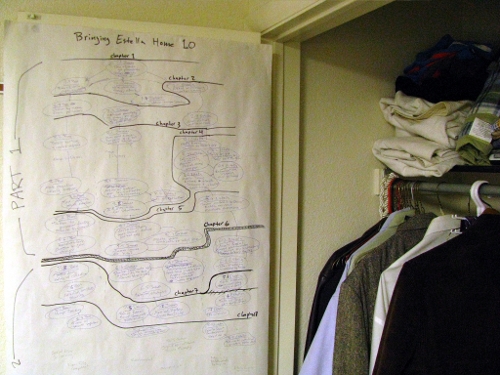
Writing’s going really well, though.  I’m about 100 pages into Bringing Estella Home right now, and even though I’m probably a day or two behind where I’d like to be, I’m generally right on schedule to finish it in April.

I say that tentatively because I’m a discovery writer, so I can’t really predict when I’m going to finish it since it’s probably going to do something crazy and surprise me.  However, I feel reasonably confident that I can finish this thing by late April.

To help out with this, I’ve engaged in a little friendly competition with Aneeka.  She’s finished her 1st draft (‘skeletal’ draft, I guess you could call it) of her next novel, but she’s going to go through and do a major revision.  We’re racing each other to see who’s going to finish first!

Hehehe…I am so going to win this.  After losing our last contest, I’d better make it up this time!

I had a surprisingly satisfying day today.  My classload is really light, but there was one midterm I had to take this week, and I took it this morning.  I spent all yesterday studying, which is why I only wrote about 500 words, but I got a 98 on the scantron section so I think I’m in good shape.  And really, I don’t have any midterms in any of my other classes (hard to believe, but true), so I think the worst of the mid-semester crunch is past me!

Man, it’s nice having almost no school obligations!

I’m starting to think I should stay here in the US this summer.  After all, if I’m trying to get ready for World Fantasy, I should put a lot of work into my stories.  If I do stay here, though, where will I go?  Maybe I could teach  Arabic at one of these summer seminar things.  Maybe I could go to the East Coast doing that.  Maybe I could stay here in Utah.  I don’t know.  It’s so complicated…and meanwhile, the clock  is ticking.

Another confession: part of me wants to go to Iraq to work for a year right after I graduate.  Why?  Well, the money would be nice.  But really, I’d want to do it because of the way that experience would enrich my writing.  Make it a lot more gritty, the conflict that more real.  It might even qualify my to write military sf–who knows?

Don’t worry–I’m not crazy enough to listen to that part of my brain.  At least, not yet. 😛

I love writing

Man, I love writing.  I wrote 1,617 words today, and when I wasn’t writing I was thinking about what I was going to write.  I only regret that I waited until about 10:30 pm to start writing; it’s 2:10 am and I still haven’t started my Arabic homework 😛

When I started Hero in Exile, I tried to plan everything out before I started writing.  As a result, writing was a real chore, and to make it more of a creative exercise than merely transcribing what I’d already worked out in my head, I played around a lot with the language and writing style.  It was still a chore, but I think my writing improved quite a lot.  I’ve gotten some really interesting comments back on my writing style for Genesis Earth, some very encouraging comments about the way I played around with the English language.

For this story, Bringing Estella Home, it’s both completely different and more of the same.  I’m going into chapter 4 without any planning or preconceptions, so practically all the world building is on the fly.  It’s wonderful.  This is the chapter where Estella enters the harem and gets assimilated, in a certain way, into Hameji society.  It’s basically her discovery of this new world, and it is so much fun creating it as I go along.  Lots of room for a creative outlet, and yet at the same time, I’m also playing around with the language aspects of the narrative like I did in Hero in Exile and Genesis Earth.  The result, I hope, is good quality creative writing.

Of course, one of the side effects of this process is that it sucks up a ton of my time.  A ton of time, and not just time–since I’ve got internet access here, there is no shortage of distractions to tempt and indulge me.  This is actually quite a serious problem–and yet, if I forced myself to focus, would I really have been more productive?  It’s hard to say, because taking little breaks every once and a while can actually help you think of better ways to phrase things.  Still, I know that I worked a lot slower because of all these distractions; perhaps a little more self-discipline would have really helped me out.

When I move out on my own and make my own writing space, it’s going to be in a secluded corner of my house somewhere, with an old desktop computer that has no internet access, just word processors and perhaps an electronic encyclopedia of some kind.

I’m going to have an overstuffed easy chair pulled up to the desk where the computer is, the kind that I can just lay back in and get absorbed by the sheer comfort of it.  I’m sitting in a chair kind of like that right now, and it is wonderful.

I’m going to have lots and lots of music on this computer, especially trance music because it helps drown out a lot of outside distractions.  This room is going to have a skylight, but it’s also going to have a door with a lock.  There will be no phone in this room, and I’ll probably leave my cell phone outside.

There will, however, be a bookshelf on the wall behind me (at least one, perhaps two), filled with all kinds of books, most of them sci fi paperbacks, but also with a few key books on various interesting and miscellaneous subjects, as well as books with quotes about writing.

Sitting prominently on my desk, between a couple of bookends, I’ll have a few copies of my own books in print, just so that I can look at them and think “wow, that’s my name on those books!  My very own name!  I’m in print!” And, at least for the first few years, it will not get old, no matter how many times I look at them. 🙂

It’s going to be great.  In the meantime, I should do my Arabic homework. 😛

I swear I’m not morbid

Wow, I had a interesting experience writing today. I only got about 650 words in, but I spent almost half an hour just walking around and thinking about it.

The basic premise of Bringing Estella Home (I should probably think of a better title…) is that the young protagonist was forcibly and unexpectedly separated from his older brother and sister when a barbarian war fleet invaded their solar system, and he’s trying to find and rescue them.  The barbarians capture and enslave both the brother and the sister–they send the brother into a very brutal brainwashing program to turn him into one of their empath soldiers, and they turn the sister into a concubine to the head of the fleet.

Well, in the scene I wrote today, the Hameji put Ben (the captured brother) through a mock execution, after putting him through weeks of physical and psychological torture.  The idea is to break him down completely so that they can remake him from the bottom up.  The execution involves putting him in an airlock and “spacing” him.

For some reason, this scene had a really huge impact on me.  It was…very brutal.  Very moving, though I’m not sure if it’s moving in the way that I want it.  It wasn’t senseless–it happens for a reason, to set things up for when he meets back up with his brother–but man, it was very brutal and disturbing.

Now…I swear I’m not a morbid person!  No, really!  My first novel was a happy, adventuresome, optimistic space opera, and I’m sure it won’t be the last one!  And really, I don’t have any pent up anger or goth tendencies or anything–it’s just, this is what I thought should happen in the story right now.  And…wow.  It was a lot more powerful than I’d thought.

This has made me realize that I’m going to need to bring in a humorous character to periodically give relief to all this tension.  I’ve got the novel figured out in my head in a rough three act format.  If all goes well, I should be finishing with act 1 before the end of next week.  At the beginning of act 2, James is going to meet up with a very interesting and quirky band of mercenaries, and that will (inshallah) be a good opportunity to bring in some comic relief.  Not too much, of course–just enough to help the reader get through the really serious, really disturbing parts.

And I know where I want this novel to end.  I don’t know how, but I know the main character’s root motivations and how that inner conflict needs to be resolved.  I actually have it all coming down to a single line of dialogue given from the head mercenary, Danica, to James at the very end of the story.  The denouement shouldn’t take up more than a chapter and an epilogue, which of course I haven’t figured out yet, but the key to everything, the thing compelling me at this point to write this story, is to get the main character (James) to get to that one line of dialogue and come to this realization about himself.

Of course, I won’t tell you what that is, since that would be giving away spoilers. 🙂 But if you want to be an alpha reader, let me know.  The goal is to have this sucker finished before the end of April.  Tough goal, especially now that so many storylines are exploding all over the place, but I think I can do it.

Interview with a character

Yeah, it’s been a while since I’ve blogged here.  Or anywhere else.

Things are going well.  I’ve been writing steadily this past week, and it’s going swimmingly well.  I’m really, really excited for the novel I’m working on right now!  I’m about 12,500 words into it right now, and my only frustration is that I can’t write it down fast enough.

That’s not to say that I don’t put off writing each day.  I always tend to put off the things that take real effort, and it really frustrates me.  Something personal I need to work on: self-discipline.  Well, don’t we all.

English 318 has been particularly motivating.  Every time I listen to one of Brandon Sanderson’s lectures, it’s like my fingers start to itch and all I really want to do is sit down and write!  He has a lot of really good advice, insightful ideas and perspectives, and it’s just really great to be taking this class from him.  This has got to be my favorite class at BYU, hands down.

Well, today we talked about character, and I had this really cool idea to sit down and do an interview with one of my characters, to try and flesh them out a bit.  When I got home, that’s what I did–I put myself on the Catriona, the ship he’s flying on, and had a little chat with him.

Of course, I skipped ahead a little bit–this isn’t where the story actually is at this point, it’s where it is in my head–and, well, you probably have no idea what I’m talking about anyways because you haven’t read what I’ve written so far.  Perhaps none of this will make any sense.  However, it was a fun exercise, so I thought I’d put it up here.  Enjoy!

I’m here on the Catriona right now, sitting next to James McCoy on the command bridge. We are somewhere out in deep space, well beyond the heliosphere of Karduna Prime, on our way to the first station of the Karduna-Gaia Nova starlane. Except for the two of us, there is nobody else around for literally millions of miles. James, welcome.

Thanks, Joe. It’s good to be with you.

I know this isn’t exactly the best time for you, what with your brother and sister getting kidnapped and all.

Well, maybe it isn’t, but here you are.

Yeah (after all, it’s not like things are going to get any better for you <cough>). Well, to start off, why don’t you tell me a bit about yourself?

Ok. Um, let’s see…I was born on the Colony, a mining station out in the Trojan asteroids just behind Kardunash III. My mom and dad are space traders–local traders, not the interstellar kind. I have a brother and a sister…

What about yourself? What can you tell me about yourself?

Well…I just finished general schooling at the colony, and was just about to start my apprenticeship with the McLellan family when this whole big mess with the Hameji happened.

What did you want to do for your apprenticeship?

I don’t know…my sister went into communications and programming, and my brother did deep space astrogation and business…I guess he wants to go off and start his own trading business, a deep space trader. But me? I haven’t figured that out yet.

I know the Hameji invasion has been pretty hard on you.

Yeah, it has.

What are you going to do about it?

I’m going to sell this ship, hire some mercenaries, and rescue my brother and sister, that’s what I’m going to do.

Sounds dangerous.

I know it does. I know it is. I’m going to do it anyway, though–or die trying.

They say that no captives have ever escaped from the Hameji. What do you think of that?

I’m still going to try. If I gave up now, how could I live with myself? Besides, there are a lot of legends about the Hameji. You can’t trust them all–they’re human beings too, just like the rest of us.

So you’re not worried?

No, I’m worried. To be honest, I’m scared out of my mind. I’m just not going to let that stop me.

So when something’s wrong, you like to take action?

I suppose. To be honest, I never really thought of it that way until the invasion. Then again, I was always the youngest child. Everyone always seemed to take action on my behalf, not the other way around.

How do you feel about being the youngest child?

Well, (don’t tell anyone, will you?), I sometimes feel that I don’t get enough respect. I mean, I’m seventeen years old, I can take care of myself, but everyone still acts as if I’m the little kid brother. My Mom clings to me whenever I’m back home, my Dad always gives the real work to my siblings, Ben always treats me like a little kid…it’s tough. I don’t like being the youngest.

You didn’t mention Estella in that list. How come?

Estella is…well, she’s different. We get along really well. I feel like I can talk with her. Ben is a good brother, and we get along and all, but I sometimes feel as if he looks down on me a little. But Estella, she’s really close. She understands me.

What makes you say that?

She likes to talk a lot. Ben likes to torment the both of us sometimes. I mean, we’re really close to him too (I mean, he’s our brother), but it’s different. Estella used to come to me with her problems while Ben was starting his apprenticeship. She was really scared about graduating and leaving the family. We got really close back then, and I shared a lot with her.

What about before her graduation?

Well, I always felt like I needed to take care of her. She’s my older sister, but back home at the colony, men are definitely the ones who wear the pants. Women can vote, but men do all the dirty work while the women take care of the home. Men are the protectors. I guess that makes me and Ben Estella’s protectors–at least until she finds a husband. If I get her back.

Yeah. . So, how do you feel about your brother Ben?

He’s my older brother. We used to fight a lot, but always good naturedly. He left for his apprenticeship when I was still in my early teens, so I haven’t seen him a whole lot since then. When I have seen him, he always tends to be in charge. He’s gotten a little bossy recently, actually. But I still love him. I’m sure he’s taking care of Estella, whereever he is.

How do you feel about the Hameji?

I hate them. They’re monsters. I wish I could drive them out of this system by myself.

If you could have any wish, what would it be?

To get things back to the way they were before the invasion. I feel like my life just sort of stopped on that day, and I’ve been wandering around somewhere else trying to get back. I hate it. I want my brother and sister back. I want things to return to the way they were.

But if that’s impossible, what will you do?

(long pause). I don’t know. It probably is impossible. But if I can’t get my brother and sister back, I might as well die with them myself.

Yeah. So…life kind of sucks for James right now. Hehe. Sorry, James. My goal with your story is to make the reader cry. Needless to say, things are only going to get more difficult for you.

But one thing I can say is that it will be worth it in the end. At least, I think it will be. I haven’t quite gotten there yet.

Oh, and I can’t have you making the story all boring with your melancholy. You’ll meet up with someone very interesting in a little while. Her name is Danica, and she’s the captain of a band of mercenaries. She’s killed at least half a dozen people with her knife and bare hands, and she’s got a bounty on her head that’ll keep her out of civilized space for many, many years to come.

Oh yes, it will be interesting when you run into her. It’ll be more interesting to see what happens to you both when she becomes your mentor.

Productivity breakdown

I’ve been thinking a lot about the writing I accomplished in the past few semesters. In some ways, I worry that I’ve become a lot more disorganized and a lot less productive than I was a year ago.

Back in winter ’08, I took a couple of really difficult classes, got up early each morning to work in the BYU Bookstore stockroom, wrote a handful of very difficult research papers…and still managed to write about 120,000 words. Oh, and I wrote on this blog almost daily. I finished my first novel, started my second, read a dozen other novels, wrote reviews of them all…
I accomplished quite a lot.

In fall ’08, however, my workload was much lighter, my classes were ridiculously easy, I didn’t have to get up early to work…and yet I only wrote about 70,000 words, didn’t hardly write for this blog, only read a couple of books, etc etc.  Much less productive.

Though, I guess you could say that I made up in other areas.  I started working for the FHSS Writing Lab, and that took a lot of my time and mental energy.  Also, I think the quality of my writing improved quite a bit, and I experimented a lot with things that I hadn’t tried previously.  Right now, I feel that Genesis Earth, my second novel, is a much better work than The Phoenix of Nova Terra.

So maybe all of this “oh my goodness where did my productivity go” is just me worrying for no reason.  It’s hard not to worry about it, though.

I know for certain that I could be much more productive with my time.  I come home tired, with less than an hour before dinner, and I usually squander the time on the internet or with video game emulators.  I tend to put off homework, and only do the stuff that will get me in trouble if I don’t do it (though some would say that that’s a life skill…hmmm…).  On any given day, the last two hours before I go to bed is filled purely with time wasting activity.  I could use an extra two hours of sleep…

Meh.  I guess it’s always a struggle.  A year from now, I’ll probably be saying “I can’t believe how productive I was back in winter ’09!” That, and “holy cow, what am I going to do after I graduate??”

Assessment

Well, it’s a new year now, and English 318 has started! We had a wonderful class yesterday, getting things set up, figuring out our writing groups and all that. I am so looking forward to this semester!

With all of these changes happening, I thought I’d do a little recap and assessment of the last six months. I tried out a lot of new things over this time, and learned quite a bit about myself as a writer. I wish I could say that all of my experiments were successful, but at least I know a little bit better what works for me and what doesn’t. Here goes.

Experiment #1: Extensive planning and prewriting

About three months before I started Hero In Exile (the book I was writing last semester), I downloaded wikidpad and wrote a huge collection of articles, all about the world and the story plot. I spent a lot of time in worldbuilding before I’d even written a single word. I wanted to try this because I’m a discovery writer, and in my previous writing I tended to figure out the details of my world on the fly, as I wrote out the story.

This experiment was largely a failure, I think. I stopped writing Hero In Exile because it became too massive to write. As I wrote the story, I kept receiving story ideas and tried to integrate those, but towards the end of the first part, I realized that I was trying to doo too much. Planning didn’t stop me from discovery writing like I always do, and by the end everything was just too cluttered.

Experiment #2: Extensive prewriting of characters using Meyers Briggs personality types

I remember how a few months ago how I wrote a long post describing my characters using the Meyers Briggs typology (INTP, ESFJ, etc). I did this because I wanted more depth to my characters, and I supposed that by planning them out a little more, I would be in a better position to fully develop them.

My assessment on this is mixed, but overall I would tend to call it a failure. There were a handful of descriptions in the personality profiles that helped me to better understand these characters, but once I sat down and started writing, the characters started to do things that surprised me and that didn’t fit into what I had planned. By trying to describe their character before writing them, I wasn’t giving them enough room to show me who they really were; I didn’t give them enough space to act on their own and surprise me.

Studying the personality profiles was good in that it got me thinking more about my characters, but not a good way for me to conceptualize them before writing. I was simply trying to structure too much and not giving myself enough room to discover them and let them act on their own. By the end, I felt as if I were forcing my characters too much, and that made things very difficult.

Experiment #3: Waiting for the ideas to accumulate critical mass

For Hero in Exile, I felt all of my ideas reach a critical mass and converge while I was studying in Jordan. I then waited for nearly a month before sitting down and writing chapter 1. I did this for a couple of reasons: first, it simply wasn’t practical to start the project while I was studying abroad, and second, I had heard that a good novel is built out of a synthesis of several ideas, not just one, and I wanted to have all my ducks in a row before I started.

This also proved to be a mistake.  Yes, it takes more than one idea to make a novel, but you don’t have to have all the ideas lined up before you start.  I guess that planners do, but I’m not much of a planner, I’m more of a discovery writer.  By waiting too long to start the book, I had too many ideas to work with.

However, with Genesis Earth, I had the exact opposite problem.  I started way too early, before I had enough ideas to work with.  Now, a year later, I’m struggling to wrap it up.  The ideas have come, but the writing process was very choppy.

How do you judge when you’re ready to start?  I have no idea how to measure it.  It’s very touchy feely.  I think I started Phoenix at the right time, but Hero was too late and Genesis was too early.  At least I’m in a better place now to tell when is a good time to start.

Experiment #4: Spend more effort on detailed physical descriptions

When I wrote Hero in Exile, I found myself spending a lot of time on the aesthetics and physical descriptions of the world.  I did the same in Genesis Earth.  In doing so, I always tried to show, not tell, by giving some visceral or sensuous detail of something the viewpoint character was sensing.

I think this was a success.  Whenever I brought in an excerpt from Hero into the quark writing group, everyone always complimented me on how how full and engaging my world was.  The descriptions really added to the sense of wonder and helped them to feel that they were there.

Experiment #5: Avoid info dumps at all costs

Related to #4 was my decision to completely excise all info dumps from my writing.  Anytime I found myself telling instead of showing, I stopped and focused on what was happening in the here and now of the story.  I also withheld information to create curiosity and intrigue within the reader’s mind.  Throughout this, of course, I always tried to keep my writing as clear as possible.

This, also, was a success, I think.  At times, the readers became confused, but the withholding of information did create a lot of curiosity and desire to read more.  Many times in the quark writing group, people said that they were sucked in by the writing and very much wanted to read on to find out what happened next!

Experiment #6: Create difficult ethical dilemmas and have the characters wrestle with them

I wanted to try writing stories that are more thematic and deal with controversial and difficult issues.  For Hero, I had the main character struggle to keep his honor and chastity, where the people he trusted and loved the most try to manipulate him by tempting him to give in to his sexual urges.

I’m not sure if this was a success or not.  I think that it was, but it was like pulling teeth, and some of the scenes are a little bit graphic.  I guess that without giving my story out to some alpha readers, I have no idea whether it was a success or not.  I have learned, however, that it’s not a good idea to sacrifice entertainment for a message.  It’s possible to do both, and if your own story is something you’re not excited to tell, it’s not going to be easy to write it.

In short, last semester I wrote about 75,000 words total, without much to show for it except the unfinished rough draft of a flawed book, and a partially finished novel that I started last year.  Still, I think I’ve learned quite a bit from the experience.
What does your muse look like?

I’m reading this interesting book by Stephen King that is a mix of personal memoir and writing advice. It’s a very interesting book, even if the language is much more colorful than anything you hear in Provo (except while in traffic, that is).

At one point, Stephen King got off on a tangent and described what his muse would look and act like if he were a living, breathing human being. Interestingly enough, he described his muse as a scruffy, disheveled old man who hangs out in basements and grunts more often than he talks.

That got me to thinking: if my muse were a living, breathing human being, what would she/he look like?

First of all, my muse would definitely be female. Even though women’s minds constantly baffle me, my muse helps me to write and understand my female characters a lot better than most of my male characters. Even though the protagonists in both of the novels I’m writing are male, I think I have a preference for female characters.

My muse is about five years younger than me and three thousand years older. She listens to my intellectual inquiries and philosophical dabblings like a younger sister, but is a lot closer to the pulse and rhythm of this world than I have ever been.

She has a soft spot for Homer and the old Greek epics (I suppose that’s right around the time when she got her start at being a muse), but she’s been deeply in love with space epics since the days of Heinlein, Herbert, and Asimov. In fact, her love of the stars must have started sometime back in the days of the Greeks and Romans, because that seems to be the only thing that’s ever on her mind. She’s definitely a night owl and I think she spends her nights stargazing while I’m asleep.

In contrast with my blunt, forward, and sometimes aggressive manner, she doesn’t really speak to me unless she knows that I’m listening. She doesn’t slap me upside the head to get me working, and she usually doesn’t come to me until I’ve been slaving away for at least half an hour. If I choose not to listen to her, she goes away without an argument.

As much as I love to toy with ideas and systems, she likes to touch, taste, see, and smell things directly with her own senses. She’s the kind of person who would take off her shoes to walk barefoot in the grass, even if it makes her late to where she’s going. She’s easily distracted and she never really lets me know where she’s going until we get there. If I listen to her and follow her, however, she almost always leads me someplace worthwhile.

My muse is very mischievous. Her favorite thing is to inconveniently interrupt me when I’m in the middle of something else to give me flashes of inspiration. I can’t tell you how many crazy ideas I’ve had in the middle of class, or a test, or general conference, or some other important thing. She teases me, too; if I don’t write down what she tells me, she won’t tell it to me a second time until I’ve racked my brain and beaten myself up several times.

My muse looks young and innocent, but don’t be deceived. It’s an act. She’s a wanderer who isn’t likely to settle down anytime soon. Blood, violence, battle, and death excite her. She thinks edgy stories are sexy and gleefully urges me to torture and confuse my characters as much as I can. Still, deep down, I think she wants the good to win out in the end, and the evil to be revealed for what it really is.

I have no idea why she came to me or why she stays with me, but she’s faithfully been with me as long as I can remember. Even though she won’t push me, she won’t let me ignore her either, and I know that whatever I do in life, she’ll be there with me. In some ways, that’s quite a burden, but in other ways, it’s very reassuring.

The Mongol hordes…in SPACE!

A while ago, I wrote a post on this blog about what we were learning in History 240 about the Turks, the Seljuks, and the Mongols.  Fascinating stuff!  Really epic!  Genghis Khan, Tamarlane, Tugril Beg, and all the rest of those guys may have been bloody, totalitarian rulers, but they did some incredible stuff, especially Genghis Khan and the Mongols.  When the sky god Tengri says he has given the world to the Mongols, and the Qiriltai elects you leader of the Mongol tribes, who can fault you for stepping up and facing your destiny?

This last semester was generally miserable, but I still remember the class lecture on the Mongols and how I sat there, eyes wide, thinking to myself “holy cow!  This would be so cool as the backdrop for a novel!” I’d love to read a historical novel set in this world, but since my passion is science fiction, I immediately started trying to figure out what sort of a culture would be analagous to the Mongols in a far future galactic empire.

Here’s what I came up with.  I’ve been meaning to write about this for months and months, but just haven’t got around to it, but I still remember my ideas very well.

First of all, this culture would develop on the fringes of sedentary civilization.  That much is obvious.   The Mongols developed out on the steppes, and the space Mongols (I’m just going to call them Hameji, since I’ve already started to incorporate this idea into Hero in Exile) would develop out on the fringes of explored space–unsettled, unterraformed planets, asteroid fields, comets, etc.

The Mongols were nomads, highly mobile, with an economy centered around horses and cattle.  Similarly, the Hameji would also be nomads, living in spaceships instead of planetary colonies and orbital stations. Their economy would be based on building and modifying spaceships; just as the Mongols were master horsemen, the Hameji would be master pilots and mechanics.

The Mongols had a secret weapon that gave them a clear offensive advantage: the highly mobile horse archer.  Similarly, the  Hameji would also have a military advantage: close range gun modifications that they could cheaply and easily attach to any ship, civilian or military.  Just as the proportion of Mongol warriors per total population was much, much higher than any other culture (due, in part, to their horse based economy), so the proportion of Hameji warriors to total population would be incredibly high.  Basically, every Hameji ship is a warship.

Things got really interesting, though, when I started imagining what the social dynamics of the Hameji would be like.

First of all, the Hameji are extremely authoritarian.  That much has to be clear, given their spacefaring nature.  When you’re on a spaceship, everyone has to work together, willingly or otherwise.  There are so many complicated operations that have to be performed precisely in order to pilot and maintain a spaceship: engines, power, navigation, life support systems, food and hydroponics, sensors–it’s so complicated.  What’s more, everyone has to work together; the guys in the engine room can’t do their work without the guys in the power plant, the navigator can’t do his job if the guys in the engine room and the deep space sensors aren’t doing theirs, and nobody can work together if life support isn’t doing its job.  Something has to keep all of these guys in line, otherwise an accident or an unexpected attack could kill everybody.

In Heinlein’s Citizen of the Galaxy, intra-ship unity was maintained by a system of cultural norms and values that restricted individual freedoms and required painful sacrifices for the good of the community.  But basically, it was rule by strict tradition.  With the Hameji, tradition definitely plays a role, but besides that, the rule of the captain is absolute law.  Heinlein’s space traders were just trying to stay alive; the Hameji are trying to conquer and subjugate the known universe.  They need an absolute ruler to keep things in line.

Since authoritarian figures play such an important role in their society, the Hameji don’t believe that all men are created equal.  They believe in a ruling class and a following class.  Those who command the spaceships are, in the minds of the Hameji, more human than those who merely follow orders.

Because of their nomadic roots, the Hameji despise the sedentary planet-born.  Just like the Mongols, they consider the “civilized” city/planet dwellers to be soft and weak, like cattle, devoid of true strength and honor. Because those who cannot command spaceships are less than human, they think nothing of killing off planets wholesale, using mass accelerators to smash them into the stone age with asteroids and space rock.  Just like the Mongols swept the world, burning cities to the ground, so the Hameji sweep across the galaxy, annihilating entire worlds.

You could think of the Hameji as bloodthirsty and evil, but really, they have to be aggressive in order to survive.  They have to capture new spaceships in order to provide space for their growing population, first of all, and that means that they have to do a lot of raiding and killing.  Since all of their neighbors have to do the same thing to stay alive, the Hameji learn to be quite good at what they do.

Mongols in space.  How cool is that?  It’s definitely got potential, I think.  I was going to throw it into Hero in Exile as yet another setting element, but now I’m thinking about writing a story with this as the main, driving conflict.  We’ll see which one ends up getting written.  It’s all on the back burner until Genesis Earth and The Phoenix of Nova Terra get written.