The American Insurgency, Part 3: The Roots of the Insurgency

tacticalgadsden1When the colonies began their war for independence in 1775, they had no formal army, but depended on civilian irregulars or “minutemen.” In a similar way, the American Insurgency was made up of ordinary citizens, self-taught and self-trained, who had prepared themselves for the coming conflict and were ready to take up arms at a minute’s notice.

To truly understand the roots of the insurgency, one must first understand the cultural differences between the coastal regions and the interior. In the early 21st century, the West Coast and the Northeast Corridor were so different from the South, Midwest, and Intermountain West as to almost be separate countries. Profound differences existed not only in politics, but in religiosity, cuisine, hospitality, family ties, the education system, economic organization, and popular culture.

The interior regions tended to be much more religious than the coasts. They tended to place more importance on traditional family structures. While the interior regions possessed many large and important cities, they tended to be more rural and thus more old-fashioned. People tended to vote more conservative than liberal, even in many of the larger cities. People also tended to be more self-reliant, and were much more likely to own guns.

Prior to the military purges of 2025, most of the United States military came from the South. This region had seceded from the union in 1861 during the first civil war, and a deep sense of Confederate pride and heritage continued to exist even 150 years later. Among these, the most independently minded state was Texas, where many people considered themselves Texans as much as Americans.

The Intermountain West, originally colonized by Mormon pioneers, still possessed a strong pioneer heritage and culture. The Mormons had spread throughout the entire country by this time, but the greatest concentrations were found in Utah, Wyoming, and Idaho. With its strong beliefs in self-reliance, emergency preparedness, and the divinely inspired nature of the American Constitution, the Mormon religious community would play a key role in the coming insurgency.

The Little Collapse of 2008 (or Great Recession as it was called at the time) led to a surge in popular interest for emergency preparedness. This “prepper” subculture especially thrived in the interior regions of the country, which were not as hard-hit as the coasts but were much more independently minded. As a part of this subculture, many people bought firearms and trained in their use, so as to protect themselves and their families.

The Obama years saw a great deal of social upheaval, which the preppers believed to be the beginnings of a general social collapse. This did a lot to fuel the movement. However, it was not the gradual collapse of American society that prompted the greatest alarm, but Obama’s policies.

In 2012, a mentally ill young man named Adam Lanza killed his mother and assaulted a local elementary school with an AR-15 style rifle. This tragedy, known as the Sandy Hook shooting after the name of the school, sparked a national uproar.

The gun control movement at this time was deeply entrenched in both the West Coast and the Northeast Corridor. They immediately exploited the shooting for political purposes, setting a pattern that would be followed in numerous mass shootings to follow. In spite of the fact that Sandy Hook was likely targeted because it was a gun-free zone, calls for “common sense gun legislation,” or in other words a government confiscation of all civilian firearms, began to be openly heard.

Few things polarized the country in the Obama years more than the gun control movement post-Sandy Hook. Fearing a mandatory gun buyback program (which would later be implemented in 2026), Americans bought guns in record numbers. Meanwhile, the gun control movement openly called for a national gun ban, further fueling the counter movement.

Molon Labe” was the response traditionally issued by the Greeks when the Persians demanded that they surrender their weapons at Thermopylae. Roughly translated at “Come and take them!” this now became the watchword for the pro-gun counter movement. For the first time in modern memory, the prospect of an armed insurrection against Washington was openly discussed.

The first clashes with the federal government occurred in Nevada and Oregon, over a dispute between the Bureau of Land Management and the Bundy family. While most Americans did not support the Bundys, and the standoffs were resolved with relatively little violence, the incidents demonstrated that armed citizens could stand up to federal authorities and force them to compromise or capitulate.

By the time Hillary Clinton was elected president in 2016, a strong pro-gun movement had taken hold in the interior regions of the United States, with an understanding that it might become necessary to defend their rights by force. However, the movement was not formally organized and had no leaders. It was more of a response to the political climate, rather than a movement that actively worked to shape it.

Clinton largely continued most of Obama’s policies, which led to more mass shootings, more homegrown terrorist attacks, more race riots, and more polarization within the gun debate. During this time, leaders began to emerge who would later play a pivotal role in the organization of the American Insurgency.

Among these was a Provo, Utah resident named Scott Bascom. A self-employed contractor and science fiction writer, Scott was one of the first people to foresee the coming civil war. He was remarkably charismatic, even before the war, though by most traditional measures of wealth or status he was completely ordinary.

As the Republican Party disintegrated in the run-up to the 2020 elections, it became increasingly obvious that Clinton would face no serious challenge in her bid for re-election. Her presidency was characterized by the worst corruption since the Gilded Age, with foreign governments openly buying favors. The US Military, sworn to protect the Constitution, began to take steps for a coup.

This ultimately proved unnecessary, as Clinton was impeached shortly after her re-election in 2021. President Kaine was a milquetoast leader who made some concessions to Libertarians and Constitutionalists. However, at the Democratic National Convention of 2024, a dark horse candidate named James Ward seized the nomination in a contested convention and immediately began to consolidate his power.

He uncovered the coup plot and used it as a pretext to sack the military leadership, installing party loyalists in positions of command. He also began to aggressively enforce federal laws that conflicted with state laws, often pitting federal authorities against state authorities. In the memorable Dewey case, he deployed the National Guard to break up a homeschooling ring in Alabama. This led to an armed confrontation, in which the federal troops prevailed.

Perhaps more than any other incident since Sandy Hook, this incited the pro-gun movement to take action and make preparations for war. But there would be very little time to prepare, as in the following year, the Steward vs. California Supreme Court case paved the way for the gun control movement’s endgame. President Ward implemented a mandatory federal gun buyback program at once, hoping to stem the conflict by forcing immediate action.

But the roots of the American Insurgency ran deeper than he’d realized.

The American Insurgency (Index)

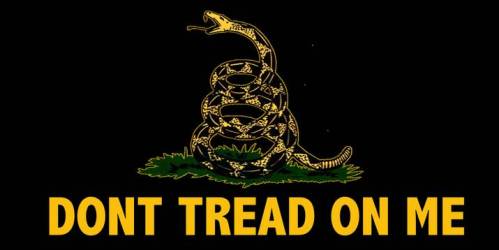
Tactical Gadsden Flag taken from The Art of Not Being Governed and published under a CC BY-SA 4.0 License.

The American Insurgency, Part 2: The Constitution Hangs by a Thread

tacticalgadsden1The sequence of events that made the American Insurgency inevitable had its roots in a political shift that had occured more than a century earlier. It began with the Progressive Era, barely a generation after the first civil war, dovetailed into the New Deal, and culminated with the near complete subversion of the United States.

It is worth taking a moment to review the founding documents and constitutional principles of the United States, to show how far the country had strayed from them in the decades leading up to the American Insurgency.

In 1776, the Declaration of Independence established the philosophical foundation of the US Constitution; namely, the principle of natural rights and the social contract:

We hold these truths to be self-evident, that all men are created equal, that they are endowed by their Creator with certain unalienable Rights, that among these are Life, Liberty and the pursuit of Happiness.

That to secure these rights, Governments are instituted among Men, deriving their just powers from the consent of the governed, That whenever any Form of Government becomes destructive of these ends, it is the Right of the People to alter or to abolish it, and to institute new Government, laying its foundation on such principles and organizing its powers in such form, as to them shall seem most likely to effect their Safety and Happiness.

This established the principle that rights are not bestowed by the State, but are held in reserve by the people. The purpose of the State is not to bestow favors or priviledges, but to preserve those rights and liberties which the people naturally possess.

The most important of these were enumerated in 1789 by the Bill of Rights, which were:

  1. The right to free speech and freedom of religion.
  2. The right to bear arms.
  3. The right from quartering soldiers.
  4. The right from unreasonable search and seizure.
  5. The right to due process.
  6. The right to a speedy and public trial.
  7. The right to a trial by jury.
  8. The right from cruel and unusual punishment.
  9. The right to retain all other rights not explictly enumerated.
  10. The right to retain all powers not explicitly granted to the federal government.

Together with the Constitution of 1788, these documents established a limited government, charged not with providing for the “common good” but protecting the individual rights and liberties of the people.

A century later, during the Progressive Era, this began to shift dramatically. Unlike the Founding Fathers, the 19th century Progressives saw government as a vehicle for achieving social reform. The concept of social engineering, so anathema to the constitutional principles of limited government, was gradually introduced until it became commonplace. Congress passed numerous laws that overreached their Constitutional mandate, and a Supreme Court dominated by Progressives upheld them. This incremental gutting of the Constitution laid the groundwork for the massive expansion of federal power under President Franklin Delano Roosevelt.

Today, FDR is largely regarded as one of the worst presidents in the history of the United States. In the years leading up to the American Insurgency, however, he was regarded as one of the best. The entitlement programs of FDR and his immediate successors had not yet failed, though the writing was on the wall, and the national debt, while skyrocketing to dangerous heights, had not yet driven the nation to bankruptcy.

It is difficult for us, looking back with the benefit of hindsight, to conceive how the people living at this time could not see the writing on the wall. While some of the more forward looking ones certainly did, the vast majority simply assumed that the broken system would continue to plod along as it always had.

However, it was not only a broken system that brought the country to its knees, but the secret combinations of power that sought to exploit it.

It is impossible to accurately document all of the players who were actively working to subvert the United States in the late 20th and early 21st centuries. We may never know whether it was a monolithic effort by a single global organization, or a loose ideological confederation of various political factions. However, we do know that there was a subversion effort of some kind, because the effects of it are measurable and well documented.

The subversion process, as described by Soviet defector Yuri Bezmenov, has four stages:

Demoralization > Destabilization > Crisis > Normalization

During the Cold War, the KGB actively funded or provided support to several left-leaning political groups in order to push the United States through these processes. The Soviet Union collapsed before the subversion was complete, but the process continued well into the 21st century until the crisis which caused the American Insurgency.

The purpose of demoralization is to effect a generational shift in basic moral values, laying the foundation for the disintegration of society. This was achieved through the social upheaval known at the time as the “culture wars.”

In the 1950s, divorce was rare, abortion was unheard of, most children were raised by their biological mother and a father, and religious practice was a major aspect of public life. By the 2010s, none of these were true. A lot of this was due to changes in government, which made divorce and abortion common and easy, incentivized single mothers on welfare to have more children, incentivized young couples to cohabit instead of getting married, and forced religious institutions to either adopt practices that ran contrary to their moral teachings or to retreat from the public sphere. In other areas, such as education, employment, law enforcement, and the media, similar trends can be documented that underscore a massive shift in social values.

The demoralization of the United States was more or less complete by the early 2000s. The destabilization process was already underway, but it accelerated dramatically under President Obama during the 2010s. During this stage, the society being subverted is pushed into violent confrontation with itself in order to foment a crisis. The race riots in Ferguson, Missouri marked a dramatic shift in race relations, ultimately leading to violence against the police. As law and order broke down, crime increased dramatically, especially in minority communities. Violence also became normal at political rallies and university events.

Historians disagree as to whether Hillary Clinton was supposed to merely further the destabilization of the country or bring it though crisis to the final stage of normalization. However, they almost universally agree that she was a major player in the subversion of the United States. Donald Trump, her Republican opponent in the 2016 election (the last year in which the Repulican Party would be a force in national politics), was probably also propelled to power by the secret combinations working to subvert the country, though most historians believe he was merely exploited by them, and not an active conspirator.

It is a testament to the resilience of the American system of government that the country did not collapse under Hillary Clinton’s presidency. However, her far-left policies pushed the United States past the point of no return. Before she was impeached and thrown from office in 2021, the Constitution was largely a figurehead document, exerting little force on the underlying political philosophy of the federal government.

The first and fifth amendments were largely dismantled in the aftermath of the college protest movement in the mid 2010s. The fourth amendment was rendered toothless by mass surveillance by the NSA, upheld by Clinton’s Supreme Court. The ninth and tenth amendments had been ignored for decades, and were effectively buried by Clinton’s sweeping economic policies following the Great Collapse in 2017.

The second amendment was the last thread by which the Constitution hung, and when President Ward attempted to annul it in 2026, the result was war.

The American Insurgency (Index)

Tactical Gadsden Flag taken from The Art of Not Being Governed and published under a CC BY-SA 4.0 License.

The American Insurgency, Part 1: Prelude to Civil War

tacticalgadsden1The American Insurgency officially broke out in 2026, as a direct result of Steward vs. The State of California which effectively nullified the 2nd amendment. However, the conflict was rooted in the politics of the previous decade, and the economic realities of the Great Collapse.

Following the election of 2016, the Republican Party split into various regional factions and ceased to be a force in American politics. None of the third parties then extant were able to pick up enough Republican dissenters to challenge the Democrats on the national stage. As a result, the 2018 elections handed the Democrats control of the House and Senate, as well as the White House.

The Great Collapse began in late 2016 / early 2017, when Germany and France fell into recession. The migrant crisis in Europe had reached the high water mark, which along with the ongoing Eurozone crisis propelled several right-wing, Euroskeptic parties into power. Referendums in Poland, Hungary, the Netherlands, Greece, and the Czech Republic all resulted in decisions to exit the EU, leading effectively to the dissolution of the union.

Following Vladimir Putin’s mysterious disappearance in April 2018, the Russian Federation collapsed and Russia ceased to exist as a single contiguous country. NATO attempted to safeguard Russia’s nuclear weapons arsenal and oversee a transitional government, but failed as the Russian oblasts either refused to recognize the authority of the Kremlin or were annexed by neighboring states. Poland and the V4 countries formed a competing alliance system for eastern Europe, and the various western European countries gradually withdrew support from NATO as they rebuilt their own national militaries.

As a result of these events, the entire Eurasian continent fell into economic collapse. Insurrections in the Chinese mainland forced the PRC to withdraw from global affairs as the country gradually imploded. Foreign investors lost a tremendous amount of capital. Stock markets across the globe plummeted, the Euro was disbanded, and regional wars broke out in the Balkans, the Caucasus, the Levant, and the South China Sea.

The immediate effect of all this was to drive foreign capital to the United States, which was not nearly as leveraged as the Eurasian countries and therefore in a much better economic position. However, the debt to GDP ratio of the United States was already over 100%, and US dollar’s days as the reserve currency of the world were numbered.

But in the short-term, the United States experienced a brief period of economic relief as the rest of the world collapsed. This boosted President Clinton’s popularity and enabled the Democrats to sweep the 2018 elections.

As soon as the Democrats had control of congress and the white house, they pushed a deeply partisan agenda. Abortion laws across the states were nullified by federal law. The federal minimum wage was raised first to $15, then to $20 as the dollar began to plummet. The welfare rolls expanded massively. Hate speech laws were passed that banned any discussion of abstinence in public schools, and mandatory consent classes began as early as grade 5. Christian churches were forced to perform gay marriages, and the movement to decriminalize pedophilia gained significant legal traction.

President Clinton was impeached and thrown out of office in 2021, but the damage had already been done. The Supreme Court was stacked with left-leaning activist judges, who overturned previous limits on federal powers and reinterpreted the US Constitution in ways that effectively nullified it. The rule of law had already broken down with the FBI’s failure to prosecute Clinton in 2016, but new court decisions effectively paved the way for the President to exercise dictatorial powers.

When the Supreme Court ruled in 2026 that the 2nd amendment was not to be construed as an individual right to bear arms, Washington immediately instituted a national mandatory gun buy-back program. Conservatives and libertarians decided they had had enough.

The American Insurgency had begun.

The American Insurgency (Index)

Tactical Gadsden Flag taken from The Art of Not Being Governed and published under a CC BY-SA 4.0 License.