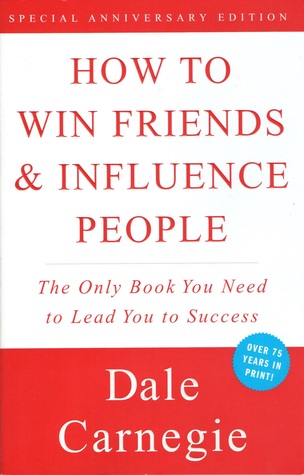
How To Win Friends And Influence People by Dale Carnegie

This is the book that invented the self-help genre, and for good reason. It was written more than 80 years ago and still stands as the definitive work on the subject. Unless you live in a cabin in the mountains where you never interact with other people, this book really is as important and life-changing as everyone says it is.

I bought this book at the urging of a friend way back in 2015, but I kept putting off actually reading it until now. I’m not entirely sure why I did. Maybe the titles were too clickbaity, or the language read like something from a sensationalist blog. Truth is, though, that Carnegie was the one who invented that kind of writing and everyone else is just trying to imitate him. And unlike your typical internet clickbait, there is actually a lot of substance behind the words.

I can summarize this book in one sentance: “To win friends and influence people, build them up and make them feel important.” There really isn’t any secret to it. The difficult part is learning how to do it and mastering the technique, for which it may take a lifetime of practice. I’ve heard that many billionaires make it a point to reread this book on a yearly basis.

This book is especially helpful if you struggle with social skills in any way. That alone should make it a must-read for most of us geeks, especially me.

Weird things happen whenever I decide to practice the advice in this book. I complimented a man on his hat, and he offered to give it to me. I gave the TSA officer a smile, and he let me pass through security without confiscating my >3 oz container of homemade fruit preserves from my cousin’s wedding. I told the cashier at the Creamery that I liked her braids, and her expression went from “I’m having a horrible day” to cheerful and happy.

It’s honestly a little freaky how well this advice works. If I’d read this book back in 2015, I may have even convinced my parents not to vote the way that they did. I certainly would have toned down the politics on this blog, and would probably have persuaded a lot more of you to see things the way I see them in the process.

So yeah, unless you’re alone on an interstellar voyage light-years from the nearest human being, this book is a must-read. And even if you are on that voyage, if there’s so much as a single other person on that starship, you definitely need to read this book.

Happiness is always a choice, take 2

CGP Grey made an awesome video last week, which should come as a surprise to nobody, but this one is exceptional even by CGP Grey’s standards. In it, he borrows some of Doctor Randy J. Paterson’s work in How to Be Miserable: 40 Strategies You Already Use and gives us a seven step program on how to be miserable. Those steps are:

  1. Stay still.
  2. Screw with your sleep.
  3. Maximize your screen time.
  4. Use your screen to stoke your negative emotions.
  5. Set vapid goals.
  6. Pursue happiness directly.
  7. Follow your instincts.

Since this basically describes 80% of people on the internet at any given time, it comes as no surprise that the video soon went mega-viral.

Generally, I think most of CGP Grey’s anti-advice is spot on. However, there is one part that I disagree with rather strongly. It’s the part where he says:

True happiness is like a bird that might land on your ship, but never if you constantly stand guard to catch him. Instead, improve your ship and sail into warmer waters. The bird will land when you aren’t looking.

Happiness is not a bird that comes and goes as it pleases, without any input from you. Instead, it is a decision you make on how you will respond to things outside of your control.

In other words, happiness is always a choice.

A while ago, I wrote a blog post on the subject. In it, I said:

There are only two classes of things in this world: things that act, and things that are acted upon. Empowerment is when you give somebody the ability to act for themselves, independent of outside forces. Disempowerment is when you take that ability away.

There is nothing more empowering than to realize that no matter where you are in life—no matter how shitty your circumstances—you can always still choose to be happy.

Happiness is a feeling that only exists inside of you. It is not something external that is forced or bestowed upon you by outside forces. It is wholly internal to your heart and mind. It is a reaction to outside forces—a reaction that you choose to make.

If happiness is not a choice—if it is something over which we have no control—then we cannot have any control over any of our feelings. Our passions are external forces that act upon us, and we are powerless to stop them because our emotional development ended at age two.

Is there anything empowering or liberating about this philosophy? No. Quite the opposite. It debases mankind and makes us no better than the animals. It destroys our agency and makes us slaves to our passions.

Happiness is always a choice.

That said, I do think there’s some truth to CGP Grey’s bird analogy as well. Happiness is not like a bird, but joy, or enduring happiness, is.

Joy is a deeper form of happiness that comes as a result of hard work and accomplishment. We can’t decide to have joy without first putting in the effort. And even when we do put in the effort, there’s no guarantee that joy will be the result. There may be pain, or failure, or even tragedy.

But even as we seek to do the things that will bring us joy, we can choose to be happy along the way. Indeed, we must. If we don’t, we risk losing the hope that enables and empowers us to keep striving. Choosing to be happy, no matter the circumstances, is the first step toward finding joy.

However, it’s important to point out that this is not a cure for depression or mental illness, which are medical conditions and must be treated as such. Choosing to be happy will not cure your mental illness any more than smiling will cure diabetes.

So, perhaps not a major disagreement, but definitely a legitimate quibble. What are your thoughts?