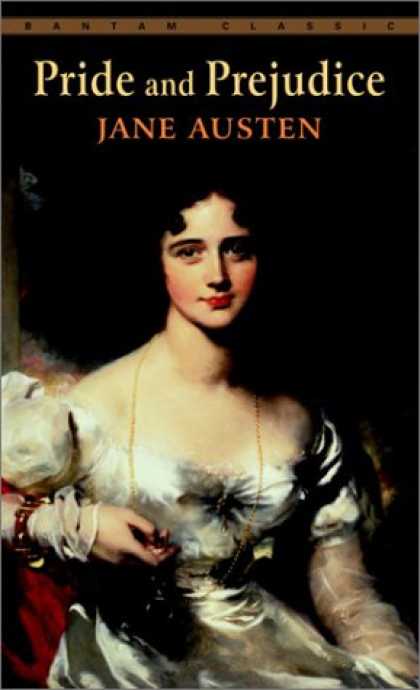
 I think the first line of this novel sums it up better than I ever could:
It is a truth universally acknowledged, that a single man in possession of a good fortune, must be in want of a wife.
I’ve been familiar with the story of Pride and Prejudice for a long time, but this was the first time I’d read the original. Even though I don’t usually go for Regency romances, I have to say that I enjoyed this book very much!
Jane Austen has a genius for character. She knows exactly what little mannerism to show or what description to give to make her characters come alive. At several points in the book, I paused and said “holy cow, that’s just like so and so,” or “haha, I know exactly what this person is like.” At no point did I feel hit over the head or dragged through a long info dump explaining this or that character’s background. Of all the possible details she could share, Austen always chooses the exact ones you need to get a clear, distinct picture–no more, no less.
Austen drives her story with some snappy, entertaining dialogue. Far from being sappy or sentimental, her main character, Elizabeth, is snarky and spirited, and she clashes with a lot of people in ways that are much more interesting (and mature) than typical girl drama. Be that as it may, I found it entertaining to compare Elizabeth’s dating/relationship experiences with my own. As different as things were back then, in some very interesting ways they are still the same.
I did feel that the novel slowed down a bit in the middle, probably because that was when Elizabeth went on the tour of Derbyshire with her relatives and left behind most of the other characters that interested me. Also (since I am a straight guy), Mr. Darcy didn’t really turn me on much, so Elizabeth’s gradual change of mind as she toured his house wasn’t as engaging to me.
One thing that confuses me, having read this book, is why women all over the place set up Mr. Darcy as the ideal male. What exactly is his appeal? He’s a little rough around the edges, has an independent streak, speaks his mind even when doing so would be rude, and is constantly aloof from everyone else. Is this what women find so appealing about him? I can see how the “Beauty and the Beast” syndrome can also be a turn-on–Elizabeth essentially wins him over by taming him–but that has less to do with who he is than how Elizabeth changes him. Do women go for a guy who they have the power to change? Is that what it is? I’m still a bit confused.
One thing made me a little mad, and it had nothing to do with the book at all; it had to do with the blurb on the back. It reads:
One of the most universally loved and admired English novels, Pride and Prejudice, was penned as a popular entertainment. But the consummate artistry of Jane Austen (1775-1817) transformed this effervescent tale of rural romance into a witty, shrewdly observed satire of English country life that is now regarded as one of the principal treasures of English literature.
Austen’s “consummate artistry” transformed this novel from “popular entertainment” to “one of the principal treasures of English literature”? Come on. That statement is as pompous as it is illogical. Once her book came out in print, Austen “transformed” nothing–the only thing that changed was the way people looked at it. It started out as a popular genre novel, like anything by Rowling or Steele or Grisham or King, and when the literati decided to claim it, they rebranded it as something else.
What irks me is this idea that “popular entertainment” is somehow inherently devoid of literary worth. Come on, people–virtually all the “great authors” before 1920 were well-read and well-loved in their day, among the masses as much as the literary elite. It’s not a sin to make money writing books.
Overall, I enjoyed this book very much. Just as Lord of the Rings is the quintessential fantasy novel, Pride and Prejudice is probably the lodestar of the romance genre. I was pleased to find that it’s not a book that only women can enjoy!