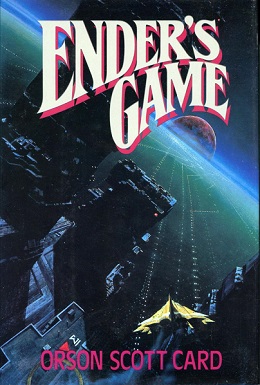
Ender’s Game by Orson Scott Card

“I’ve watched through his eyes, I’ve listened through his ears, and I tell you he’s the one.  Or at least as close as we’re goign to get.

“That’s what you said about the brother.”

“The brother tested out impossible.  For other reasons.  Nothing to do with his ability.”

“Same with the sister.  And there are doubts about him.  He’s too malleable.  Too willing to submerge himself in someone else’s will.”

“Not if the other person is his enemy.”

“So what do we do?  Surround him with enemies all the time?”

“If we have to.”

“I thought you said you liked this kid.”

“If the buggers get him, they’ll make me look like his favorite uncle.”

“All right.  We’re saving the world, after all.  Take him.”

Thus begins one of the greatest SF classics of all time, Ender’s Game. With such a spectacular beginning, it only keeps getting better.

I decided to reread Ender’s Game because a friend of mine in Washington was reading it.  I read this book back in high school in only two sittings–the first twenty pages in the library, and the rest back home, where I finished it wide-eyed at three in the morning.  I didn’t regret a single moment of it, then or now.

One of the most fascinating things to me about this book is the way that Orson Scott Card breaks almost all of the rules of writing.  On every page, he “tells” much more than he “shows”–some of the battles he glosses over in only a couple of paragraphs.  He gives only minimal setting details, and very few of these are visceral or concrete–it’s very hard to “get into” the world of Ender’s Game the way you would with a fantasy novel.  Most of the characterization consists of “navel gazing”–Ender thinking to himself about how bad things are, rather than taking action.

Breaking these rules, however, is exactly the thing that makes this a good book.  The story isn’t in the setting, or in the nitty gritty of the battles–it’s in Ender’s mind, how he reacts to the forces around him, and how those forces change him. “Telling” rather than “showing” allows him to keep the pace at a breakneck, thrilling speed while cutting out unnecessary details, and the “navel gazing” allows us to get an intimate picture of Ender’s mind.

It goes to show that good writing isn’t just about knowing the rules, but knowing how to break them.  And when it comes to plot, character, pacing, foreshadowing, thematic elements, and the hero cycle, Orson Scott Card proves his masterful brilliance in this work beyond a doubt.

One of the most fascinating things about this book is that it hits all eight points of the Campbellian monomyth.  This excellent article (originally published in Leading Edge) explains how.  The most incredible thing to me is that the year after Ender’s Game came out, Orson Scott Card did it all again–wrote a blockbuster book hitting all eight points of the monomyth–with Speaker for the Dead, which I think is a superior book.

Ender’s Game is a true classic of the science fiction genre.  Not only is it a highly entertaining story, it is deeply meaningful and insightful as well.  It’s one of those books you can reread multiple times, and it only keeps getting better.  Whether or not you’re a fan of science fiction, this is a book you will deeply benefit from reading.

Why I love Robert Charles Wilson

From Mysterium, which I plan to review here soon:

“Do you ever wonder, Howard, about the questions we can’t ask?
“Can’t answer, you mean?
“No. Can’t ask.
“I don’t understand.”
Stern leaned back in his deck chair and folded his hands over his gaunt, ascetic frame. His glasses were opaque in the porch light. The crickets seemed suddenly loud.
“Think about a dog,” he said. “Think about your dog–what’s his name?”
“Albert.”
“Yes. Think about Albert. He’s a healthy dog, is he not?”
“Yes.”
“Intelligent?”
“Sure.”
“He functions in every way normally, then, within the parameters of dogness. He’s an exemplar of his species. And he has the ability to learn, yes? He can do tricks? Learn from his experience? And he’s awarer of his surroundings; he can distinguish between you and your mother, for instance? H’es not unconscious or impaired?”
“Right.”
“But despite all that, there’s a limit on his understanding. Obviously so. If we talk about gravitons or Fourier transforms, he can’t follow the conversation. We’re speaking a language he doesn’t know and cannot know. The concepts can’t be translated; his mental universe simply won’t contain them.”
“Granted,” Howard said. “Am I missing the point?”
“We’re sitting here,” Stern said, “asking spectacular questions, you and I. About the universe and how it began. About everything that exists. And if we can ask a question, probably, sooner or later, we can answer it. So we assume there’s no limit to knowledge. But maybe your dog makes the same mistake! He doesn’t know what lies beyond the neighborhood, but if he found himself in a strange place he would approach it with the tools of comprehension available to him, and soon he would understand it–dog-fashion, by sight and smell and so on. There are no limits to his comprehensions, Howard, except the limits he does not and cannot ever experience.
“So how different are we? We’re mammals within the same broad compass of evolution, after all. Our forebrains are bigger, but the difference amounts to a few ounces. We can ask many, many more questions than your dog. And we can answer them. But if there are real limits on our comprehension, they would be as invisible to us as they are to Albert. So: Is there anything in the universe we simply cannot know? Is there a question we can’t ask? And would we ever encounter some hint of it, some intimation of the mystery? Or is it permanently beyond our grasp?”

This is the kind of science fiction that I love: the kind that brings me right up to the limits of human knowledge and makes me feel naked in the face of the unknown. The kind where the aliens truly feel alien, not like an unusually bizarre race of human beings. I want the aliens to surprise me–I want to feel that there’s something about them that is completely beyond my comprehension. Something sublime, something romantic.

In all of his books that I’ve read, Robert Charles Wilson captures this feeling spectacularly. So does Arthur C. Clarke, C. J. Cherryh, and Orson Scott Card. Larry Niven, Jerry Pournelle, John Scalzi and Alastair Reynolds are excellent writers, and I’ve genuinely enjoyed their books, but their aliens are too…understandable. Too clear cut, too defined. After a while, you don’t feel that there’s anything left to surprise you, anything that is so alien it’s beyond your grasp.

In some ways, I think this boils down to the author’s worldview. Those with a more positivist worldview believe that the world is fundamentally understandable, and that every phenomenon can be modeled and predicted, provided that we have a sophisticated enough understanding of natural law. The interpretivist worldview, on the other hand, posits that while truth may exist, there are limits to our understanding–that some things are inherently unpredictable and impossible to model.

I used to think that I was a positivist. Then I took Poli Sci 310 with Goodliffe, and it turned my world upside down. Genesis Earth is, in some ways, a product of that personal worldview shift. I don’t think I’m anywhere near on par with my aliens as Wilson, Clarke, and Card are with theirs, but I hope I’m on my way.